


US Tax Forms
IRS Form 8962 for NRIs: Premium Tax Credit and APTCIRS Form 8962 for NRIs: Premium Tax Credit and APTC
Written by Shubham Jain
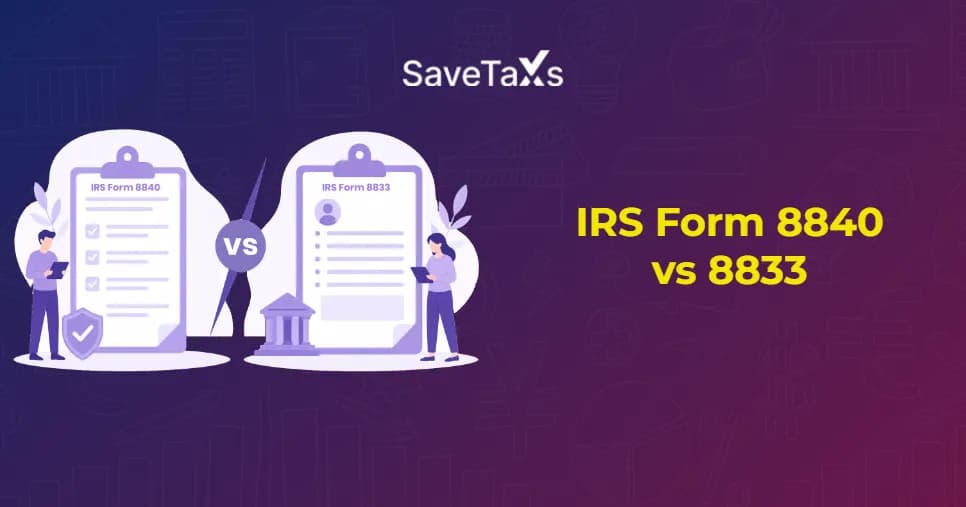
As a nonresident alien, getting confused between Form 8840 and Form 8833 is normal because both forms can affect your U.S. tax treatment, but they serve different purposes. Form 8840 is used by eligible individuals to claim the closer connection exception to the Substantial Presence Test, while Form 8833 is used to disclose certain treaty-based tax positions. Considering this, filing Form 8840 allows an eligible nonresident alien to claim the closer connection exception to the Substantial Presence Test by showing that they had a tax home and a closer connection to a foreign country. Form 8833, on the other hand, is used to disclose certain treaty-based tax positions, including certain positions under which a taxpayer claims treaty residency in a foreign country instead of the United States.
Understanding the key difference between the two forms helps you handle your tax situation better and avoid unnecessary tax penalties. To help you out, this blog compares IRS Form 8840 vs. Form 8833, explains when you need to fill them out, and highlights their key differences. So read on and gather all the information.
Let’s say you were present in the U.S. for fewer than 183 days during a tax year but otherwise met the Substantial Presence Test. You may still qualify for the closer connection exception if you maintained a tax home in a foreign country and can establish a closer connection to that country than to the United States. Form 8840 is used to claim this exception. Confused?
For instance, if you are an Indian tax resident and otherwise meet the U.S. Substantial Presence Test, you may still be treated as a nonresident alien for U.S. tax purposes if you independently satisfy all requirements for the closer connection exception and properly file Form 8840. Considering this,
To establish a closer connection to a foreign country, the IRS considers the overall facts and circumstances. Relevant factors may include where you maintain your permanent home, where your family and personal belongings are located, your banking and business activities, driver's license, voting rights, and the address shown on official documents.
If you were present in the U.S. for 183 days or more during the year, you generally cannot claim the closer connection exception using Form 8840. However, you may still need to evaluate whether an applicable tax treaty provides a separate basis for nonresident treatment. If you are also treated as a resident of a treaty country under its domestic tax rules, you may need to evaluate the applicable treaty's tie-breaker rules and, if eligible, claim treaty treatment using Form 8833 and Form 1040-NR. Additionally, green card holders generally cannot claim the closer connection exception. The exception is also unavailable to individuals with a pending adjustment-of-status application or who have applied or taken steps to apply for lawful permanent residence.
This was all about IRS Form 8840. Moving ahead, now let's know about IRS Form 8833.
With Savetaxs, fulfill your US tax obligations with confidence and complete accuracy.
If you were present in the U.S. for 183 days or more, you generally cannot claim the closer connection exception using Form 8840. However, if you are also a resident of a country that has an applicable tax treaty with the U.S., you may need to examine the treaty's residency tie-breaker rules. If you qualify for treaty residence in the foreign country, Form 8833 may be required to disclose that treaty-based position.
If your home country has an applicable tax treaty with the U.S., you may need to apply the treaty's tie-breaker rules if both countries treat you as a resident. These rules can determine your treaty residence, while the specific treaty provisions determine how different types of income are taxed. With these rules, you may be treated as a resident of your home country for treaty purposes instead of the United States if you satisfy the applicable treaty requirements and properly disclose the treaty-based position. Confused?
If you are required to file Form 8833 and fail to make the required disclosure, you may be subject to a $1,000 penalty for each failure. The penalty may not apply if you can establish reasonable cause and that the failure was not due to willful neglect. Failure to file the form does not, by itself, automatically make you a U.S. tax resident or create a tax on your global assets.
So this is how IRS Form 8833 works. Moving further, let's know the key difference between IRS Form 8840 and IRS Form 8833.
The key difference between IRS Form 8840 and IRS Form 8833 is as follows:
IRS Form 8840 allows an eligible individual who would otherwise meet the Substantial Presence Test to claim the closer connection exception and potentially remain a U.S. nonresident for tax purposes. However, you must have been present in the United States for fewer than 183 days during the relevant tax year.
In contrast, IRS Form 8833 is used to disclose certain treaty-based return positions that override or modify U.S. tax rules. For example, a qualifying dual-resident taxpayer may use it to disclose a treaty-based claim of residence in India under the applicable U.S.-India tax treaty. This treaty-based position may change how your income is taxed in the U.S., while the applicable treaty provisions and your home country's tax rules determine how different types of income are treated in each country.
The table below shows who should file which IRS form:
| Particulars | IRS Form 8840 | IRS Form 8833 |
|---|---|---|
| Filer | NRIs who otherwise meet the SPT but satisfy the requirements for the closer connection exception, including having a foreign tax home and a closer connection to that foreign country than to the United States. | NRIs and dual-resident taxpayers who are required to disclose a qualifying treaty-based return position, subject to applicable Form 8833 exceptions. |
| Green Card Holders | Not qualify | Not eligible for Form 8840; may potentially claim treaty treatment using Form 8833 if the applicable treaty and other requirements are satisfied. |
| Tax Filing Status Affected | Non-resident alien vs resident alien classification | Form 8833 itself is a disclosure form and does not independently determine residency. However, a valid treaty-based position disclosed on the form can affect how a dual-resident taxpayer is treated for U.S. income-tax purposes. |
Filing Form 8840 may allow an eligible individual who otherwise meets the SPT to claim the closer connection exception and be treated as a nonresident alien for U.S. tax purposes. Form 8840 is used when you qualify for the closer connection exception under U.S. domestic tax rules. Form 8833 is used when you take a qualifying treaty-based position that must be disclosed under the applicable IRS rules. Therefore, whether you need Form 8833 depends on the treaty position you are claiming, not simply on whether you qualify for Form 8840.
If you file Form 1040-NR, attach Form 8840 if you are claiming the closer connection exception. Attach Form 8833 when you are required to disclose a qualifying treaty-based position. If you are not required to file a U.S. tax return, you can submit Form 8840 separately to the IRS by the applicable Form 1040-NR filing deadline.
Form 8833 is generally attached to the applicable U.S. tax return and must be filed by the applicable return deadline, including any valid filing extension. In contrast, the filing deadline for IRS Form 8840 depends on whether you file a US tax return or not. Considering this:
So this was all about the IRS Form 8840 vs. 8833 comparison. Moving forward, let's know the common mistakes to avoid when filing IRS Form 8840 and IRS Form 8833.
Here are some common mistakes you should avoid when filing IRS Form 8840 and IRS Form 8833:
These are the common mistakes you should avoid when filing IRS Form 8840 and IRS Form 8833.
Connect with Savetaxs and, with expert guidance, simply understand your US tax obligations.
Lastly, from the IRS Form 8840 vs. 8833 comparison, it is clear that both forms serve different tax purposes in the US. Form 8840 helps eligible nonresident aliens who otherwise meet the Substantial Presence Test claim the closer connection exception and potentially remain nonresidents for U.S. tax purposes. In contrast, IRS Form 8833 is used to disclose certain treaty-based tax positions that may override or modify U.S. tax rules and can result in reduced or different U.S. tax treatment where the applicable treaty provides such benefits. Choosing the correct IRS form depends on your U.S. residency status, physical presence, tax home, closer connection, and any applicable treaty-based position and filing requirements.
If you are still confused between the two forms or facing issues claiming U.S. tax benefits, connect with Savetaxs. Our team of tax experts can help you determine the appropriate IRS form for your situation and prepare and file it accurately
This article is for general informational purposes only and does not constitute tax, legal, financial, or investment advice. Laws, regulations, rates, and procedures may change over time and may vary based on individual circumstances.
While SaveTaxs makes reasonable efforts to keep the information accurate and up to date, readers should verify applicable rules with official authorities or consult a qualified professional before making decisions based on this information.
Vipul Jain is the Co-Founder of SaveTaxs and a tax expert with experience in Indian and NRI taxation. He advises individuals, NRIs, and businesses on tax filing, tax planning, capital gains, DTAA, and compliance matters. He focuses on making complex tax concepts simple and helping taxpayers make informed, compliant decisions. See Full Bio

Want to read more? Explore Blogs

_1786539671275.webp&w=828&q=75)