



Investment & Financial Planning
NRI Property Sale: How to Calculate Capital Gains TaxNRI Property Sale: How to Calculate Capital Gains Tax
Written by Shubham Jain

Like Indian residents, NRIs can also invest in India and avail the tax benefits. Considering this, over the years, ULIP investment plans (Unit-Linked Insurance Plans) have become a popular investment option among NRIs. Further, to invest in these plans, NRIs need to follow the stated Foreign Exchange Management Act (FEMA) guidelines.
ULIP plans serve as an investment tool that helps policyholders reach their long-term financial goals. There are several ULIP plans available for NRIs to participate in the financial market of India. Further, want to know more about the ULIP plans for NRIs? Continue reading the blog and get all the information.
ULIP stands for Unit Linked Insurance Plans. As its name suggests, it is a financial product that combines insurance and investment in one plan. Considering this, a section of the premium from the plan is invested in life insurance coverage. Additionally, the remaining amount of the premium is invested in several funds according to the preference of the investors.
Further, while ensuring life insurance coverage, the ULIP plans offer market-linked returns to investors. This makes them an excellent choice for NRIs looking for financial protection and wealth creation.
This was all about ULIP investment plans for NRIs and how they work. Moving ahead, let's know the key features of it for NRIs.

The key features of ULIP plans that it offers to NRIs are as follows:
It is the key feature of ULIP plans for NRIs. In this, considering your risk appetite, you can select the investment plan. Additionally, you can access the benefits of both, i.e., equity and debt funds. Through the investment allocation feature, even after investment towards your selected funds, you are allowed to invest in your future premiums.
This feature allows you to change your investment from time to time. Considering this, under ULIP plans, you get the feature of paying an additional amount over your current investment plan. Further, choosing this plan allows you during the end of the completion of the plan to fetch a larger amount.
If there is market fluctuation or you want to change your investments, under ULIP plans, you can switch between funds. This offers flexibility in your investments. Additionally, it works according to your financial goals and requirements. Apart from this, when the market is slowing down, you can change your investments into debt funds, and when the market gets stable, change them into equities.
For NRIs, tax savings on ULIPs are a distinguishing feature. Under section 80C of the IT Act 1961, up to INR 1,50,000 per annum premium on ULIP plans is tax-free in India. Apart from this, upon maturity under Section 10 (10D), if you fulfill the conditions stated in Section 10 (10D), the amount gets tax-free. Moreover, death benefits are fully tax-free.
After the completion of the lock-in period, ULIP investment plans provide the benefits of partial withdrawals. Considering this, without compromising the entirety of the investment, it allows NRIs to use their funds for financial emergencies. Further, the withdrawal amount and the number of times you can withdraw depend on your chosen ULIP plan.
In ULIP plans, NRIs have the convenience of paying premiums through several modes, including NRO and NRE accounts. It ensures hassle-free and seamless transactions. For regular payment, NRIs can opt for the single premium payment option. Additionally, can also opt for half-yearly, monthly, or annual payment. This flexibility in payment methods is designed to fulfill the diverse financial needs of NRIs.
These were the key features of ULIP investment plans available for NRIs. Moving further, let's know the benefits of these plans for NRIs.
With our comprehensive taxation solutions, as an NRI simplify your Indian tax obligations.
Investing in ULIP plans offers NRIs several benefits. It allows NRIs to invest in various market-related securities, such as debts and securities, and get higher returns. Want to know more benefits offered by ULIP plans to NRIs? Read the next section and get your answers.
ULIP plans offer market-linked returns, providing you the ability to invest in debt, equity, and balanced funds. This enables you to get the benefits of the growing economy of India and capitalize on long-term financial growth. It further assists you in improving your investment portfolio.
ULIP investment plans offer flexible opportunities to investors. It includes:
Certifying financial stability for future requirements like education of the children or retirement, ULIP promotes long-term, disciplined savings. By committing to regular contributions, you can make a financial cushion and, over time, create a substantial corpus.
Therefore, opt for ULIP investment plans if you are looking for the well-being of your family. This plan also helps you learn a good habit of saving and investing money, along with generating wealth for the long term.
Now, moving ahead, let's know the eligibility criteria that NRIs need to follow to invest in ULIPs.
To be eligible to invest in ULIP plans in India, as an NRI, you should comply with the FEMA rules and regulations. Additionally, you also need to submit the mentioned documents to invest in the ULIP plan.
These were the documents that NRIs need to submit while applying for ULIP plans in India. Moving further, let's know the tax benefits that NRIs get from ULIP plans.
Connect with Savetaxs, take control of your Indian taxation, and unlock the complete potential of your returns.
Here is a detailed overview of the tax benefits ULIP Plans offer to NRIs:
All Indian citizens and NRIs get tax exemption on the premium paid to ULIP plans. Considering this, under section 80C of the IT Act 1961, on the premium paid up to INR 1,50,000, NRIs are allowed to claim a tax deduction. However, if the premium amount is INR 2,50,000 and equal to or less than 10% of the assured sum. In this scenario, under section 10 (10D) of the IT Act, 1961, NRIs on maturity benefits can claim tax exemption.
Applicable under Section 10 (10D), NRIs can claim tax exemption on the sudden death of the policyholder while holding the ULIP investment plan. Further, for maturity, subject to the mentioned provision below, NRIs enjoy several tax benefits:
Further, if the annual policy premium is more than INR 2,50,000, NRIs are liable to pay capital gains tax. It applies to the ULIP plans purchased after February 2021. Apart from this, for any reason, if you make a withdrawal before the completion of the 5-year lock-in period. In this scenario, the withdrawal amount is added to your taxable income and taxes as per your income slab rate. However, if the withdrawal is made after a 5-year lock-in period, no tax is charged.
Also, if you face double taxation, under the Double Tax Avoidance Agreement (DTAA), you can claim a tax refund or exemption. It helps you avoid paying taxes on the same income twice.
This was all about the tax benefits NRIs received from ULIP investment plans. Moving ahead, let's know how NRIs can invest in these plans.
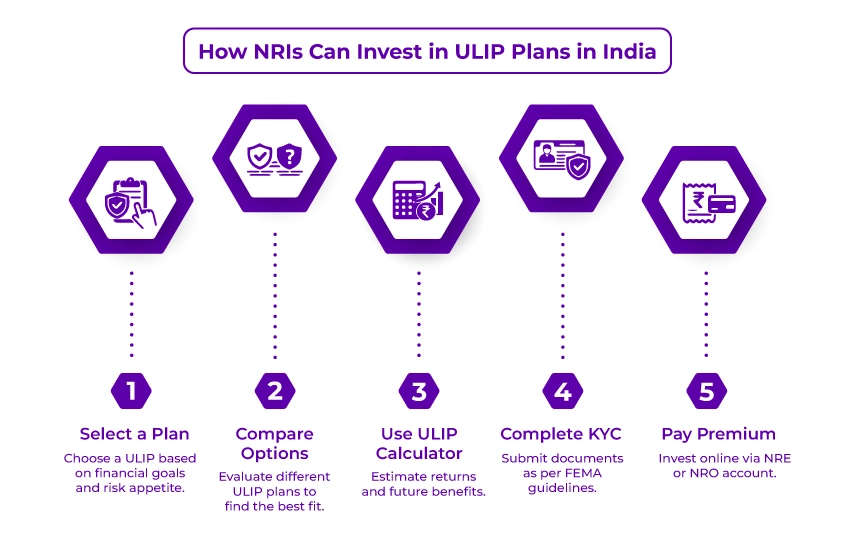
NRIs can invest in ULIP plans in India by choosing the investment that matches their risk appetite and financial goals. Here is how they can do so:
So, this is how NRIs can invest in ULIP plans in India. Further, investments should be made to adhere to regulations stated by the Reserve Bank of India (RBI) and FEMA.
Lastly, ULIP plans for NRIs are a unique mix of life insurance and investment. It is an attractive option for NRI investors looking for financial security and wealth creation in India. Considering this, with so many options available, when choosing a ULIP investment plan, you should be cautious and opt for the one that provides you with comprehensive insurance and returns.
Further, if you are seeking reliable NRI investment services, connect with Savetaxs. We have a team of financial experts who can assist you in selecting the right investment plan as per your financial goals and risk tolerance. Additionally, they can also help you with tax planning in India.
This article is for general informational purposes only and does not constitute tax, legal, financial, or investment advice. Laws, regulations, rates, and procedures may change over time and may vary based on individual circumstances.
While SaveTaxs makes reasonable efforts to keep the information accurate and up to date, readers should verify applicable rules with official authorities or consult a qualified professional before making decisions based on this information.
Shubham Jain is the Founder of SaveTaxs and has extensive experience in Indian and NRI taxation. He advises individuals, NRIs, and businesses on tax filing, tax planning, capital gains, DTAA benefits, fund repatriation, and compliance matters. He regularly writes about taxation and related financial topics. His focus is on making complex tax concepts easy to understand. Through his articles, he helps taxpayers stay informed, avoid common mistakes, and stay compliant with Indian tax laws. See Full Bio

Want to read more? Explore Blogs

_1781845771869.webp&w=828&q=75)
_1778936280179.webp&w=828&q=75)