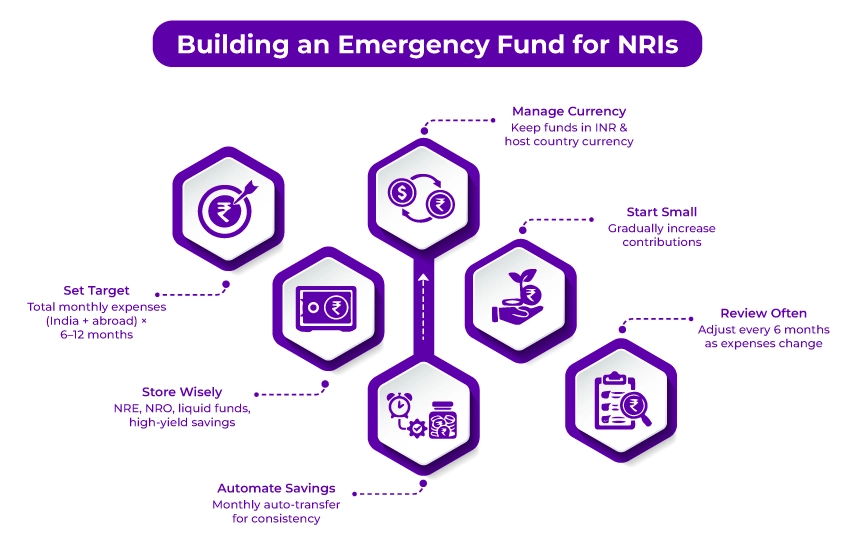
An emergency fund for NRIs (Non-Resident Indians) is a pool of money that is set aside to cover unexpected events. It helps cover expenses during unforeseen circumstances without withdrawing long-term savings or taking unnecessary debt. It may cover medical treatments for relatives, urgent trips to India, job loss, or income disruption, etc.
Usually, it is advised to keep 3-6 months of living expenses aside. However, for NRIs, keeping aside a target range of 6-12 months of essential living expenses would be more suitable. While calculating the emergency fund target amount, you must include expenses for both abroad and in India. In this blog, we will learn more about what emergency fund planning means for NRIs.
- An emergency fund is a pool of funds set aside for use in unpredictable situations.
- An NRI should aim to save 6-12 months' worth of their overall expense, considering their financial obligations both abroad and in India.
- Store emergency funds across multiple accounts and investments, including liquid mutual funds in India, NRE accounts, NRO accounts for rupee liability, and a high-yield savings account in the host country.
- As an NRI, you should periodically review your emergency fund to ensure it meets changing financial needs, ideally making adjustments every six months.
- NRIs must avoid relying only on credit cards, investing emergency savings in illiquid products, using the fund for planned expenses, and engaging in high-risk investments.
What is an Emergency Fund for NRIs?
An emergency fund is a pool of money that you set aside entirely for unplanned circumstances and not for predictable expenses. The objective behind this fund is to help you have funds for a sudden financial crisis without taking loans or withdrawing long-term NRI investments at a loss.
These funds have a broad purpose for NRIs (Non-Resident Indians). It may cover expenses for travel to India for some emergency, medical treatments for relatives, replacement of important documents, or sudden changes in visa status. In these unexpected situations, these funds can be used immediately without any hassle.

How Much Should an NRI Save in an Emergency Fund?
For individuals living and earning in a single country, saving three to six months' expenses may work. However, for NRIs, there are unique cross-border financial challenges in which the standard emergency fund would not help. They may face unpredictable and financially demanding situations. Considering this, a more beneficial approach is six to twelve months of overall monthly expenses.
6-12 Month Rule for NRIs
Being an NRI, you need to set aside a bigger buffer as compared to the residents in your home country. Your target must be to keep six to twelve months of overall expenses in your emergency fund. This fund will safeguard you from risks that come along with residing abroad, from currency fluctuations to emergency travel and unreliability in a job.
Computing Monthly Expenses in Both Countries
While calculating the amount to be kept in an emergency fund, you must include expenses from both abroad and in India:
- Important insurance premiums
- Monthly loan payments in both nations
- Cost for emergency travel to India
- Household expenses like rent, utilities, insurance, etc, abroad
- Financial commitments in India, such as supporting family, property maintenance, etc.
Contract Workers and Freelancers
If your income is irregular or if you are a contract worker or a freelancer, you must maintain 9-12 months of expenses. This will help you cover expenses during slow periods in freelance work or gaps between contracts.

How to Build an Emergency Fund for NRIs?
Consider the following steps to build an emergency fund as an NRI:
Step 1: Compute the Preferred Sum
Start calculating all important monthly expenses, including food, utilities, transportation, premiums, etc. Also, think about the expenses in India, like emergency trips to India, medical costs, family care, etc.
Now, multiply the overall sum by 6-12 months. The calculated amount becomes the emeregency fund target that you need to save.
Step 2: Determine Where You Will Store the Funds
Instead of staying dependent on a single account for emergencies, try to divide the amount into different locations. Store the funds based on where they will be needed, such as:
- For emergencies in India, an NRE savings account.
- A part in liquid mutual funds in India to get better returns without losing liquidity.
- If you have a rupee liability that needs local currency, store the funds in an NRO account.
- A high-yield NRI emergency savings account in your resident country for quick access.
Step 3:Automatic Transfers
Automate transfers from your salary account to your emergency savings account every month to stay consistent. It is because consistency is important to build an emergency fund. Additionally, you can ensure that a fixed portion of your funds gets transferred directly into your emergency fund by dividing your paycheck.
Step 4: Review Currency Exposure
If you are expecting emergencies abroad, keep a portion of your fund in your host country's currency. Similarly, if you think major emergency expenses will occur in India, maintain a majority of your funds in Indian rupees. This will help you ensure that you can access funds anytime when you need to use them.
Step 5: Start Small and Grow Slowly
If you feel that the emergency target amount is large, start with an amount that's manageable for you. You can start with a few hundred dollars and then gradually increase the contributions as your financial situation improves.
Step 6: Check and Adjust Regularly
Expenses may keep increasing over your lifetime. Keep monitoring your emergency fund every six months and adjust the target amount as required.
Where Should NRIs Keep Their Emergency Fund?
Determining the emergency fund target plays an important role; similarly, deciding the emergency fund location is also essential. You can divide the funds strategically between your host country and India. Here is where you can store the funds:
Liquid Mutual Funds in India
With liquid mutual funds, you can earn up to 7-8% returns. The funds in these accounts are put into debt securities that mature within 90 days. You can take out the money in one day. Additionally, you don't need to pay exit penalties such as fixed deposits.
NRE Accounts for Emergencies in India
NRE (Non-Resident External) accounts are ideal for emergencies back in India and are a tax-free investment option for NRIs. These account allows you to earn tax-free interest in India and limit-free repatriation. The rate of interest may vary depending on the bank, generally from 3.5% to 7.5%.
You can transfer money to and from India easily without any complex paperwork.
NRO Account for Liabilities in Rupee
An NRO (Non-Resident Ordinary) account allows you to manage money earned in India, like rent, dividends, or pensions. Unlike NRE accounts, the interest gets taxed at a rate of 30% along with a surcharge. Also, there is a limit on repatriation of 1 million USD.
This account works well if you need funds in Indian rupees for regular expenses in India.
High-Yield Savings Account in Your Host Country
Put some portion of your emergency fund into a high-yield savings account (HYSA) where you are currently residing. While standard savings accounts only offer around 0.01% interest, these accounts can offer interest rates of up to 4.66% APY.
This account will help you have quick access to funds during emergencies and should have sufficient funds to cover expenses of about two months.
Distribute Strategically Across Accounts
Spreading your emergency fund across these accounts can be beneficial. Here is how you can split the amount smartly:
- Utilize an NRO account for rupee expenses
- Keep NRE savings aside for emergencies in India
- Put two months of expenses in your overseas savings
- Keep a part of the fund in liquid mutual funds to get better returns and access it easily.
File your NRI ITR in minutes with expert guidance from Savetaxs.
What Should NRIs Avoid Using for an Emergency Fund?
It's important to know where to save, but it's equally essential to know where not to save. Here is what an NRI should not use for an emergency fund:
Avoid Credit Dependability
You must not replace an emergency fund with credit cards and personal loans. These cards can create a financial burden in the long run and may add high-interest debt.
Don't Use Locked or Illiquid Products
Emeregency funds are meant to be accessed instantly. So, you must avoid the following options as these are not suitable for urgent requirements:
- Real estate, because you cannot sell it quickly
- Long-term insurance plans lock money for several years
- Fixed deposits, because premature withdrawals may trigger penalties
- Retirement accounts as withdrawals may attract taxes and penalties, such as 401K or NPS.
Avoid Using Funds for Non-Emergencies
Since the emergency fund is pooled for unpredictable expenses, it must not be considered as a backup when low on budget. Don't utilize the funds for:
- Celebration
- Holidays
- Shopping
- Upgrading lifestyle
- Planned purchases
- Investment opportunities
No Use of High Risk Investments
Don't place the emergency funds in:
- Direct shares
- Equity mutual funds
- Complex products like AT 1 bonds
- Investment schemes that assure unusually high returns

What are Some Key Considerations for NRIs?
Emergency funds are important for NRIs to manage expenses during unforeseen circumstances. Here are some things that an NRI must consider:
Liquid Mutual Funds for Better Returns
To enjoy an effective balance between liquidity and stability, invest in liquid funds. These funds are ideal for holding a part of your India-based emergency fund.
You can even withdraw the amount the same day or the next day. Additionally, it offers better returns as compared to a traditional savings account.
NRI Medical Fund for Parents in India
You can't predict medical care for aging parents. To ensure that you can handle their healthcare needs quickly without affecting your emergency fund, maintain a separate medical reserve of nearly 10 lakh rupees.
Strategic Distribution of Funds
A strategically planned and well-balanced NRI emergency fund usually includes:
- An NRE account for India-related emergencies
- A savings account outside India for urgent needs
- Liquid funds for moderately higher returns without reducing accessibility.
Additional Protective Layer
Investing in insurance doesn't replace your emergency fund; instead, it works together. It will help reduce the financial burden of predictable risks. You can maintain enough coverage in the form of the following:
- Term life insurance
- Disability or income protection
- Health insurance for your family and yourself
- Property insurance (if you own a home in India)
- Health insurance or senior citizen coverage for parents in India
Navigate your entire NRI tax journey with expert assistance at Savetaxs.
Final Thoughts
An NRI must approach emergency fund planning with a personalized strategy beyond standard financial advice. The typical advice of three to six months of expenses may not work for your cross-border circumstances. Instead, aim for 6-12 months of expenses in both your host country and India, particularly if you face irregular income or need to support parents' medical emergencies. Review your emergency fund quarterly and adjust goals annually,
Moreover, building a solid emergency fund is important for financial security abroad. To get expert advice on the same, contact the experts at Savetaxs. Our team can provide expert-backed consultation on emergency fund planning for NRIs. Contact us right away, as we are actively working 24*7 for our clients across all time zones.
Note: This guide is for information purposes only. The views expressed in this guide are personal and do not constitute the views of Savetaxs. Savetaxs or the author will not be responsible for any direct or indirect loss incurred by the reader for taking any decision based on the information or the contents. It is advisable to consult either a CA, CS, CPA or a professional tax expert from the Savetaxs team, as they are familiar with the current regulations and help you make accurate decisions and maintain accuracy throughout the whole process.
Mr. Ritesh has 20 years of experience in taxation, accounting, business planning, organizational structuring, international trade financing, acquisitions, legal and secretarial services, MIS development, and a host of other areas. Mr Jain is a powerhouse of all things taxation.
- NRE FDs vs Debt Mutual Funds: Which Is Better for NRIs?
- Multi-Cap vs Flexi-Cap Funds: Which Is Better for NRIs?
- What is the Difference Between Domestic vs Global vs International Funds?
- What is Portfolio Management Services for NRIs?
- Unit Linked Insurance Plan for NRIs
- Top 8 Mistakes NRIs Should Avoid When Buying Property in India
- Active vs Passive Mutual Funds: Best Investment Option for NRIs
- What is Mutual Fund KYC for NRIs?
- Which is the best for NRIs: SIP, SWP, or STP?
- ELSS vs ULIP: Which is Best for NRIs?
Want to read more? Explore Blogs
Frequently Asked Questions
No matter what your source of income is, we've got you covered. There’s a plan for everybody!