NRI Income Tax Compliance
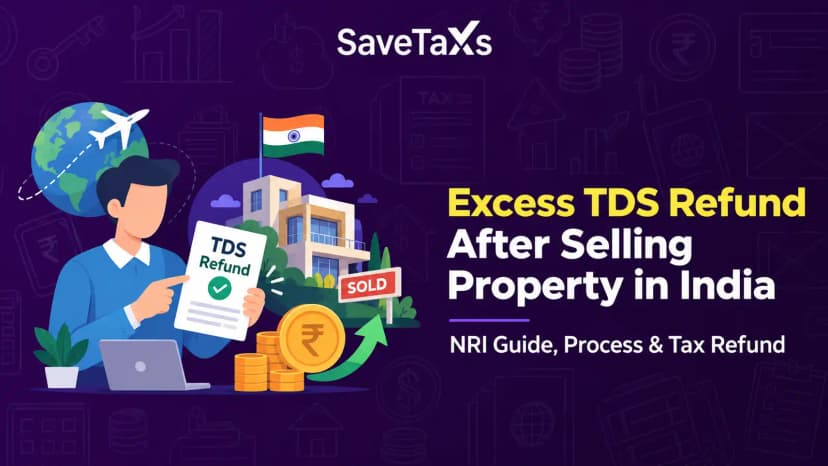
How to Claim Excess TDS Refund After Selling Property in India as an NRIHow to Claim Excess TDS Refund After Selling Property in India as an NRI
Written by Shubham Jain

_1780747645942.webp&w=3840&q=75)
An income tax refund is issued to a taxpayer when the taxes paid (via TDS, advance tax, or self-assessment tax) exceed the actual tax liability for the financial year. You can claim your refund by filing and e-verifying your income tax refund.
In this guide, we will cover the entire concept of income tax refunds, from tips for claiming the maximum refund to eligibility, how refunds are calculated and claimed, how to check the income tax refund status online, and much more.
Keep the following tips in mind while claiming the maximum refund on filing ITR.
1: Choose the Most Beneficial Tax Regime: Start by choosing the tax regime that is most beneficial to you by calculating the tax payable under both the old and the new regime, considering all the applicable deductions and tax exemptions under both. Then file your ITR under the regime with the lowest tax outflow, as this will increase your TDS refund amount.
2: Verify the TDS Amount Deducted: Generally, the TDS amount to be deducted is auto-populated in your ITR. However, it is essential to cross-verify the TDS-deducted particulars with documents such as Form 16 and Form 26AS.
3: E-Verify The Return: This is mandatory. Get your ITR e-verified within 30 days of filing it. However, it is highly recommended that you e-verify your ITR as soon as you file your return, as timely e-verification ensures faster processing of refunds.
An income tax refund is the money the government refunds or reimburses when the total taxes you have paid during a FY exceed your actual tax liability.
Let us assume that the TDS and the advance tax paid by Mr. Aman is Rs 20,000, and his actual tax liability is Rs 10,000. The excess of Rs 10,000 will be refunded to Mr. Aman by the Income Tax Department; this refunded amount is known as the Income Tax Refund.
The overpayment of taxes generally occurs when the deductor deducts a higher TDS or TCS than you actually owe, when advance tax payments are made, or when self-assessment tax is paid while filing ITR. The income tax refund will be credited to your validated bank account once your ITR is processed.
As a taxpayer, you are eligible for a tax refund if the income tax you paid through TDS, TCS, self-assessment tax, or advance tax exceeds your actual tax liability. However, to claim the tax refund, you must file an Income Tax Return. If you fail to file an original return in the first place or a belated return, you will forfeit any eligible refund and be unable to claim it.
Let us understand the income tax refund calculation using Mr. Aman's example.
Mr. Aman has the following income and tax deductions for FY 2025-26 (AY 2026-27).
The calculation of Income tax and the tax liability:
| The Particulars | Amount |
|---|---|
| Salary | Rs 20,00,000 |
| Less: Standard Deduction | Rs 75,000 |
| Taxable Salary | Rs 19,25,000 |
| Interest Income | Rs 20,000 |
| Gross Total Income | Rs 19,45,000 |
| Deduction under section 80CCD(2) | Rs 50,000 |
| Taxable Income | Rs 18,95,000 |
| Total tax payable under the new tax regime | Rs 1,86,160 |
| Taxes Already Paid (TDS, advance tax, and self-assessment tax) | Rs 1,90,000 |
| Tax Refund | Rs 3,840 |
To claim an income tax refund, you must file an ITR, even if you are not legally required to do so. While filing the ITR, as you report your income for the financial year and the TDS already deducted, the income tax utility calculates the tax due, and, if any, the refund is calculated automatically if the TDS deducted exceeds the actual tax liability.
1: Choose the Right ITR Form: Based on your residential status, income level, and the structure of income, you must choose the applicable ITR form for you. Filing under the wrong ITR form will result in unwanted notices, disclosures, under-reporting of income, and other non-compliances, which can altogether delay ITR processing and the overall income tax refund settlement for you.
2: Know your Actual Tax Liability: Please ensure that you disclose all the deductions, income, and exemptions in the utility.
3: Verify the TDS Particulars: While filing the ITR, the TDS deducted is auto-populated from the information available with the income tax department. Hence, be proactive and cross-verify each and every TDS particular with the information available to you to ensure transparency.
4: Accurately Report the Bank Details: It is important to report all of your bank account details accurately. This is because the refund credit may be delayed or held if the bank account is not functioning or the details you entered are invalid.
5: Timely e-verification: Get the e-verification of your ITR returns as soon as possible after filing the return, as it entails the further process of the ITR and the refund credit.
As the taxpayer, you can check the income tax refund status online using various methods after filing your ITR for the relevant AY (Assessment Year).
One of the most common ways to check the income tax refund status is via the income tax e-filing portal. To do so, follow the steps mentioned below.
Alternatively, as a taxpayer, you can check the refund status on the NSDL e-PAN Protean portal by following the steps below.
Another way to check the income tax refund status is via the TRACES portal by following these steps.
1: Go to the income tax e-filing portal.
2: Log in to the portal by using your PAN and the password.
3: Go to the "e-file", click on "Income Tax Return" and then select "View Form 26AS".
4: You will be redirected to the TRACES portal. Select the box displayed ont the screen and click on Proceed.
5: Click on the link at the bottom of the page, and click "View Tax Credit (Form 26AS)" to view your Form 26AS.
6: Choose the relevant AY and set the view format to "Text".
7: You will see the details associated with.
You can use any of the three methods above to check the status of your income refund online.
While you check the status of your income tax returns, you might get confused about what the current status actually means. The following table decodes the status message, what it means, and what the taxpayer should do if such a message is displayed.
| Refund Status Message | What Does The Message Mean | What you should do |
|---|---|---|
| Refund Paid | This means the refund has been processed and is successfully credited to your bank account. | Check your bank account or refund reference details. |
| Refund Issued | ITD has issued the refund, and it is under transfer |
Wait a few days for the refund to be credited, and track its status. |
| Refund failure | Refund could not be credited due to incorrect bank details or validation issues. | Raise a refund request and revalidate your bank account. |
| Refund returned | The refund credited earlier was returned undelivered or failed. | After correcting the details, submit a refund reissue request. |
| Refund determined and sent to the Refund Banker | The department has approved the refund and has sent it to the banker for processing. | Wait for the refund to get credited and monitor the status. |
| Refund banker processing refund | The refund banker is processing your refund payment. | No such action required, wait for an update. |
| Refund processed, No demand, No refund | The return has been processed, but no refund is due, and no tax demand exists. | Verify tax computation in the intimation order. |
| Demand determined | The income tax department assessed additional tax rather than issuing a refund. | Check for a notice under Section 143(1) and respond. |
| Rectification Processed, Refund Determined | The refund became due after the rectification request was processed. | Track the refund status for the payment. |
| Return processing pending | The ITR has been filed, but income tax processing is still underway. | Wait for ITR processing completion. |
| ITR processed, but the refund has not yet been determined. | Return processed, but the refund is not yet finalized. | Monitor the portal for the next updates. |
| Under processing | The tax department is examining the refund request. | No action needed. |
| Refund reissue submitted | The taxpayer (you) has requested the reissue of a failed or returned refund. | Wait for the reprocessing. |
| Refund Reissued | After the reissue request, the refund has been reprocessed. | Track bank credit. |
| No e-filed return or invalid return | The ITD does not have a valid, processed return associated with the refund. | You must verify the return-filing status and correct any issues. |
The following table shows the typical refund processing timeline and the expected refund credit once processing is complete for both NRIs and Indian Residents.
| ITR Form | Who Can File It | Typical Refund Processing Time | Expected refund credit after processing |
|---|---|---|---|
| ITR-1 (Sahaj) | Salaried individuals, two house property. other income sources. | 7-20 days | 1-10 days |
| ITR-2 | NRIs, and HUFs with capital gains, multiple properties, foreign assets, etc. | 15-45 days | 5-15 days |
| ITR-3 | Business/ professional income, such as proprietors, freelancers, etc. | 30-60 days | 5-15 days |
| ITR-4 (Sugam) | Presumptive taxation taxpayers | 15 -30 days | 5 -10 days |
Generally, the processing time starts once the ITR is e-verified. However, the processing time may vary based on the mismatch check, refund volume, and scrutiny. The simple ITR forms, such as ITR-1 and ITR-4, are processed faster, whereas forms like ITR-2 and ITR-3, which are also applicable to NRIs, take longer due to additional verification.
Note: Pre-validated bank details and an error-free ITR can speed up the entire process.
If your income tax refund is delayed beyond its usual time, the following could be the reason.
The income tax returns are now processed more strictly for the current assessment year than in preceding assessment years.
Taxpayers claiming a high refund (for example, above Rs 50,000) or a higher refund than in the previous year are facing delays in processing their refunds this year.
This generally helped the department verify each claim using the expanded database available.
Please note that the particulars mentioned in your returns match the dates as per Form 26AS and AIS.
It may be that, at times, details on the Form 26AS and AIS are incorrect; please provide feedback in such cases.
It is generally recommended to file your Income Tax Return well in advance and before the due date.
And if returns are filed close to the due date, due to high return-filing volumes, the refund may be delayed.
Check whether the provided bank account information is accurate and that the account is duly pre-validated.
Check if the bank account you hold is still active. If you have changed the bank account at any time after filing the return, update it on the portal.
The income tax department has the power to withhold the refund amount if there is any pending demand notice that has not yet been resolved.
Once the return is filed and the e-verification is pending, the filing process is incomplete.
Unless the filing process is completed, the refund will not be processed. Hence, it is advisable to e-verify your return as soon as it is filed. Doing so will speed up the entire refund process.
Furthermore, you can raise a grievance on the income tax portal if there is an undue delay in your refund
The department may adjust current-year refunds against pending tax demands after due intimation under the Income Tax Act.
Connect with Savetaxs and fulfill your tax obligation with 100% compliance.
In case the income tax refund was not credited to you due to incorrect bank details, a closed bank account, or another reason, you can request that the Income Tax Department reissue the refund by following the steps below.
As a taxpayer, if you have paid excess tax and the income tax department of India delays the refund, you may incur interest on the refund amount. Under section 244A of the Income-tax Act, interest on the income-tax refund is provided.
The interest is generally calculated at 0.5% per month, which makes it 6% per annum on the refund amount. The interest is calculated from the invoice date to the payment dates, or from the start of the assessment year, depending on the type of taxes paid, until the refund is issued.
The income tax department will send you the income tax refund amount electronically, that is, by direct credit to your bank account. Henceforth, you must ensure that you have reviewed the correct bank details and validated the account before filing the ITR.
At times, the income tax refund may not be credited to your bank account if you have any pending demand dues to meet. The Department of Income Tax has the authority to offset the income tax refund against any of the pending demand dues.
Hence, if this is the case with you too, you might not receive the income tax refund credited message.
Generally, no, the income tax refund received is not taxable. However, ensure that the interest received on the refund amount will definitely be taxable under the head "Income From Other Sources" at the applicable income tax slab rate.
If you have any queries regarding your income tax refund, you can contact any of the following helpline numbers.
International callers must use this number
Alternatively, you can also send an email regarding your refund query to "[email protected]".
From filing your taxes to deduction and compliance, the experts at Savetaxs handle everything for you.
In a nutshell, an income tax refund is a payment from the Income Tax Department to eligible taxpayers. Meaning it is provided to individuals who have paid more tax than their actual tax liability. Hence, understanding all the key aspects of income tax refunds as an NRI is essential for ensuring 100% tax compliance.
This article is for general informational purposes only and does not constitute tax, legal, financial, or investment advice. Laws, regulations, rates, and procedures may change over time and may vary based on individual circumstances.
While SaveTaxs makes reasonable efforts to keep the information accurate and up to date, readers should verify applicable rules with official authorities or consult a qualified professional before making decisions based on this information.
Vipul Jain is the Co-Founder of SaveTaxs and a tax expert with experience in Indian and NRI taxation. He advises individuals, NRIs, and businesses on tax filing, tax planning, capital gains, DTAA, and compliance matters. He focuses on making complex tax concepts simple and helping taxpayers make informed, compliant decisions. See Full Bio
Want to read more? Explore Blogs