NRI Returning to India
NRI Returning to India from GermanyNRI Returning to India from Germany
Written by Hatim Dudhiyawala


After living in Singapore for several years, moving back to India doesn't end with booking flight tickets. As an NRI returning to India from Singapore permanently, you first need to consider several things. For instance, clear your tax obligations there, review your investments, collect your final employment income, and decide what to do with your CPF or SRS savings. Additionally, plan your return to India.
The timing of these actions matters, as it directly affects your tax obligations and residential status in India. For instance, depending on your residential status in India, income you receive from Singapore after returning to India may be taxable or tax-free in India.
Confused and want to know about all this in detail? You're in the right place. This blog explains Singapore-specific tax and financial matters NRIs need to consider when moving to India from Singapore. So read on and clear up all your confusion.
Before leaving Singapore, one of the key steps you need to consider is whether your Singapore tax clearance applies to you. It is the process through which the Inland Revenue Authority of Singapore (IRAS) reviews and collects the tax payable by a foreign or permanent resident who is leaving the job or the country.
The employer generally files Form IR21. Employers in Singapore file this form with IRAS to secure tax clearance when their non-citizen employee leaves their job, goes on an overseas posting, or leaves the country for more than three months, where tax clearance is required. Considering this, an employer should notify IRAS at least one month before their employee:
Once the employer learns of the employee's departure, they must withhold the employee's due money until they receive the relevant clearance directive from IRAS or till the withholding period ends. The withheld amount may include the following:
IRAS requires employers to withhold all monies due to a non-Singapore citizen employee in applicable tax-clearance cases, including salary, bonus, overtime pay, leave pay, allowances, gratuities, and lump-sum payments. Certain severance payments that constitute compensation for loss of office may not be taxable.
Considering this, as an NRI, when returning to India from Singapore, inform your employer in Singapore about this early. The longer you delay telling them about your departure, the later your final salary and other payments will be.
Additionally, before leaving Singapore, keep the following documents by your side:
Have access to your Singpass and IRAS myTax Portal for as long as you need the above-mentioned documents.
Connect with Savetaxs for personalized guidance from experts based on your tax obligations and residential status.
If you received your final bonus after returning to India from Singapore, it does not make the income tax-free because it is overseas income, or make it taxable in India merely because you receive it here. The income treatment depends on:
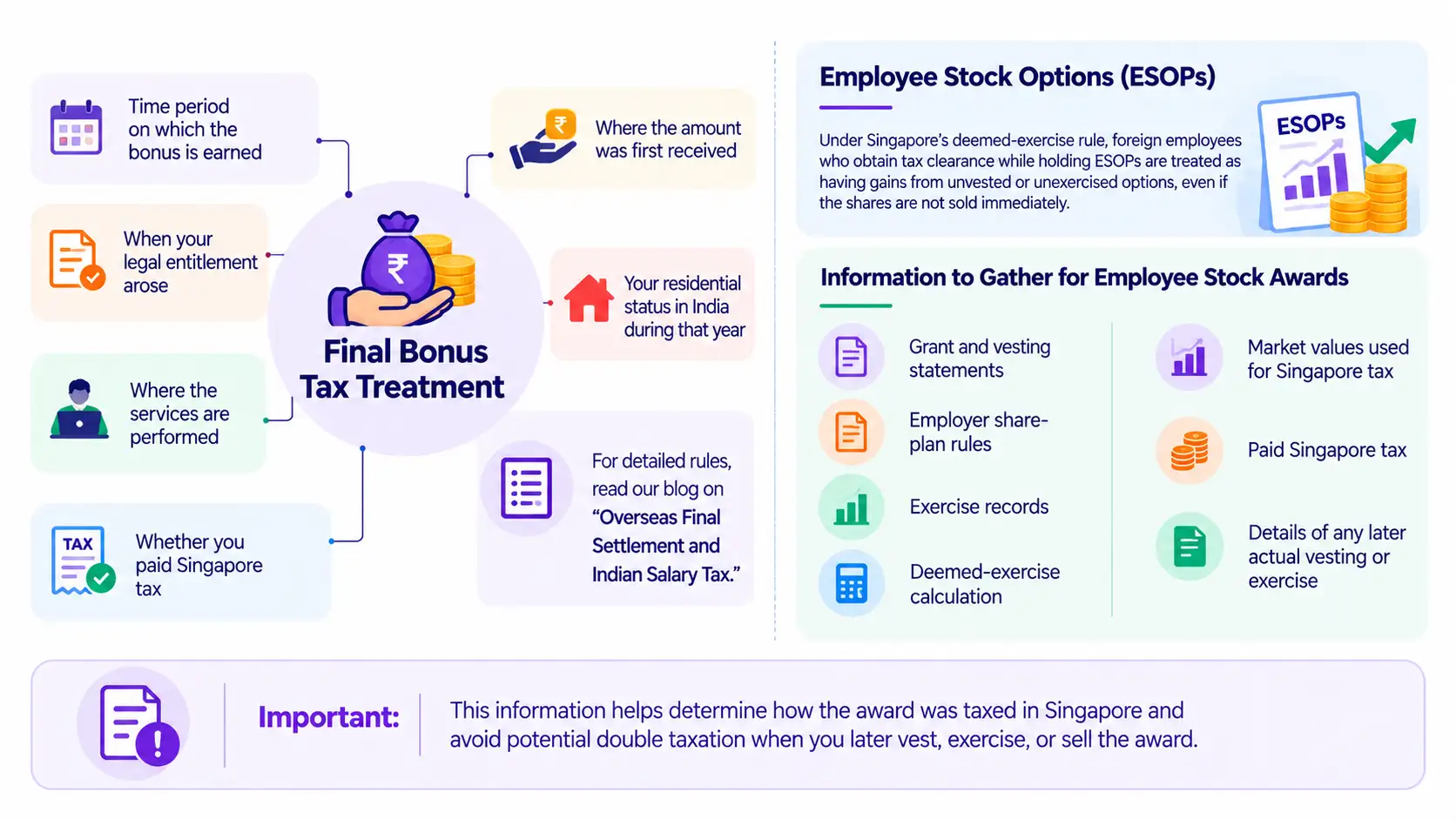
For a detailed overview of how your overseas income tax in India is treated, read our blog on "Overseas Final Settlement and Indian Salary Tax."
Also, pay special attention to your Employee Stock Option Plans and Employee Share Ownership Plans. Under Singapore's deemed-exercise rule, foreign employees who obtain tax clearance while holding these investments are treated as having gains from unvested or unexercised share or award options. This is applicable even when you do not sell the shares immediately.
Further, if you hold employee stock awards, gather the following information:
This information can help you determine how the award was taxed in Singapore and avoid potential double taxation when you later vest, exercise, or sell the award.
So, before returning to India, obtain your Singapore Tax Clearance. Next, let's cover how to determine your tax status in India after returning.
In India, for each applicable tax year, you need to determine your residential status. Under the Indian Income Tax Law, your residential status depends on the statutory conditions applicable to the tax year, including your physical presence during the tax year and the preceding years. Considering this, do not assume that:
So, after landing in India, determine your residential status using your passport, travel records, and the applicable statutory conditions.
For tax years beginning on or after April 1, 2026, your residential status is determined under the Income Tax Act, 2025, instead of the Income Tax Act, 1961. The residential-status framework remains broadly unchanged, including the RNOR criteria.
A returning NRI under the Income Tax Law can come under one of the three categories:
| Indian Residential Status | General Indian Tax Scope |
|---|---|
| Non-Resident Indian (NRI) | Taxed on Indian source income |
| Resident but Not Ordinarily Resident (RNOR) | Taxed on Indian income plus foreign income derived from a business controlled in or a profession set up in India |
| Resident and Ordinarily Resident (ROR) | Taxed on global income subject to exemptions and treaty relief |
This was a simplified comparison of Indian residential status for NRIs returning to India from Singapore. You still need to review the source, receipt, accrual, and character of each item.
Further, if you hold Singapore bank interest, employment payments, dividends, investments, retirement savings, or rental income, RNOR status is particularly important for you. However, you cannot review your RNOR status and foreign income item by item. Also, not all your foreign payments are exempt under RNOR status.
Singapore income does not become taxable in India only when your RNOR status changes to ROR. Depending on your residential status, the nature of the income, where it accrues, and where it is first received, some Singapore income may be taxable in India even while you are an RNOR. Once you become an ROR, foreign income is generally included in your Indian taxable income, subject to applicable exemptions and treaty relief.
Considering this, Singapore income that you need to review includes:
As mentioned earlier, India taxes RORs on their global income. This means that after you become an ROR, even if you keep your Singapore income in your foreign bank account, you are still liable to pay tax on it in India.
Generally, foreign income that accrues outside India and is first received outside India is not taxable in India for an RNOR or non-resident merely because it is later remitted to India. However, the income may still fall within the Indian tax scope if it is received or deemed to be received in India, accrues or is deemed to accrue in India, or, in the case of an RNOR, is derived from a business controlled in India or a profession set up in India. Also, transferring existing foreign income to India does not by itself make the original income taxable again merely because of the remittance. So, before filing ITR in India, review the underlying source and original receipt.
Now, moving further, let's know what you should do with your CPF and SRS savings.
The Central Provident Fund (CPF) and the Supplementary Retirement Scheme (SRS) are different schemes, so you cannot apply the same withdrawal strategy to them.
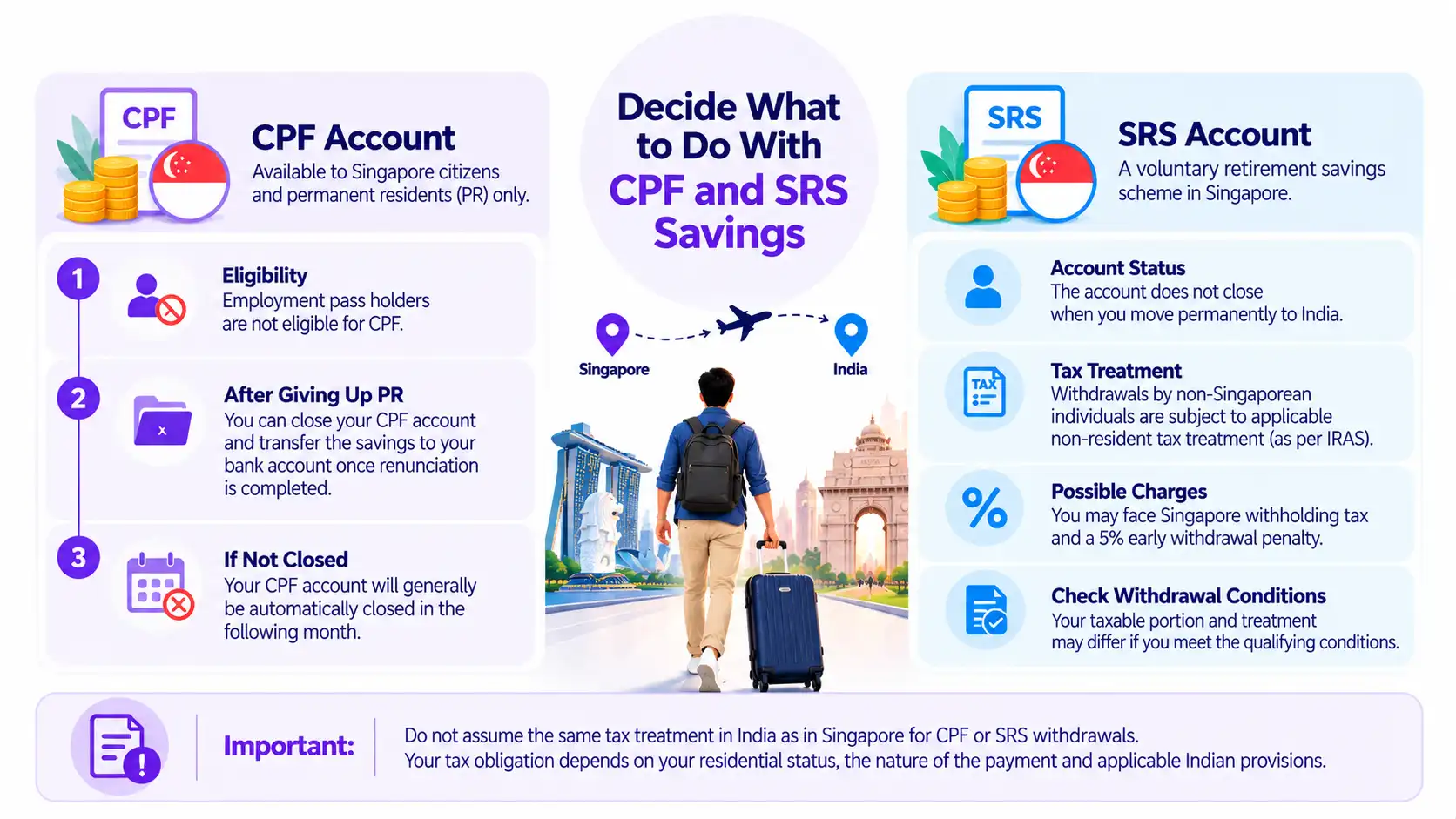
CPF scheme is available to Singapore citizens and permanent residents. Working on an employment pass in Singapore does not make you eligible for the CPF scheme unless you are a Singapore citizen or hold PR status.
After getting PR status in Singapore, if you leave the country and subsequently give up Singapore PR, you may close your CPF account and transfer your CPF savings to your bank account once your renunciation is completed. If you do not do so, your CPF account will generally be automatically closed in the following month.
So, before applying for the process, check the following things:
Additionally, do not assume that you face the same tax obligation on CPF withdrawal in India as in Singapore. Your tax obligation on CPF withdrawal in India depends on your residential status, the nature of the payment, your contributions in the past, and applicable Indian provisions.
SRS is a voluntary retirement savings scheme in Singapore. Like other retirement accounts, this account also does not close when you move permanently to India. However, according to IRAS, SRS withdrawals by non-Singaporean individuals who do not work and live in the country are subject to the applicable non-resident tax treatment. Depending on your withdrawal circumstances, you may face Singapore withholding tax and a 5% early withdrawal penalty.
Further, if you fulfill the qualifying withdrawal conditions, your taxable portion and withdrawal treatment may differ from your original premature account withdrawal. So check your current conditions before withdrawing.
Also, determine whether this withdrawal is taxable in India based on your residential status. Apart from this, don't focus only on tax; consider investment options, currency exposure, fees, and withdrawal restrictions in Singapore.
This covers CPF and SRS accounts. Moving forward, let us know why you want to review your Singapore bank accounts and investments.
As an NRI returning to India from Singapore, inform your Singapore bank, insurer, investment platform, and broker about your relocation. Also ask whether you can keep these accounts as an Indian resident. Some platforms let you keep Singapore accounts with an updated address, while others restrict you from holding them. So review your:
Additionally, update your:
Retaining Singapore assets does not mean paying tax in India on their full value. Like Indian assets, you need to consider income, capital gains, and disclosure of your Singapore assets separately. You generally need to report foreign assets and income in India once you become an ROR. That said, subject to ITR instructions, RNORs and NRIs are not required to report their foreign assets in Schedule FA.
Considering this, keep a record of your foreign assets containing the following information:
So, this is why you should review your Singapore bank accounts and investments before moving to India. Moving forward, let's look at why you need to update your NRE, NRO, and FCNR accounts in India.
Once you return to India permanently, review your NRI bank accounts under FEMA and RBI rules and inform your banks of the change in your residential status. Your NRE and NRO accounts generally need to be redesignated appropriately, while eligible FCNR(B) deposits may continue until maturity under applicable RBI rules.
With that in mind, inform Indian banks promptly when your residential status changes. Considering this, Indian banks ask you to:
For a brief overview, read our blog on NRE, NRO, and resident accounts. Additionally, even after your residential status change, you can hold FCNR fixed deposits till their maturity date.
Moreover, an RFC account helps you retain your permitted foreign currency in India without converting it into INR immediately. So review our resident foreign currency account before moving to India. Do not leave your NRI accounts unchanged after your residential status changes. Redesignate or convert them in accordance with applicable FEMA and RBI requirements.
That is why you should update your NRE, NRO, and FCNR accounts once you return to India permanently from Singapore. Moving ahead, let's know how to claim foreign tax credit under the India-Singapore DTAA.
During your transition year from Singapore to India, depending on your residential status, you may be liable to pay tax on the same income in both countries. For instance:
To avoid double taxation on the same income, you can claim a foreign tax credit under the India-Singapore DTAA. This does not mean you are exempt from paying tax in India; instead, eligible foreign tax paid on the same income may generally be claimed as a credit against the Indian tax attributable to that income, subject to the applicable DTAA and Indian tax rules.
To claim the foreign tax credit in India on your already paid taxes on the same income in Singapore, you need to submit the following documents:
Additionally, to claim the foreign tax credit, you need to fill out Form 67 and submit it electronically through the Income Tax e-Filing portal within the applicable timeline.
So, this is how you can claim a foreign tax credit under the India-Singapore DTAA. Moving forward, let's take a quick overview of Singapore-to-India relocation through a checklist.
Here is a quick checklist that you need to consider when moving from Singapore to India:

Use the checklist above when returning to India from Singapore to stay compliant with the rules and regulations of both countries.
At Savetaxs, we help returning NRIs efficiently manage their foreign investments and plan their smooth return to their home country.
Lastly, as an NRI returning to India from Singapore, you need to stay compliant with the rules and regulations of both countries. Complete the Singapore tax clearance before leaving the country, where required. Additionally, review your CPF, SRS, bank accounts, stock options, and investments you held in Singapore. After coming to India, determine your residential status under Indian income tax law, update your bank accounts in accordance with applicable FEMA and RBI rules, and manage your Indian and foreign investments properly.
If you're having trouble handling all this on your own, connect with Savetaxs. Our team of tax experts helps returning NRIs determine their residential status in India, review their Singapore income, and file ITR in India. Contact us and plan your smooth return to India.
This article is for general informational purposes only and does not constitute tax, legal, financial, or investment advice. Laws, regulations, rates, and procedures may change over time and may vary based on individual circumstances.
While SaveTaxs makes reasonable efforts to keep the information accurate and up to date, readers should verify applicable rules with official authorities or consult a qualified professional before making decisions based on this information.
Vipul Jain is the Co-Founder of SaveTaxs and a tax expert with experience in Indian and NRI taxation. He advises individuals, NRIs, and businesses on tax filing, tax planning, capital gains, DTAA, and compliance matters. He focuses on making complex tax concepts simple and helping taxpayers make informed, compliant decisions. See Full Bio
Want to read more? Explore Blogs