


US Tax Forms
IRS Form 8962 for NRIs: Premium Tax Credit and APTCIRS Form 8962 for NRIs: Premium Tax Credit and APTC
Written by Shubham Jain
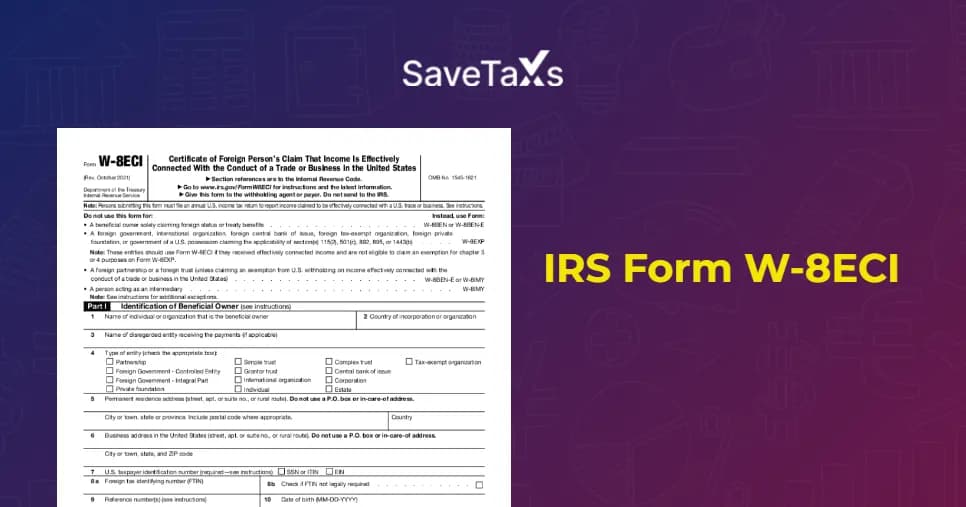
If you are an NRI earning income from the US, you must be familiar with IRS Form W-8BEN. It is used to certify foreign status and claim tax treaty benefits. However, if you earn income through an active trade or business in the US, you need to submit Form W-8ECI and not W-8BEN.
Choosing the wrong form can lead to unnecessary 30% withholding, additional compliance requirements, or incorrect tax treatment. It is important to understand when your income qualifies as effectively connected income (ECI) to stay compliant and avoid costly errors.
In this blog, we will discuss what Form W-8ECI is, who needs to submit it and who does not, how to fill it out correctly, and much more.
Form W-8ECI is an IRS form used by foreign individuals and entities to confirm that their income sourced from the US is effectively connected income (ECI). It is also known as the certificate of a foreign person's claim that income is effectively connected with the conduct of a trade or business in the United States.
ECI refers to the income that is directly linked to active business operations within the United States. When income qualifies as ECI, it is taxed at the graduated US income tax rates. Instead of the typical 30% flat withholding rate that applies to most other U.S. source income for foreigners, it has the same rates that apply to U.S. residents.
The automatic 30% withholding on ECI payment can be removed by submitting Form W-8ECI with the payer. Instead, the income is reported on Form 1040-NR, and the taxes are paid at the appropriate rate after allowable business expenses are deducted. This can be more beneficial, especially when business expenses lower the effective tax rate below 30%.
Foreign nationals, particularly Non-Resident Indians (NRIs), must fill out W-8ECI when they receive U.S.-source income effectively tied to a trade or business they manage in the U.S. This includes:
The main concept is the active business connection to the U.S. Effectively Connected Income is about income derived from business operations in the country and not passive income like dividends, royalties, or interest from U.S. investments.
With Savetaxs, accurately file your US taxes, maximize your tax benefits, and stay compliant with the IRS.
As discussed above, you need to use W-8ECI for income that qualifies as effectively connected income (ECI). ECI is the income that has a genuine connection to a trade or business in the U.S. Some common examples for NRIs include:
You need to submit W-8ECI when a U.S. withholding agent, such as your client, payer, or financial institution, is making payments to you that would otherwise be subject to 30% withholding. However, you think that those payments qualify as ECI.
So, by submitting this form, you inform the payer to stop withholding at 30% and instead provide you the gross amount, under the understanding that you will self-report and pay tax on it through Form 1040-NR.
W-8ECI becomes inappropriate and must be avoided in the following situations:
You may face unexpected US tax filing obligations and compliance issues if you use W-8ECI incorrectly for income that is not ECI.
Before we move forward with the steps to complete the form, you need to gather some information and documents. Here are the details required to complete Form W-8ECI for NRIs:
Here is how you can file W-8ECI:
Sign the form, print your name, date it in the MM-DD-YYYY format, and state your capacity (Individual, Director, Authorized Signatory, etc.). An unsigned W-8ECI is invalid and won't be accepted by the payer.
The table below lists the correct form to use based on your situation:
| Situation | Correct Form |
|---|---|
| NRIs receiving US dividends, interest, or royalties | W-8BEN (individual) |
| Indian company earning passive US income | W-8BEN-E |
| NRI with active US business generating business profits | W-8ECI |
| Indian company with U.S. trade or business operations | W-8ECI |
| Foreign government or international organisation | W-8EXP |
| Foreign financial intermediary receiving payments for others | W-8IMY |
| NRI providing services within the US as part of the business | W-8ECI |
| NRI freelancer working remotely from India for US clients | W-8BEN (services performed outside the US are generally not considered ECI) |
If you have active business operations in the U.S., then you must use W-8ECI. However, if an NRI operates remotely from India and does not conduct business in the U.S., their income will not be considered as ECI, and hence, a W-8BEN will be the correct form to use.
W-8ECI requires a U.S. TIN, and without it, your form will not be considered valid. So, if your income qualifies as ECI and you don't have a TIN, you must apply for one.
Form W-8ECI might not be accepted by the withholding agent if a valid U.S. TIN is absent (when required). The payer may be required to apply relevant withholding rules based on the nature of the payment. This can include the standard 30% withholding for certain U.S. source payments or other applicable withholding provisions under the Internal Revenue Code. Here is an example of an NRI.
Consider Vikram, an NRI who owns and operates an Indian grocery store in New Jersey, incorporated as a U.S. LLC, earning approximately $85,000 annually from his U.S. business activities. He also has investments in U.S. stocks that provide him with dividend income.
For his grocery business income derived from his active business operations in the U.S., Vikram files a W-8ECI with his U.S. bank and other U.S. payers. He has an EIN for his U.S. LLC and annually files Form 1040-NR, reporting his business income as ECI, claiming legitimate business expenses (such as rent, inventory, wages, and utilities) against it. He then pays U.S. income tax at graduated rates on his net profit.
For his passive income from U.S. securities, like dividends, Vikram submits Form W-8BEN to the relevant U.S. withholding agents to certify his foreign status and to claim any necessary treaty benefits.
When he uses W-8ECI for his US business income, he avoids 30% withholding on business receipts. This will replace it with the actual tax on his net business income, which, after deducting expenses, results in a significantly lower effective tax rate. This highlights the practical advantage of ECI treatment when legitimate deductions are available.
It's important to note that W-8ECI is not a tax filing; instead, it serves as a certification form provided to the payer. After submitting W-8ECI, the payer will stop withholding, and you will be responsible for self-reporting and paying U.S. taxes on the ECI through the annual tax return process.
NRIs with ECI typically have a U.S. filing obligation and must file Form 1040-NR, adhering to the IRS requirements for the tax year.
On Form 1040-NR, ECI is reported separately from non-ECI U.S. income. Business-related deductions are claimed against ECI to calculate net taxable income. This includes rent, salaries, depreciation, professional fees, and inventory costs. Then, tax is calculated using the graduated U.S. income tax rates applicable to the relevant tax year after accounting for allowable deductions and adjustments.
With Savetaxs, complete Form W-8BEN-E accurately, avoid unnecessary withholding, and stay compliant with IRS regulations.
Here are some common mistakes that you must not make when filing Form W-8ECI:
Form W-8ECI is crucial for a specific scenario where your U.S. income is derived from actively running a business or conducting trade in the United States. For NRIs in that situation, this form prevents a 30% flat withholding, with graduated tax rates based on net income. This is typically more beneficial when there are legitimate business deductions.
Key considerations include confirming that your income genuinely qualifies as ECI before using the form, ensuring you have a U.S. TIN, submitting W-8ECI to the appropriate payer, and filing Form 1040-NR annually to report and pay taxes on the net ECI.
Moreover, if you are still confused, contact an expert at Savetaxs. Our team of experts can help you file Form W-8ECI and also help you understand which form you need to use based on your situation. Contact us today, as we are actively working 24/7 across all time zones to help our clients.
This article is for general informational purposes only and does not constitute tax, legal, financial, or investment advice. Laws, regulations, rates, and procedures may change over time and may vary based on individual circumstances.
While SaveTaxs makes reasonable efforts to keep the information accurate and up to date, readers should verify applicable rules with official authorities or consult a qualified professional before making decisions based on this information.
Shubham Jain is the Founder of SaveTaxs and has extensive experience in Indian and NRI taxation. He advises individuals, NRIs, and businesses on tax filing, tax planning, capital gains, DTAA benefits, fund repatriation, and compliance matters. He regularly writes about taxation and related financial topics. His focus is on making complex tax concepts easy to understand. Through his articles, he helps taxpayers stay informed, avoid common mistakes, and stay compliant with Indian tax laws. See Full Bio

Want to read more? Explore Blogs
_1786539671275.webp&w=828&q=75)
Form W-8ECI is used when your U.S.-source income is effectively connected with a U.S. trade or business. It generally allows payments to be made without the standard Chapter 3 withholding because the income is instead reported on a U.S. tax return and taxed on a net basis.
Form W-8BEN, on the other hand, is used for passive U.S.-source income (such as dividends, royalties, or interest) to certify foreign status and, where applicable, claim a reduced withholding rate under an income tax treaty. Unlike Form W-8ECI, Form W-8BEN generally does not require a U.S. TIN unless it is needed to claim certain treaty benefits.