-for-401(k)_1790057066765.webp&w=828&q=75)
US Tax Filing and Compliance
Net Unrealized Appreciation (NUA) for 401(k): A Guide for NRIs Moving to IndiaNet Unrealized Appreciation (NUA) for 401(k): A Guide for NRIs Moving to India
Written by Vipul Jain

I hardly earned anything or nothing at all in the U.S. this year, so it means I don't need to file, right? This is a common misconception among international students, H-4 spouses, H-1B professionals, and other nonresident aliens (NRAs) in the U.S. However, the reality is often surprising: Nonresident aliens do not enjoy a minimum income threshold. In many situations, they are required to file something, even if their income is zero.
Filing is not always about owing taxes; instead, sometimes it is necessary due to reporting obligations tied to your visa status, irrespective of your earnings. In this blog, we will learn when filing is necessary, which forms to use, and the potential consequences of not filing.
The confusion around filing comes from mixing up two separate issues: owing tax and having a filing obligation. You can owe zero dollars yet still need to submit something to the IRS for various reasons:
In short, most nonresident aliens on F-1, J-1, M-1 or Q-1 visas must file Form 8843 annually, even if their income is zero. Additionally, anyone with U.S. source ECI needs to file Form 1040-NR, regardless of the amount generated.
The table below lists who needs to file, using which form and its purpose:
| Situation | Form Required | Purpose |
|---|---|---|
| Holders of F-1, J-1, M-1, or Q-1 visa with no income | Form 8843 | Documents exempt status for the substantial presence test and not an income return. |
| Any U.S. source ECI like wages, self-employment, or business profits | Form 1040-NR | It reports income and is taxed at graduated rates. |
| Tax withheld on any U.S. payment | Form 1040-NR | Claims a refund for over-withheld tax |
| U.S. source FDAP income like dividends, interest, rent, and royalties and not fully treaty-exempt | Form 1040- NR + Schedule NEC | Taxed at a flat 30% or reduced treaty rate on the gross amount |
| Claiming a treaty exemption | Form 8833 (attached to 1040-NR) | Reports your treaty-based position |
| Needing a tax ID to file | Form W-7 (for ITIN) | Required if you don't qualify for an SSN |
| Every 1040-NR filer | Schedule O1 | Reports visa status, residency history, and treaty claims |
Practical Guideline: If you were on a visa, had a U.S. bank account with withholding, or experienced any U.S. related income event during the year, it's advisable to check your requirement before assuming you are exempt.
Connect with Savetaxs and get expert cross-border support throughout the filing process.
Not all income is treated equally
Understanding this difference is important because even a single dividend payment can create a filing requirement, since FDAP income has no income threshold either.
*A Narrow Exception: Nonresident aliens present for less than 183 days generally do not owe taxes on capital gains, with a few notable exceptions. Additionally, interest paid on most U.S. bank deposits for nonresident aliens is often exempt from tax and reporting.
Standard Deduction Exception: Under Article 21(2) of the U.S. India tax treaty, students and business apprentices from India can claim a standard deduction of $15,750 for the 2025 tax year. This is one of the few treaty provisions of its kind that most other nationalities don't benefit from. Conversly. personal exemptions remain suspended for all taxpayers through 2025. Hence, most NRAs can offset their income that way.
Form 8843 confuses many students because it is not a traditional tax return, which means it doesn't report income or taxes. Instead, it confirms that your time in the U.S. doesn't contribute to your residency status due to your exempt visa category (such as F-1, J-1, M-1, or Q-1).
Missing this form for a couple of years may not result in immediate issues, but it could complicate your residency calculations later. For example, it could affect audits, visa transitions, or green card applications, when tax compliance history might be reviewd.
Let's understand two different scenarios under one rule:
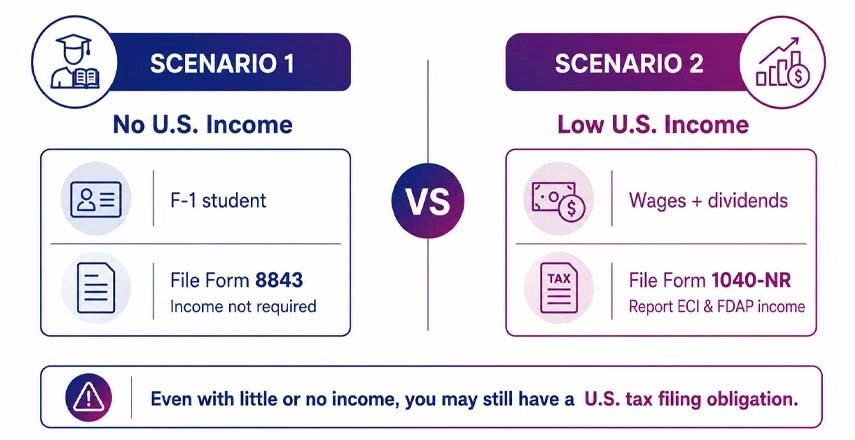
In August 2025, Arjun moved to the U.S. on an F-1 visa for his master's program without any assistantship, job, or U.S. income. Assuming he doesn't need to file because he earned nothing, he skips the tax season. Later, when applying for CPT work authorization, his university's international office inquires about Form 8843, which he hadn't filed. He ends up filing it late with an explanation. If he had filed it on time during his first year, he would have avoided the hassle, as Form 8843 doesn't concern income.
Priya, on an H-1B visa, arrives in August 2025 and earns $28,000 in wages over four months, with taxes withheld from each paycheck. She also earns $150 in dividends from a U.S. brokerage account. She assumes that a partial year with little dividend income might not require filing. However, both sources of income require reporting on Form 1040-NR. This means her wages as ECI (to reconcile withholding and determine her tax refund or amount due) and her dividends as FDAP income on Schedule NEC, taxed at a flat 30% or reduced treaty rate.
Further, since her employer withheld taxes, her deadline is the 15th of April 2026. Also, if she were self-employed, she'd have the deadline until June 15.
Here are the deadlines for filing based on your income source:
Here are the potential consequences you may face for not filing;
Fortunately, most issues can be rectified. Filing correctly and on time is much easier than reconstructing several years' worth of records later.
Here are some common filing mistakes that you must avoid:
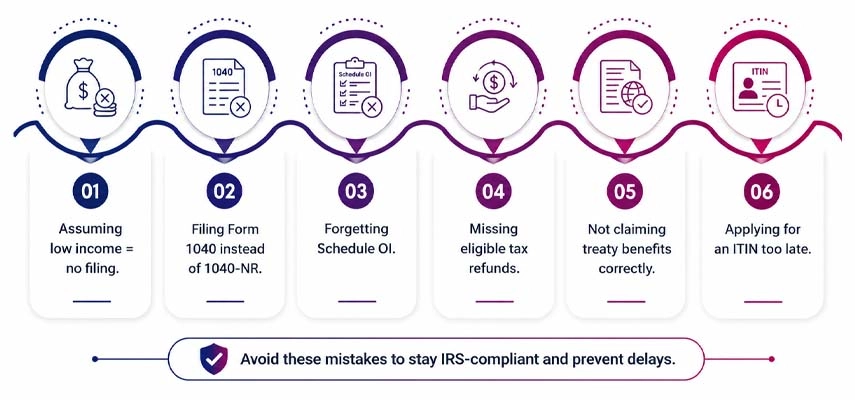
Get help staying compliant with your US tax filing requirements with dedicated support from Savetaxs.
For nonresident aliens, the ideas of "no income" and "low income" don't mean "no filing obligation" as they might in other contexts. Obligations exist based on visa category, withholding, and treaty claims, regardless of how much one has earned. If you’ve spent any portion of the year in the U.S. on a visa or received any payment with tax withheld, it’s important to verify what you need to submit to the IRS, even if your tax liability turns out to be zero.
Furthermore, in more complex situations that involve multiple visa transitions, treaty claims, or years of missed filings, seeking assistance from an expert at Savetaxs is advised. We have an entire team of professionals familiar with the cross-border rules who can help you understand what is required and help you comply with every nonresident alien filing requirement. Connect with us right away, as we are actively working 24/7 across all time zones.
This article is for general informational purposes only and does not constitute tax, legal, financial, or investment advice. Laws, regulations, rates, and procedures may change over time and may vary based on individual circumstances.
While SaveTaxs makes reasonable efforts to keep the information accurate and up to date, readers should verify applicable rules with official authorities or consult a qualified professional before making decisions based on this information.
Shubham Jain is the Founder of SaveTaxs and has extensive experience in Indian and NRI taxation. He advises individuals, NRIs, and businesses on tax filing, tax planning, capital gains, DTAA benefits, fund repatriation, and compliance matters. He regularly writes about taxation and related financial topics. His focus is on making complex tax concepts easy to understand. Through his articles, he helps taxpayers stay informed, avoid common mistakes, and stay compliant with Indian tax laws. See Full Bio

Want to read more? Explore Blogs