-for-401(k)_1790057066765.webp&w=828&q=75)
US Tax Filing and Compliance
Net Unrealized Appreciation (NUA) for 401(k): A Guide for NRIs Moving to IndiaNet Unrealized Appreciation (NUA) for 401(k): A Guide for NRIs Moving to India
Written by Vipul Jain

As an NRI, if you have a tax debt in the United States and assets sitting in India, such as a bank account, securities, or investments, you may have wondered how far the IRS's reach can actually go. Questions like "Can they touch money that has never set foot in America?" must be wandering in your head.
Well, the answer is more nuanced than a simple yes or no. The IRS has real tools to pursue the assets abroad, but its power looks very different based on where those assets sit and which country you are dealing with. This blog will answer all your questions regarding whether the IRS can seize foreign assets for NRIs.
Here is the quick answer: The IRS cannot directly seize your foreign assets physically without getting cooperation from the foreign country involved, but it has several indirect tools to pursue those assets or the people who own them.
The tax authorities from the United States do not automatically extend across the borders. A US levy notice has no legal force in India unless the Indian government or the courts agree to enforce it. That is the core limitation and also the reason this area of tax law involves so much bureaucratic maneuvering.
With that being said, "cannot direct seize" here doesn't mean the IRS "cannot collect tax". The IRS has designed a built-out set of workarounds over the last two decades, which has been possible, albeit larger, through the information-sharing laws and selective bilateral agreements.
The IRS is most likely to pursue foreign assets when the following conditions are in place.
In practice, most of the individual NRIs with modest tax debt will not see aggressive cross-border IRS asset seizure attempts. Such attempts tend to escalate in cases involving massive underreported income debts that are unresolved for years, or deliberate masking of income for years despite the IRS's repeated contact.
Savetaxs helps NRIs file their US taxes under expert guidance and with 100% compliance.
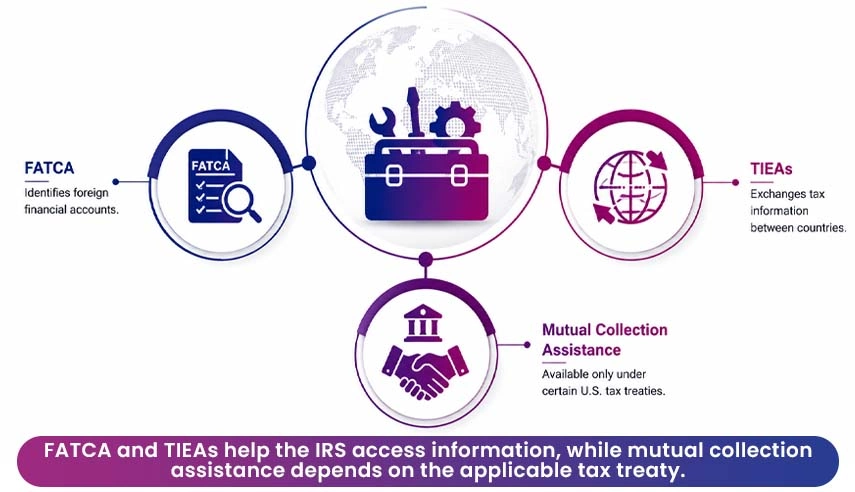
While chasing the foreign money overseas, the IRS does not work alone. The IRS relies on three main international legal frameworks.
The Foreign Account Tax Compliance Act requires foreign financial institutions, including most banks in India, to report the account-related information of US persons directly to the IRS.
This strategy means that the IRS often already knows about your Indian bank accounts, investments, and balances well before any action toward the foreign asset collection starts. FATCA is not a seizure tool; instead, it is a visibility tool. However, it removes the "IRS doesn't know" assumption that used to give some taxpayers a false sense of confidence.
The tax information exchange agreements let the IRS request specific financial information from other countries even without a full income tax treaty in place. This type of agreement supports investigation and enforcement but does not grant seizure authority. The TIEAs are about information, not asset recovery.
This is the primary mechanism behind cross-border enforcement, and it is also the most limited one. Only a small number of the US tax treaties include a mutual collection assistance provision; treaties with countries like Canada, France, Denmark, the Netherlands, and Japan contain such clauses.
Here's an important take for NIRs: The current US Indian tax treaty does not include a mutual collection assistance provision. This directly means that the IRS cannot ask the Indian authorities to seize or freeze your Indian assets under this mechanism, the way it could with a treaty partner like Canada.
However, this does not make your Indian assets untouchable; it just means the IRS has to rely on other tools, which are generally slower and less direct.
The IRS cannot directly seize foreign bank accounts, in most cases involving India, but there are two notable exceptions worth understanding:
| Scenario | Can The IRS Reach It |
|---|---|
| The funds in a processed Indian-based bank account with no US presence. | Generally no direct seizure, limited to indirect pressure and litigation. |
| Funds in the US branch or correspondent account of an Indian bank account. | Yes, the IRS can issue a levy here. |
| Assets in a country with mutual collection assistance, for example Canada. | Yes, via a formal mutual collection assistance request. |
| Domestic US assets tied to the taxpayer | Yes, the standard IRS levy and seizure rules may apply as usual. |
The correspondent account angle often surprises taxpayers. If your Indian bank has a relationship with a US bank to process the dollar transactions, the IRS may be able to levy the funds sitting in that US-based correspondent account, even though your actual account is in India. This is a narrower and more technical tool than a direct account seizure, and it is not routinely used for a smaller individual case.
Though the IRS has an expanding toolkit, there are real limits it cannot reach:
Real estate that is physically located in countries without mutual collection assistance provisions. Such assets remain outside the direct IRS seizure authority.
Assets held in countries with strong asset-protection or banking secrecy laws that do not directly cooperate with the US enforcement requests.
Property where the local courts decline to enforce any kind of US tax judgment, which happens more often than people expect, especially where the enforcement would conflict with the local law or public policy.
There are certain items categorized under US law itself, such as specific retirement accounts and modest amounts of personal property, which are protected from levy, even domestically.
None of these means that the foreign assets are a safe hiding place. This simply means that direct seizure is harder, and the IRS often shifts toward indirect pressure such as passport restrictions, litigation, or waiting out the taxpayer's net US re-entry or asset movement.
Most NRIs who end up in serious IRS collection trouble did not get there because they had assets abroad. They ended up there because of unresolved compliance gaps. Here's how NRIs can actually lower the risk of IRS asset collection.
File FBAR (FinCEN Form 114) every year if you combine foreign account balances that exceed $10,000 at any time in the tax year.
File Form 8938 if you have foreign financial assets that meet the specific reporting threshold under the FATCA. The threshold generally depends on US residency and filing status.
Respond to the IRS notices as soon as you can, even if you are overseas. Not responding promptly and being silent is what typically escalates a routine notice into a formal collection case.
Consider an Offer in Compromise or Installment Agreement if you have a genuine tax debt. Because assuming that distancing will make the issue disappear won't lead you anywhere.
If you have unreported foreign income or accounts, consult a qualified tax professional about the appropriate IRS compliance or disclosure option based on your circumstances, ideally before the IRS identifies the gap on its own through the FATCA data.
Let us understand this concept with an example. Aush is a green card holder who later moved back to India. He had an outstanding IRS tax debt of $45,000 from rental income that he failed to report on a US property he sold years ago. He further owns an apartment in Mumbai and has savings accounts with an Indian-nationalized bank.
Ayush assumed that since he is now in India, the IRS has no way to touch anything. Whereas in reality, His Indian bank reports the required account information under the applicable FATCA reporting framework, through which the information may ultimately be exchanged with the IRS. Now, because India has no mutual assistance provision with the US, the IRS cannot ask Indian authorities to freeze his Mumbai apartment or the bank account directly.
What the IRS can do is flag his passport for restrictions if this debt is categorized as seriously delinquent, chase any of the US-based assets that he still holds, or directly reach funds if his Indian banks have a US correspondent account with an appropriate balance tied to him. In case Ayush ever plans to return to the US and opens a new account, his collection actions will still be active on him, and the debt will be collectible.
The next best practical path he can move onto isn't assuming the tax debt will disappear; it is just addressing it via the payment plan or the professional negotiation with the IRS before it escalates further.
Manage your cross-border taxes as an NRI globally with Savetaxs expert NRI Taxation Guidance.
Yes, the reach of the IRS into foreign assets is definitely real, but it isn't automatic or unlimited. For NRIs with property or money in India specifically, the absence of a mutual collection assistance provision in the current India U.S. tax treaty means there is no direct treaty-based mechanism for the IRS to seize assets located in India. However, FATCA reporting, correspondent account levies, and passport restrictions still give the IRS meaningful leverage.
In cases where you have outstanding US tax debt and assets in India, the smartest move is not waiting in the distance; it is just seeking assistance with a qualified cross-border tax professional before enforcement actions escalate.
This article is for general informational purposes only and does not constitute tax, legal, financial, or investment advice. Laws, regulations, rates, and procedures may change over time and may vary based on individual circumstances.
While SaveTaxs makes reasonable efforts to keep the information accurate and up to date, readers should verify applicable rules with official authorities or consult a qualified professional before making decisions based on this information.
Vipul Jain is the Co-Founder of SaveTaxs and a tax expert with experience in Indian and NRI taxation. He advises individuals, NRIs, and businesses on tax filing, tax planning, capital gains, DTAA, and compliance matters. He focuses on making complex tax concepts simple and helping taxpayers make informed, compliant decisions. See Full Bio

Want to read more? Explore Blogs