

NRI Income Tax Compliance
How to Claim Excess TDS Refund After Selling Property in India as an NRIHow to Claim Excess TDS Refund After Selling Property in India as an NRI
Written by Shubham Jain
_1784375756402.webp&w=3840&q=75)
You've probably already seen 31 July mentioned as the ITR filing date for 2026, but AY 2026-27 has several important deadlines depending on the taxpayer and return stage. In this guide, we'll explain the complete ITR filing deadlines 2026 calendar, including original, belated, revised and updated-return timelines.
ITR filing deadlines for AY 2026-27 vary according to the taxpayer's filing category and applicable compliance requirements.
The original ITR deadline differs from the statutory deadlines for belated, revised and updated returns.
FY 2025-26 income is reported in AY 2026-27 under the Income Tax Act, 1961.
31 July 2026 is not the only original-return deadline, with 31 August, 31 October and 30 November applying to specified categories.
The belated ITR deadline for AY 2026-27 is 31 December 2026, or earlier if assessment is completed, subject to applicable provisions.
The revised-return deadline for AY 2026-27 extends to 31 March 2027, or earlier if assessment is completed, based on the applicable transition-year provisions.
Official Income Tax Department guidance should be checked for deadline changes or extensions before relying on any tax calendar.
ITR filing deadlines 2026 are the prescribed dates for filing income-tax returns at different stages of the AY 2026-27 return cycle. These dates cover original returns as well as, where legally permitted, belated, revised and updated returns.
Moreover, AY 2026-27 relates to income earned during FY 2025-26. The Income Tax Department confirms that returns for FY 2025-26 are filed for AY 2026-27 under the Income Tax Act, 1961, even though filing takes place after the new Income Tax Act, 2025 comes into force.
For example, income earned between 1 April 2025 and 31 March 2026 belongs to FY 2025-26 and is reported through an AY 2026-27 return. Taxpayers should therefore select AY 2026-27 when filing that return on the e-Filing portal.
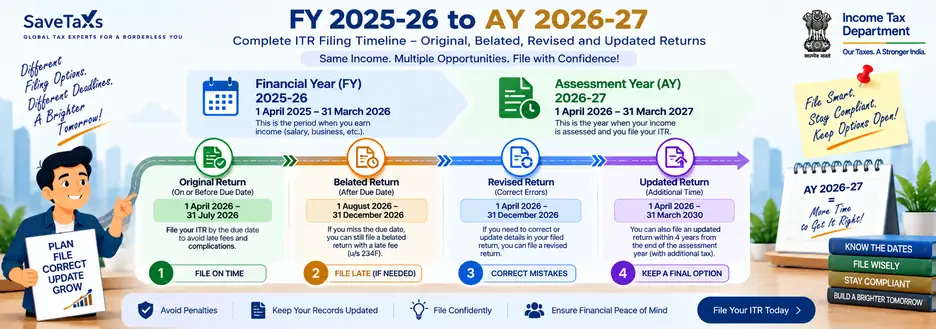
ITR filing deadlines matter because different taxpayer categories and return stages have different statutory timelines. Relying on a single date such as 31 July can therefore give an incomplete picture of the AY 2026-27 filing calendar.
For example, the Income Tax Department confirms 31 August 2026 as the due date for ITR-4 for AY 2026-27, while its transition guidance identifies 31 July, 31 August, 31 October and 30 November as relevant original-return dates for different categories.
At the same time, the original filing deadline is only one stage of the compliance timeline. A taxpayer may later encounter a belated-return, revised-return or updated-return deadline, each governed by different provisions and conditions.
ITR filing deadlines for AY 2026-27 vary according to the taxpayer's filing category and applicable compliance requirements. This makes a complete deadline calendar more useful than treating July 31 as a universal date.
The AY 2026-27 ITR calendar includes multiple original-return deadlines followed by separate belated, revised and updated-return timelines. The table below provides the key dates at a glance.
| Filing stage | Applicable situation | AY 2026-27 deadline |
|---|---|---|
| Original return | Regular non-audit category | 31 July 2026 |
| Original return | Specified non-audit business/professional category | 31 August 2026 |
| Original return | Tax-audit cases | 31 October 2026 |
| Original return | Specified transfer-pricing cases | 30 November 2026 |
| Belated return | Original deadline missed | 31 December 2026, or earlier if assessment is completed |
| Revised return | Correction of an eligible AY 2026-27 return | 31 March 2027, or earlier if assessment is completed |
| Updated return (ITR-U) | Eligible cases under Section 139(8A) | Up to the applicable statutory ITR-U window |
The Income Tax Department confirms the 31 December 2026 belated-return deadline and states that the revised return for AY 2026-27 can be filed before the expiry of the relevant assessment year, subject to completion of assessment and the applicable transition provisions.
Importantly, the table distinguishes return stages rather than treating every date as another version of the ITR last date. An original return deadline tells you when the return should ordinarily be filed, while a belated or revised deadline applies to a different filing situation.
Original ITR filing deadlines are the first prescribed dates by which taxpayers in different categories should submit their AY 2026-27 returns. The applicable date depends primarily on the taxpayer's filing category and whether audit or transfer-pricing requirements apply.
31 July 2026 applies to the regular non-audit category where the prescribed conditions do not place the taxpayer under a later deadline. This date is commonly associated with individuals and other taxpayers whose returns do not require the relevant audit or transfer-pricing compliance.
For example, the Income Tax Department's official e-Campaign messages in July 2026 reminded taxpayers to file AY 2026-27 returns by 31 July.
31 August 2026 applies to specified non-audit business or professional cases covered by the applicable AY 2026-27 return framework. This is particularly relevant for taxpayers who might otherwise incorrectly assume that all individual taxpayers share the July deadline.
For example, the official ITR-4 guidance specifically gives 31 August 2026 as the AY 2026-27 due date for ITR-4.
31 October 2026 is the principal ITR deadline for applicable tax-audit cases where transfer-pricing provisions do not create a later deadline. The audit requirement changes the filing timetable because the return follows additional audit-related compliance.
For example, the Income Tax Department states that the tax-audit report for FY 2025-26 is generally due one month before the corresponding ITR deadline, making 30 September 2026 the audit-report date for cases where the ITR is due on 31 October 2026.
30 November 2026 is the principal ITR deadline for specified transfer-pricing cases. These cases receive a later return deadline because transfer-pricing compliance introduces additional reporting requirements.
For example, the Income Tax Department identifies 31 October 2026 as the tax-audit report deadline for transfer-pricing cases where the corresponding ITR deadline is 30 November 2026.

The belated ITR deadline for AY 2026-27 is 31 December 2026, or earlier if the assessment is completed, subject to the applicable statutory provisions. A belated return is relevant when the taxpayer does not file the original return by the applicable Section 139(1) deadline.
For example, a taxpayer whose original deadline was 31 July 2026 may still have a belated-return window extending to 31 December 2026, subject to the statutory conditions. The Income Tax Department expressly confirms this AY 2026-27 deadline under Section 139(4) of the Income Tax Act, 1961.
At the same time, the belated-return deadline should not be confused with the original filing deadline. The later date provides a statutory filing route after the original deadline; it does not convert the original deadline into December.
For detailed post-deadline guidance, see missed ITR filing deadline.
The revised ITR deadline for AY 2026-27 is 31 March 2027, or earlier if assessment is completed, under the applicable transition-year provisions. A revised return is used to correct an eligible return that has already been filed.
For example, if a taxpayer discovers an error in an AY 2026-27 return after filing, the taxpayer can consider a revised return if the statutory conditions are satisfied. The Income Tax Department states that the revised return for AY 2026-27 remains governed by Section 139(5) of the Income Tax Act, 1961 and can be filed before the expiry of the relevant assessment year or completion of assessment, whichever is earlier.
In addition, the Income Tax Department's current ITR-1 guidance states that from AY 2026-27, a revised return filed after 31 December and up to 31 March may attract an additional fee under Section 234I.
Therefore, 31 March 2027 should be treated as a revised-return deadline, not as the original ITR filing deadline.
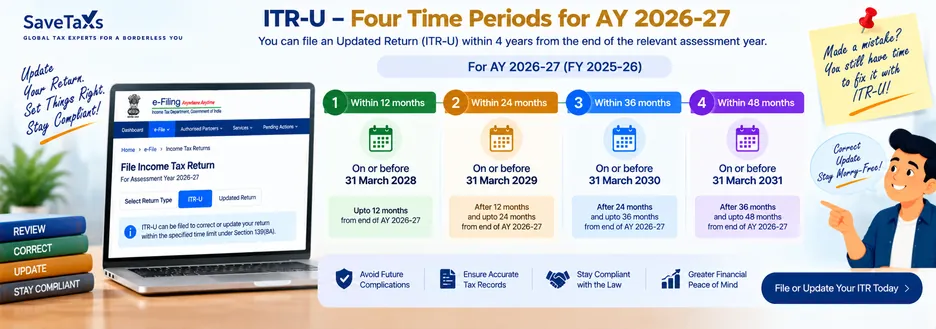
The ITR-U deadline is the statutory window available for an eligible taxpayer to file an updated return after considering the applicable conditions and additional tax requirements. Unlike an original or revised return, an updated return has specific restrictions and tax implications.
For example, the Income Tax Department confirms that an updated return for AY 2026-27 can still be filed under Section 139(8A) of the Income Tax Act, 1961 after the new Act comes into force, because AY 2026-27 remains governed by the old Act.
Moreover, the official ITR-U form provides four filing periods: up to 12 months, 12–24 months, 24–36 months, and 36–48 months from the end of the relevant assessment year.
For AY 2026-27, taxpayers should therefore verify the applicable ITR-U window and additional-tax requirements before filing rather than treating ITR-U as a simple extension of the original deadline.
The ITR deadline that applies to you depends on your filing category and the stage of your return. Use the following framework to identify the relevant part of the AY 2026-27 calendar.
Regular non-audit taxpayer: Check the applicable regular original-return deadline, generally 31 July 2026.
Specified non-audit business or professional taxpayer: Check the applicable 31 August 2026 deadline.
Tax-audit case: Check the 31 October 2026 ITR deadline.
Transfer-pricing case: Check the 30 November 2026 ITR deadline.
Original deadline missed: Check the 31 December 2026 belated-return deadline.
Error found after filing: Check eligibility and timing for a revised return, including the 31 March 2027 outer date for AY 2026-27 under the applicable provisions.
Income or return needs updating later: Check the separate ITR-U eligibility and statutory window.
For example, a freelancer filing an eligible ITR-4 should not automatically use 31 July merely because the taxpayer is an individual; the official ITR-4 guidance gives 31 August 2026 for AY 2026-27.
The government can modify an ITR filing deadline through an official notification or other authoritative communication. Consequently, taxpayers should not rely permanently on a date published before a deadline change.
For example, the Income Tax Department publishes taxpayer communications and filing updates through its e-Filing portal. Its current AY 2026-27 communications include specific deadline reminders for different filing periods.
Moreover, an extension applies only when officially announced and should not be inferred from informal reports or social-media posts. When a deadline is close, check the Income Tax Department's latest notification, circular, or e-Filing communication.
The official Income Tax Department e-Filing portal is the primary source for verifying current AY 2026-27 ITR filing information. Official sources should take priority whenever a third-party tax calendar conflicts with government guidance.
First, confirm that you are checking AY 2026-27, not Tax Year 2026-27. The Income Tax Department explains that AY 2026-27 covers FY 2025-26, while Tax Year 2026-27 relates to income earned during FY 2026-27 and has a later filing cycle.
Second, check the latest return-related communication and applicable category. The official downloads section currently provides AY 2026-27 ITR utilities, including the common ITR-1 to ITR-4 utility.
Third, verify whether an official notification has changed the deadline before you submit your return. This is particularly important for a deadline-calendar page because dates can change during the filing season.
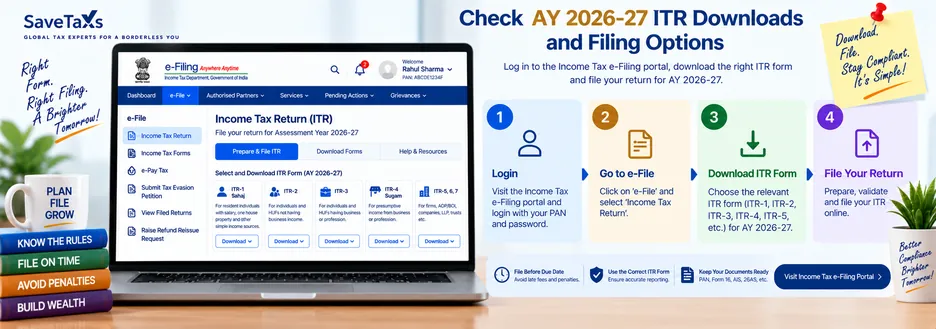
You can use the Income Tax Department e-Filing portal as the primary official source for current filing information.
Missing an original ITR deadline moves the taxpayer into a different filing situation governed by separate statutory rules. The taxpayer should then check the applicable belated-return provisions rather than treating the original deadline as still open.
For example, the Income Tax Department states that a belated AY 2026-27 return may generally be furnished by 31 December 2026, or earlier if assessment is completed.
However, detailed late-filing procedures, fees and post-deadline decisions are outside the scope of this deadline-calendar guide.
An AY 2026-27 deadline calendar is the simplest practical tool for tracking multiple ITR filing stages. Instead of remembering one date, record the applicable original deadline and any later return-stage deadlines relevant to your situation.
For example, a taxpayer can create four calendar entries for the principal original-return dates: 31 July, 31 August, 31 October and 30 November 2026, then separately note 31 December 2026 for belated returns and 31 March 2027 for eligible revised returns.
The Income Tax Department's e-Filing portal also provides current ITR utilities and assessment-year-specific resources. As of September 2026, its downloads page lists the latest common ITR-1 to ITR-4 utility as version 1.2.4, released on 2 September 2026.
The next step is to map your taxpayer category to the relevant original deadline and then track any later return-stage deadline separately. This approach keeps the filing timeline clear without confusing original, belated, revised and updated returns.
Use this checklist:
Identify the assessment year: Confirm that the return relates to AY 2026-27 and FY 2025-26.
Identify your filing category: Determine whether the regular, business/professional, audit or transfer-pricing timeline applies.
Record the original deadline: Use the applicable official date rather than assuming 31 July.
Track the return stage: Keep separate dates for belated, revised and updated returns.
Check official updates: Verify whether CBDT or the Income Tax Department has announced any extension or modification.
Complete filing and verification: Submit the appropriate return and complete the required verification process.
For example, if your original deadline has passed but you need to understand the remaining filing window, the relevant question is no longer “What was my original due date?” but “What post-deadline route is currently available?”
ITR filing deadlines 2026 are not limited to one July date; the AY 2026-27 return cycle contains multiple deadlines based on taxpayer category and return stage. The principal original-return dates are 31 July, 31 August, 31 October and 30 November 2026, followed by separate belated, revised and updated-return timelines.
Moreover, the deadline for filing an original ITR is different from the statutory deadlines for belated, revised and updated returns. For AY 2026-27, the Income Tax Department confirms 31 December 2026 for belated returns and provides a revised-return window extending to 31 March 2027 under the applicable provisions.
Finally, remember that FY 2025-26 income is reported in AY 2026-27 under the Income Tax Act, 1961, even though the new Income Tax Act, 2025 is now in force.
By identifying your filing category, tracking the correct return stage and checking official updates, you can use the AY 2026-27 ITR calendar confidently instead of relying on a single generic deadline.
This article is for general informational purposes only and does not constitute tax, legal, financial, or investment advice. Laws, regulations, rates, and procedures may change over time and may vary based on individual circumstances.
While SaveTaxs makes reasonable efforts to keep the information accurate and up to date, readers should verify applicable rules with official authorities or consult a qualified professional before making decisions based on this information.
Shubham Jain is the Founder of SaveTaxs and has extensive experience in Indian and NRI taxation. He advises individuals, NRIs, and businesses on tax filing, tax planning, capital gains, DTAA benefits, fund repatriation, and compliance matters. He regularly writes about taxation and related financial topics. His focus is on making complex tax concepts easy to understand. Through his articles, he helps taxpayers stay informed, avoid common mistakes, and stay compliant with Indian tax laws. See Full Bio
Want to read more? Explore Blogs