NRI Income Tax & Compliance

NRI Property Sale Without PAN: Is It Possible?

Shubham Jain
Written by Shubham Jain
Updated on: June 29, 202617 mins Editorial Standards
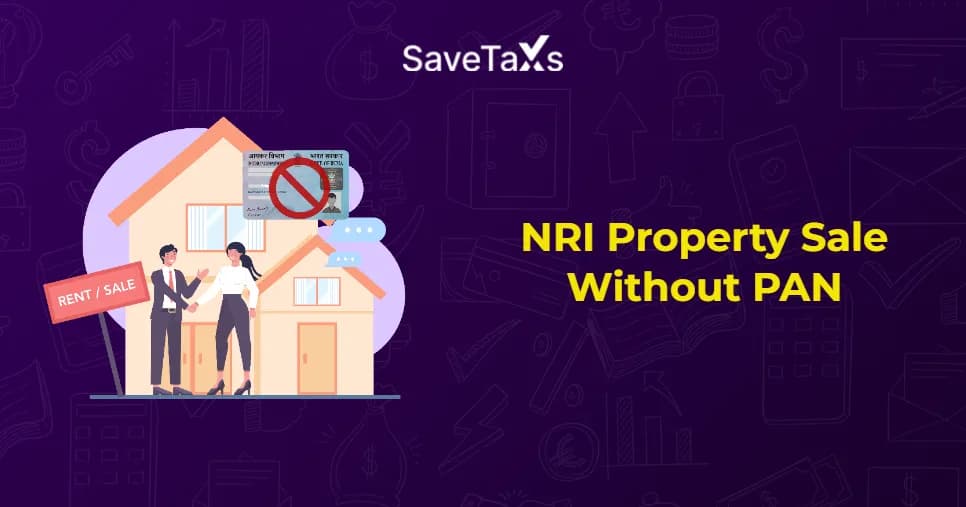
NRI Property Sale Without PAN

Many NRIs have inherited property in India, or they purchased it before moving overseas. As an NRI, selling property in India can be a complex process as it includes lots of documentation, FEMA compliance, repatriation rules, and higher TDS. Considering this, one common question that often arises in the mind is, "NRI property sale without PAN in India?"

The short and simple answer to this question is that, technically, being an NRI, you can sell property in India without a PAN. However, you face several hurdles, like a higher TDS deduction, tax refund challenges, and compliance issues for the buyer.

Confused? Let's break down this in a simple way to help you understand the rules and options you have when selling property in India. Read the blog and get your answers.
Key Takeaways
  • It is legally possible for NRIs to sell property in India without a PAN card. However, as a result of this, they face several consequences, such as paying higher TDS, facing issues in property registration, etc.
  • When selling a property in India, obtaining a PAN is the most practical solution. It saves your time, money, and potential legal headaches.
  • Additionally, without a PAN, you cannot file an ITR in India. This means your excess TDS stays permanently with the government.
  • A PAN card for an NRI property transaction is an important document. It helps them in claiming a refund of the higher TDS deduction, simplifying the repatriation process, claiming a lower TDS deduction certificate under section 197, and more.
  • You can apply for a PAN card online using the NSDL or UTIITSL website. The application process is completely online; you do not need to visit India.

Can NRIs Sell Property in India Without a PAN Card?

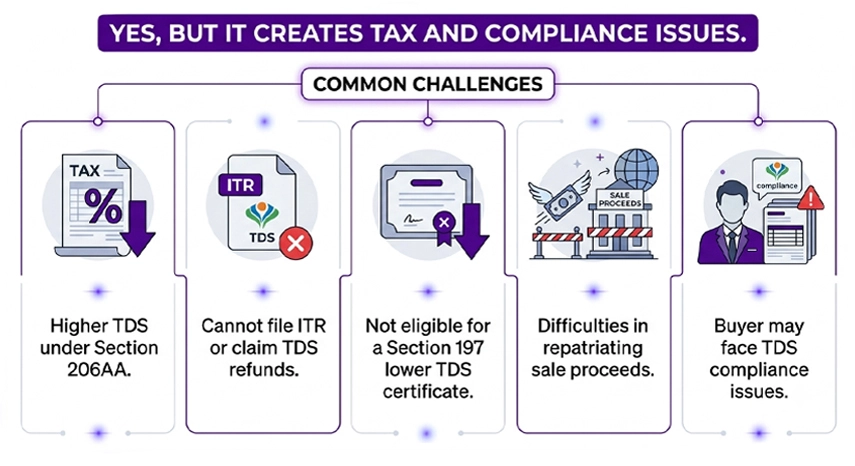
Yes, technically, NRIs can sell property in India without a PAN card. The requirement to quote or furnish PAN during property registration depends on the transaction value, applicable provisions of Rule 114B of the Income-tax Rules, and the requirements of the concerned registration authority. However, not having a PAN creates significant practical, financial, and tax compliance issues for NRIs when selling property in India. Here is what actually happens when you sell property without a PAN:

  • TDS Deducted at Higher Rate Under Section 206AA: Without a valid PAN, you face higher TDS deduction under Section 206AA. The buyer deducts TDS at the applicable tax rate or 20%, whichever is higher. Considering this, for NRI property sellers, TDS is already higher compared to residents under Section 195. Further, NRI property sale TDS without a PAN increases, reducing the received net profit.
  • No ITR Filing, No Refund: Without a PAN card, you won't have a tool to file your tax returns in India and claim any due tax refunds. This means the excess TDS amount stays permanently with the government.
  • No Section 197 Certificate Possible: Under Section 197, you can apply for a lower TDS deduction certificate to match TDS with your actual tax liability. However, without a PAN card, you cannot apply for the certificate.
  • Repatriation Complications: For overseas remittances, Form 15CA and, wherever applicable, Form 15CB are generally required. PAN is typically required for tax compliance and banking documentation, making repatriation more difficult without it.
  • Compliance Issues for the Buyer: The buyer may also face issues in completing their part of the sale transaction. It is because while depositing the TDS to the tax officials, they also need to submit your PAN card.

So, technically, for NRIs, property sale without a PAN card in India is possible, but it creates issues for practical and financial implications for both buyer and seller. Moving ahead, let's know the challenges NRIs face when selling property without a PAN card in India.

Stop Taking Stress Over NRI Taxes

Connect with Savetaxs and simply manage your tax obligations from start to end.

Challenges NRIs Face Selling Property Without a PAN Card

Apart from paying higher TDS, several practical hurdles also arise when an NRI sells a property without a PAN in India. These are as follows:

  • Sub-Registrar Requirements: In India, many Sub-Registrar offices may require PAN or PAN quoting depending on the transaction value and the applicable legal and state registration requirements, which can delay registration if PAN is unavailable.
  • Buyer Resistance: To avoid complications, most buyers and their CAs or lawyers refuse to proceed with the sale further until the seller gives their PAN card. It is because during a property sale, the buyer needs to deduct TDS and deposit it with the government. Without the PAN card of the seller, the buyer faces compliance exposure, and it may further result in walking away from the deal.
  • Loss of Capital Gains Exemptions: Under section 54 (reinvestment in residential property) and section 54EC (investment in specified bonds), you can claim tax exemptions for capital gains. However, to claim the capital gains tax deductions, you need to file an ITR, for which you need a PAN. So, without PAN, you can not opt for these tax-saving options.

These are the challenges NRIs face when they sell property in India without a PAN card. Moving further, let's know the tax and TDS implications for them selling property without a PAN in India.

Tax and TDS Implications for NRIs Selling Property Without PAN

The normal tax and TDS implications for NRIs selling property with PAN include:

  • The long-term capital gains (LTCG) imposed on property held for more than two years is 20% plus surcharge and cess.
  • Short-term capital gains (STCG) on property held for 24 months or less are generally taxable at the applicable Income Tax Slab Rates, along with the applicable surcharge and cess.

The entire situation changed when an NRI sale property without a PAN in India.

Scenario TDS Rate ITR Refund Lower Certificate Tax Exemptions
NRI with PAN 20% LTCG + surcharge + cess Yes Yes, under section 197 Yes, under sections 54 and 54EC
NRI without PAN Higher of applicable rate or 20% No No No

Confused, let's better understand with an example.

For instance, Priya is an NRI living in Canada. In Mumbai, she has an inherited flat worth INR 80,00,000. Additionally, she does not have a PAN card. Now, imagine she sold her Mumbai flat. On the sales, the TDS will be deducted from the total sale price. This could result in more than INR 16,00,000 being deducted upfront. If Priya makes a profit of INR 30,00,000, her actual capital tax gain would be INR 6,00,000.

However, without a PAN card, she cannot file an ITR and cannot recover her additional INR 10,00,000 that was deducted. Apart from this, she also cannot apply for lower TDS and claim any tax exemption after reinvesting the amount. If before selling her flat, Priya had applied for a PAN card, she could get all the tax and TDS benefits. Here, not having a PAN cost her over INR 10,00,000.

This was all about the tax and TDS implications for NRIs selling property without PAN. Moving forward, let's know how to apply for a PAN as an NRI.

How to Apply for a PAN as an NRI?

The process to apply for a PAN card is straightforward and can be completed online without visiting India. Here is how you can do so.

  • Step 1: Visit the NSDL (Protean) or the UTIITSL portal online.
  • Step 2: Select Form 93 if you are an NRI or Form 95 if you are an OCI or a foreign citizen.
  • Step 3: Fill in your personal details such as name, date of birth, overseas address, contact number, and email ID.
  • Step 4: Upload all the required documents. It includes a copy of your passport, overseas address proof, and your DOB proof.
  • Step 5: Pay the applicable fee.
  • Step 6: After cross-verifying all the mentioned details, submit the PAN application form. Additionally, also note down the acknowledgment number you received after submitting the application. It further helps you in tracking your PAN application status.

After online submission, you will receive your PAN within 2-4 weeks. You can also apply for your PAN card through Indian embassies or designated PAN centres available in your country.

Further, it is advisable to apply for your PAN card before starting the property sale process. It provides you with time to get your PAN card on time and reduce your TDS deduction.

So here is how you can apply for a PAN as an NRI. Now, moving ahead, let's know what if you cannot get your PAN before the property sale in India.

What If You Cannot get a PAN before the Sale?

Due to some reasons, a property sale cannot wait, as you get a great deal and the buyer is also ready to pay a favourable amount; however, you do not have a PAN. In such circumstances, here is how you can reduce the damage:
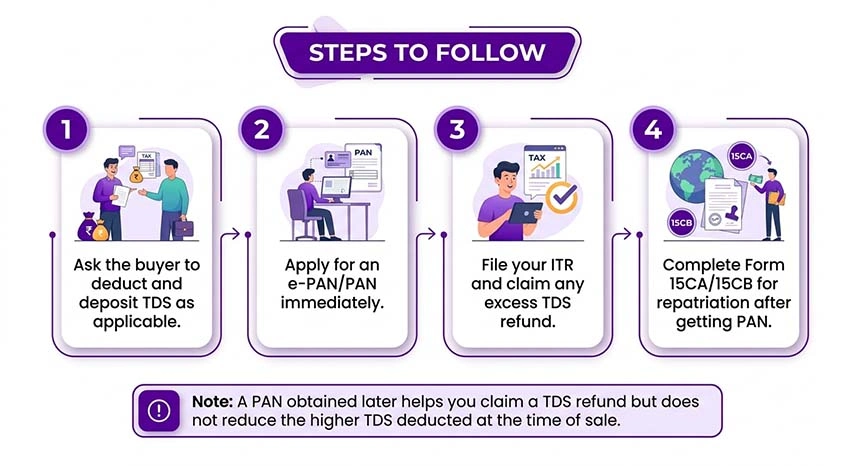
  • Step 1: Tell the buyer under Section 195 to deduct the TDS at the applicable rate and deposit the amount with the tax official. Ask the buyer to comply with the applicable TDS deduction and reporting requirements under the Income-tax Act. If you do not have a PAN, consult a qualified tax professional regarding the applicable compliance requirements.
    You can also submit Form 60. It is a declaration stating you do not have a PAN. However, it does not exempt you from paying higher TDS.
  • Step 2: Apply for PAN immediately on an urgent basis. You can also opt for an e-PAN (digital PAN card). You obtain it within 48 hours of your PAN application submission on your registered email ID. It holds the same legal validity as a physical PAN card.
  • Step 3: Once you have received your e-PAN or physical PAN card, file ITR for the relevant assessment year. Claim the credited TDS and apply for a refund of the excess deducted TDS. Even if the sale has already been made, as long as you file your ITR within the due date or as a belated return, you can claim TDS refund.
  • Step 4: Once you get your PAN card, you can also smoothly proceed further with the repatriation process. For you, your CA can file the correct Form 15CA/ 15CB and instruct your bank to process the overseas transfer.

Although this approach does not resolve the Section 206AA issue at the time of tax deduction. However, it provides you with a way to claim a refund for your excess TDS deduction.

NRI Tax Filing Made Easy

At Savetaxs, we help you file your ITR on time, fix your tax refund delays, avoid tax penalties, and respond to tax notices.

Consult Now!

Final Thoughts

Lastly, an NRI property sale without PAN is technically possible; however, it comes with several issues, such as paying higher TDS, facing issues with sale registration, being unable to claim a tax refund, and more. In simple terms, to claim all these benefits, a PAN card is important for property transactions.

Further, selling property as an NRI can feel daunting, but with the right guidance and preparation. If you need assistance in obtaining a PAN card, connect with Savetaxs and apply for PAN card services. We have a team of experts who help you obtain your PAN card with ease. We can also help you with ITR filing and tax planning in India.

Note: This guide is for information purposes only. The views expressed in this guide are personal and do not constitute the views of Savetaxs. Savetaxs or the author will not be responsible for any direct or indirect loss incurred by the reader for taking any decision based on the information or the contents. It is advisable to consult either a CA, CS, CPA or a professional tax expert from the Savetaxs team, as they are familiar with the current regulations and help you make accurate decisions and maintain accuracy throughout the whole process.

About Author
Shubham Jain
Shubham Jain Founder & NRI Tax Advisor

Shubham Jain is the Founder of SaveTaxs and has extensive experience in Indian and NRI taxation. He advises individuals, NRIs, and businesses on tax filing, tax planning, capital gains, DTAA benefits, fund repatriation, and compliance matters. He regularly writes about taxation and related financial topics. His focus is on making complex tax concepts easy to understand. Through his articles, he helps taxpayers stay informed, avoid common mistakes, and stay compliant with Indian tax laws. See Full Bio

FREE Assistance
NRI Tax Consultation

Get expert assistance with ITR filing, DTAA benefits, and tax compliance in India.

Get Assistance
Recent Post

Want to read more? Explore Blogs

Frequently Asked Questions

When an NRI sells a property in India without a valid PAN, the TDS rate under Section 206AA is a flat 20% on the total sale consideration, plus applicable surcharge and health & education cess.

No, an NRI cannot claim a refund of TDS without a PAN card. It is because a PAN card is strictly required to file an ITR, which is the legal way to claim a TDS refund.

NRIs can apply for a PAN card as an NRI in India online through a government-authorized portal like UTIITSL or Protean (formerly NSDL). The entire PAN application includes submitting the correct form based on your citizenship, paying the global processing fees, and dispatching physical supporting documents.

Under Indian tax laws, if an NRI has no PAN card, the excess TDS remains with the Income Tax Department and can only be recovered by filing an ITR.

Section 206AA of the Income Tax Act mandates that anyone receiving taxable income in India should provide their PAN. If an individual fails to furnish their PAN to the deductor, the payer needs to deduct TDS at a higher rate.