

NRI Returning to India
NRI Returning to India from GermanyNRI Returning to India from Germany
Written by Hatim Dudhiyawala


After living overseas for several years, moving to India is both a financial and emotional milestone for NRIs. But what if you come to India mid-year before settling your overseas income and start working for an Indian company? Does your overseas final settlement and Indian salary attract tax? Many returning NRIs think that, for tax purposes, they will remain a non-resident in India for the entire year.
This is what you may miss. Even if you are an NRI, you are liable to pay tax on income that is taxable in India during that financial year. However, your tax obligation on the final settlement received after returning to India depends on several factors. These include your residential status in India, the nature of the payment, your total income, where you performed the services, and when foreign tax was deducted.
Confused? This blog provides you with complete information on overseas final settlement and Indian salary tax. So read on and clear all your doubts.
There is no simple yes-or-no answer. To determine the correct tax treatment of final settlement received after returning to India, you need to break your payment into separate components and examine each one independently. For instance, your final settlement may consist of:
Combining the above-mentioned amounts in one bank transfer does not mean that, under Indian tax law, they have the same character. In these circumstances, you need to answer the following questions.
To determine salary tax liability, the place of employment services plays a vital role. For instance, if you worked overseas before returning to India, the salary earned from that employment may generally be foreign-source income; its taxability in India depends on your residential status and the applicable receipt and accrual rules. However, if you work for a foreign employer after returning to India, that salary may fall under Indian tax obligations even if you receive it in your foreign account.
With expert guidance from Savetaxs, simply manage your tax obligations in India and stay compliant with Indian laws.
Foreign salary tax for returning NRIs also depends on the due or receipt basis, whichever is earlier. Therefore, the date you receive the salary is not always the relevant date.
The legal entitlement date depends on when you became legally entitled to the amount under your employment contract and applicable records.
First received means where you first got the income. There is a key difference between receiving and transferring money. For instance, if you first receive your foreign salary in your overseas bank account and later transfer that money to India, the money transfer is not considered a fresh receipt of salary.
However, if you directly receive your foreign salary in your Indian account, it may fall under the "receipt-in-India" rule. According to the Indian Income Tax Department, as per applicable rules, the scope of total income depends on the following factors:
So don't decide your tax obligation based only on the country where you performed the job or the bank account where you receive your foreign salary. Now, moving ahead, let's see how your residential status affects your final settlement after returning to India.
Residential status under the Indian Income Tax Department is a key factor in determining whether overseas salary is taxable in India. It remains the same for the whole financial year and does not change after each payment, only because you receive one amount before and another after returning to India.
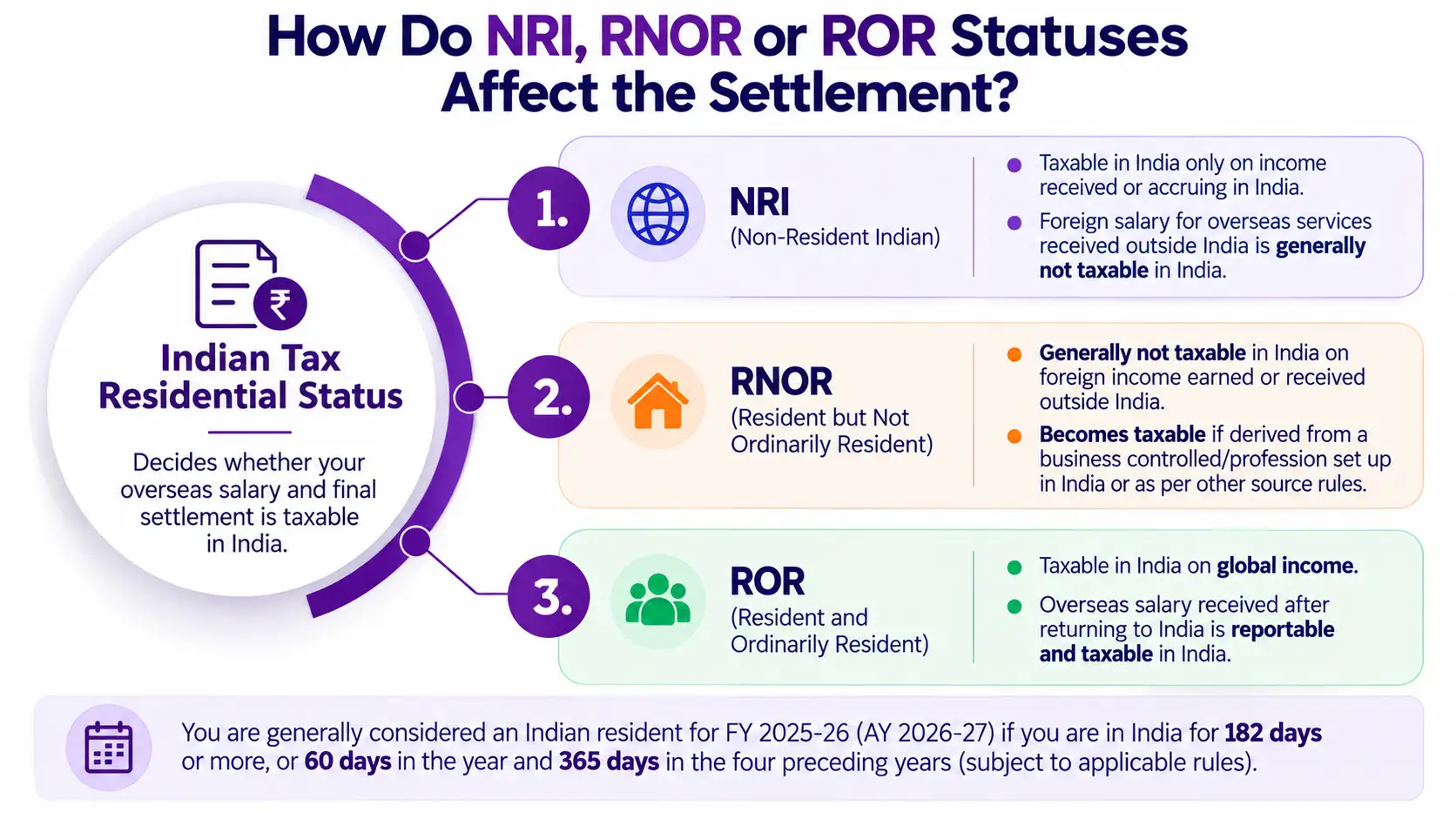
For instance, for FY 2025-26 corresponding to AY 2026-27, you are generally considered an Indian resident if:
If you do not satisfy either of the mentioned conditions for tax purposes, you are considered an NRI. So, before determining foreign final settlement tax in India, first analyze Indian tax residency rules for returning NRIs.
An NRI is generally liable to pay tax in India on the following income:
Usually, for NRIs, foreign salary for services that they performed overseas and received outside India is not taxed in India. However, if you receive foreign salary directly into an Indian bank account, or earn income for services associated with India, the rule may change.
RNOR is a transitional residential category that may apply to NRIs returning to India after living abroad for several years. Depending on your travel history, you may receive RNOR status after returning to India. Under this status, you are generally not liable to pay tax on your foreign income earned or received outside India. However, under RNOR, your foreign income becomes taxable if it is derived from a business controlled or a profession set up in India, or if another source rule applies.
RNOR status and foreign income do not exempt you from paying taxes in India. So review it before excluding any final settlement.
An ROR is liable to pay tax in India on their global income. So, if you hold ROR status, then your overseas salary after returning to India is reportable and taxable in India even when:
Further, if the foreign country also taxes your final settlement, you may be able to claim tax relief under the applicable DTAA or Indian foreign tax credit rules to address double taxation on the same income, subject to the applicable conditions.
The payment date alone is not enough because it does not fully determine your tax obligation after returning to India. Suppose you moved to India in September and received your foreign salary in November. In this situation, you cannot determine the Indian taxability of that income only because you received it outside India.
So the review should consider:
| Basis | Question to Examine |
|---|---|
| Residential status | Your residential status in India during the year you received the income |
| Nature of payment | Is it a salary, gratuity, bonus, leave pay, severance, or reimbursement? |
| Service location | Where did you perform the employment duties? |
| Accrual | When did the amount become due? |
| First receipt | Did you first receive the amount in India or overseas? |
| Foreign tax | Was tax on it deducted or paid overseas? |
So, this is how your residential status affects your foreign employer settlement after relocation. Moving to the next section, let's know the tax treatment of salary, bonus, gratuity and leave encashment.
As mentioned earlier, salary, bonus, gratuity, and leave encashment have different tax treatments in India. With this in mind, when you receive overseas salary after returning to India, provide a complete breakdown.
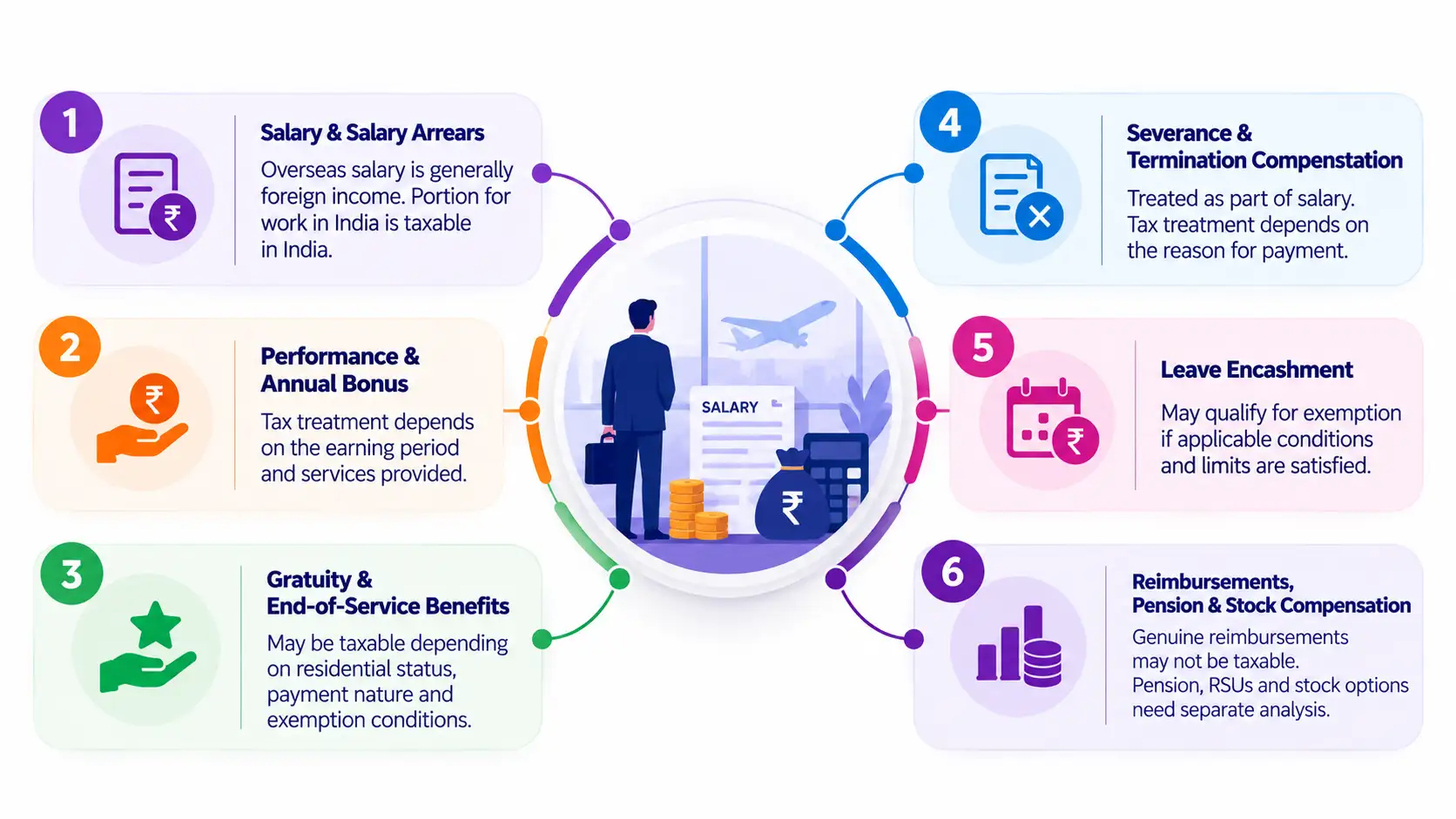
Salary received for work you perform outside India is generally classified as foreign income. Your tax obligation in India depends on your residential status, first receipt, accrual, and treaty rules. If a part of the overseas salary is related to work performed in India, that part is taxable in India even if the employer pays it outside India.
In addition, you also need to consider salary arrears received from a foreign employer, as the amount may also relate to your earlier job period and be due or received in the year you return to India. If salary arrears increase your Indian tax obligation, you may be able to claim tax relief instead of directly exempting that income.
Your bonus should relate to the period earned and the services provided. For instance, the bonus you received after returning to India relates to your overseas income. It has a different basis for analysis from a retention bonus that you received from your job in India. Determining the bonus from the following records can help you:
Further, a delay in receiving the payment does not change the underlying source of the bonus.
Generally, under Indian rules, overseas gratuity and end-of-service benefits may be taxable in India depending on the residential status, nature of the payment, source of income, and applicable tax exemption conditions. Tax exemption on them may depend on the following situations:
Country-specific rules may also impact when you receive the due amount and whether foreign tax applies. For instance, UAE end-of-service benefit should be determined under both the UAE and Indian tax rules.
Severance pay or compensation can also be considered a part of salary. When determining the tax obligation, check why you receive this amount and what employment right it falls under. This is because payments received for loss of employment, contractual termination, or a notice period have different tax treatment. Additionally, where applicable, also evaluate Indian relief for termination compensation.
Payment received for accumulated but unused employment leave may qualify for tax exemption; however, the applicable employment category, statutory conditions and exemption limit should be satisfied. Do not assume the amount is not taxable only because it is stated as "leave settlement."
With that in mind, review the employment category, previous claims, applicable law, amount, and current tax exemption limit.
Supported by bills, a genuine reimbursement of employment expenses may not have the same character as your salary income. However, excess reimbursement, a fixed allowance, or a payment consisting of personal expenses is taxable. To support the treatment, preserve expense reports, do the settlement calculation, and follow employer policies.
You need to do a separate analysis of pension withdrawals, RSUs, retirement account distributions, deferred compensation, and stock options. This is because the tax obligation on them is not the same as your last employment date.
Also, keep the above-mentioned items out of your ordinary salary income calculation until you review the specific exercise, vesting, withdrawal, or payment rules. Next, let us know how Indian salary is taxed after returning.
Salary you received for services you performed in India is taxable in India irrespective of your residential status or whether the employer is an Indian or foreign company. As a result, after returning from overseas, if you start working for an Indian employer, the employer must deduct applicable TDS from your salary based on the applicable salary-TDS provisions. Also, your Indian employer may not know about:
Because of this, the deducted TDS from your Indian salary can be lower or higher than your final tax obligation. With this in mind, you should provide your Indian employer with information about your previous salary and TDS. Even if that information isn't part of your payroll, you are responsible for correctly reporting your taxable income in India. You should also pay any balance tax through advance tax or self-assessment tax, as applicable.
Considering this, keep the mentioned Indian employment documents by your side:
Also, if you are liable to pay tax on your overseas final settlement and Indian salary, do not mention only the amount stated on Form 16.
This is how your Indian salary is taxed after returning to India. Moving forward, let's know about DTAA and foreign tax credit on overseas employment income.
Under domestic laws, you may be liable to pay tax on your final settlement received after returning to India from a foreign country. Also, depending on your residential status (ROR) in India, you may also be liable to pay tax on that income in India. This may result in double taxation of the same income, but relief may be available under the applicable DTAA or Indian foreign-tax-credit rules, subject to the applicable conditions.
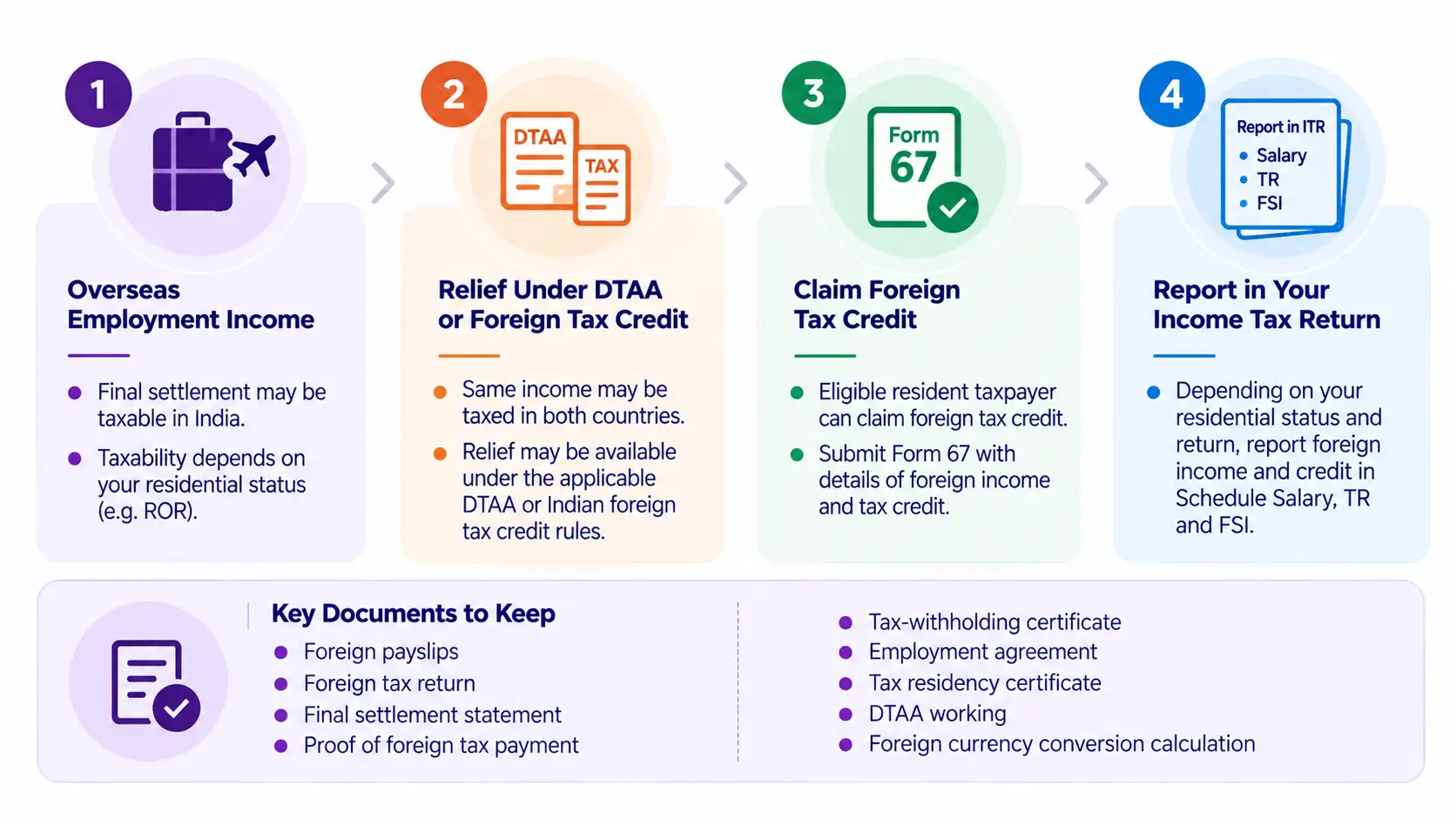
Under the applicable DTAA or Indian tax rules, an eligible resident taxpayer may claim a foreign tax credit for income on which foreign tax has already been paid. If you claim the eligible foreign tax credit in India, you need to submit Form 67. It provides complete information about your foreign income and tax credit.
Depending on your residential status and the tax return, you may need to also report the foreign income and credit in:
To report the foreign income, keep the following information by your side:
For a detailed overview, read our blog on foreign tax credit and Form 67. Next, learn how to report overseas settlement and Indian salary in your ITR.
Before reporting your overseas settlement and Indian salary in your ITR, first determine your residential status and the applicable ITR form. After that, rather than reporting your net credited foreign salary income, do a component-wise reconciliation. Practically, here is how you can do so:
Choose the correct ITR form depending on your income type. If your income type does not include business or professional income, opt for ITR-2; if it does, fill out ITR-3. For more details, read our blog on tax filing for NRIs and returning residents.
Also, don't forget to mention your overseas final settlement, as it may not be fully reflected in the AIS or Form 26AS. Now, moving ahead, let's better understand Indian salary and foreign salary in the same year with an example.
Connect with Savetaxs for personalized guidance and manage your foreign income and tax in India smoothly.
Rahul is an NRI who has lived and worked in the UAE for several years. In the current financial year, he worked in the UAE until 31 August. After that, he returned to India and joined an Indian company on 1 October. In November, he received a foreign employer settlement after relocation, which was transferred to his UAE bank account. It includes the following amounts:
| Component | Amount |
|---|---|
| Outstanding August salary | INR 3,00,000 |
| Performance salary | INR 4,00,000 |
| Unused leave payment | INR 1,50,000 |
| End-of-service gratuity | INR 6,00,000 |
| Expense reimbursement | INR 50,000 |
In addition, between October and March, he also earned INR 12,00,000 from his job in India. In this scenario, Rahul's Indian income is completely taxable in India as it is earned there. However, because of his past travel history, his residential status in India is RNOR. The UAE settlement should be analysed component-wise; if the relevant amounts are foreign-source income earned and received outside India and do not fall within any applicable RNOR exception or Indian exemption/taxability rule, they may generally not be taxable in India.
Lastly, after returning to India, the tax treatment of your overseas final settlement and Indian salary depends on your residential status. This determines whether you are liable to pay tax on your global income or on income that is taxable in India under the applicable residential-status and source rules. In addition, the nature, source, first receipt, and accrual of every settlement also impact your tax obligation. Also, whether your residential status is NRI, RNOR, or ROR determines whether you are liable to pay tax on the income you earned in India during a financial year.
After you return to India, your residential status can change faster than you think. If you need any assistance in managing your foreign income and planning your taxes before returning to India, connect with Savetaxs. Our cross-border and financial experts provide the right guidance based on your financial goals and retirement plans in India.
This article is for general informational purposes only and does not constitute tax, legal, financial, or investment advice. Laws, regulations, rates, and procedures may change over time and may vary based on individual circumstances.
While SaveTaxs makes reasonable efforts to keep the information accurate and up to date, readers should verify applicable rules with official authorities or consult a qualified professional before making decisions based on this information.
Shubham Jain is the Founder of SaveTaxs and has extensive experience in Indian and NRI taxation. He advises individuals, NRIs, and businesses on tax filing, tax planning, capital gains, DTAA benefits, fund repatriation, and compliance matters. He regularly writes about taxation and related financial topics. His focus is on making complex tax concepts easy to understand. Through his articles, he helps taxpayers stay informed, avoid common mistakes, and stay compliant with Indian tax laws. See Full Bio
Want to read more? Explore Blogs