NRI Returning to India
Returning to India from New ZealandReturning to India from New Zealand
Written by Shubham Jain

For NRIs returning to India from Germany, it often looks easy on paper because the country is rule-driven and structured. And this is where they make the mistake. As an NRI, if you are also planning to move back to India from Germany, know that it is not as simple as booking flights and obtaining a visa. You need to meet your tax obligations in the country, review your income and salary, settle your loans, and manage the investments you held there efficiently.
The process doesn't end when you return to India from Germany; it starts. You need to determine your residential status in the country, redesignate or close your NRI accounts as applicable under FEMA rules, fulfill your tax obligations in India, and so on.
Stressed? Don't worry, you are on the right page. This blog provides complete information on how an NRI returning to India from Germany can plan their journey and what they need to consider. So read on and clear all your doubts.
When moving back to India from Germany permanently, you need to fulfill a few legal and practical steps. Some involve public authorities, while others involve contracts and services. The process starts five or more months before you leave and continues until you arrive at your destination.
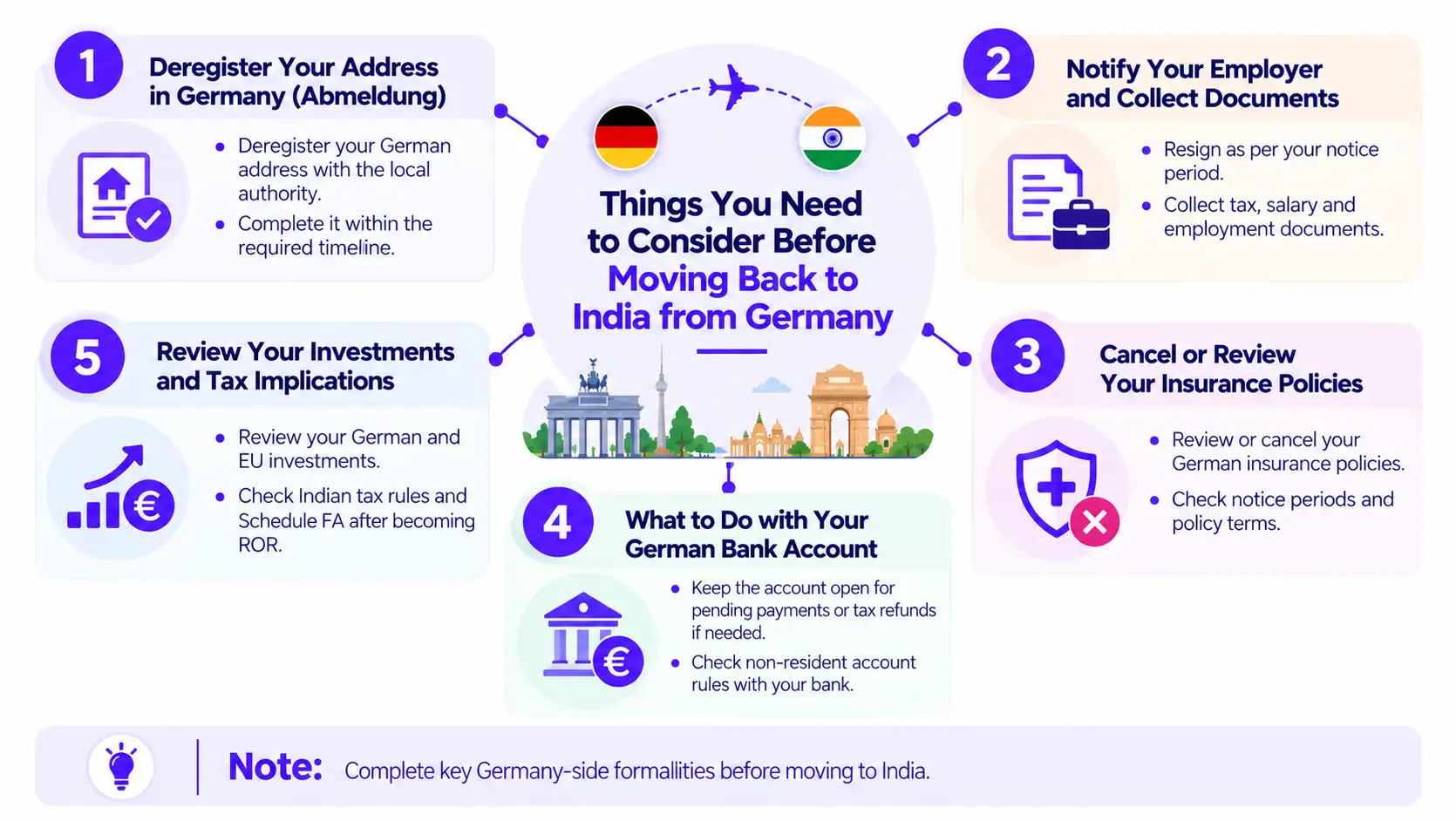
The Abmeldung is an official deregistration of your address in Germany. Under the Federal Registration Act (Bundesmeldegesetz or BMG), you must officially deregister your residential address with your local registration office before leaving the country. You can generally deregister your German address:
If you do not do so on time, you may face an administrative fine of up to €1,000. Additionally, if you are a non-EU citizen, deregistration does not mean your residence permit is canceled automatically. As a result, you should inform the foreign authority of your departure separately. This step may also be useful as supporting documentation when applying for a pension refund.
When leaving Germany, you need to cancel your employment contract according to the applicable notice period under your employment contract, collective agreement, or German law. Submit your resignation (Kündigungsschreiben) in writing and keep one copy for your records.
Additionally, collect the following documents before leaving your job:
If you have unused leave, take it before leaving your job or have your employer pay it out. Also, confirm the bank account where you need to receive your final salary.
When you return to India from Germany permanently, you need to review the insurance policies you held there. Some German insurance policies may need to be cancelled, amended, or transferred when you permanently move your residence outside Germany.
Therefore, under the applicable policy terms, you may need to terminate, amend, transfer, or continue each policy depending on your circumstances. Check the termination and renewal terms of each policy and act according to the applicable notice period. The most common insurance policies include:
NRIs returning to India from Germany should consider whether they need to keep their German bank accounts open for some time after departure. Even after your departure, you may want to keep it open for some time if you are expecting pending payments or a German tax refund. Here is why you should do so:
Additionally, you may be able to close your German bank account by post or through another method permitted by your bank, subject to its requirements. Also, moving abroad may affect your German bank account or the services available to you, as some banks may restrict or close accounts when customers become non-resident. This completely depends on the terms and conditions of the bank where you held the account.
Note down all the German and European assets that you hold before moving to India permanently:
Tell your broker about your change of residence and ask whether they support Indian residents. This is because some German investment platforms may allow you to hold your existing assets but restrict you from purchasing new ones.
Also, once you gain ROR status, your income and capital gains from German investments generally become taxable in India, subject to the applicable Indian tax rules and the India-Germany DTAA. Additionally, once your residential status changes to ROR, you generally need to report your specified German assets in Schedule FA in the applicable ITR form.
This is what you should do before leaving Germany. Now, let's look at what you should do when moving back to India from Germany.
Connect with Savetaxs for personalized guidance based on your tax obligations and residential status in India.
Many NRIs returning to India from Germany consider their departure from the country as the end of their tax obligations there. But that's not the case. You need to consider the following things after you leave the country.
Germany follows the calendar tax year (January to December). However, German tax liability is not determined simply by counting the number of months you stayed in the country. Your German tax status depends on factors such as whether you maintained a residence or habitual abode in Germany and the applicable German tax rules.
There is no general German exit tax for every person leaving Germany. Specific German exit-tax rules may apply depending on your circumstances, including certain qualifying shareholdings and investment-fund holdings.
Additionally, you may be owed a refund. In Germany, assuming you work the whole year, salary tax is withheld during the year. If you left the country mid-year, you may have overpaid in taxes. To get the refund, keep your German bank account open.
If you are an Indian citizen and have made German pension contributions for less than 60 months, you may be eligible for a refund if you satisfy the applicable statutory conditions.
However, you must wait a period before you can claim a refund. Considering this, you can generally apply for a pension refund after a waiting period of 24 calendar months from leaving compulsory German pension insurance, provided the statutory conditions are satisfied.
Before leaving the country, download your Versicherungsverlauf (pension record), which shows your complete contribution history. Also, keep your deregistration certificate (Abmeldebescheinigung) safe, as you'll need it when you submit the application. After the waiting period ends, call the Deutsche Rentenversicherung directly.
Moving back from Germany does not make you a tax resident in India. This depends on your physical presence during the financial year, your past travel history, and other applicable residential-status conditions. To determine your tax residency in India, follow the rules under the Income Tax Act 2025. In India, an individual may be classified as a Resident or Non-Resident, and a resident may further be classified as Resident and Ordinarily Resident (ROR) or Resident but Not Ordinarily Resident (RNOR):
| Indian Tax Residential Status | Calculation | General Indian Tax Scope |
|---|---|---|
| Resident and Ordinarily Resident (ROR) | Resident status is determined under the applicable Indian residence tests, followed by the RNOR/ROR conditions | Generally liable to tax in India on global income, subject to applicable tax rules and DTAA relief. |
| Non-Resident Indian (NRI) | Does not qualify as a resident under the applicable Indian residential-status tests. | Generally liable to tax in India on income received, accruing, or arising in India, subject to the applicable provisions and DTAA. |
| Resident Not Ordinarily Resident (RNOR) | Was a non-resident in 9 out of the 10 preceding tax years or was in India for 729 days or less during the 7 preceding tax years, subject to the applicable conditions. | Generally liable to tax on Indian income and specified foreign income covered by the applicable provisions. |
Use the following things to calculate your residential status after moving back to India from Germany:
For a brief overview, read our blog on the Indian tax residency rules for returning NRIs.
After returning to India, contact your Indian banks where you hold NRI accounts and tell them about your FEMA residential change. Under FEMA, when your residential status changes to resident, your NRE and NRO accounts need to be redesignated or otherwise dealt with as permitted under the applicable rules.
As a result, you need to redesignate or otherwise deal with them as permitted under FEMA. You can redesignate your NRE account as a resident account or transfer the funds to an RFC account, and redesignate your NRO account to a resident account. Additionally, under FEMA, you can keep your FCNR fixed deposit account till its maturity date.
German income generally becomes taxable in India on a worldwide-income basis when you are ROR, subject to the applicable Indian tax rules and the India-Germany DTAA. As an ROR, you must generally pay tax in India on your global income, even if you receive it in an overseas account, subject to the applicable Indian tax rules and the India-Germany DTAA. Common income from Germany that you generally receive after returning to India includes:
Transferring your old German savings to India does not make it taxable. There is a major difference between the transfer and the underlying income. For a detailed overview of foreign salary taxation in India, read our blog on "Overseas Final Settlement and Indian Salary Tax."
This is what you should do after returning to India from Germany. Moving ahead, let's see whether German exit tax applies.
German exit tax does not apply to every returning NRI. It depends on whether you hold qualifying shareholdings or investment-fund interests that fall within the German exit-tax rules. It is a key concern for NRIs like you who hold a qualifying substantial ownership interest in a German company or fall within another covered situation under German law. Considering this, before moving to India, consult a German tax expert if you are:
The tax, rather than an actual asset sale, can be based on a deemed disposal. So, review it before your residency ends in Germany.
Now, moving forward, let's look at how foreign tax credit works under the India-Germany DTAA.
Under the domestic laws of both countries, you may be liable to pay tax in both India and Germany in the departure year. The India-Germany DTAA helps you avoid paying tax twice on the same income in both countries. The tie-breaker treaty factors help resolve overlapping residency. These are as follows:
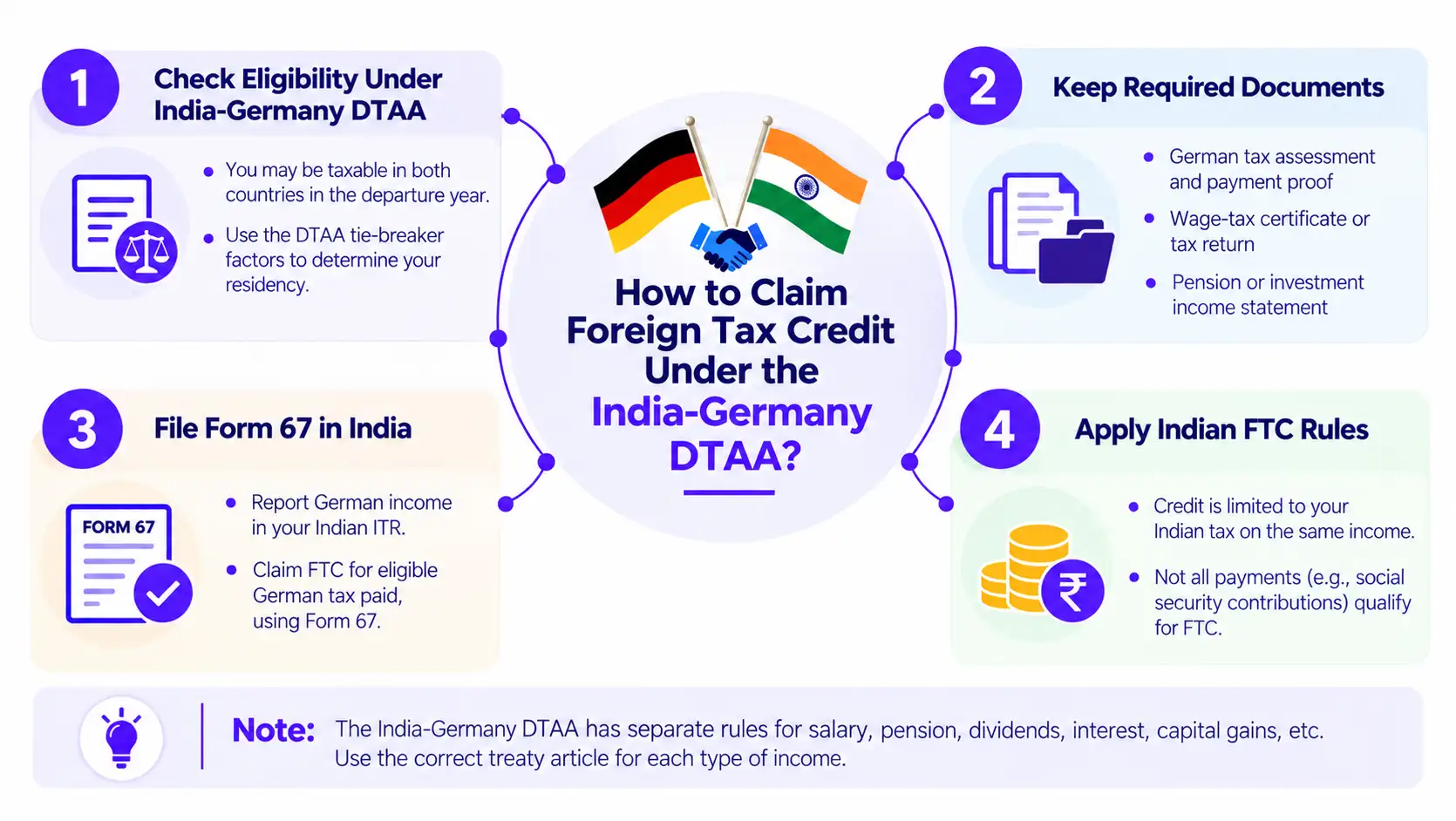
The India-Germany DTAA has separate rules for pensions, salary, government, dividends, interest, government service, capital gains, and other income. So, do not use the same treaty article for every German payment.
For a brief overview, read our guide on the India-Germany DTAA. Further, if you are liable to pay tax on the same income in both India and Germany, you can claim a foreign tax credit (FTC) under the DTAA for eligible German tax paid on the relevant income, subject to the applicable Indian FTC rules. Considering this, to claim the foreign tax credit, you need to keep the following documents by your side:
Additionally, you need to fill out Form 67 to claim the foreign tax credit on German income in India. The credit amount may be restricted to the Indian tax obligation on the same income. Also, you cannot claim the FTC for every payment you make in Germany or for social security contributions.
So, here is how you can claim FTC under the India-Germany DTAA. Moving forward, get a quick overview of the Germany-to-India return plan through a checklist.
Here are the things you need to consider as an NRI returning to India from Germany:
Consider the following things:
| Particulars | What to Do? |
|---|---|
| Complete Abmeldung | Do deregistration of your German address |
| Obtain deregistration certificate | Keep the Abmeldung certificate by your side as proof of deregistration |
| German home | Terminate your German home or document the status of the property or accommodation you retain properly |
| Employer notification | Tell your German employer about your departure and confirm your end of employment date or relocation arrangements |
| Final payroll records | Gather your payroll records, wage-tax documents and other employment-associated papers |
| Bonus, severance & stock awards | Review any pending bonus, employment stock awards, severance payment or other job-related amounts that may be paid after your arrival in India. |
| German tax records | Download and retain your German tax returns, tax assessments, and other associated tax correspondence. |
| Pension contribution record | Before leaving the country, collect your pension records. |
| Future pension rights | Ask Deutsche Rentenversicherung about your eligibility and pension rights. |
| Pension refund | Check your eligibility before requesting a pension refund if you have made German pension contributions for less than 60 months. |
| Insurance | Notify your health insurer and other German insurers about your departure. |
| Bank & brokerage accounts | Ask German banks and brokers whether you can hold your German bank and investment accounts after returning to India. |
| Financial statements | Download bank, pension and investment statements covering your German financial assets and transactions. |
| Company interests | Review substantial interests in Germany or other exit tax exposure before returning to India. |
| Access to German portals | Retain secure access to German tax, insurance, banking, pension and other relevant online portals |
Consider the following things after moving to India from Germany:
| Particulars | What to Do? |
|---|---|
| Record arrival date | Record your arrival date in India and track your subsequent international travel. |
| Determine Indian tax residency | According to your past travel history, present days in India during a financial year, citizenship/PIO status and other applicable conditions, determine your residential status |
| Review FEMA residence | Determine your residential status under the applicable FEMA rules. |
| Indian bank accounts | Notify your Indian banks of any residential status change for NRI accounts. |
| German financial institutions | Update German banks, brokers and insurers with your new residency and address information (where needed) |
| German income | Track your German salary, investment income, pension, rental income and other German-source income you received after departure. |
| Income receipt evidence | Keep records stating where and when you first received the German income |
| Foreign assets and income register | Prepare and maintain a list of your German assets and income |
| India-Germany DTAA | Review whether you are eligible for the India-Germany DTAA |
| Foreign tax credit | Claim FTC under the India-Germany DTAA for eligible German income on which foreign tax has been paid, subject to the applicable Indian FTC rules and documentation requirements. |
| Schedule FA | Once your residential status changes to ROR, report your German assets in Schedule FA |
| Tax year reconciliation | When reporting your German income in the Indian ITR, reconcile the calendar year in Germany with India's financial year |
So, consider this checklist when planning to return to India from Germany.
At Savetaxs, we help returning NRIs manage their foreign investments and tax obligations in India.
Lastly, as an NRI returning to India from Germany, coordinate with the tax rules and regulations of both countries. Before leaving Germany, deregister your address, review your final payroll, pension rights, health insurance, bank accounts, investments, and more. After arriving in India, determine your residential status based on your travel history and the applicable residential-status conditions, and meet your tax obligations in the country.
If you're having trouble planning your return to India from Germany, connect with Savetaxs. Our team of financial and cross-border tax experts will help you manage your investments and tax obligations in both countries. Contact us and plan a smooth return journey to India.
This article is for general informational purposes only and does not constitute tax, legal, financial, or investment advice. Laws, regulations, rates, and procedures may change over time and may vary based on individual circumstances.
While SaveTaxs makes reasonable efforts to keep the information accurate and up to date, readers should verify applicable rules with official authorities or consult a qualified professional before making decisions based on this information.
Hatim Dudhiyawala is a Certified Public Accountant (CPA) with SaveTaxs and specializes in Indian and NRI taxation. He advises individuals, NRIs, and businesses on income tax filing, capital gains taxation, DTAA benefits, fund repatriation, and tax compliance. With experience in cross-border tax matters, Hatim helps taxpayers understand complex regulations and make informed decisions. Through his articles, he shares practical insights to help readers stay compliant and manage their tax obligations with confidence. See Full Bio

Want to read more? Explore Blogs