


Investment & Financial Planning
NRI Property Sale: How to Calculate Capital Gains TaxNRI Property Sale: How to Calculate Capital Gains Tax
Written by Shubham Jain

An NRI can invest in gold in India through Gold ETFs (Exchange-Traded Funds) and Gold mutual funds using their NRE or NRO accounts. Gold ETFs track the performance of gold. It requires a demat and trading account and is traded on stock exchanges, offering high liquidity.
They invest in gold directly by purchasing bullion or futures contracts. Gold ETFs are ideal for investors seeking a convenient, liquid, and low-cost way to gold for portfolio diversification.
On the other hand, gold mutual funds don't need a demat account and can be purchased through easy SIPs, making them suitable for long-term and disciplined investment. A gold mutual fund is an ideal way for investors to invest in gold and diversify their portfolios.
Keep reading this blog to learn more about the differences between gold ETFs and gold mutual funds for NRIs.
Both gold ETFs and Gold mutual funds allow NRIs to invest in gold without actually purchasing physical metal. However, the way both of these operate is different. Here's how:
Gold ETFs are listed on Indian stock exchanges, and you can purchase units just like equity shares. Each unit that you purchase will represent fixed grams of gold, backed by physical bullion.
Follow these steps to invest in gold ETFs for NRIs:
Gold ETFs for NRIs offer several benefits, such as high liquidity, transparent pricing, and negligible price fluctuations.

Gold mutual funds are open-ended mutual fund schemes that invest in gold ETFs as the underlying asset.
Consider the following steps to invest in gold mutual funds for NRIs:
A demat account for NRIs is not required to invest in gold mutual funds. Additionally, the NAV (Net Asset Value) shifts based on the price of gold ETFs after fund charges.
NRIs who are not permitted to open a trading/demat account in their country of residence (USA, Canada, and restrictions at some AMCs), gold mutual funds are a convenient option for them.
Here is a table highlighting the main differences between gold mutual funds and gold ETFs to help you decide which gold investment will suit you better:
| Feature | Gold Mutual Funds | Gold ETFs |
|---|---|---|
| Meaning | Gold mutual funds invest in gold or assets related to gold, like gold ETFs, gold producers, and mining companies. | Gold ETFs are instruments that track the performance of gold. It invests in gold by purchasing bullion or futures contracts. |
| Account Requirement | These funds don't need a demat account. Only an NRE/NRO bank account is needed. | It requires a demat and trading account. |
| Liquidty | It is moderate and can be redeemed after the market closes. | It is highly liquid and is traded at any time during market hours. |
| SIP | You can invest in gold mutual funds through a systematic investment plan (SIP). | You cannot invest in gold ETFs through SIPs as the units of ETF must be bought with a lump sum payment. |
| Costs | Gold mutual funds have higher costs, like entry and exit loads. | No entry or exit loads apply to gold ETFs. However, demat and brokerage charges are applicable. |
| Taxability | Long-term capital gains and taxes applicable to jewelry are charged on gold mutual funds. | These are subject to long-term capital gains and are exempt from VAT and securities transaction tax. |
| Restrictions | Some AMCs (Asset Management Companies) restrict US/Canadian NRIs | Some brokers restrict US/Canada NRIs |
What does this mean for NRIs:
The FEMA (Foreign Exchange Management Act) governs gold investing in India, and NRIs need to adhere to the banking and repatriation rules:
An NRI can invest in gold through:
FCNR deposits are not allowed to buy gold ETFs or gold mutual funds directly. Additionally, you cannot use direct foreign currency for investment; the money must flow through an NRO/NRE account in Indian Rupees.
Investment made to an NRE account can be repatriated without any limits. On the other hand, investment made to an NRO account has a limit on the repatriation amount as well as a tax clearance requirement. (Form 145/146).
Fresh investments from the NRIs in the US/Canada are not allowed by some funds due to the rules of FATCA (Foreign Account Tax Compliance Act). This is applicable more to mutual funds than ETFs.
You can avoid a penalty and keep your investment valid by following the rules of FEMA.
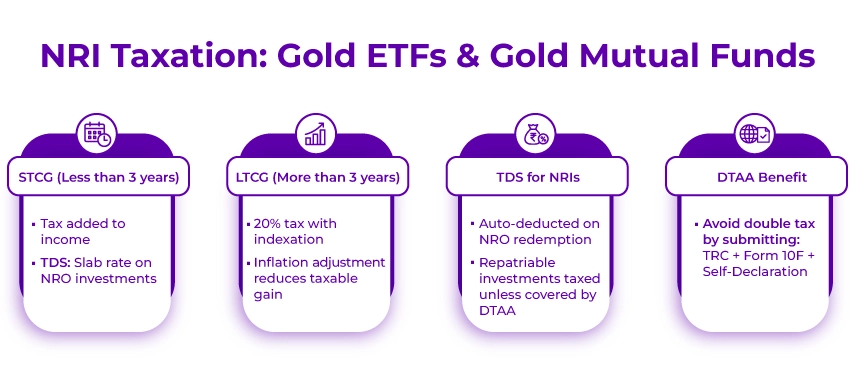
Gold ETFs and gold mutual funds are taxed similarly under Indian laws:
Get advice from the expert while investing in gold in India as an NRI.
Consider the following factors to choose between gold ETFs vs gold mutual funds based on your investment needs:
You should opt for a gold ETF if you are an NRI who:
It is ideal for NRIs staying in the UAE, Singapore, the UK, Europe, and Australia.
Go for gold mutual funds if you are an NRI who:
These investments are ideal for US/Canada NRIs, beginners, and passive investors.
Both gold ETFs and mutual funds offer various benefits appealing to different types of investors. The choice between these two investment options depends on several factors, like your trading style, investment amount, flexibility, and management preferences. Stock market-savvy investors typically get attracted towards ETFs, while gold mutual funds are ideal for investors who value structured and professional management.
If you are still confused about making a choice and the tax obligations associated with the investment. Then, you must seek assistance from an expert at Savetaxs. We have a team of experts who have been serving NRIs with the best taxation consultancy services. You can stay confident with your tax obligations while investing in gold as an NRI in India with the help of our experts. Contact us right away.
This article is for general informational purposes only and does not constitute tax, legal, financial, or investment advice. Laws, regulations, rates, and procedures may change over time and may vary based on individual circumstances.
While SaveTaxs makes reasonable efforts to keep the information accurate and up to date, readers should verify applicable rules with official authorities or consult a qualified professional before making decisions based on this information.
Shubham Jain is the Founder of SaveTaxs and has extensive experience in Indian and NRI taxation. He advises individuals, NRIs, and businesses on tax filing, tax planning, capital gains, DTAA benefits, fund repatriation, and compliance matters. He regularly writes about taxation and related financial topics. His focus is on making complex tax concepts easy to understand. Through his articles, he helps taxpayers stay informed, avoid common mistakes, and stay compliant with Indian tax laws. See Full Bio

Want to read more? Explore Blogs
_1781845771869.webp&w=828&q=75)
_1778936280179.webp&w=828&q=75)