


Investment & Financial Planning
FCNR Deposit Interest Rates in 2026FCNR Deposit Interest Rates in 2026
Written by Vipul Jain


Mutual funds offer diversified portfolio options to NRIs, whereas real estate is a safe investment option for NRIs in India. While both investment options have their different benefits, understanding their details is vital for making the correct investment choice as per your preferences.
Considering this, to help you out, in this blog, we have done a mutual fund vs real estate comparison. It will help you know about the mutual funds and real estate individually, their benefits, and limits. So, read on and choose the right investment option as per your financial goals and preferences.
Mutual funds help NRIs to diversify their investment portfolio by providing the flexibility of choosing across investments from multiple industries and regions. It includes debt, equities, and money market instruments. These investments provide an effective and easy way to invest as per your preferences in several asset classes. Also, these are managed by professionals.
Further, NRIs with some restrictions can invest in most mutual fund categories in India. Considering this, to invest in mutual funds, NRIs need to have an NRE account or an NRO account. Now, let's know the popular investment options available in these funds.
Moreover, some AMCs, due to FATCA compliance requirements, do not allow investments from Canada and U.S.-based NRIs. So before investing in these schemes, it is advisable to check the documents.
Here is the list of benefits NRIs get when investing in mutual funds:
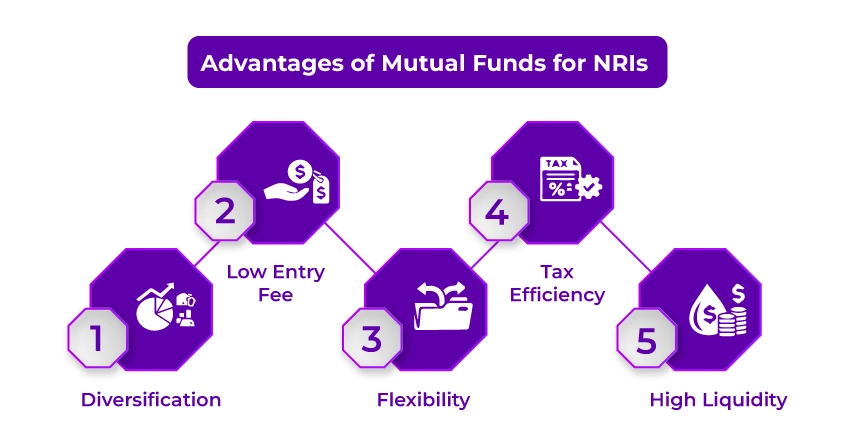
Unlike any investments, mutual funds do have some drawbacks. These are as follows:
So, this was all about mutual funds for NRIs. Now, let's know real estate for NRIs.
With the emotional connection of having a property in their own country, real estate investments always remain a safe investment choice among NRIs. For generations, it has remained a favorable investment option.
However, when people hear "real estate," most of them imagine a house, rent it out, or later sell it for profit. Correct? But it is not so. There are different types of real estate properties in which NRIs can and cannot invest. Confused? Under the Foreign Exchange Management Act (FEMA), NRIs are allowed and not allowed to invest in the following properties in India:
Further, let's know the advantages and disadvantages of investing in real estate for NRIs.
Here is the list of benefits real estate offers to NRIs:
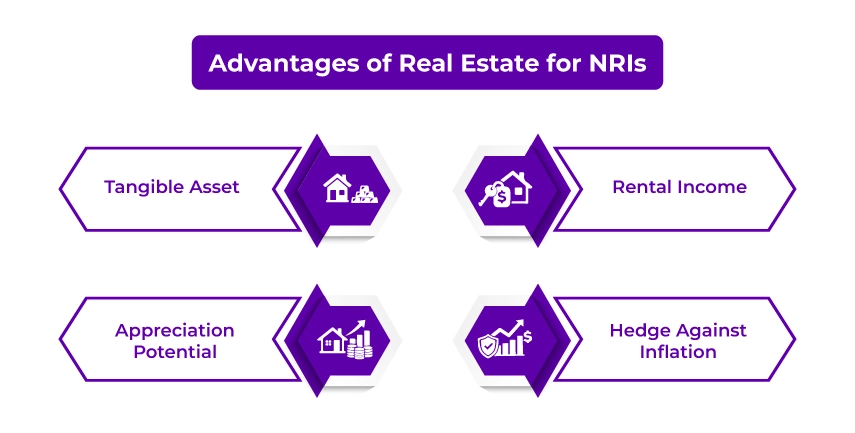
The drawbacks of investing in real estate are as follows:
This was all about real estate investments for NRIs. Now, when you have an understanding of both the funds, let's compare mutual funds vs real estate. It will provide you with an idea of which investment is the best for you.
File your taxes online without any markup and increase your refunds.
Here is the table below that states the key difference between mutual funds and real estate. Read on, clear all your doubts about these investments:
| Basis | Mutual Funds | Real Estate |
|---|---|---|
| Initial Investment Required | The initial investment requirement is very low. Through SIPs generally start with INR 100 | The initial investment requirement is very high. Generally, traditional property costs INR 10,00,000 +, REITs cost as low as INR 100 to INR 500 via the stock exchange. |
| Ease of Entry | Simple, you can invest online via AMC websites or apps in a few minutes. | Traditional property investments require detailed paperwork, whereas REIT investments are easy to invest in online, like stocks. |
| Liquidity | You can redeem the mutual funds partially or fully at any time except for ELSS. | Selling property consumes both effort and time. |
| Returns | Historically, for equity funds, market-linked 10-15% annually. | Dependent on location, generally 7-12% but can vary widely. |
| Risk Level | The risk in mutual fund investments ranges from moderate to high, depending on the fund type, i.e., debt, equity, hybrid, and more. | The investment risk in real estate is high as it consists of regulatory risk, market cycles, and location dependency. |
| Management Effort | Zero effort, as mutual funds are managed by financial experts | Have high management efforts as it needs personal involvement in tenants, maintenance, and legal issues. |
| Diversification | Easy, one SIP provides you the exposure to several bonds and stocks. | Difficult as one property in a single location ties up a large amount. |
| Tax on Short-Term Capital For equity Gains | A 20% tax is imposed on equity funds if sold before 12 months, and debt is taxed as per the income slab rate. | If the property is sold within 2 years of purchase, tax is imposed as per the income tax slab rate. |
| Tax on Long-Term Capital Gains | For equity funds above INR 1,25,000: 12.5% | If the property is sold after 2 years, a 20% tax is imposed with indexation benefits. |
| Regular Income Possibility | Yes, through Systematic Withdrawal Plan (SWP) or dividend plans, regular income is possible. | Yes, through rental income, regular income is possible. |
| Transparency | Very high- regular NAV updates, SEBI-regulated, and portfolio disclosure. | Not always is the low cost transparent. Additionally, black money is still prevalent. |
| Control Over Asset | Low- you do not control specific bonds/ stocks. | High as physical assets are owned and managed by you. |
| Inflation Protection | Against inflation, equity funds provide a good hedge. | Generally, property appreciates with inflation. |
| Leverage (Loan Possibility) | Limited, as getting a loan against mutual funds is possible, however, it is limited in value. | High, as you can use property to get large loans. |
| Ownership Cost | Minimal with an expense ratio between 0.1% to 2.5% exit load if any. | High as it includes stamp duty, property tax, broker fees, registration, and maintenance. |
| Time Commitment | Minimal, as it is managed by professionals. So set and forget with SIPs. | High- from legal matters to tenant issues, have heavy time engagement. |
| Regulatory Oversight | Strong- SEBI-regulated, high transparency, and audited funds | Less robust- regulation is improved by RERA, however, not as centralised. |
| Best Suited For | Beginners, passive investors, and salaried individuals. | HNIs, experienced investors, and people seeking ownership of tangible assets. |
| Ideal for Short-Term Goals | Yes, mutual funds are ideal via liquid or debt funds for short-term capital goals. | Not ideal due to high entry/exit costs and low liquidity. |
| Ideal for Long-Term Goals | Yes, specifically for equity mutual funds for wealth creation. | Yes, if held for several years, specifically in developing areas. |
| Emotional Satisfaction | Low as it is purely a financial product. | High as physical ownership gives emotional security. |
| Legacy and Inheritance Value | Simple to transfer with a demat account or a nominee. | Strong as property has high inheritance and sentimental value in Indian homes. |
This was all about mutual funds vs real estate. Moving ahead, let's know which among the two is the best investment option for NRIs.
When it comes to mutual funds vs real estate, there is no one-size-fits-all answer. Your investment choice depends on your personal connection to India, financial goals, and risk tolerance.
Further, for many NRIs, a combination of both mutual funds and real estate fits better. It is because real estate offers them emotional fulfillment and long-term security. On the other hand, mutual funds provide quick growth and flexibility.
Choose the best investment option as per your financial goals and risk.
Lastly, the mutual funds vs real estate debate will always come down to your financial goals and personal preferences. Additionally, selecting between these two investment options is not about choosing a winner; it is about knowing what aligns with your lifestyle and financial goals.
Furthermore, if you are confused and looking for financial advice, connect with Savetaxs. We have a team of financial advisors who can assist you in selecting the right investment options as per your financial goals and risk appetite.
This article is for general informational purposes only and does not constitute tax, legal, financial, or investment advice. Laws, regulations, rates, and procedures may change over time and may vary based on individual circumstances.
While SaveTaxs makes reasonable efforts to keep the information accurate and up to date, readers should verify applicable rules with official authorities or consult a qualified professional before making decisions based on this information.
Vipul Jain is the Co-Founder of SaveTaxs and a tax expert with experience in Indian and NRI taxation. He advises individuals, NRIs, and businesses on tax filing, tax planning, capital gains, DTAA, and compliance matters. He focuses on making complex tax concepts simple and helping taxpayers make informed, compliant decisions. See Full Bio

Want to read more? Explore Blogs
_1781845771869.webp&w=828&q=75)
_1778936280179.webp&w=828&q=75)
_1778936089630.webp&w=828&q=75)
There is no single best investment option for an NRI in India, as it totally depends on your financial goals, risk, and tax rules in your resident country. Considering this, popular investment options for NRIs include: