
NRI Income Tax Compliance
How to Claim Excess TDS Refund After Selling Property in India as an NRIHow to Claim Excess TDS Refund After Selling Property in India as an NRI
Written by Shubham Jain
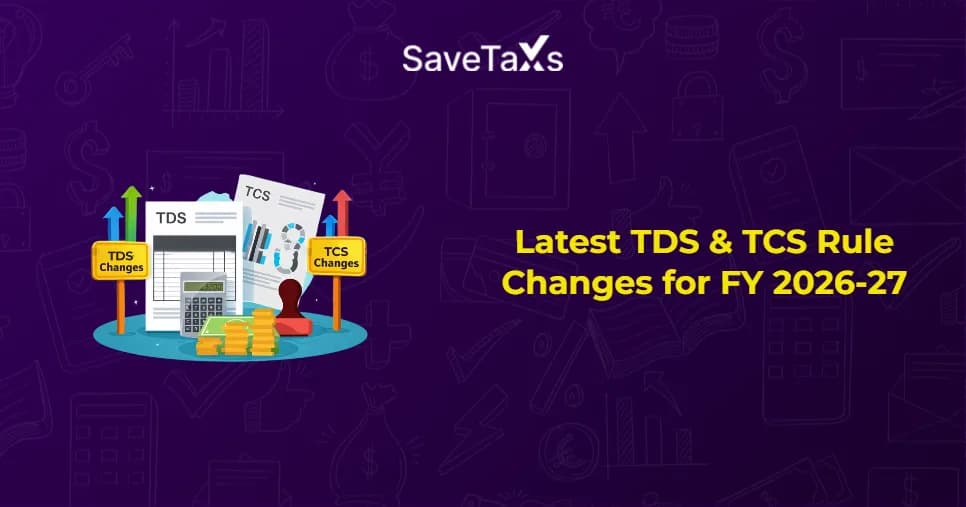
The TDS and TCS framework in India has changed from April 1, 2026. And the change is not just in small ways, as the Income Tax Act 2025 has restructured the TDS provisions from the ground up. Furthermore, the section numbers are changing, forms are being restructured and renamed, the Assessment year is being replaced by the Tax Year, and, in some cases, even the TAN is being phased out in favor of PAN.
If you are an NRI, a salaried employee, or a business owner in India, understanding these TDS and TCS changes from April 1, 2026, is important, as they directly affect how tax is deducted, reported, and filed in India.
In this guide, we will explain the TDS and TCS changes from April 1, 2026, so you know exactly what to expect and what to update before the deadline.
The following are the TDS and TCS changes from April 1 2026:
The new Income Tax Act 2025 has restructured the TDS provisions into three broad categories.
Every FVU code has been reassigned. Ensure you update your ERP and TDS software before filing the first quarterly return for the Tax Year 2026-27. The old section codes filed for the new year will trigger the validation errors.
Starting April 1, 2026, there is no assessment year, as the concept of tax years is introduced. The tax year equals the financial year. For example, income received in TY 2026-27 is reported in the ITR for TY 2027-28. Ensure that the ERP, returns, and documentation are updated to reflect the new reference.
Until April 2026, Form 16 was the annual TDS certificate for salaried employees. The form has now been changed to Form 130 in line with the new TDS rules. Form 16A is now known as Form 131. Likewise, Form 27D becomes Form 133. The content and the structure of the forms are, however, largely unchanged.
Ensure that your payroll teams and the HR issue the accurate form number for the upcoming tax year. Any certificate issued as Form 16 for the year 2026-27 will be noncompliant.
The supply of manpower services is now exclusively covered as work in line with the new TDS rules aligned to Section 194C. The TDS rates are: 1% where the payment is made to a resident individual or HUF; 2% for all others.
If you are missing out on deducting the TDS on manpower supply invoices, correct that for April 1, 2026.
The interest awarded by the Motor Accident Claims Tribunal (MACT) to a natural person is now completely exempt from Indian income tax. There is no need to deduct TDS on such interest payments. Previously, the Rs 50,000 threshold did not apply. The entire amount is exempted. Legal payors and insurers must likewise update their payment systems.
The process for obtaining a lower- or nil-deduction certificate is being automated under the new TDS compliance framework. The new system applies preferred eligibility rules based on the past tax filing and projected liability. This way, lower- or nil-TDS certificates can be granted automatically when the criteria are met, without any manual intervention by the officer.
This enhancement helps enterprises process large volumes of vendor LDC applications each year by significantly reducing backlog.
Section 400(2) of the Income Tax Act 2025 has been revised to reflect the binding nature of the Central Board of Direct Taxes guidelines for both tax authorities and deductors. This clause was accidentally omitted from the new law draft.
From April 1, 2026, the CBDT circulars related to TDS and TCS, including Section 194R prerequisites rules and Section 194S virtual digital assets, must be followed compulsorily. They are no longer considered just advisory guidelines.
Form 3CD, the tax audit report, has been replaced by Form 26 under the new Act. Furthermore, the TDS/TCS disclosure, which was Clause 34 in the old form, now spans Clauses 49, 50, and 51 and includes a dedicated Schedule.
Another significant change is in the new equivalent of Clause 34(b), which now requires:
Now, for large enterprises and organizations with thousands of TDS transactions across different sections, filing TDS returns and providing exact counts of underreported transactions requires accurate system-level tracking rather than human review. You cannot do it manually at the end of the year.
As an enterprise, you must build system evaluation tracking into your TDS workbench as soon as possible, before March 2027.
This is a big change in which quantitative accountability replaces qualitative declarations in tax audits.
Under the new TDS rules under Section 194IA, when an Indian resident buys immovable property from a non-resident, TDS must be deducted and deposited using the buyer's PAN rather than the seller's TAN. Previously, the buyer needed to register the TAN just for this transaction, but that requirement has now been removed under the new TDS/TCS rules. In a nutshell, this is a direct compliance relief for buyers dealing with an NRI seller in high-value commercial or residential property deals.
Note: For transactions under Section 194IA, a separate return form is still required. It is not reported in Form 140 (the new Form 26Q).
The following table demonstrates the several TCS categories that now carry a flat 2% rate.
|
Category |
Old Rate |
New Rate |
|---|---|---|
|
Alcoholic liquor |
1% |
2% |
|
Scrap |
1% |
2% |
|
Coal, lignite, and iron ore |
1% |
2% |
|
Tendu leaves |
5% |
2% |
|
LRS - medical and education |
5% (above the threshold of Rs 10 lakh) |
2% |
|
Overseas tour packages |
5% up to Rs 10L/ 20% above |
Flat 2% |
For the overseas tour package, the new TCS rate is a flat 2%, which completely removes the earlier slab structure. The 20% rate above the Rs 10 lakh threshold was a real operational pain point for corporate booking group tours and travel agents, and it is now gone.
From April 1 2026, the filing window for TDS/TCS correction statement is reduced to two years from the end of the financial year in which the original statement was due.
The following table shows the penalties for TDS & TCS non-compliance.
|
Default |
Consequence |
|---|---|
|
Failure to deduct the TDS |
In such a case, the interest at 1% per month from the date of deductibility. |
|
TDS deducted but not deposited |
Interest at 1.5% per month. |
|
Late filing of TDS return |
Rs 200 per day |
|
Non-deduction of applicable TDS |
Expense disallowed in the deductor's tax calculations. |
|
Ignoring the binding CBDT guidelines |
Reassessment risk and potential penalty proceedings. |
The non-deduction results in an expense disallowance, which is a P&L risk, not just a compliance issue. The risk directly matters to CFOs and the tax heads of large enterprises.
Use the following checklist to ensure that you are compliant and ready for the new TDS and TCS rules.
Connect with Savetaxs and receive personalized assistance for your NRI tax obligations.
The TDS and TCS changes from April 1, 2026, under the Income Tax Act 2025 are more than just a renaming exercise. The forms are being replaced or restructured, the number of sections is changing, the concept of tax year is being replaced with assessment year, and TAN is being phased out for individual deductors.
As an NRI, the tax compliance framework gets stricter, and the penalty provision remains unchanged. Henceforth, getting the transaction right from April 1, 2026, is far less costly than correcting your defective return or responding to TDS notices.
Moving forward, if you are unsure about how these changes apply to your specific situations, Savetaxs is the name to trust. We have a team of qualified CA who understands NRI cross-border taxation and will consult with you on your specific situation.
Connect with us as we serve our clients 24/7 across all time zones.
This article is for general informational purposes only and does not constitute tax, legal, financial, or investment advice. Laws, regulations, rates, and procedures may change over time and may vary based on individual circumstances.
While SaveTaxs makes reasonable efforts to keep the information accurate and up to date, readers should verify applicable rules with official authorities or consult a qualified professional before making decisions based on this information.
Vipul Jain is the Co-Founder of SaveTaxs and a tax expert with experience in Indian and NRI taxation. He advises individuals, NRIs, and businesses on tax filing, tax planning, capital gains, DTAA, and compliance matters. He focuses on making complex tax concepts simple and helping taxpayers make informed, compliant decisions. See Full Bio
Want to read more? Explore Blogs