

NRI Income Tax Compliance
Repatriable Meaning: Understanding Repatriable Funds and Money TransfersRepatriable Meaning: Understanding Repatriable Funds and Money Transfers
Written by Shubham Jain

Foreign Direct Investment (FDI) and Foreign Institutional Investment (FII) are two types of investment in India that contribute to the country's economic growth. Both forms of foreign investment bring capital inflows from outside India; however, they differ in their investment styles, objectives, nature, and economic impact.
In this blog, we will understand the clear difference between FDI vs FII, what they mean, what particulars they differ on, the advantages and disadvantages of each investment type, and more.
FDI stands for Foreign Direct Investment, and it refers to an investment made by an individual, company, or NRI that invests directly in assets and businesses in another country with the intent to acquire long-term control or significant influence over their operations.
Foreign direct investment goes beyond just buying shares and waiting for the returns. It moreover involves actively participating in the business aspect, such as setting up a factory, acquiring a company, forming a joint venture, or establishing a wholly owned subsidiary.
The Foreign Exchange Management Act (FEMA) regulates FDI incentives in India, and the Department for Promotion of Industry and International Trade (DPIIT) administers them. Based on the investment sector, FDI is permitted either via the automatic route or the approval route, which requires clearance from the relevant government ministry.
An example of FDI investment involves taking a long-term interest in a business, which generally means owning a significant stake, such as 10% or more, in a company or setting up a subsidiary or joint venture, or acquiring an asset in India.
Some other common examples of FDI in India are:
Savetaxs helps NRIs file their ITR in India with expert guidance and 100% compliance.
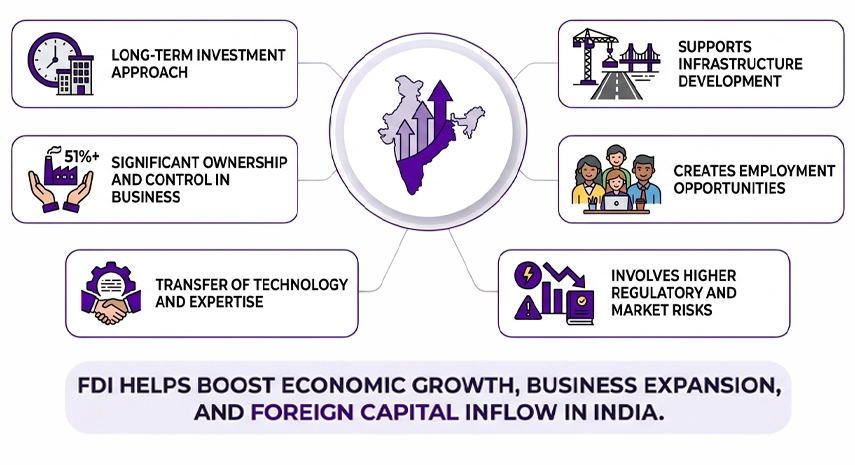
The following are the features of Foreign Direct Investment in India:
FII stands for Foreign Institutional Investors, which refers to investments made by foreign institutions in India. Such investments are made in Indian financial products, including mutual funds, hedge funds, pension funds, stocks, and debentures in both the primary and secondary markets.
With respect to FII investments in stocks, bonds, and other financial instruments, a medium- or short-term horizon is suitable for capturing trend changes in the country. Unlike FDI, the FII does not invest any indirect control or ownership of the business. It is a purely financial investment aimed at generating returns from market movements.
Following the SEBI regulatory overhaul in 2014, the DII has largely been replaced by the Foreign Portfolio Investment (FDI). Although FII still remains the widely used term, the concept is similar.
Some of the common examples of FII in India are
The following are the features of the foreign institutional investment:

Short-term Investment: Generally, the FII seeks a short-term investment horizon to capitalize on market movements. They make medium- to short-term investments and usually adjust their holdings in line with market trends.
The following table clearly demonstrates the difference between Foreign Direct Investment vs Foreign Institutional Investment.
| Factors | FII (Foreign Institutional Investment) | FDI (Foreign Direct Investment) |
|---|---|---|
| Meaning | FII is a type of short-term investment in the financial assets and stocks of a foreign country, made solely for capital gains and without management control. | FDI is a direct, long-term, physical investment in a foreign country by a company or an individual to establish a business presence or acquire management control. |
| Investment entry and exit | Easy to enter and exit. | Difficult to enter and exit. |
| What does it bring? | Long/Short-term capital | Long-term capital, technology, resources, strategies, and know-how. |
| Economic growth | Yes | Yes |
| Outcomes | Helps enhance the country's capital. | Helps enhance the country's GDP. |
| Target | There is no such specific target; investment flows into the financial markets. | Targeted investment in a certain company. |
| Control over a company | Investors have no managerial control or influence. | Investors have higher control and influence over the company. |
| Nature | Typically short- to medium-term investments. | Long-term investment commitment. |
| Objective | Earning a financial return and diversification of the portfolio. | Establishment of technology transfers, operation, and market expansion. |
| Focus | Investment in securities such as bonds, stocks, and derivatives. | Investment in physical assets such as buildings, factories, and infrastructure. |
| Influence | Influences market trends, asset prices, and liquidity over time. | Such investments directly impact the host country's economy, job creation, and technology transfer. |
| Investment Horizon | Short investments with flexible entry and exit. | Long-term commitment. Here, the investments span several years or decades. |
| Regulatory Framework | These are managed by the financial market regulations, including the reporting requirements. | Subject to foreign ownership regulation and the approval for investment processes. |
| Risks | Prone to market risks, volatility, and potential capital outflow. | These investments carry risks from political, regulatory, and economic factors in the foreign country. |
| Examples | A US foreign institution is investing in the bonds and stocks of an Indian company. | A UK multinational corporation establishes a manufacturing plant in India. |
| Tenure of Investment | Generally short to medium term in nature. | Long term. |
| Targeted Investment | No specific company is targeted. | Investments in a specific company. |
| Investee company benefits | Capital infusion | Benefits like strategic insights, technology, and operational know-how. |
| Ease of the investment | Easy to enter and exit the market. | Challenging to enter and exit due to intricate regulations. |
| Impact of Investment | Improves the capital of the nation's businesses | Boosts the GDP and the economic development. |
| Transfer of control or influence | No influence or control over the company. | Influence or control is transferred to the investor. |
The following are the advantages of Foreign Direct Investment (FDI):
The following are the disadvantages of foreign direct investments:
The following are the advantages of Foreign Institutional Investment (FII).
The following are the disadvantages of a foreign institutional investor (FII).
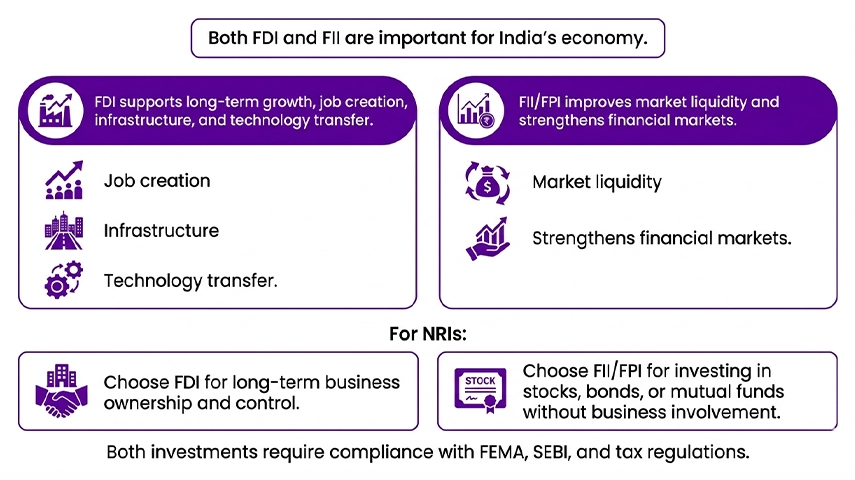
Both FDI and FII play distinct but certainly significant roles in India's economic development. The FDI aims at building the real economy, jobs, factories, exports, and technology. It is the foundation of long-term industrial growth. The FII builds financial market infrastructure and provides liquidity, helping make the Indian financial market competitive.
Talking for NRIs, specifically if you want to participate actively in an Indian business with long-term control intent, FDI is the appropriate framework for you.
Further, if you want to invest in Indian financial instruments, such as stocks, mutual funds, or bonds, through a registered entity without operational involvement, an FPI (a modern equivalent of an FII) is the appropriate framework.
Both the FDI and FII require compliance with FEMA, SEBI, and applicable tax treaty provisions.
Get expert consultation from Savetaxs cross-border NRI business experts to ensure seamless operations.
Understanding the difference between the FDI and FII is essential for investors investing in India. The FDI offers long-term stability, tangible economic contributions, and operational control, but it also comes with regulatory complexity and limited liquidity. The FII, on the other hand, offers flexibility, liquidity, and easy market access, but it does bring limited indirect economic impact and market volatility.
There is no one-size-fits-all kind of answer here. Overall, the right choice depends entirely on your investment objective, time horizon, risk tolerance, and the level of involvement you want in the Indian economy.
As an NRI getting through these investment options, particularly when FEMA compliance, Indian tax obligations, and repatriation rules are involved, consulting a qualified advisor with expertise in cross-border investments is strongly advisable before committing your capital. Such an expert is Savetaxs. We have an expert team of FDI and FII portfolio managers and investment bankers providing end-to-end consultation on conducting in-depth financial research, analyzing cross-border capital inflows and outflows, and ensuring you maintain regulatory compliance for foreign investment.
Furthermore, the experts provide consultation on analyzing market opportunities for you, building validation models, tracking the macroeconomic indicators, and consulting you on long-term strategic investments and short-term portfolio allocations.
Connect with us as we serve our clients 24/7 across all time zones.
This article is for general informational purposes only and does not constitute tax, legal, financial, or investment advice. Laws, regulations, rates, and procedures may change over time and may vary based on individual circumstances.
While SaveTaxs makes reasonable efforts to keep the information accurate and up to date, readers should verify applicable rules with official authorities or consult a qualified professional before making decisions based on this information.
Vipul Jain is the Co-Founder of SaveTaxs and a tax expert with experience in Indian and NRI taxation. He advises individuals, NRIs, and businesses on tax filing, tax planning, capital gains, DTAA, and compliance matters. He focuses on making complex tax concepts simple and helping taxpayers make informed, compliant decisions. See Full Bio
Want to read more? Explore Blogs