
NRI Income Tax Compliance

DTAA Between India and Thailand

Hatim Dudhiyawala
Updated on: July 6, 202612 mins Editorial Standards
India-Thailand DTAA

The Double Tax Avoidance Agreement (DTAA) is an agreement signed between India and Thailand to avoid double taxation on the same income. The India-Thailand DTAA applies to individuals, NRIs, and business earnings in both nations. So, if you earn income in both countries, the DTAA helps you to pay taxes in one country and offset what you owe in the other country. 

The DTAA between India and Thailand can be described as a framework for bilateral economic relations between these two countries. It provides a clear mechanism for eliminating double taxation, boosting trade and investment, and simplifying tax obligations among taxpayers. 

Want to know more about the India-Thailand DTAA? This blog provides complete information about the agreement, from its meaning to TDS rates and capital gain taxation. So read on and know all about it. 

Key Takeaways
  • The India-Thailand DTAA helps taxpayers and businesses to avoid paying taxes on the same income twice in both countries.
  • The DTAA establishes maximum TDS rates for specific income categories in the country where the income is generated.
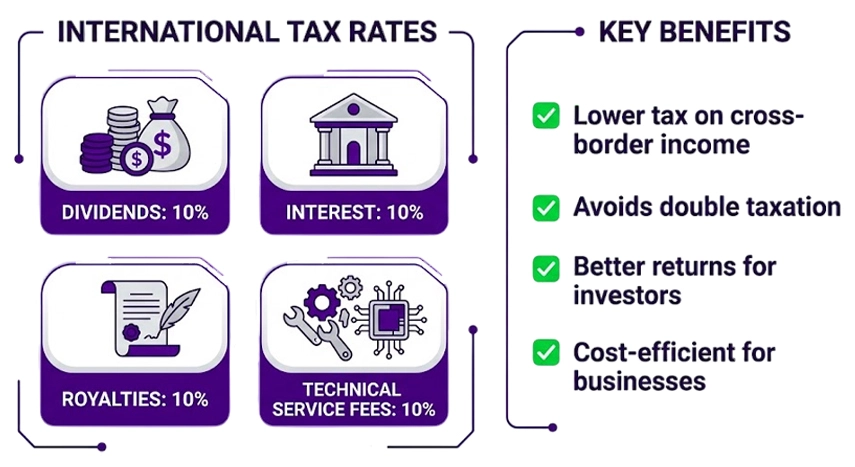
  • Under the DTAA between India and Thailand, dividends, interest, royalties, and technical service fees are subject to a 10% TDS.
  • There are specific tax rules for capital gains and employment income under the DTAA between India and Thailand. 
  • NRIs can also claim tax credits or reduce TDS by submitting proper documentation in both countries.

What is Double Taxation Avoidance Between India and Thailand?

The Double Tax Avoidance Agreement between India and Thailand was signed on July 29, 2015, and came into force on October 13, 2015. Since then, the agreement has been of considerable significance, mainly in trade and investment and cultural exchange.

Additionally, the India-Thailand DTAA applies to businesses that are operated by the residents of the contracting states or both contracting states. Apart from this, NRIs are also eligible to claim tax credits under the DTAA or reduce TDS by submitting the mandatory documents in both countries. The agreement includes several income types such as dividends, business profits, capital gains, interests, royalties, and more. The key objective of the agreement is to simplify the taxation of income between the two countries to prevent tax evasion. 

This was all about the Double Taxation Avoidance Agreement between India and Thailand. Moving ahead, let's know the significance of the agreement between the two countries. 

Significance of DTAA for Both Countries

From an economic point of view, the India-Thailand DTAA is a vital agreement for both nations. It helps in the following ways:

  • Boosts Bilateral Trade: The first thing that the agreement does is to remove the double taxation barrier. It further helps in promoting the chances of more trade between the two nations.
  • Promote Foreign Direct Investment (FDI): The agreement benefits both nations as it offers tax benefits and encourages foreign investors to invest in them. Additionally, it has been seen that with the introduction of DTAA, Indian and Thai companies have gotten easy access to invest in each other's nations.
  • Improves Competitiveness: Reducing the tax burdens under the DTAA helps in cutting down the expenses of corporations, boosting their ability to compete in the global market.
  • Facilitates Technology Transfer: The exchange of knowledge and technology has been made possible by royalties and fees for technical services between the two countries. 
  • Supports Economic Growth: The DTAA between India and Thailand plays a vital role in making a favourable business environment and in the economic development of both countries.

Apart from the economic impact, the agreement has also strengthened the diplomatic ties between the two nations. Here is how:

  • Showcase Mutual Trust: The DTAA proves the finance and taxation aspects between the two governments.
  • Provides a Structure for Dialogue: It states how the tax authorities of two countries will work and communicate with each other.
  • Encourages Cultural Exchange: By simplifying the tax issues, the agreement helps in the growth of tourism, people-to-people contacts, and student exchange. 

Furthermore, the agreement also provides several legal and administrative advantages:

  • Legal Certainty: The DTAA between India and Thailand states the legal means of solving common disputes regarding tax issues between the two nations.
  • Reduced Compliance Burden: Under DTAA, taxpayers get an easy compliance process and, for some income types, get the possibility of lower tax rates.
  • Streamlined Procedures: The agreement allows standard tax methods of providing mutual assistance and information in tax matters. It further helps in boosting the administrative effectiveness. 

This is why the India-Thailand DTAA has significance in both countries. Moving further, let's know the taxes covered under the agreement. 
Taxes Covered Under DTAA

Taxes Covered Under DTAA

The taxes covered under the DTAA between India and Thailand are as follows:

  • For Thailand
    • Income Tax: It includes the general income tax imposed on citizens and resident companies.
    • Petroleum Income Tax: It is a tax that is imposed on the income generated from the petroleum business in the country.
  • For India
    • Income Tax: It includes any additional charges on income tax.
    • Wealth Tax: Although, from 2015, the wealth tax is not currently in force, it was mentioned in the DTAA between India and Thailand. 

Furthermore, the agreement also includes other similar taxes that may be introduced in the future by one or both of the countries after the execution of the DTAA. This clause in the agreement is stated to save the tax systems of both nations from changing to agree with each other. 

Now, moving ahead, let's know the India-Thailand DTAA tax rates. 

India-Thailand DTAA Tax Rates

One of the key benefits of the India-Thailand DTAA is the introduction of low taxation on some income types. The applicable DTAA rate depends on the treaty conditions and beneficial ownership requirements.. 

  • Dividends: Under the DTAA provision, dividends are subject to 10% TDS paid by a company of one contracting states to the other contracting state. Compared to domestic tax rates in both nations, this rate is low, and it is further beneficial for cross-border investors. 
  • Interest: The agreement states that interest income is subject to 10% TDS in the country where it is generated and where the income owner is a resident of the other contracting state. This accommodation includes interest from bonds, securities, or debentures.
  • Royalties: On gross payment, royalties are subject to 10% tax, while technical service fees are subject to 10% fixed tax in the income source country. This includes the act of paying for any patented, planned, copyrighted, trademark, secret formula, or process to be used or have the right to use. 

These lower tax rates are beneficial for individuals, NRIs, and businesses engaged in cross-border activities. Here is how they help them in cross-border activities:

  • The lower taxation rates offer businesses more investment, more efficiency at less cost.
  • Additionally, for artists or authors who receive royalties from another country, the reduced tax rates save a lot of amount. 

This was all about the India-Thailand DTAA tax rates. Moving further, let's know the taxation on capital gains under this agreement. 

Taxation on Capital Gains Under DTAA

An essential factor of the DTAA between India and Thailand is the taxation of capital gains, as it impacts the asset transfer and investment between the countries. Considering this, the agreement provides specific tax rules for different types of capital gains:

Income from Immovable Property

Capital gain generated from the sale of immovable property is taxable in the country where the property is located. This applies to the following:

  • Land and buildings
  • Fixtures and fittings of land and buildings
  • The right to receive either fixed or variable payments for the mineral deposit and other natural resources. 

For instance, an NRI holds a property in India, and the capital gains arising from its sale are taxable in India as per the DTAA on NRI property income. This DTAA provision certifies that the country where the property is located has the first right to tax the capital gains arising from the sale of such property, irrespective of the residency of the seller.

Capital Gains from Shares

The taxation on capital gains arising from the shares depends on the nature of the shares. Considering this:

  • If the shares are held more than 50% directly or indirectly in real estate in one of the contracting states, then capital gains arising from such are taxable in that nation. 
  • In the case of other shares, the capital gains are generally taxed in the resident country of the company that issues the shares.

This DTAA provision is specifically vital for investment in business real estate and aims to reduce the use of holding companies to avoid taxes.

Capital Gains from Other Moveable Property

For movable property forming part of the business assets of a permanent establishment, the profit generated from the sale of such property is taxed in the country where it is located. 

Capital Gains from Ships and Aircraft

Capital gains arising from the sale of aircraft or ships used in movable property or international traffic are taxable only in the effective management of the business enterprise where it is located.

Other Property Gains

The capital gains arising from other property gains that are not mentioned above are taxable in the residence country of the taxpayer.

These DTAA benefits on capital gains help the taxpayers in the following ways:

  • These provisions provide clarity on where the capital gains arising from a particular asset will be taxed, helping investors to make the right decisions.
  • Additionally, by allocating taxing rights between the two nations, they prevent double taxation on capital gains. 
  • Apart from this, they may also influence investment structure, specifically in real estate investments. 

This is how capital gains are taxed under the DTAA. Moving forward, let's know the employment income taxation under the agreement. 

Employment Income Taxation Under DTAA

The employment income taxation under DTAA between India and Thailand is vital for individuals working temporarily in another country. Considering this:

  • General Rule (Taxable Where Work is Performed): Income generated from employment is taxable in the country where the employment is physically located.
  • The "183-Day Rule":  Income remains taxable in the resident country of the employee if they fulfill three specific conditions.
    • It includes the presence of the employee in the host country for not more than 183 days during a financial year.
    • The salary received for work performed by an individual in a country other than their resident country, and the payment is received from the employer who is a resident of that country.
    • Additionally, the wages are not for any permanent or temporary location the employer has in another country. 
  • Benefit for Short-Term Assignments: This 183-rule is highly beneficial for short-term assignments or business trips, as the employee will be exempt from paying tax in the host nation for that temporary work. 

So, this is how, under the DTAA between India and Thailand, employment income is taxed. 

Looking for a Trustworthy NRI Tax Filing Platform?

Connect with Savetaxs, and get personalised tax assistance as per your tax obligations.

Talk to an Expert!

Final Thoughts

Lastly, the India-Thailand DTAA works as a mechanism that helps in strengthening the economic relations between the two countries and eliminates the risk of tax evasion. Through laying down specific taxation rules for different income types, NRI DTAA benefits provide tax relief and prevent double taxation for NRIs, investors, and individuals with international income.

Furthermore, for NRIs, it may be complex to manage global tax compliance and secure the treaty benefits, which require tax expert guidance. The experts at Savetaxs help in simplifying the complexity of the DTAA between India and Thailand tax claim process. From obtaining the tax residency certificate (TRC) to form filing, we help at every step of the process. So, connect with us and simplify your tax journey in India. 

Note: This guide is for information purposes only. The views expressed in this guide are personal and do not constitute the views of Savetaxs. Savetaxs or the author will not be responsible for any direct or indirect loss incurred by the reader for taking any decision based on the information or the contents. It is advisable to consult either a CA, CS, CPA or a professional tax expert from the Savetaxs team, as they are familiar with the current regulations and help you make accurate decisions and maintain accuracy throughout the whole process.

About Author
Hatim Dudhiyawala
Hatim Dudhiyawala Certified Public Accountant (CPA)

Hatim Dudhiyawala is a Certified Public Accountant (CPA) with SaveTaxs and specializes in Indian and NRI taxation. He advises individuals, NRIs, and businesses on income tax filing, capital gains taxation, DTAA benefits, fund repatriation, and tax compliance. With experience in cross-border tax matters, Hatim helps taxpayers understand complex regulations and make informed decisions. Through his articles, he shares practical insights to help readers stay compliant and manage their tax obligations with confidence. See Full Bio

FREE Assistance
NRI Tax Consultation

Get expert assistance with ITR filing, DTAA benefits, and tax compliance in India.

Get Assistance
source bage
Recent Post

Want to read more? Explore Blogs

Frequently Asked Questions

The India- Thailand DTAA is a tax agreement that helps individuals, NRIs, investors, and businesses to avoid double taxation on the same income when doing cross-border transactions. 

Residents of India or Thailand, including NRIs and businesses earning income in the other country, can claim the DTAA benefits. The DTAA benefit is subject to eligibility and tax residency conditions.

Under the India-Thailand DTAA, the dividends and interest income are generally taxed at 10%, depending on treaty conditions.

The DTAA prevents double taxation, helps in claiming foreign tax credit on paid taxes, promotes cross-border investments, and provides tax clarity to NRIs and businesses operating between Thailand and India.

Yes, capital gains are taxable under the India-Thailand are taxable depeds on the asset type and its location. For instance, capital gains generated from immovable property are generally taxed in the country where the property is situated.