




US Tax Forms
IRS Form 8962 for NRIs: Premium Tax Credit and APTCIRS Form 8962 for NRIs: Premium Tax Credit and APTC
Written by Shubham Jain
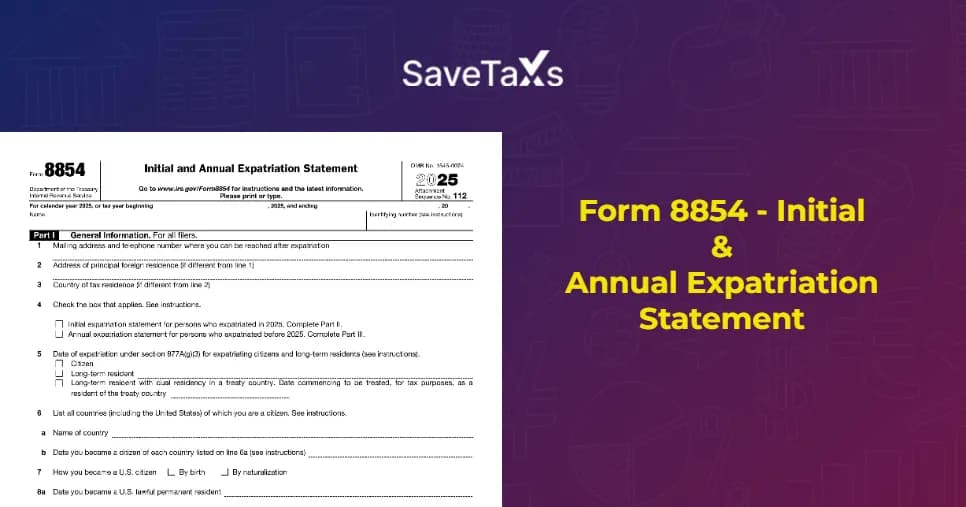
When you are in the process of giving up your US citizenship or surrendering your Green Card, please know that this is not just an immigration decision. It is beyond that; it's a tax event. And the IRS requires you, as the taxpayer, to formally document this using IRS Form 8854.
This form is legally mandated for anyone who expatriates from the United States, whether by renouncing citizenship or abandoning permanent residency. Missing it or filing this form incorrectly has serious repercussions. For NRIs who have held a green card for years before they plan to return to India immediately, Form 8854 is the last but most important US tax obligation you need to fulfill.
Form 8854 helps the government confirm that you have settled all of your tax obligations. Further, it determines whether you are classified as a covered expatriate; if you fall into this category, you must pay an additional tax.
In this guide, we will understand expatriation and Form 8854 (Initial and Annual Expatriation Statement).
Form 8854, officially known as the "Initial and Annual Expatriation Statement, " is a form that formalizes your departure from the US tax system. This form is applicable to two groups:
U.S. citizens, those who have relinquished their citizenship (through renouncing their citizenship at a US embassy, voluntary relinquishment of nationality, or loss of citizenship under specific conditions).
Long-term residents (the lawful permanent resident who holds a Green Card for some time between 8 and 15 years) who are terminating their residency in the United States.
The Form 8854 does three things: first, it certifies your tax compliance; second, it calculates your total net worth and determines whether or not you owe the exit tax. Even if you owe nothing, filing Form 8854 is still required to formally end your US tax obligations. Without filing Form 8854, you may face penalties and may be unable to certify compliance with the expatriation rules, which can affect your covered expatriate status.
With respect to who needs to file Form 8854, it is generally understood that it is US citizens who renounce their citizenship and long-term permanent residents, that is, green card holders who abandon their status. This is the definition that catches many NRIs off guard: if you received your Green Card in 2010 and formally surrendered it in 2025, you have held it for more than 8 years. You are a long-term resident for US tax purposes, and Form 8854 is mandatory.
Who does not need to file Form 8854:
Savetaxs helps you settle your US tax obligations with 100% compliance and under the guidance of an expert CPA.
Your covered expatriate status determines whether or not you owe the exit tax. You are a covered expatriate if you are able to satisfy any one of the tests at the time of expatriation.
| Test | 2025 Threshold | 2026 Threshold | Details |
|---|---|---|---|
| Net Worth Test | $2 million or more | $2 million or more | Not needed for inflation; includes all worldwide assets valued as if they were gifts. |
| Tax Liability Test | Average annual net income tax exceeds $206,000 | Average exceeds $211,000 | Average of the five tax years before the expatriation after the foreign tax credits (FTC). |
| Compliance Test | Cannot certify five years of compliance | Same | Failing to certify that you have met all federal tax obligations for the five years before expatriation. |
Important: The compliance test is one of the most overlooked and easiest to fail. If you have even one unfiled return, missed FBAR, or even one unpaid balance during that five-year lookback period, you are not eligible to certify compliance. This automatically makes you a covered expatriate, keeping aside your net worth of tax liability.
The following are the steps to file Form 8854. Before completing the Form 8854, gather the following.
Personal & Status Information
Asset Valuation Information (For covered expatriates)
The fair market value of all worldwide assets as of the day before expatriation; this includes your real estate in India and the US, investment accounts, retirement accounts, business interests, and personal property.
Adjusted tax basis (cost basis) for every asset, needed to calculate the unrealized gain.
Values that are related to your deferred compensation, pension entitlements, and any interests in non-grantor trusts.
Tax compliance documentation:
You must attach Form 8854 to your financial year income tax Form 1040 or 1040-NR. Your final return includes income from January 1 through the date of expiration; after that date, you are a non-resident for the remaining year.
Furthermore, send a copy of the completed Form 8854 to the
Internal Revenue Service.
3651 South Interregional Highway 35.
Austin, TX 78741.
The Internal Revenue Service (IRS) will need the specific copy in addition to the one in the attachment to your final year's tax return. Failing to do so may result in consequences.
The Form 8854 is filed with your federal income tax return for the year that encompasses your expatriation date. For many people expatriating in 2025, meaning.
| Situation | Filing Deadline | Where To File |
|---|---|---|
| Filing with your final Form 1040 or Form 1040-NR | Due date of your return (April 15, 2026, or June 15 for those abroad, with extensions to October 15) | Attached to your return. |
| Separate Copy Required | Same Due Date | Mail to: Internal Revenue Service, 3651 S IH35, MS 4301AUSC, Austin, TX 78741. |
For most expatriates, Form 8854 is a one-time filing event completed in the year of expiration and is never needed again.
However, if you are classified as a covered expatriate and continue to receive a specific type of deferred income after expatriation, you shall file Form 8854 annually for each year the income is received.
Type of income that may need annual Form 8854 filing:
These situations are way less common but quite important, especially for NRIs who have held a significant balance in a US 401(k) or an IRS account and elected to defer tax on those amounts rather than treating them as immediately distributed at expatriation. If any of the aforementioned is applicable to you, your annual Form 8854 filing continues until those deferred amounts have been fully taxed.
Filing Form 8854 does not automatically trigger the exit tax, but it is how the IRS determines whether the exit tax applies.
For each asset category, the exit tax calculation differs.
The existing tax exclusion applies to all assets combined, not separately to each asset. It is a single lifetime exclusion that applies to the total estate, not to per-asset exemptions.
The penalty for failing to file Form 8854 (or filing it with incorrect information) is $ 10,000 every year unless you can demonstrate the failure was because of a reasonable cause and it was not a willful neglect.
Beyond the direct penalty, there are broader consequences.
Sunita is an Indian professional who obtained her US Green Card in 2012 and worked in California until 2023. She formally surrendered her Green Card by filing Form I-407 in January 2024, after holding it for almost 12 years, thereby making her a long-term resident.
Her net worth at the time of expatriation was approximately $1.4 million, below the $2 million threshold for a covered expatriate. Her average annual US income tax for the first five years was approximately $45,000, well below the $201,000 threshold.
The question was the compliance test. Sunita's US CPA discovered that she had not filed Form 8938 (FATCA) for two of the prior five years despite holding the NRE and NRO accounts in India that exceeded the reporting threshold. This means she could not cleanly certify full five-year compliance on Form 8854, which would make her a covered expatriate by default, subject to the exit tax on her worldwide assets.
To fix this using the IRS streamlined Foreign Offshore Procedure, her CPA files the missing Form 8938 returns. This is a compliance program for non-willful failure to file Form 8854. One of the five-year compliance records was corrected, and Sunita filed her full compliance on Form 8854 and was not qualified as a covered expatriate. No exit tax is applicable.
The lesson here is that the five-year compliance certification is not just a formality. Missing FBAR Form 8938 or any other required U.S. return in the five years before the expatriation directly affects your exit tax exposure, and correcting it before filing the Form 8854 is always the right sequence.
The following are the common mistakes to avoid when filing Form 8854. Watch out for these:
Savetaxs helps NRIs with end-to-end NRI tax consultation.
Form 8854 is a formal close of your U.S. tax chapter, and how you complete this form will decide whether you exit the U.S. tax system cleanly or carry costly obligations forward.
For NRIs who have held a Green Card for 8 or more years before returning to India, this form is non-negotiable. The three covered expatriate estates- net worth, income tax, and tax compliance are all binary, meaning meet any one of them and the next taxation may be applicable, whereas the compliance test in particular catches the people who are never intended to expatriate without proper planning.
The right approach here is to complete your five-year compliance audit first, get a proper asset valuation before your expatriation date, and file the Form 8854 on time with your final return. Then send over the standable copy to Autin and work with a US CPA experienced in expatriation tax well before formally surrendering your Green Card or renouncing citizenship.
Savetaxs CPAs will help you end-to-end with expert guidance to file Form 8854, including data collection, balance sheet preparation, covered expatriate testing, statement assembly, and filing coordination. Connect with us as we serve our clients 24/7 across all time zones.
This article is for general informational purposes only and does not constitute tax, legal, financial, or investment advice. Laws, regulations, rates, and procedures may change over time and may vary based on individual circumstances.
While SaveTaxs makes reasonable efforts to keep the information accurate and up to date, readers should verify applicable rules with official authorities or consult a qualified professional before making decisions based on this information.
Vipul Jain is the Co-Founder of SaveTaxs and a tax expert with experience in Indian and NRI taxation. He advises individuals, NRIs, and businesses on tax filing, tax planning, capital gains, DTAA, and compliance matters. He focuses on making complex tax concepts simple and helping taxpayers make informed, compliant decisions. See Full Bio
Want to read more? Explore Blogs


_1786539671275.webp&w=828&q=75)