


US Tax Forms
IRS Form 8962 for NRIs: Premium Tax Credit and APTCIRS Form 8962 for NRIs: Premium Tax Credit and APTC
Written by Shubham Jain
The IRS Form 6252: Installment Sale Income Form is used to report the income earned from selling a property with installment payments, allowing the taxpayer to disperse their capital gain over multiple tax years. Now, if you are an NRI living in the United States, planning to sell a property and structuring a deal so that the buyer of the property ends up paying you the capital gain in several years instead of clearing the payment all at once, then Form 6252 is your pick to report your capital gains to the IRS.
If you look at Form 6252 from a broader perspective, it is actually a useful tool to spread your overall tax bill. However, for NRIs, there is one detail that cannot be missed: FIRPTA withholding, and it does not spread out as your income from a property sale does.
For NRIs, understanding how installment reporting works along with the FIRPTA withholding rules is essential to have a smooth and well-planned property sale in the USA. In this blog, we will understand how Form 6252 works and what the NRIs' specific complications are that they need to figure out during the process.
The simple answer is that Form 6252, Installment Sale Income, is an IRS form used to report income from the sale of personal or real property under an installment agreement.
The installment sale works when at least one payment from the property disposition is received after the tax year ends. However, an installment sale generally does not include the personal property dispositions of a person who frequently sells the same type of property. Dealer dispositions and property held primarily for sale in the ordinary course of business generally do not qualify for installment reporting.
The form helps in computing the taxpayer's overall gross profit percentage at the time of the sale. This same percentage is then applicable to each property payment the taxpayer received in the upcoming tax year. This helps to determine whether it is a taxable gain or a tax-free return to your original investment.
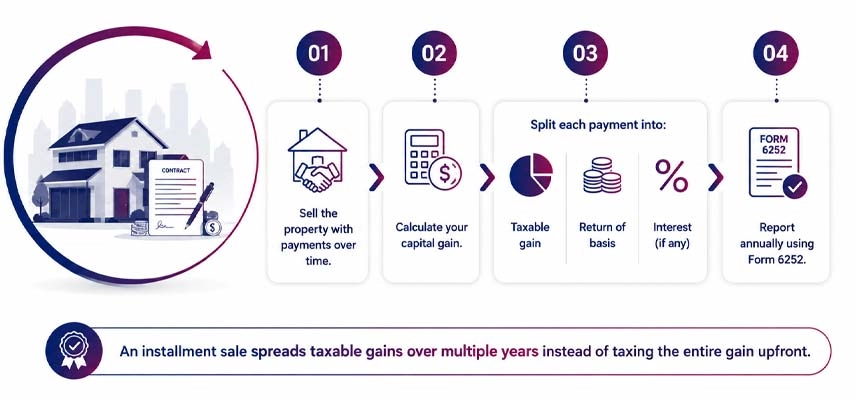
Well, in layman's language, an installment sale simply means that the buyer of the property is obliged to pay you over time rather than paying in one lump sum at the time of closing. This is commonly done through a promissory note with respect to the scheduled payments, a few times with the seller acting as the lender.
The installment sale tax mechanism works in the following way.
You need to compute your overall capital gain on the sale by doing the sale price minus your adjusted basis and the expenses incurred while selling the property.
You compute your gross profit percentage by dividing your gross profit by the contract price.
Each of the payments that you have received will be split using your gross profit percentage. In that a part is the taxable profit, part is the tax-free return of your basis, and part of it is the interest income, if applicable, which is taxed separately.
You need to report this breakdown every year on Form 6252, as long as the payment is not settled.
This disperses your overall tax liability into different tax years rather than accumulating it in one year of sale. This will help you lower the effective tax rate, as the lump sum gains will likely put you into the higher tax bracket.
Savetaxs helps NRIs file their US tax returns with complete 100% compliance.
As a taxpayer, you are eligible to file Form 6252 at any point in time you realize that the capital gain on the property is subject to the installment method. You are not required to file this Form if the property does not provide you with a gain, even though its payments are received in the following tax years. In this case, a business needs to report the sale using IRS Form 4797.
That aside, Form 6252 is not required to report the sale of securities and stocks traded over-the-counter or in any established market. Such sales must be treated as if they were received in the same tax year in which the sale was made.
Nonresident aliens selling qualifying U.S. real property through an installment sale may use Form 6252 if the installment method applies.
You will file this form in the year you are making the sale to establish your gross profit percentage, and then in every following tax year you receive the payment, where you will report the gain portions of that year's collection.
The following are the sales qualified for Installment reporting:
The following are a few sale categories that are definitely excluded from installment reporting.
The only formula to compute the installment sale income for NRIs is quite simple if you have all the right inputs in hand.
Gross Profit Percentage = Gross Profit ÷ Contract Price.
From there on, for every payment that you received in the subsequent tax year:
Taxable Gain For The Year = Payments Received (excluding the interest) * The Gross Profit Percentage.
For instance, if your total capital gains from the sale are around $200,000, and the total proceeds of the contract are $ 500,000, then your gross profit percentage after the right computation will be around 40%. In case you received a $50,000 payment, which is only the residual in a given tax year, the $20,000 of that is taxable gain, and the remaining $30,000 will be the tax-free return of your basis.
Any kind of interest that is charged on the installment note needs to be separately. Ensure that it is not reported as part of the gain calculations; instead, it will be reported as ordinary interest income. As it does not get any plus point for the more favorable treatment that is applicable to the gain portion.
The following is all the necessary information that you will need to file Form 6252.
You will need
The filing process for Form 6252 is that you need to file the form as part of your yearly US federal tax return. To file the US return, use Form 1040-NR if your residential status in the US is that of a nonresident alien or Form 1040 if you are a resident alien or a citizen of the United States. Now the gain that is computed on your Form 6252 will flow to the appropriate part of your federal tax return. However, this will depend on the sold property type, and it will be reported on Form 4797, Schedule D, or on another applicable schedule.
The deadline for filing Form 6252 is the same as that of your regular tax return due date every year. Just ensure that you file Form 6252 along with your annual federal tax return and within the applicable due date. If you qualify for extensions, you may use it to file the federal tax return and the form.
Another thing is that you will continue filing the form annually for every tax year in which you have received the payment under the installment note and not just in the year of sale.
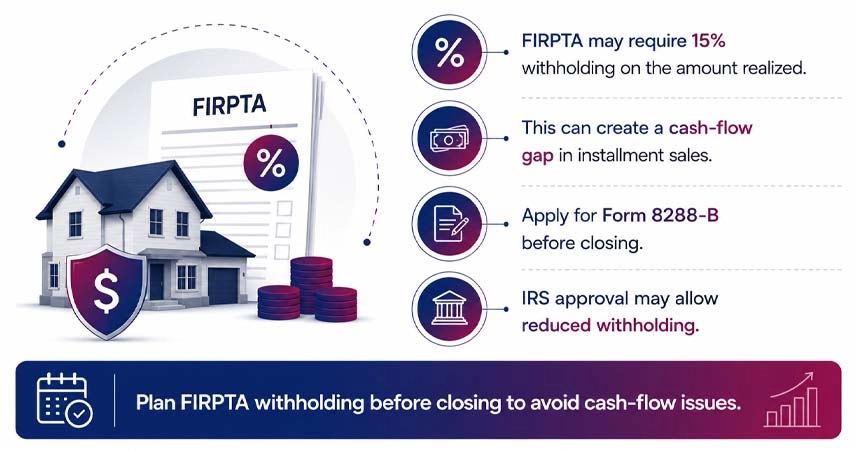
For NRIs, it is one of the most important things to understand before they plan to structure a deal for any US property sale as an installment sale. The FIRPTA Foreign Investment in Real Property Tax Act states that the buyer is required to withhold 15% of the full amount of the sale realized, not just the capital gain, and not just the cash paid at closing. Further, the buyer is generally required to withhold 15% of the amount realized unless a statutory exception applies or the IRS approves a reduced withholding certificate.
With respect to the standard FIRPTA regulatory framework, the 15% withholding is applicable to the complete amount that's upfront realized, regardless of whether you receive that money now or over multiple tax years through an installment note.
In simpler terms, this can mean the withholding obligations at closing surpass the actual cash the seller received in year one, creating a cash-flow mismatch.
The solution to this is to apply for the certificate of withholding using Form 8288-B before the property sale closes. If you are using the installment sale method under Section 453, the form lets you request a reduced FIRPTA withholding rate based on the taxes you are actually expected to owe, since you received the overtime payments instead of withholding tax on the entire sale amount upfront.
Now, if the IRS happens to approve your requests, the buyer is obliged to only withhold the approved amount. Depending on the installment agreement and applicable tax rules, interest may also be required or recognized separately from the installment gain.
Every coin has two sides; similarly, Form 6252 has some definitive benefits but also a few limitations to understand.
Ashutosh is an NRI based out of Delhi; he sold his rental US property for $600,000. However, he agreed to a seller financing arrangement in which the buyer of the rental property would pay over five years. $350,000 is his original cost basis after adjusting for depreciation; this gives Ashutosh a total gain of $250,000, and the percentage of gross profit is around 42%.
Initially, Ashutosh thought that the installment payments meant that he only owed the tax and had to face the withholding on the smaller annual payments that we will actually receive every year. However, Ashutosh's tax advisor who has its expertise in US property tax for NRIs, flagged that under the standard FIRPTA regulatory framework, the buyer of the property will still be required to withhold 15% of the entire realized amount, which is $600,000 at the closing, unless Ashutosh applies in advance for a withholding certificate using Form 8288-B and requests a lower withholding tied to his installment property sale under Section 453.
Luckily, after hearing the tax advisor's advice, Ashutosh filed Form 8288-B well before the closing, providing all the important details of the installment terms and his applicable tax liability tied to each year's payment. With the approved certificate, the withholding at the closing was lower to better align with the tax due under the installment structure rather than the entire amount being upfront. As the payments started to come in each tax year, he began filing Form 6252, reporting the taxable gains portion for each installment on his Form 1040-NR. Ashutosh's case highlights why, for NRIs, it is extremely important to plan the FIRPTA withholding certificate process in accordance with the installment sale structure well in advance, and not as an afterthought once the property deal is already closed.
The following are the common filing mistakes NRIs end up making:
Savetaxs provides you with expert US-India tax strategy and filing orientation.
The IRS Form 6252 is an essential and useful tool for NRIs selling their properties in the United States and can help disperse their large gain across multiple tax years rather than paying the entire amount all at once. However, for NRIs, this framework comes with respect to the FIRPTA withholding that can operate on two different transactions and does not sync up automatically. As a taxpayer, you have to be very mindful of all of it; if you get this wrong, you can experience a cash crunch at the closing of the deal.
As an NRI, if you are aiming for a seller-financed sale of your property in the US, you need to take professional assistance well before you get under contract and sign any agreed-upon paperwork. The help of a professional is required when you are there to evaluate whether a Form 8288-B withholding certificate application makes sense for your situation. You need to align the installment sale structures with your FIRPTA withholding pieces from the very start because this alignment is what will actually determine whether the deal works the way you expect it to at closing.
Savetaxs is one such tax professional that will help you with Form 6252 preparation and filing. From organizing the data to completing the form, submitting it, and checking for errors, our experts will provide end-to-end guidance at every step.
Connect with us as we serve our clients 24/7 across all time zones.
This article is for general informational purposes only and does not constitute tax, legal, financial, or investment advice. Laws, regulations, rates, and procedures may change over time and may vary based on individual circumstances.
While SaveTaxs makes reasonable efforts to keep the information accurate and up to date, readers should verify applicable rules with official authorities or consult a qualified professional before making decisions based on this information.
Vipul Jain is the Co-Founder of SaveTaxs and a tax expert with experience in Indian and NRI taxation. He advises individuals, NRIs, and businesses on tax filing, tax planning, capital gains, DTAA, and compliance matters. He focuses on making complex tax concepts simple and helping taxpayers make informed, compliant decisions. See Full Bio

Want to read more? Explore Blogs
_1786539671275.webp&w=828&q=75)