


Investment & Financial Planning
FCNR Deposit Interest Rates in 2026FCNR Deposit Interest Rates in 2026
Written by Vipul Jain


Multi-asset allocation funds offer investors a single investment that further combines equities, debt, and one additional asset class, such as gold, real estate, and so on. Considering this, multi-asset allocation funds for NRIs, residents, and businesses are investment options that, with risk management, balance growth potential and increase wealth in India.
Confused? In this blog, you will get to know about multi-asset allocation funds and why they are classified as a diversified choice for NRIs. So, read on and gather all the information.
A multi-asset allocation fund, in simple terms, is a type of mutual funds that invest your money in a diversified mix of asset classes. It generally includes debt (bonds), equity (stocks), and commodities like gold.
However, unlike traditional mutual funds that concentrate on one investment category, multi-asset allocation funds make your investment in three or more different assets. This, further, through diversification, reduces the risk while still offering growth potential. Here is how the multi-asset allocation funds work:
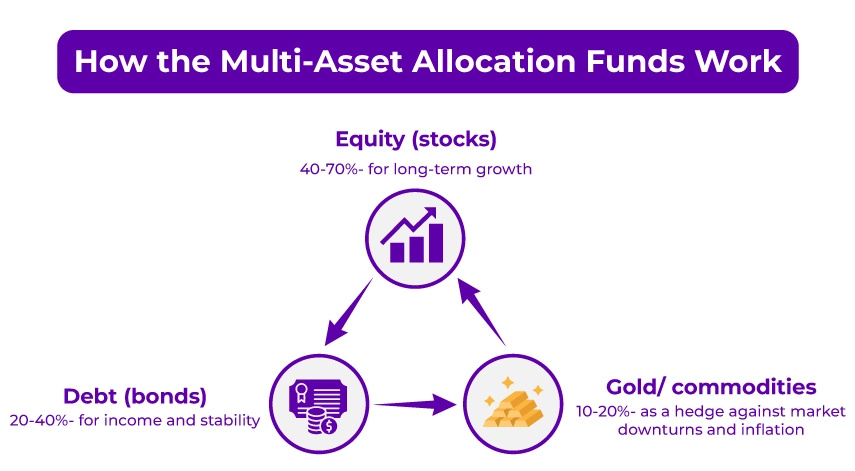
Additionally, during the economic shifts, each asset class responds differently. Considering this, based on the market conditions, the fund managers allocate assets to investors. For instance, during periods of volatility, fund managers shift to gold and debt rather than equity.
So, this was all about multi-asset allocation funds. Moving ahead, let's discuss why these investment options are suitable for NRIs.
Multi-asset allocation funds are suitable for NRIs because they provide the option to invest across different assets such as debt, equity, and gold. It provides a balanced approach to NRIs that further helps them manage risk while focusing on steady returns. According to SEBI, it is mandatory to invest at least 10% of the minimum funds in three asset classes.
Here is what multi-asset allocation funds for NRIs mean for you: for investing in debt funds, equity, and gold ETFs, you do not need to open a separate bank account. Additionally, you get all three assets in one fund, with each of them with own rebalancing needs and tax treatment. For NRIs who are with controlled risk looking for a long-term stable income, these funds provide a smooth market volatility.
Another benefit that NRIs get from investing in multi-asset allocation funds is professional management. The fund manager constantly tracks the market conditions and, as needed, adjusts the asset mix. This saves NRIs from the hassle of making an active decision. Additionally, through NRE or NRO accounts, while living overseas, NRIs can easily access these investments. It makes the investment process fully compliant and simple with Indian regulations.
In simple terms, you can say that investing in multi-asset allocation funds provides NRIs with meaningful exposure to the growth of India without giving time to the market or rebalancing the portfolios manually. All in one place- these funds offer diversification, convenience, and stability to investors.
So, here is why multi-asset allocation funds are a suitable investment choice for NRIs. Moving further to the next section, let's look at the top 10 multi-asset allocation funds for NRIs.
Here, the table below showcases the top 10 multi-asset allocation funds for NRIs in India based on consistency, AUM, and performance:
| Sr. No. | Multi-Asset Allocation Fund (Direct Growth) | Asset Under Management (in Crore) | 3-Year CAGR | 5-Year CAGR | Expense Ratio (%) |
|---|---|---|---|---|---|
| 1. | Nippon India Multi-Asset Omni FoF Fund | INR 1,477 | 20.2% | NA | 0.13 |
| 2. | Nippon India Multi Asset Active FoF Fund | INR 907 | 20.0% | NA | - |
| 3. | ICICI Prudential Multi Asset Fund | INR 71,900 | 19.8% | 23.9% | 0.67 |
| 4. | Nippon India Multi Asset Allocation Fund | INR 8,722 | 20.8% | 18.9% | 0.27 |
| 5. | Kotak Multi Asset Allocator FoF- Dynamic Fund | INR 1,857 | 18.8% | 20.3% | - |
| 6. | SBI Multi Asset Allocation Fund | INR 11,306 | 18.2% | 15.9% | 0.59 |
| 7. | HDFC Multi-Asset Active FoF Fund | INR 5,036 | 16.8% | NA | 0.07 |
| 8. | HDFC Multi Asset Fund | INR 5,149 | 15.4% | 16.1% | 0.8 |
| 9. | ICICI Prudential Asset Allocator Fund | INR 28,586 | 15.4% | 15.6% | 0.2 |
| 10. | Franklin India Income Plus Arbitrage Active FoF Fund | INR 87 | 14.1% | 15.3% | 0.24 |
These were the top 10 multi-asset allocation funds for NRI. Moving ahead, now let's know how these funds actually work.
As mentioned at the beginning of the blog, to manage risk, multi-asset allocation funds invest in different asset classes. Based on market trends and economic conditions, fund managers constantly monitor and adjust asset allocations. Further, this approach helps investors looking for growth and stability when investing in these hybrid multi-asset funds.
Additionally, diversification helps in reducing the effect of volatility. SEBI has made it mandatory that at least 10% of the investment in multi-asset funds be made in three asset classes. Apart from this, investors receiving benefits from a portfolio managed by professionals provide a different combination of asset classes. It also eliminates the requirement for individual investment research.
Further, the multi-asset allocation funds aim to combine the fixed-income stability, growth potential of equities, and hedging benefits of gold. This further improves the experience of investment and minimizes return volatility. Investing in these funds provides you with an equal balance between your returns and risk.
This is how multi-asset allocation funds work. Moving further, let's look at the taxation of multi-asset funds for NRIs.
We have a team of tax professionals who simply your tax obligations in India
In India, the taxation rules for multi-asset allocation funds are based on their average equity exposure. Amendments to the 2020 Budget state that, based on the classification of funds, investors are taxed.
The recent changes in the multi-asset allocation funds indicate that funds with more than 65% equity exposure are taxed according to equity. Further, with lower exposure of 65% are taxed like debt funds.
Considering this, the taxation on equity funds is done on two bases: short-term and long-term capital gains.
| Capital Gains Tax on Multi-Asset Allocation Funds | Holding Period | Old Tax Rate | New Tax Rate |
|---|---|---|---|
| Short-Term Capital Gains (STCG) | Less than a year | 15% | 20% |
| Long-Term Capital Gains (LTCG) | More than a year | 10% | 12.50% |
Further, let's know the taxation on debt mutual funds.
| Capital Gains Tax on Multi-Asset Allocation Funds | Description |
|---|---|
| Short-Term Capital Gains (STCG) | If you sell the debt funds within three years, tax will be imposed as per your income tax slab rate in India. |
| Long-Term Capital Gains (LTCG) | For debt funds held for more than 3 years, 12.5% is the flat tax rate without indexation benefit. |
Here, the removal of indexation funds for debt funds states that the whole capital gain received from selling the funds after three years will be taxed at a 12.5% flat rate.
Now, let's know the TDS for NRIs on multi-asset allocation for funds.
This is how multi-asset allocation funds are taxed in India. Moving ahead, let's know how NRIs can invest in these funds.
Here is the step-by-step process to invest in multi-asset funds for NRIs:
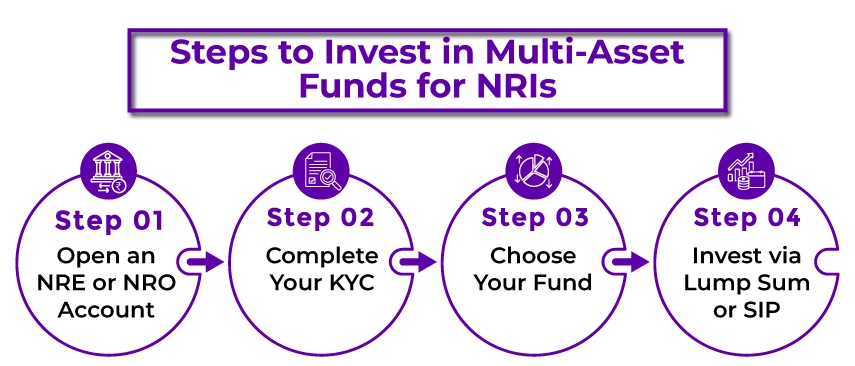
NRIs can invest in multi-asset allocation funds on a repatriable or non-repatriable basis. Considering this, if you opt for an NRE account, all your investments are fully repatriable.
Once your residential status changes to NRI, you need to complete a new know your customer (KYC) process with updated documentation. The papers should reflect your NRI status. For this, you need to submit the following documents:
Further, many AMCs now provide NRIs with the facility of video KYC from overseas, so you do not need to visit India or the Indian embassy.
Not all multi-asset funds are the same. Some are more conservative (40-50% equity), while others lean heavily on equity (60-70%). So when choosing a fund, match it with your financial goals and risk tolerance.
There are two ways in which you can invest in multi-asset allocation funds:
Further, a combination of investing in both is also a good option, i.e., 60% as a lump sum and 40% via SIP for more than 12 months.
So, here are the steps to invest in multi-asset allocation funds.
Connect with Savetaxs, and get qualified advice on Indian investment, insurance, and tax planning that aligns with your financial goals.
Lastly, multi-asset allocation funds offer a comprehensive, diversified investment strategy. It is a suitable option for investors who have less time for active management and lower risk tolerance. Additionally, multi-asset allocation funds for NRIs are also good options for diversifying their portfolios.
Further, seeking to invest in India with confidence? Savetaxs offers expert fund recommendations, research-backed insights, and seamless investing to NRIs. Connect with us now to start building a diversified investment portfolio.
This article is for general informational purposes only and does not constitute tax, legal, financial, or investment advice. Laws, regulations, rates, and procedures may change over time and may vary based on individual circumstances.
While SaveTaxs makes reasonable efforts to keep the information accurate and up to date, readers should verify applicable rules with official authorities or consult a qualified professional before making decisions based on this information.
Shubham Jain is the Founder of SaveTaxs and has extensive experience in Indian and NRI taxation. He advises individuals, NRIs, and businesses on tax filing, tax planning, capital gains, DTAA benefits, fund repatriation, and compliance matters. He regularly writes about taxation and related financial topics. His focus is on making complex tax concepts easy to understand. Through his articles, he helps taxpayers stay informed, avoid common mistakes, and stay compliant with Indian tax laws. See Full Bio

Want to read more? Explore Blogs
_1781845771869.webp&w=828&q=75)
_1778936280179.webp&w=828&q=75)
_1778936089630.webp&w=828&q=75)