US Tax Filing and Compliance
S Corporation Health Insurance for 2% Shareholders: Tax Rules and DeductionsS Corporation Health Insurance for 2% Shareholders: Tax Rules and Deductions
Written by Shubham Jain

Owning an S corporation can allow business income, losses, deductions, and credits to pass through to shareholders and be reported on their individual tax returns. However, a loss reported on Schedule K-1 is not automatically deductible in full.
The amount an owner can deduct may depend on their S corporation shareholder basis, the amount they have at risk in the business, passive activity rules, and the excess business loss limitation. These rules can prevent a shareholder from using a business loss immediately, even when the corporation reports a loss for the year.
Understanding S corporation shareholder basis and loss limitations helps U.S. business owners calculate allowable deductions, track suspended losses, and report distributions and shareholder loans correctly.
Shareholder basis is the adjusted tax investment a shareholder has in an S corporation. It is important because it can determine how much of the corporation’s losses the shareholder may deduct, whether certain distributions are taxable, and how to calculate gain or loss when shares are sold.
There are two main types of S corporation shareholder basis:
These amounts are calculated separately. Stock basis generally begins with the shareholder’s cost of the shares or applicable initial investment. Debt basis generally comes from qualifying loans the shareholder makes directly to the corporation.
Basis is not necessarily the same as the business’s market value, the shareholder’s percentage of the company’s accounting equity, or the amount of cash in the corporate bank account. It is a tax calculation that changes as the corporation operates and the shareholder completes transactions with the business.
For example, an owner may invest $25,000 in S corporation stock and later lend the corporation another $10,000. Subject to the applicable rules, the owner may have stock basis and debt basis to track separately. Those amounts affect loss deductions in different ways.
The shareholder—not the corporation—is generally responsible for maintaining the records needed to calculate their basis. Schedule K-1 provides important tax information, but it does not show the shareholder’s complete stock and debt basis calculation. The IRS explains these requirements in its S Corporation Stock and Debt Basis guidance.
Get professional help with S Corp tax returns, shareholder reporting, and compliance.
Stock basis and debt basis both matter when an S corporation passes losses through to its shareholders, but they do not work in exactly the same way.
A shareholder’s stock basis generally increases for qualifying income and certain contributions or other basis adjustments. It generally decreases for non-dividend distributions, specified nondeductible expenses, and losses or deductions.
Under the general ordering rules, stock basis is adjusted annually in this order:
Special rules and elections can affect this order, so shareholders should check the applicable Form 7203 instructions before finalizing a calculation.
Stock basis cannot be reduced below zero.
Example: Suppose a shareholder begins the year with $30,000 of stock basis, receives $10,000 of qualifying income, and takes a $12,000 non-dividend distribution. Before other adjustments, the calculation is:
| Stock basis calculation | Amount |
|---|---|
| Beginning stock basis | $30,000 |
| Add: qualifying income | $10,000 |
| Less: non-dividend distribution | -$12,000 |
| Stock basis before other adjustments | $28,000 |
The shareholder has $28,000 of stock basis before accounting for other relevant adjustments and losses. This is an illustrative calculation, not a complete basis worksheet.
Debt basis generally arises when the shareholder lends money directly to the S corporation and has tax basis in bona fide debt owed by the corporation.
A personal guarantee of a corporate bank loan does not, by itself, create debt basis. A shareholder generally obtains basis from a guaranteed obligation only to the extent they make a qualifying payment under the guarantee.
Debt basis may allow a shareholder to deduct qualifying losses that exceed available stock basis. However, the debt must satisfy the applicable requirements, and the shareholder must track its adjusted tax basis.
When losses reduce debt basis, later repayment of the loan may produce taxable gain. The result depends on the loan’s adjusted basis and the applicable rules. A repayment is not automatically tax-free just because the corporation is returning money it previously borrowed.
Shareholders should retain records of direct loans, including loan agreements where appropriate, amounts advanced, repayments, and basis adjustments. They should also distinguish genuine loans from capital contributions.
Stock basis generally determines whether a non-dividend distribution is tax-free. Debt basis is not used to make that determination.
For losses, qualifying stock basis and debt basis can both matter, subject to the applicable limitations. A shareholder with insufficient stock basis may still have available debt basis, but the loss must satisfy the relevant rules before it can be deducted.
The IRS provides the official calculation framework in the Instructions for Form 7203.
Even when an S corporation allocates a loss to an owner, the shareholder must apply the federal tax limitations before determining how much can be deducted on their individual return.
The four principal shareholder loss limitations generally apply in this order:
Certain deduction-specific restrictions may also apply. The appropriate analysis depends on the type of loss, the shareholder’s participation, and their individual tax circumstances.
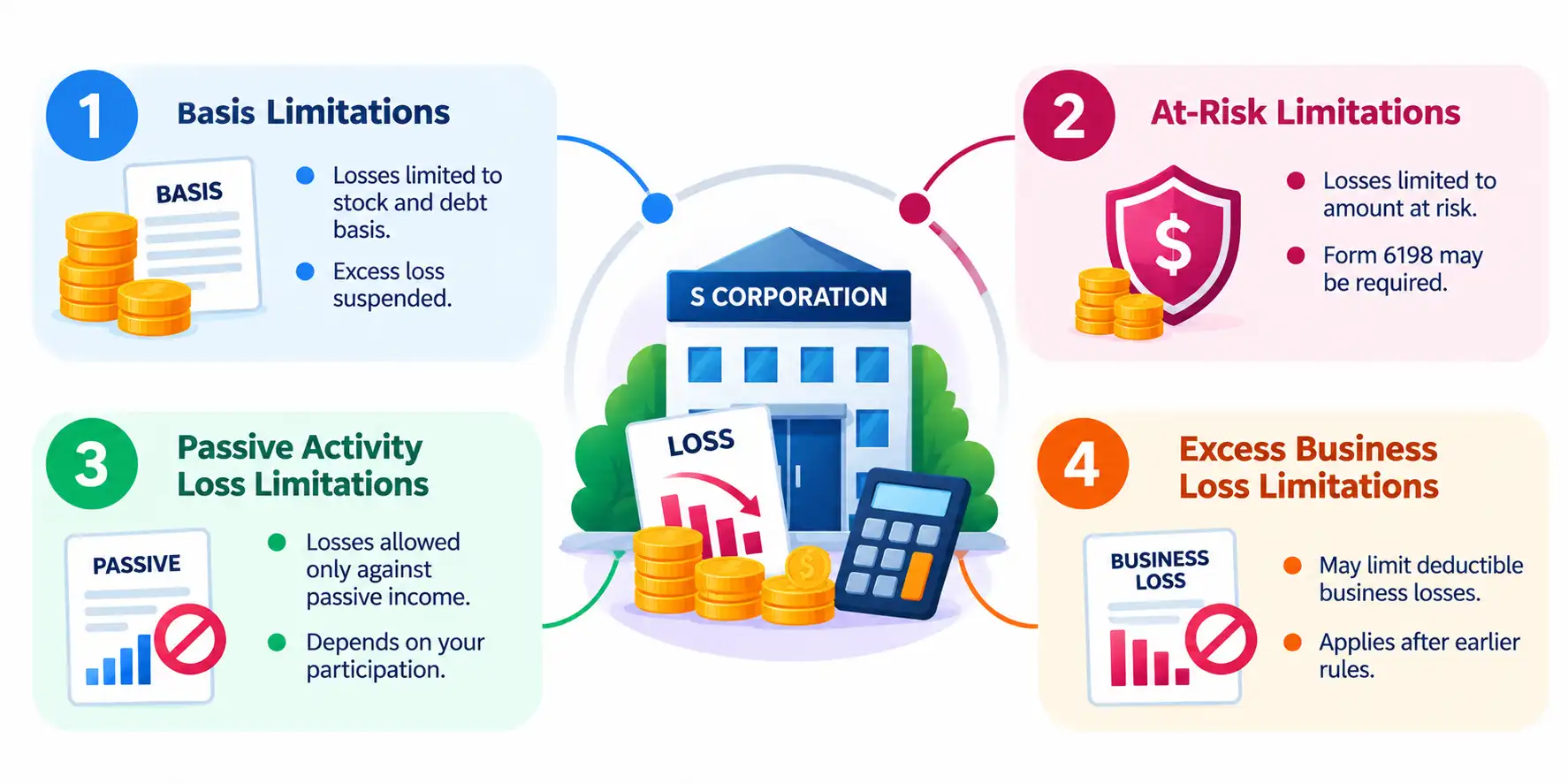
A shareholder’s aggregate S corporation losses and deductions generally cannot exceed the available stock basis and qualifying debt basis under the applicable rules.
If the loss exceeds basis, the excess is generally suspended under the basis limitation. It may become deductible in a future year when sufficient basis becomes available, but it must still satisfy the other applicable limitations.
The at-risk rules generally limit losses to the amount the shareholder has at risk in the activity. This amount is not necessarily equal to the shareholder’s stock and debt basis.
Certain financing arrangements or protections against economic loss may affect what counts as an amount at risk. Where required, Form 6198 is used to calculate the allowable amount under these rules.
Passive activity rules may further restrict losses after the basis and at-risk rules have been considered.
Whether an S corporation activity is passive depends on the applicable tax rules and the shareholder’s participation. Being an owner or receiving a Schedule K-1 does not, by itself, establish that the activity is nonpassive.
The excess business loss rules may limit the business losses an individual can deduct after the earlier limitations. The applicable threshold depends on the tax year and taxpayer circumstances.
The IRS outlines the limitation sequence in its Shareholder’s Instructions for Schedule K-1 (Form 1120-S). Shareholders should review the instructions applicable to the tax year being filed rather than relying on a prior-year threshold or worksheet.
When a shareholder’s allocated loss exceeds available stock and debt basis, the excess is generally suspended under the basis limitation rather than deducted in full in the current year.
Basis-suspended losses generally carry forward indefinitely and may become deductible in a later year if sufficient basis becomes available. However, the losses must still satisfy other applicable limitations, including the at-risk and passive activity rules.
A basis carryforward does not guarantee a deduction in a future year. It means the loss remains available for consideration under the applicable rules.
Suppose a shareholder has $12,000 of available basis for loss purposes and receives a Schedule K-1 reporting a $20,000 loss. Assume the full loss is otherwise eligible for consideration under the basis limitation.
| Item | Amount |
|---|---|
| Loss allocated to shareholder | $20,000 |
| Available basis | $12,000 |
| Loss potentially allowed under the basis limitation | $12,000 |
| Loss suspended by the basis limitation | $8,000 |
The shareholder may be able to deduct the suspended $8,000 in a later year if sufficient basis becomes available. The loss must still pass the other applicable limitations before it can be deducted.
This example is simplified. The actual calculation may be more complex if the shareholder has multiple types of losses or deductions, prior-year suspended amounts, debt-basis adjustments, or other relevant tax items.
Shareholders should review suspended losses before selling or otherwise disposing of their shares. Under the general rules, basis-suspended losses can be lost when the shareholder disposes of all their S corporation stock. Certain transfers have special rules, so the result should be reviewed before completing a transaction.
For this reason, owners should maintain a year-by-year schedule of suspended losses and discuss the potential tax impact with a qualified tax professional before a complete disposition.
Get expert guidance on shareholder basis, suspended losses, and S Corporation tax planning.
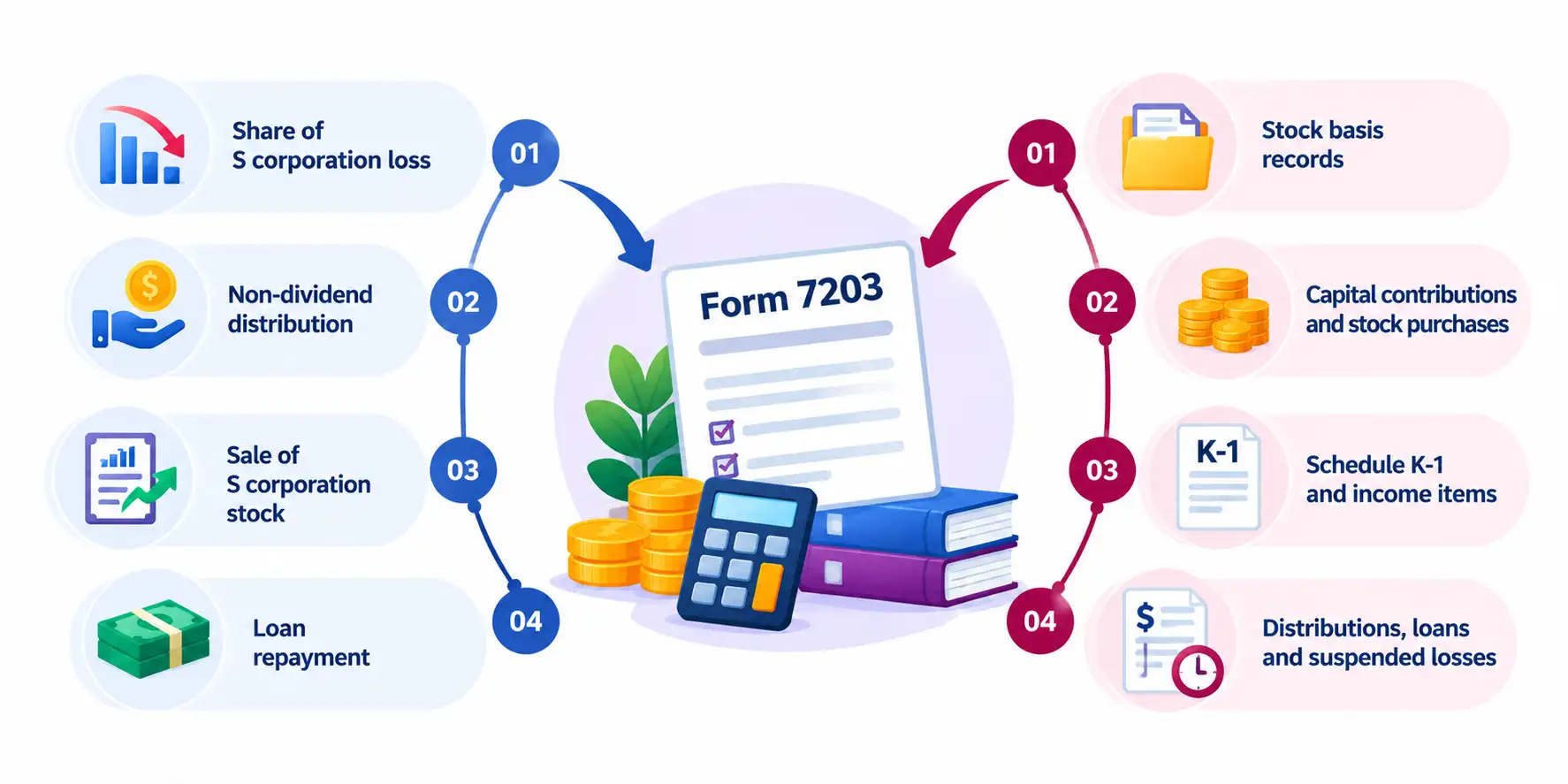
Form 7203, S Corporation Shareholder Stock and Debt Basis Limitations, helps shareholders calculate stock basis, debt basis, and the amount of certain losses and deductions that may be allowed on their individual tax returns.
The IRS generally requires shareholders to file Form 7203 when they:
Confirm the filing requirements against the current form instructions for the tax year being filed.
To calculate basis and complete Form 7203 accurately, shareholders should retain:
Schedule K-1 is an important source of information, but shareholders should not assume it contains every amount needed to establish their basis.
Download the current form and review its requirements on the official IRS Form 7203 page.
Tracking shareholder basis is an important part of S corporation tax compliance. It helps owners determine whether losses can be deducted, whether distributions may be taxable, and how shareholder loan repayments should be treated.
Maintain accurate stock and debt basis records, track suspended losses from year to year, and apply the applicable loss limitations in the correct order. If your business has shareholder loans, substantial losses, or a planned stock sale, professional tax guidance can help you understand the consequences before filing or completing a transaction.
For assistance with S corporation tax returns and compliance, visit: Savetaxs S Corporation Services.
This article is for general informational purposes only and does not constitute tax, legal, financial, or investment advice. Laws, regulations, rates, and procedures may change over time and may vary based on individual circumstances.
While SaveTaxs makes reasonable efforts to keep the information accurate and up to date, readers should verify applicable rules with official authorities or consult a qualified professional before making decisions based on this information.
Shubham Jain is the Founder of SaveTaxs and has extensive experience in Indian and NRI taxation. He advises individuals, NRIs, and businesses on tax filing, tax planning, capital gains, DTAA benefits, fund repatriation, and compliance matters. He regularly writes about taxation and related financial topics. His focus is on making complex tax concepts easy to understand. Through his articles, he helps taxpayers stay informed, avoid common mistakes, and stay compliant with Indian tax laws. See Full Bio

Want to read more? Explore Blogs