US Tax Filing and Compliance
Form 2553: How to Elect S Corporation StatusForm 2553: How to Elect S Corporation Status
Written by Hatim Dudhiyawala

Missing the deadline to elect S Corporation status does not always mean your business has lost the opportunity to use that tax treatment. The IRS provides a procedure that may allow eligible businesses to request relief when they intended to elect S Corporation status but failed to file Form 2553 on time.
This relief is generally governed by Revenue Procedure 2013-30. However, relief is not automatic. The business must meet the applicable eligibility conditions, explain why the election was late, demonstrate appropriate corrective action, and provide the required shareholder statements.
This guide focuses on S Corporation late election relief, including eligibility requirements, the three-years-and-75-days rule, reasonable cause, supporting documentation, and the options available if the business does not qualify. For the standard Form 2553 filing process, eligibility rules, and regular filing deadline, see our guide to Form 2553: How to Elect S Corporation Status.
S Corporation late election relief is an IRS procedure that may allow an eligible business to obtain S Corporation status from its intended effective date even though it did not file Form 2553 within the normal deadline.
Under the usual rules, an S Corporation election must generally be filed no later than two months and 15 days after the beginning of the tax year for which it is intended to take effect, or during the preceding tax year. If the business misses the applicable deadline, the election may not take effect for the intended year under the ordinary rules.
Revenue Procedure 2013-30 provides a route for certain late elections without requiring a private letter ruling, provided the business satisfies the relevant conditions.
A business may have intended to operate as an S Corporation but overlooked the filing deadline, misunderstood the filing requirement, or discovered later that the election had not been submitted or accepted.
If the business meets the applicable relief conditions, it may be possible to request recognition of the intended S Corporation election rather than simply accepting a later effective date.
However, relief is generally designed for elections that would otherwise be valid. It does not automatically fix an ineligible shareholder, an impermissible ownership structure, or every other defect in an S Corporation election.
Review your election timeline, eligibility, and documentation before requesting late-election relief from the IRS.
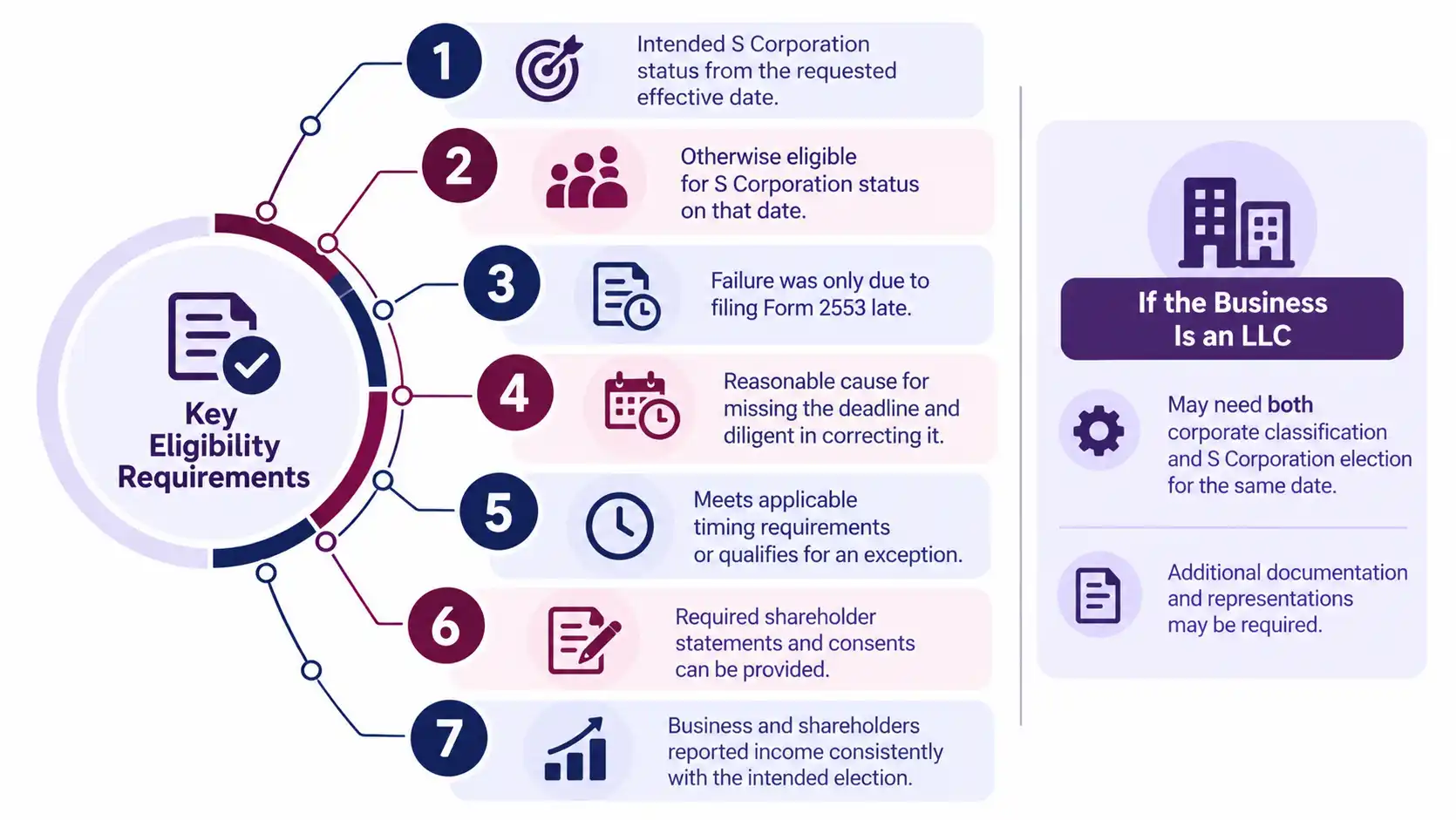
Eligibility for late-election relief depends on the business's circumstances, intended effective date, tax reporting history, and reason for missing the deadline. The central question is whether the business intended to elect S Corporation status and meets the specific conditions under Revenue Procedure 2013-30.
For the standard eligibility requirements for making an S Corporation election, see our Form 2553 filing guide. For late-election relief, the business generally needs to establish that:
The exact requirements depend on whether the applicant is an existing corporation or an eligible entity that also needs a late corporate classification election.
An eligible LLC may face additional considerations if it needs both corporate tax classification and S Corporation status to be effective from the same date.
In such cases, the late-election relief procedure may require additional representations and documentation. The business should not assume that the rules for an existing corporation automatically apply to its circumstances.
Review the IRS's Late Election Relief guidance before preparing the request.
The general relief period under Revenue Procedure 2013-30 is three years and 75 days from the intended effective date of the election.
This is an important timing condition, but it is not a guarantee that the IRS will grant relief. The business must also satisfy the other applicable requirements.
Suppose a corporation intended its S Corporation election to take effect on January 1, 2024, but did not file Form 2553 by the normal deadline.
The general three-years-and-75-days period is calculated from the intended effective date, January 1, 2024—not from the day the business discovered the mistake.
The business should calculate the applicable deadline carefully and check the current IRS procedure before filing its request.
A limited exception may be available for certain corporations that meet the other applicable requirements but file outside the general three-years-and-75-days period.
The corporation and all shareholders must have reported income consistently with S Corporation status for the intended year and subsequent years. At least six months must have elapsed since the corporation filed its tax return for the first intended S Corporation year. Neither the corporation nor any shareholder may have been notified by the IRS of a problem regarding S Corporation status within six months of the date the first-year Form 1120-S was timely filed.
This exception does not generally apply to an LLC seeking relief for a late corporate classification election. Review the current IRS instructions to determine which relief procedure applies to your business.
Reasonable cause is a central requirement for late-election relief. The business must explain why it failed to file Form 2553 on time and demonstrate that it acted diligently after discovering the failure.
The IRS evaluates the circumstances under the applicable rules. There is no universal explanation that guarantees approval.
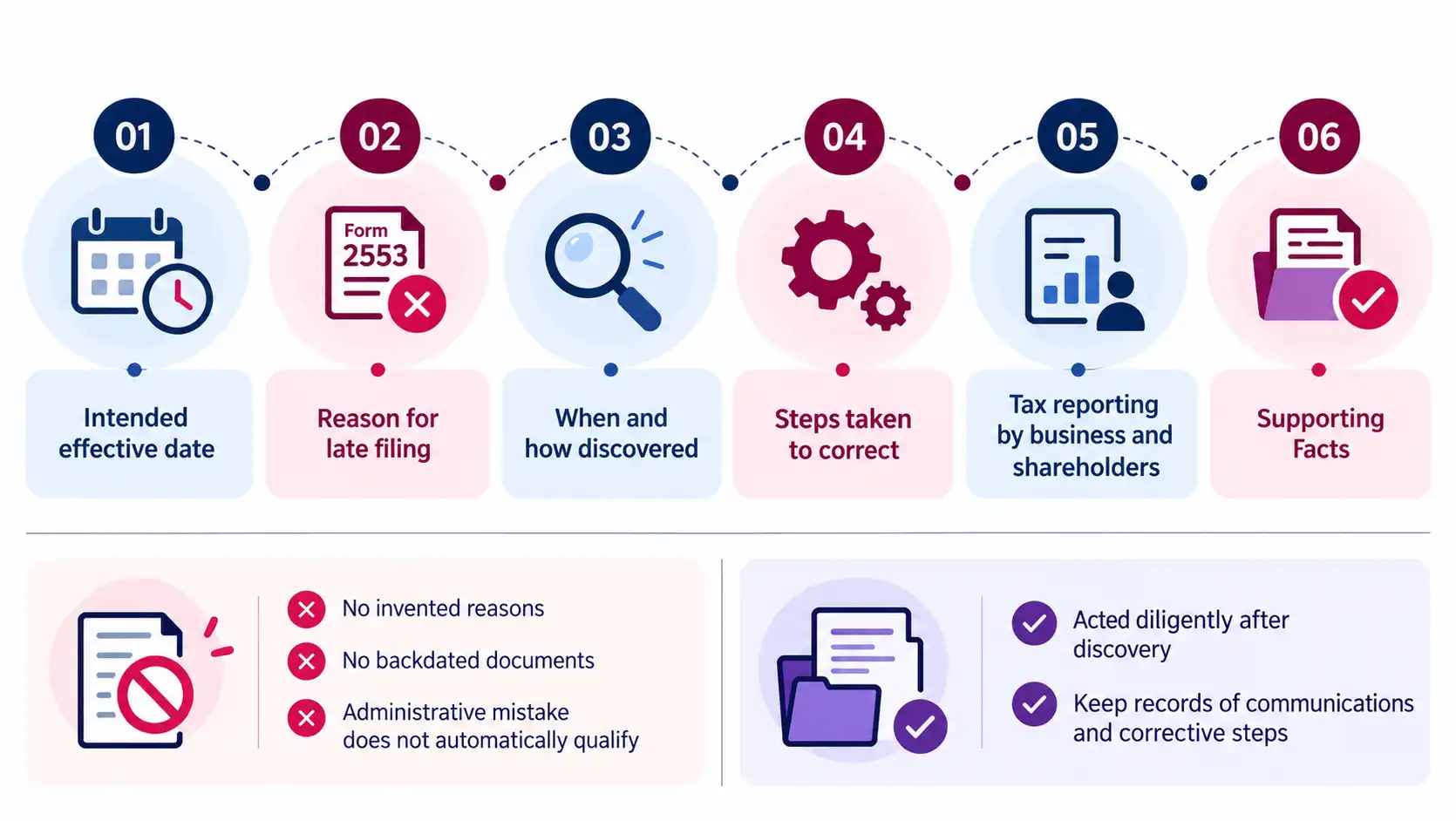
A reasonable-cause statement should accurately describe:
The explanation must reflect what actually happened. A business should not invent a reason, backdate documents, or assume that an administrative mistake automatically satisfies the reasonable-cause requirement.
The procedure considers not only why the deadline was missed but also whether the business acted diligently after discovering the problem.
Keeping records of the discovery, communications with the preparer, corrective steps, and submission can help document the timeline. Whether those facts establish reasonable cause depends on the individual circumstances and applicable IRS standards.
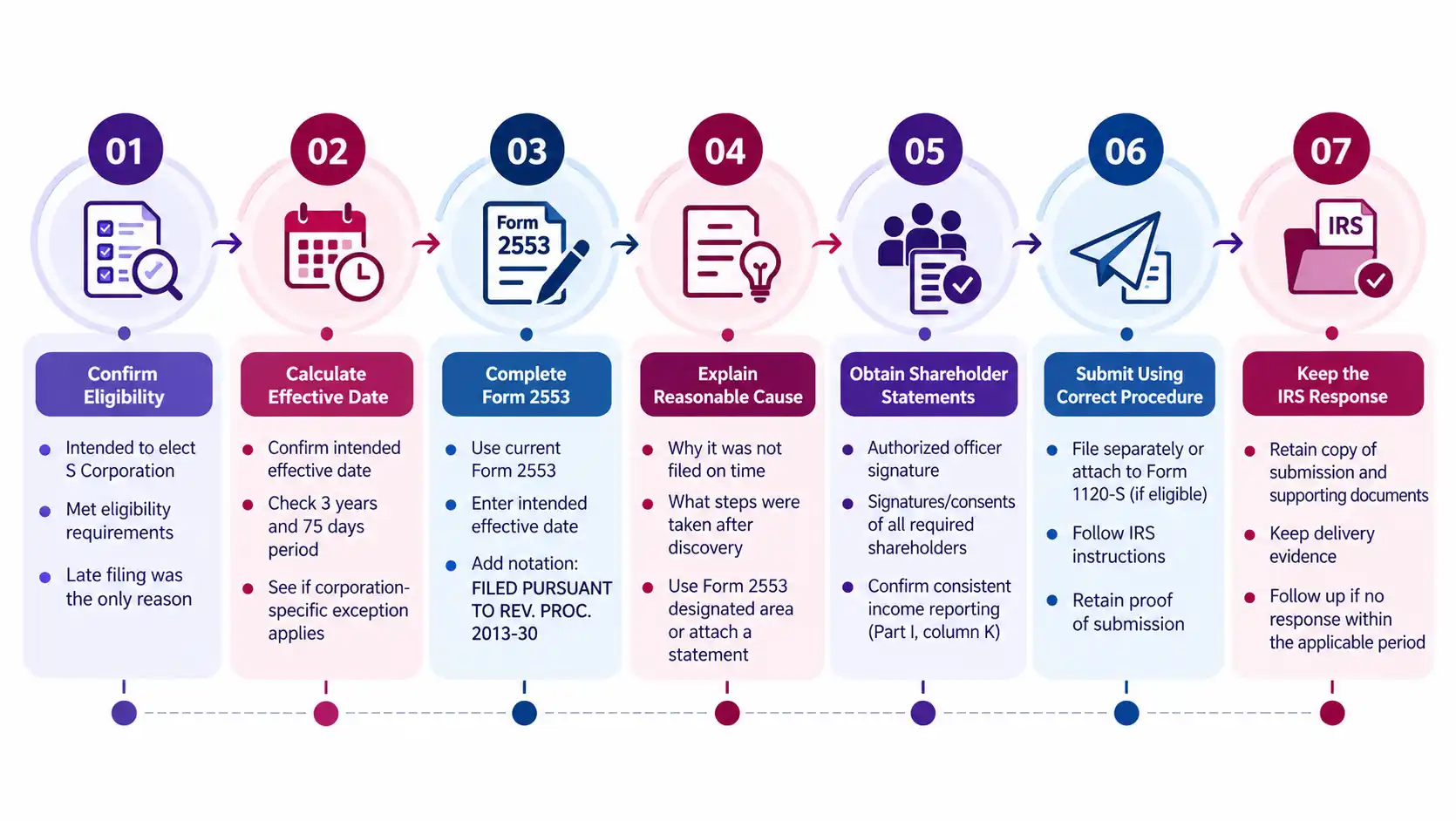
The request generally involves completing Form 2553, providing the necessary explanation and supporting statements, and following the submission instructions applicable to the business.
Check that the business intended to elect S Corporation status, met the applicable eligibility requirements, and failed to qualify solely because the election was late.
If the issue involves an LLC that also needed a corporate classification election, determine whether the additional relief requirements apply.
Confirm the effective date entered on Form 2553 and calculate the relevant three-years-and-75-days period. Check whether the corporation-specific exception could apply if the general period has passed.
Do not calculate the deadline from the date the mistake was discovered.
Use the current Form 2553 and its instructions to submit the late election. Confirm that the form reflects the intended effective date and includes the required information, consents, and signatures.
For a late election under Revenue Procedure 2013-30, the IRS instructions direct the business to enter the following notation at the top of the first page:
FILED PURSUANT TO REV. PROC. 2013-30
Additional statements may be necessary, depending on the case.
Provide an accurate explanation of why the form was not filed on time and what the business did to correct the error after discovering it.
The explanation may be provided in the designated area on Form 2553 or in an attached statement, as permitted by the current instructions.
The filing must include the authorized officer's signature and the signatures or consents of all persons who were shareholders during the period specified by the applicable IRS instructions. Required shareholders must also provide statements confirming consistent income reporting on affected returns. Completing Form 2553, Part I, column K, generally satisfies this statement requirement.
Check the current instructions for the applicable relief pathway and ownership circumstances. Missing consent or incomplete documentation can prevent the election from qualifying for relief.
The appropriate submission method depends on the business's filing circumstances.
Under the IRS instructions, Form 2553 may be filed separately. In qualifying cases, it may instead be attached to Form 1120-S, provided the applicable conditions are satisfied. If delinquent Forms 1120-S are involved, the instructions specify how they must be handled.
Do not assume that every late election should be attached to an annual return. Follow the current IRS instructions for the relevant situation and retain proof of submission.
Official guidance: IRS Instructions for Form 2553.
Keep a copy of the complete submission, supporting statements, delivery evidence, and IRS correspondence.
If the IRS does not communicate acceptance or nonacceptance within the applicable follow-up period, use the contact instructions in the current Form 2553 guidance to check the election's status.
Do not assume that submitting the request automatically means the election has been accepted.
If a business does not meet the conditions for relief under Revenue Procedure 2013-30, it may need to consider requesting a private letter ruling from the IRS.
A private letter ruling is a separate process with its own procedural requirements and user fee. It is not an automatic alternative, and the IRS must evaluate the request under the applicable rules.
The business should first identify why the simplified relief procedure is unavailable. For example, the issue may involve the timing of the request, missing eligibility conditions, inconsistent tax reporting, or an additional entity-classification election.
Depending on the facts, the business may also need to review its prior federal tax returns and determine which filing treatment applies until the election is recognized.
Because an incorrect assumption about S Corporation status can affect both the entity and its shareholders, professional tax guidance may be appropriate before submitting a request or amending returns.
Understand your filing responsibilities and evaluate next steps when your S Corporation election was submitted late.
S Corporation late election relief may help an eligible business correct a missed Form 2553 deadline, but the business must satisfy the applicable IRS requirements. The intended effective date, reasonable-cause explanation, corrective action, shareholder consents, consistent tax reporting, and filing procedure all matter.
Before submitting a late-election request, review Revenue Procedure 2013-30 and the current Form 2553 instructions. If the business has an unusual ownership structure, a late corporate classification election, or prior returns filed under a different tax treatment, qualified tax guidance can help clarify the appropriate procedure.
This article is for general informational purposes only and does not constitute tax, legal, financial, or investment advice. Laws, regulations, rates, and procedures may change over time and may vary based on individual circumstances.
While SaveTaxs makes reasonable efforts to keep the information accurate and up to date, readers should verify applicable rules with official authorities or consult a qualified professional before making decisions based on this information.
Shubham Jain is the Founder of SaveTaxs and has extensive experience in Indian and NRI taxation. He advises individuals, NRIs, and businesses on tax filing, tax planning, capital gains, DTAA benefits, fund repatriation, and compliance matters. He regularly writes about taxation and related financial topics. His focus is on making complex tax concepts easy to understand. Through his articles, he helps taxpayers stay informed, avoid common mistakes, and stay compliant with Indian tax laws. See Full Bio

Want to read more? Explore Blogs