US Tax Filing and Compliance
S Corporation Late Election Relief: Form 2553 RulesS Corporation Late Election Relief: Form 2553 Rules
Written by Shubham Jain

Choosing S Corporation taxation is an important decision for an eligible U.S. business. However, forming an LLC or corporation does not automatically establish S Corporation tax status. The business must meet the applicable IRS requirements and make a valid election.
Form 2553, Election by a Small Business Corporation, is used by an eligible corporation or other qualifying entity to elect S Corporation status for federal tax purposes. The form identifies the business, specifies the requested effective date, and records the shareholder consents required under IRS rules.
Filing the form correctly matters because an incorrect effective date, missing consent, or late submission can affect the election. This guide explains how to check eligibility, complete Form 2553, submit it to the IRS, and respond if the filing deadline has passed.
Form 2553 is the IRS form used by an eligible corporation or qualifying entity to elect S Corporation status under Section 1362(a) of the Internal Revenue Code.
An S Corporation generally passes its income, deductions, credits, and losses through to its shareholders for federal income-tax purposes. The business nevertheless has its own reporting and compliance responsibilities.
Form 2553 establishes the requested federal tax election when the applicable requirements are satisfied. It does not create a separate legal entity or replace the business's state registration documents.
For example, an eligible LLC can generally elect S Corporation taxation while remaining an LLC under state law.
For a broader explanation of how S Corporation taxation works, see the Savetaxs guide to What Is an S Corporation?
Review eligibility, election timing, and filing requirements before submitting Form 2553 to the IRS.
Before filing Form 2553, confirm that the business and its owners meet the federal eligibility requirements.
Generally, an eligible business must satisfy the following conditions:
Certain trusts, estates, individuals, and qualifying tax-exempt organizations may be permitted shareholders.
Yes. An eligible LLC can generally elect S Corporation taxation if it satisfies the applicable requirements.
Depending on its existing federal tax classification, an eligible LLC may be treated as having elected corporate classification when it files a valid Form 2553 and meets the relevant IRS conditions. A separate Form 8832 is not always required.
However, an LLC should confirm its current tax classification and election circumstances before filing. The rules can differ if the entity has an unusual ownership structure or is seeking multiple tax elections.
An election should not be filed based solely on a business owner's expectation of tax savings. An ineligible shareholder or impermissible ownership arrangement can prevent the business from qualifying or jeopardize its S Corporation status.
Review the official IRS Form 2553 instructions before proceeding.
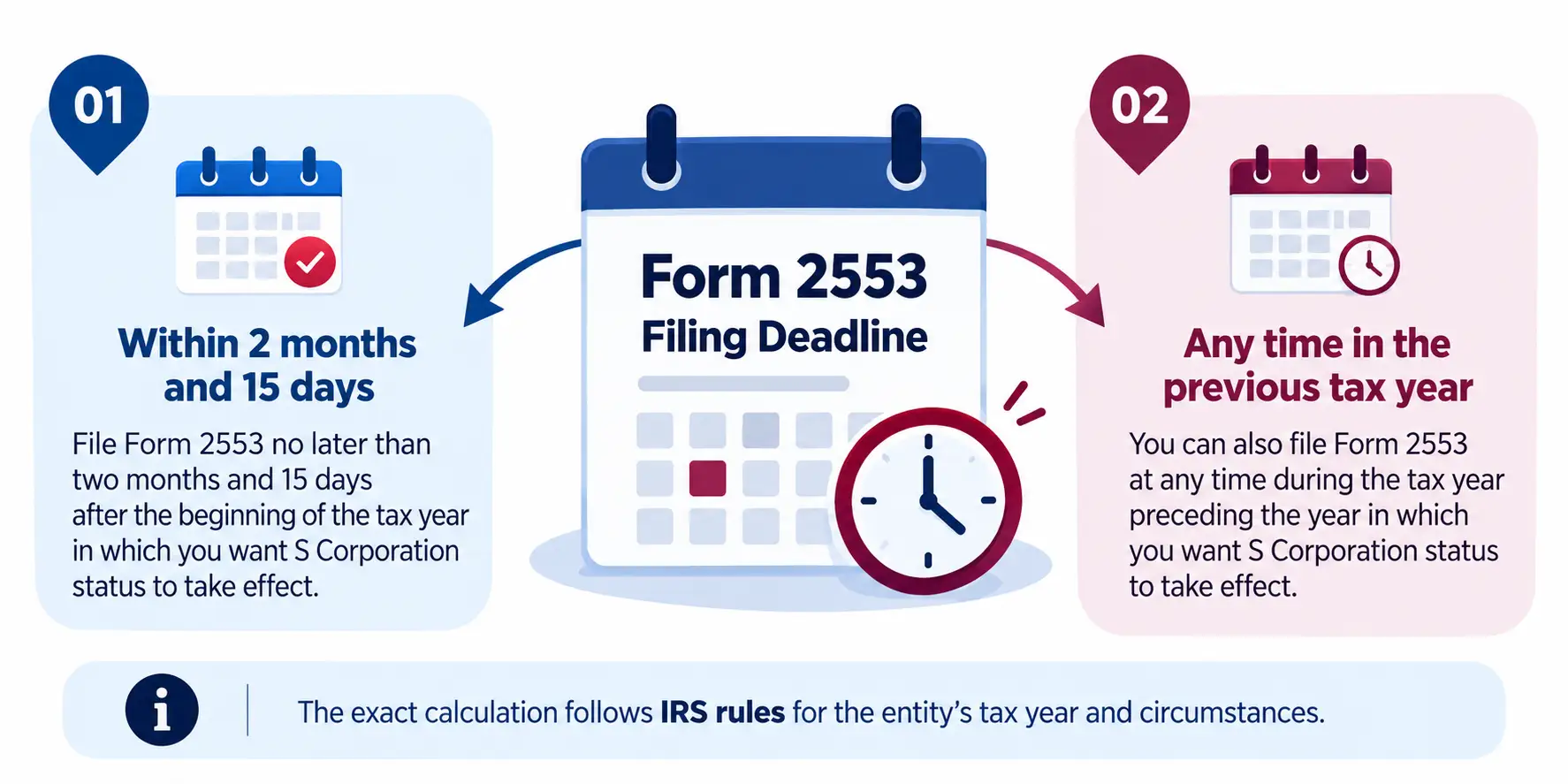
The filing deadline depends on the tax year for which the business wants S Corporation status to begin.
Generally, Form 2553 must be filed:
The exact calculation follows IRS rules for the entity's tax year and circumstances.
Suppose an eligible business wants its S Corporation election to take effect on January 1, 2027.
For a typical calendar-year business, the usual filing deadline is March 15, 2027. The business should verify the applicable deadline and any weekend or holiday adjustment before submitting the form.
Filing before the intended effective date is not always sufficient by itself. The business must also satisfy the applicable timing rules and other eligibility conditions.
A newly formed business may have a short initial tax year. In that case, the deadline can depend on the date its first tax year begins rather than simply following the standard January-to-March calendar-year pattern.
Businesses with a short tax year, an existing C Corporation classification, or a proposed retroactive effective date should calculate the deadline using the current IRS instructions.
Use the current IRS version of Form 2553 and follow its instructions. The exact entries depend on the entity's legal structure, tax year, ownership, and requested effective date.
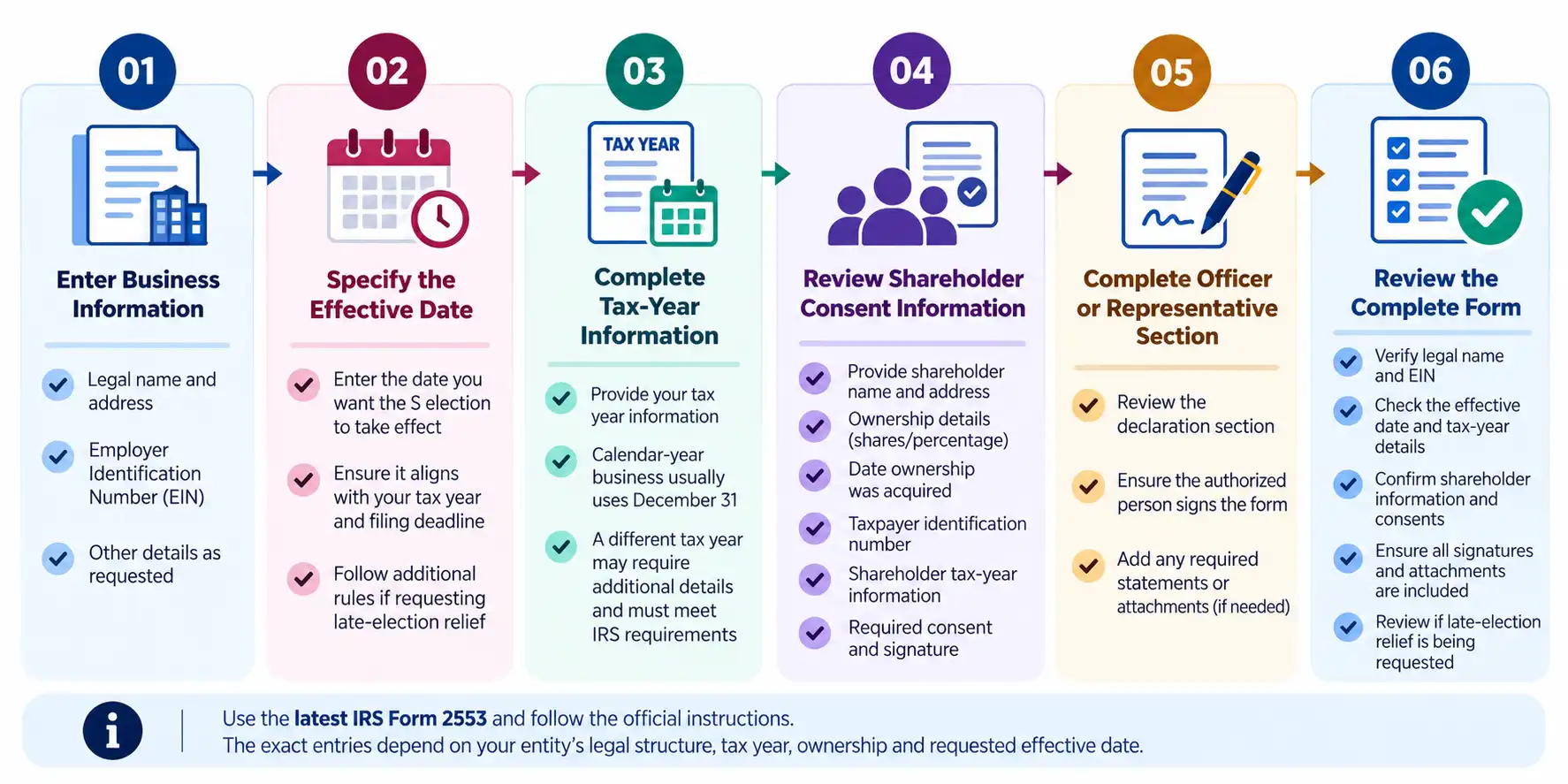
Provide the business's legal name, address, employer identification number (EIN), and other identifying information requested on the form.
Check the information against the entity's IRS records. An incorrect EIN or inconsistent legal name can delay processing or require clarification.
Enter the date on which the business wants its S Corporation election to take effect.
Confirm that the date aligns with the business's tax year and the applicable filing deadline. If the business is requesting late-election relief, additional instructions apply.
Form 2553 requests information about the business's tax year and related circumstances.
A calendar-year business generally uses a tax year ending December 31. An entity requesting a different tax year may need to provide additional information or meet separate requirements.
Do not assume that selecting a different year-end is automatically permitted.
Part I includes information about shareholders and their consent to the election.
Depending on the entity and ownership circumstances, the form generally requires information such as:
The appropriate shareholders must consent under the applicable rules. Additional requirements can apply to certain trusts, estates, jointly owned interests, and other ownership arrangements.
Check that all required consent information is complete before submission.
The form includes declarations and signature requirements for the person authorized to make the election on behalf of the business.
Review the applicable signature instructions carefully. If the entity has unusual ownership, tax-year, or election circumstances, additional statements or attachments may be necessary.
Before filing, verify:
An incomplete form can delay processing and may affect the requested effective date.
After completing the form, submit it using the filing method and IRS destination applicable to the business.
The correct IRS mailing address or fax number depends on the business's location and the current IRS filing instructions.
Use the official IRS Form 2553 page and its current “Where to File” guidance. Do not rely on an address copied from an old form or an unrelated business filing.
Retain a complete copy of the signed form, all attachments, and evidence of submission. If mailing the form, use a trackable method that provides appropriate proof of mailing or delivery.
Submitting Form 2553 does not mean the business should assume that every aspect of its requested election has been accepted.
Monitor IRS correspondence and retain the acceptance notice with the company's permanent tax records.
If the business does not receive a response, follow the current IRS instructions for checking the election's status. The IRS instructions describe follow-up steps when acceptance or nonacceptance has not been communicated within the applicable period.
Do not treat silence as proof of acceptance. If the effective date is important for payroll or tax reporting, resolve uncertainty promptly.
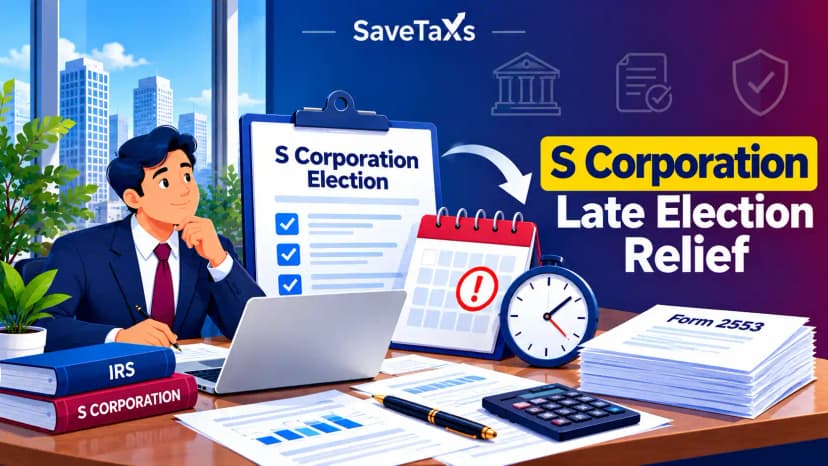
Missing the normal Form 2553 deadline does not automatically mean that a business cannot elect S Corporation status. The IRS provides late-election relief for eligible businesses, subject to specific requirements and procedures. Eligibility depends on factors such as the reason for the delay, the intended effective date, and whether the business and its shareholders meet the applicable conditions.
If your business missed the deadline, review our detailed guide to S Corporation Late Election Relief: Form 2553 Rules for eligibility requirements, reasonable cause, the three-years-and-75-days rule, required documentation, and the steps for requesting relief.
Once the IRS accepts the election, the business should update its tax and accounting records and prepare for its ongoing compliance responsibilities.
Store the IRS confirmation with the company's formation documents, EIN information, filed Form 2553, and supporting records.
A shareholder who performs services for an S Corporation generally must receive reasonable compensation through payroll. The business should review its payroll setup and applicable employment-tax obligations.
An S Corporation generally files Form 1120-S and provides Schedule K-1 to each shareholder as required.
For details about the annual return, read the Savetaxs guide to Form 1120-S: S Corporation Tax Return Guide.
Federal S Corporation status does not automatically satisfy every state requirement. Depending on the state, a separate election, consent, tax return, annual fee, or other filing may apply.
See S Corporation State Taxes and State-Level Elections for further guidance.
Organize your tax records and understand the reporting responsibilities that follow your S Corporation election.
Form 2553 is the principal form used to elect S Corporation status for federal tax purposes. Before filing, a business should confirm its eligibility, determine the intended effective date, calculate the applicable deadline, collect the required shareholder consents, and verify the current submission instructions.
If the deadline has passed, review the IRS late-election relief rules before assuming the election is unavailable. After acceptance, maintain the IRS confirmation and prepare for payroll, annual tax-return, and applicable state-level responsibilities.
Careful preparation helps the business establish its intended tax status while reducing avoidable delays and compliance issues.
This article is for general informational purposes only and does not constitute tax, legal, financial, or investment advice. Laws, regulations, rates, and procedures may change over time and may vary based on individual circumstances.
While SaveTaxs makes reasonable efforts to keep the information accurate and up to date, readers should verify applicable rules with official authorities or consult a qualified professional before making decisions based on this information.
Hatim Dudhiyawala is a Certified Public Accountant (CPA) with SaveTaxs and specializes in Indian and NRI taxation. He advises individuals, NRIs, and businesses on income tax filing, capital gains taxation, DTAA benefits, fund repatriation, and tax compliance. With experience in cross-border tax matters, Hatim helps taxpayers understand complex regulations and make informed decisions. Through his articles, he shares practical insights to help readers stay compliant and manage their tax obligations with confidence. See Full Bio

Want to read more? Explore Blogs