US Tax Filing and Compliance
S Corporation Late Election Relief: Form 2553 RulesS Corporation Late Election Relief: Form 2553 Rules
Written by Shubham Jain

Electing S corporation status with the IRS does not automatically settle your business's state tax obligations. Depending on where your company is formed, registered, or doing business, you may need separate state filings, state-level elections, or payments of franchise and entity-level taxes.
These requirements can affect your total tax cost, filing workload, and the amount of state tax ultimately reported by shareholders. They can also differ significantly between states.
For example, California generally taxes S corporations on California net income and imposes a minimum franchise tax, subject to applicable exceptions. Utah, by contrast, requires qualifying S corporations to file a state return but states that its minimum tax does not apply to S corporations. These differences demonstrate why a federal S Corp election should not be treated as a complete state tax plan.
This guide explains how S corporation state taxation works, which state-level elections may apply, and what business owners should review before filing.
An S corporation is a federal tax classification that generally allows business income, deductions, credits, and losses to pass through to shareholders for federal income tax purposes. The company still has its own filing and compliance responsibilities.
State taxation is a separate question. A state may follow the federal S corporation election for some purposes while imposing its own income tax, franchise tax, minimum tax, annual fee, withholding requirement, or filing obligation.
Your business's state tax position can depend on several factors:
A business formed in one state may therefore have tax obligations in another state. Formation alone does not determine every filing requirement.
Get expert support for S Corporation tax returns, state filings, and compliance requirements to meet your business obligations.
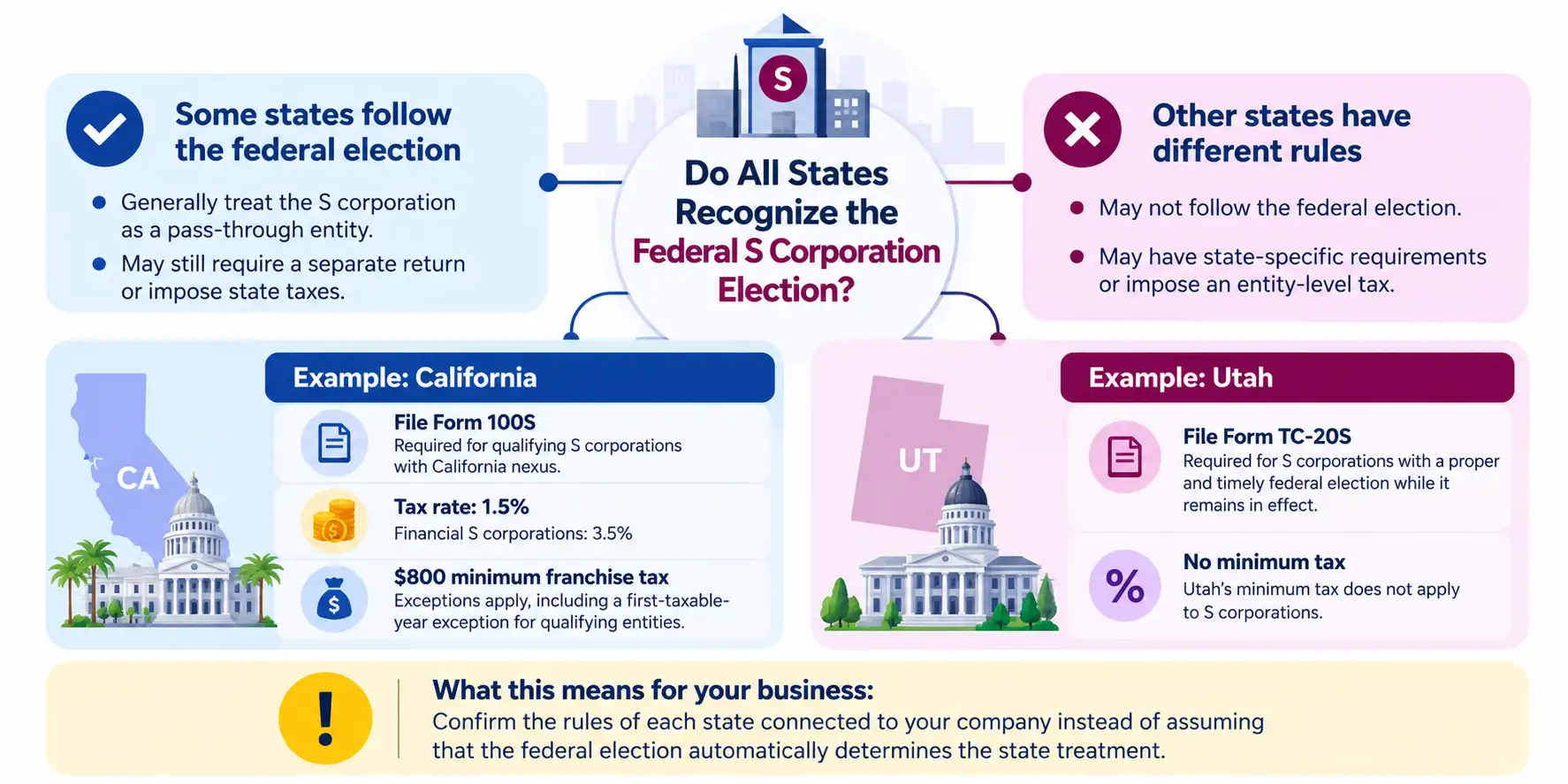
No. State treatment is not uniform. Some states generally follow the federal S corporation election, while others impose state-specific requirements or taxes.
Even when a state recognizes the federal election, it may require a separate return or impose a tax at the entity level.
California requires qualifying S corporations to file Form 100S when they are incorporated or registered in California, do business there, or receive California-source income under the applicable rules.
California generally taxes S corporation income at 1.5% and imposes an $800 minimum franchise tax on corporations subject to it. Financial S corporations are generally subject to a 3.5% tax rate. Exceptions apply, including a first-taxable-year exception for qualifying newly incorporated or qualified corporations. The precise result depends on the entity's circumstances.
Utah requires an S corporation with a proper and timely federal election to file Form TC-20S while the federal election remains in effect. The Utah State Tax Commission states that the minimum tax does not apply to S corporations.
These examples illustrate different state approaches; they are not a complete list of state rules.
What this means for your business: Confirm the rules of each state connected to your company instead of assuming that the federal election automatically determines the state treatment.
The amount and type of state tax depend on the laws of each relevant state and your business's activities.
Some states impose income tax directly on an S corporation or require it to calculate and report state-level income. The state may also tax shareholders on their allocated shares of income.
The calculation may differ from the federal calculation because state tax rules do not always conform to federal tax rules.
A franchise tax may apply because a company is incorporated, registered, or doing business in a state. A minimum tax can apply even when the business has little or no taxable income.
For example, California's minimum franchise tax rules can result in a payment obligation even when an S corporation operates at a loss, subject to applicable exceptions.
Certain states impose annual fees or other charges based on the business's legal form, registration, or activity. These are distinct from state income tax and may have separate payment deadlines.
A state may require an S corporation to withhold tax on income allocated to shareholders who are not residents of that state. Other states may offer composite returns or entity-level tax elections as alternatives, subject to their rules.
If state tax is expected to be due during the year, estimated payments may be required. Payment frequency, thresholds, and due dates vary by jurisdiction.
The important point is that pass-through federal taxation does not mean the S corporation has no state-level tax costs.
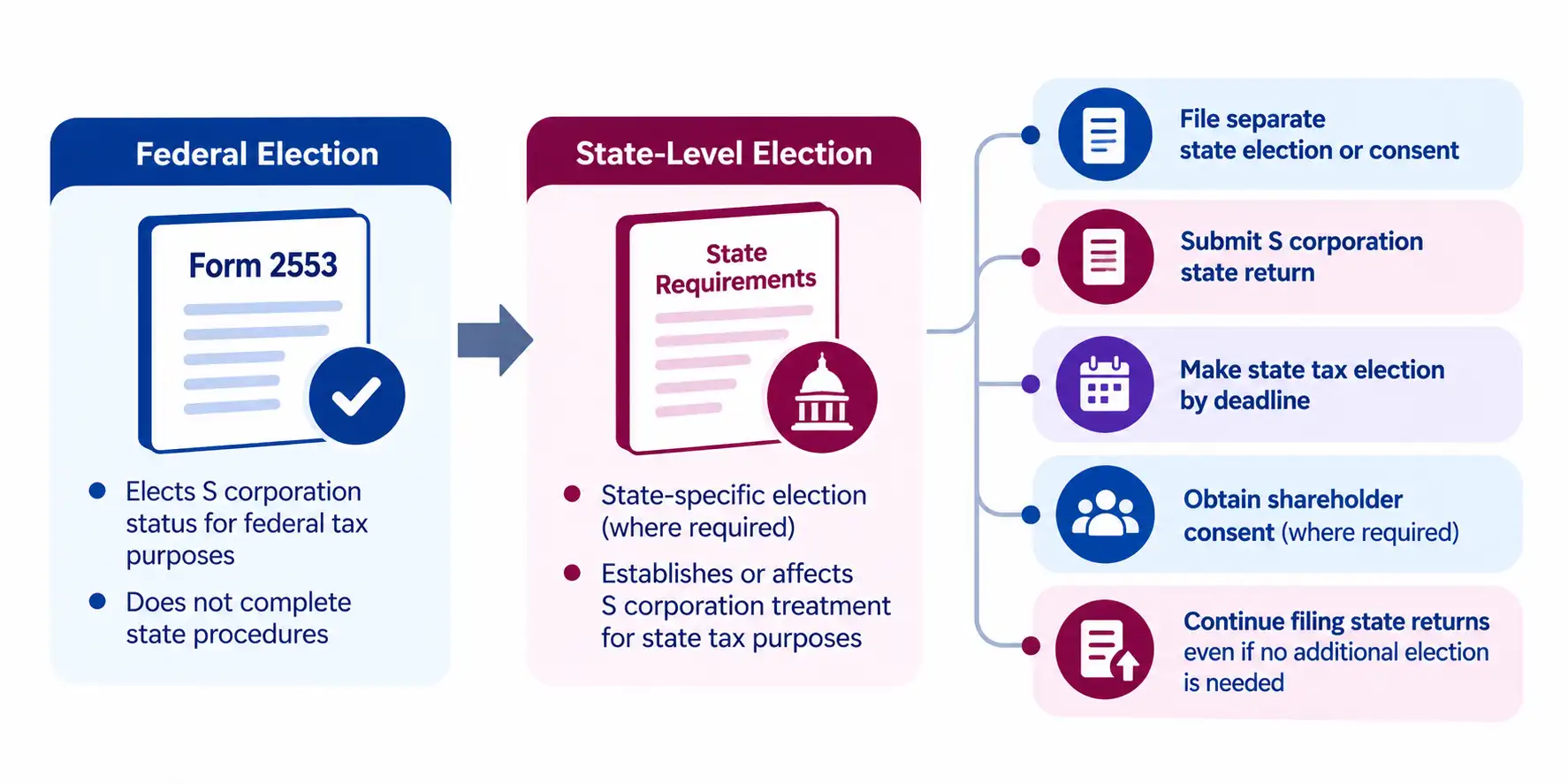
A state-level S corporation election is a state-specific election, where required, that establishes or affects the business's S corporation treatment for state tax purposes. It is distinct from filing a state return or making an optional PTE tax election.
Do not confuse the federal S corporation election with a state election. Filing IRS Form 2553 establishes the federal election when the applicable requirements are met; it does not automatically complete every state procedure.
Depending on the state, a business may need to:
Not every state requires a separate S corporation election. Some states generally follow the federal classification but still impose state taxes and filing requirements.
Review the rules when you first elect S corporation status, register or begin operating in a new state, change your business structure, add or change shareholders, or begin considering an entity-level tax election.
Also confirm whether an election is annual, irrevocable for a specified period, renewable, or subject to a specific effective date. Those conditions cannot be assumed to be the same in every state.
A pass-through entity tax (PTE tax) election allows an eligible pass-through business to elect to pay certain state income taxes at the entity level rather than having all of the relevant state income tax paid directly by its owners.
Some states introduced or expanded these elections in response to the federal individual state and local tax (SALT) deduction limitation. Federal SALT deduction rules have since changed, so the potential benefit of a PTE election should be evaluated under the federal rules applicable to the relevant tax year. The availability and treatment of a PTE election also vary by state and tax year.
The process may involve:
Rhode Island permits qualifying pass-through entities to elect to pay state tax at the entity level under its PTE rules. Its Division of Taxation describes an election at a 5.99% rate for eligible entities under the relevant provisions. The rate applies to the income covered by the election under the applicable state rules. The relevant tax-year forms and instructions should be checked before making the election.
This is a state-specific example, not a universal PTE tax rate.
No. The potential benefit depends on the state's election rules, the income covered by the election, the federal deduction treatment of the entity-level payment, shareholder circumstances, payment timing, and any credits or adjustments available to owners.
An election can also introduce additional calculations, estimated payments, filing requirements, and administrative work. A business should compare the likely overall result with the cost of complying with the election before proceeding.
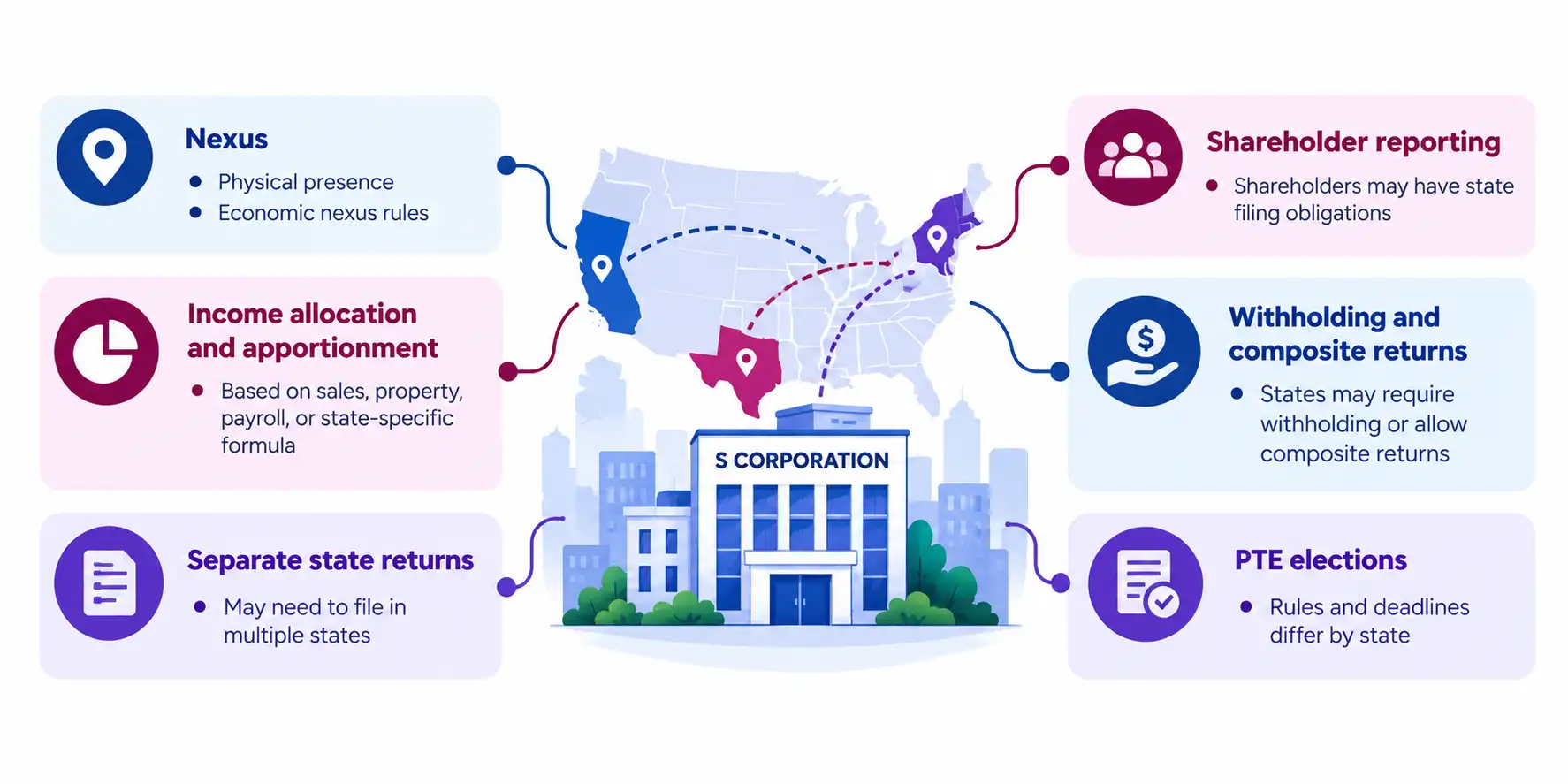
An S corporation may have tax obligations in several states if its activities create a filing or tax connection under those states' laws.
For example, a business may be incorporated in one state, employ staff in another, and make sales or hold property in a third. The state where the business was formed does not necessarily have exclusive taxing authority over its income.
Before expanding into another state, estimate the additional registration, tax, payroll, and filing requirements—not just the expected revenue.
Use this checklist to organize a state-by-state review.
Include the state of formation, registration states, locations of offices and employees, and states where the company has property, sales, or other business activity.
Verify the federal S corporation election and determine how each relevant state treats the business. Do not assume every state follows the federal election in the same way.
Check state income taxes, franchise or minimum taxes, annual fees, withholding, estimated payments, and separate returns.
Determine whether a state-level election or consent is needed, whether a PTE election is available, and how the relevant deadlines and payment rules work.
Assess whether owners need state individual returns, nonresident withholding, composite filing, or information about entity-level tax payments.
Use the relevant state's official tax agency website and current-year instructions. Rules, forms, and deadlines can change, so older articles should not replace current official guidance.
Keep a record of the states reviewed, filing positions, elections made or declined, supporting calculations, and relevant deadlines. This makes future compliance and tax planning more consistent.
Understand state tax rules, franchise taxes, and PTE elections with professional guidance tailored to your business.
S corporation state tax compliance is more than filing the federal Form 1120-S. State recognition rules, franchise taxes, minimum payments, nonresident shareholder requirements, multistate activity, and optional PTE elections can all affect the business's obligations.
Because these rules vary by jurisdiction and tax year, a decision that works in one state may not produce the same result in another. Reviewing each state's requirements before an election or expansion can help business owners avoid missed filings, unexpected tax costs, and unnecessary administrative work.
Savetaxs' CPAs, Enrolled Agents, and tax experts can help business owners review applicable federal and state filing requirements, assess relevant state elections, and organize compliance based on their business circumstances. The appropriate scope of support depends on the states involved and the company's tax situation.
This article is for general informational purposes only and does not constitute tax, legal, financial, or investment advice. Laws, regulations, rates, and procedures may change over time and may vary based on individual circumstances.
While SaveTaxs makes reasonable efforts to keep the information accurate and up to date, readers should verify applicable rules with official authorities or consult a qualified professional before making decisions based on this information.
Shubham Jain is the Founder of SaveTaxs and has extensive experience in Indian and NRI taxation. He advises individuals, NRIs, and businesses on tax filing, tax planning, capital gains, DTAA benefits, fund repatriation, and compliance matters. He regularly writes about taxation and related financial topics. His focus is on making complex tax concepts easy to understand. Through his articles, he helps taxpayers stay informed, avoid common mistakes, and stay compliant with Indian tax laws. See Full Bio

Want to read more? Explore Blogs