US Tax Filing and Compliance
How to Report Multiple 1099 Forms on a U.S. Tax Return: A Guide for NRIsHow to Report Multiple 1099 Forms on a U.S. Tax Return: A Guide for NRIs
Written by Hatim Dudhiyawala
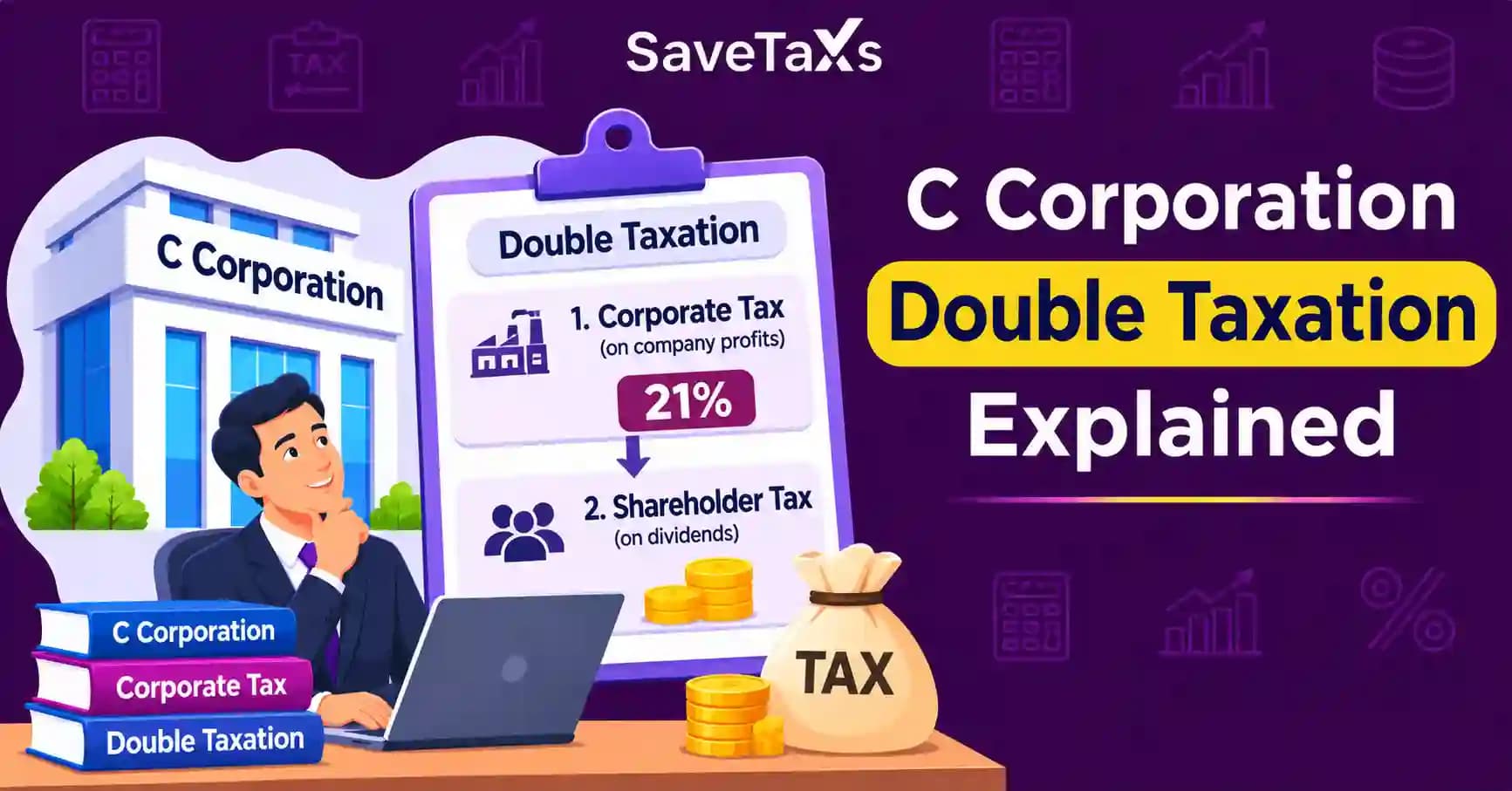
A C Corporation offers business owners a separate legal structure, limited liability protection and flexibility in raising capital. However, one important tax consideration is C Corporation double taxation.
Unlike businesses that generally use pass-through taxation, a C Corporation is typically taxed separately from its shareholders. The corporation pays federal income tax on its taxable profits. If it distributes its after-tax profits to shareholders as dividends, shareholders may also owe individual income tax on those dividends.
This two-level tax treatment is commonly called double taxation.
For U.S. business owners, understanding how this process works is important when deciding how to structure a business, distribute profits and plan for long-term growth.
Double taxation in a C Corporation refers to the potential taxation of corporate profits at two different levels:
A C Corporation is treated as a separate taxpayer for federal income tax purposes. Its shareholders do not generally report the corporation's ordinary business profits directly on their individual returns merely because they own shares.
Instead, the corporation reports its taxable income and pays applicable corporate income tax. When it distributes earnings as dividends, shareholders generally report taxable dividend income on their individual tax returns.
The corporation generally cannot deduct dividends paid to shareholders as a business expense. This is why the same underlying corporate earnings can be subject to tax at both levels.
For a broader explanation of the business structure, see our guide to how a C Corporation works.
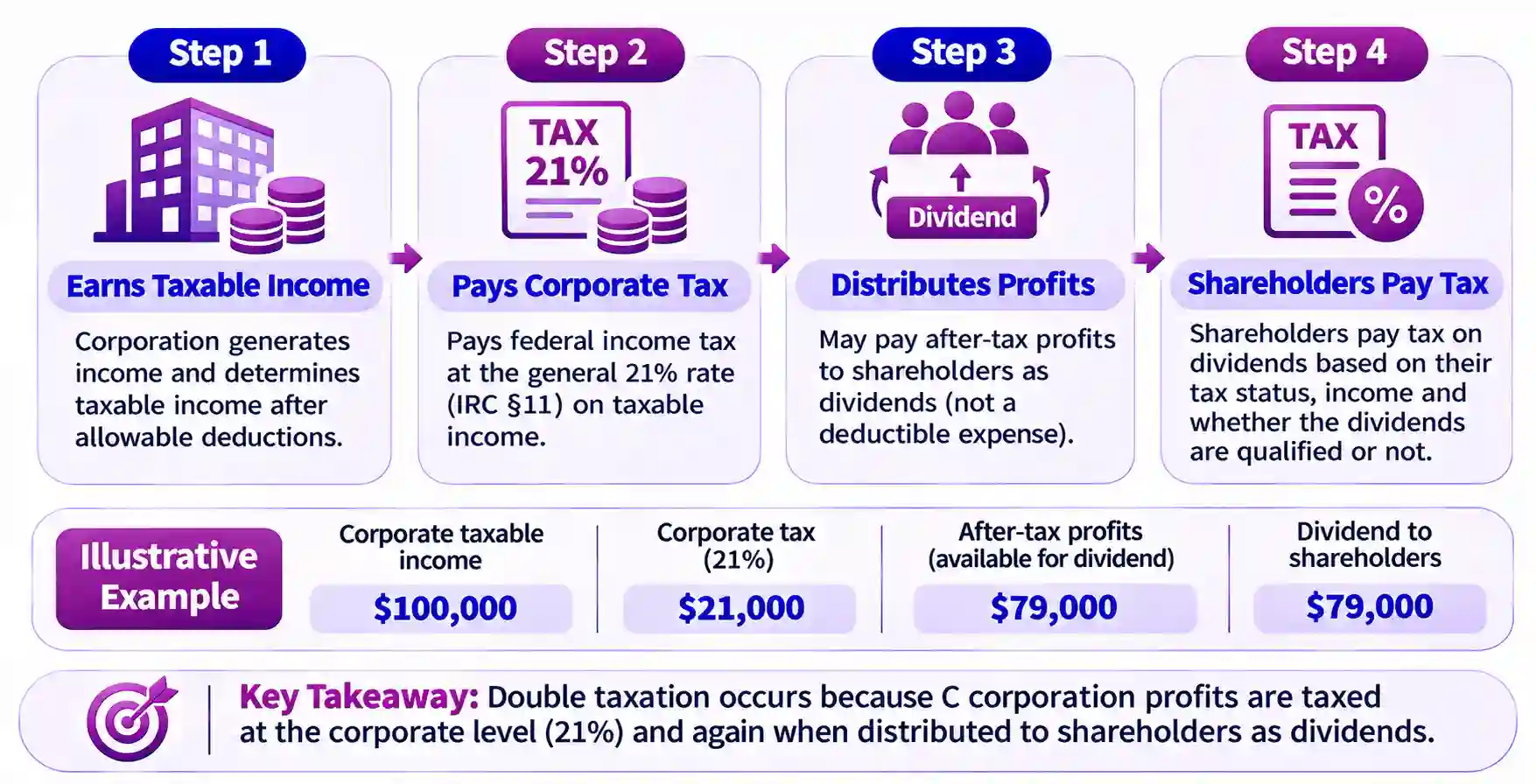
C Corporation double taxation generally occurs through the following process.
A C Corporation generates income through its business activities. After applying allowable deductions and other applicable tax adjustments, the corporation determines its taxable income.
The general federal corporate income tax rate is 21% under Section 11 of the Internal Revenue Code.
The corporate tax is calculated on taxable income, not simply on gross revenue.
For a detailed explanation of the corporate tax calculation, see our guide to the C Corporation federal tax rate.
The corporation calculates and pays its applicable federal income tax.
For example, assume a C Corporation has $100,000 in taxable income and qualifies for the general 21% federal corporate income tax rate.
| Particulars | Amount |
|---|---|
| Corporate taxable income | $100,000 |
| Illustrative federal corporate tax at 21% | $21,000 |
| Remaining amount after federal corporate tax | $79,000 |
The corporation has $79,000 remaining after the illustrative federal corporate tax, before considering any other applicable taxes, liabilities or business decisions.
The corporation may decide to distribute some or all of its available after-tax profits to shareholders as dividends.
For example, assume the corporation distributes the entire $79,000 to its shareholders as a dividend.
The dividend is not deductible by the corporation. Therefore, the corporation's payment of dividends does not reverse the corporate income tax already paid.
Individual shareholders who are U.S. citizens or resident aliens generally report taxable dividends on their individual federal income tax returns.
The applicable tax treatment depends on whether the dividends are qualified or nonqualified, the shareholder's income and filing circumstances, and other relevant tax rules. Corporate shareholders may be subject to separate dividend tax rules. Dividends paid to nonresident alien shareholders are generally subject to U.S. withholding tax, which may be reduced under an applicable tax treaty.
This creates the second level of taxation.
Continue with the $100,000 example.
Assume the corporation pays $21,000 in federal corporate income tax and distributes the remaining $79,000 as dividends.
For illustration only, assume the shareholder's entire dividend qualifies for a 15% federal dividend tax rate.
| Tax calculation | Amount |
|---|---|
| Original corporate taxable income | $100,000 |
| Corporate federal income tax | $21,000 |
| Dividend distributed | $79,000 |
| Illustrative shareholder dividend tax at 15% | $11,850 |
| Total illustrative federal taxes | $32,850 |
| Amount remaining after both tax layers | $67,150 |
The illustrative combined federal tax burden is 32.85% of the original $100,000 corporate taxable income.
Important: This is a simplified example, not a universal C Corporation tax rate. Actual results may differ based on the shareholder's dividend classification, taxable income, eligibility for preferential rates, potential Net Investment Income Tax, state and local taxes, and other applicable rules. The example assumes an eligible U.S. individual shareholder whose entire dividend qualifies for the 15% federal qualified-dividend rate. Certain individual shareholders may also owe the 3.8% Net Investment Income Tax (NIIT) on dividend income if they meet the applicable income and other requirements.
Get professional support with corporate tax calculations, dividend-related considerations and C Corporation tax planning.
When a C Corporation distributes profits to shareholders, the tax treatment generally depends on whether the distribution qualifies as a dividend and how the dividend is classified for individual income tax purposes.
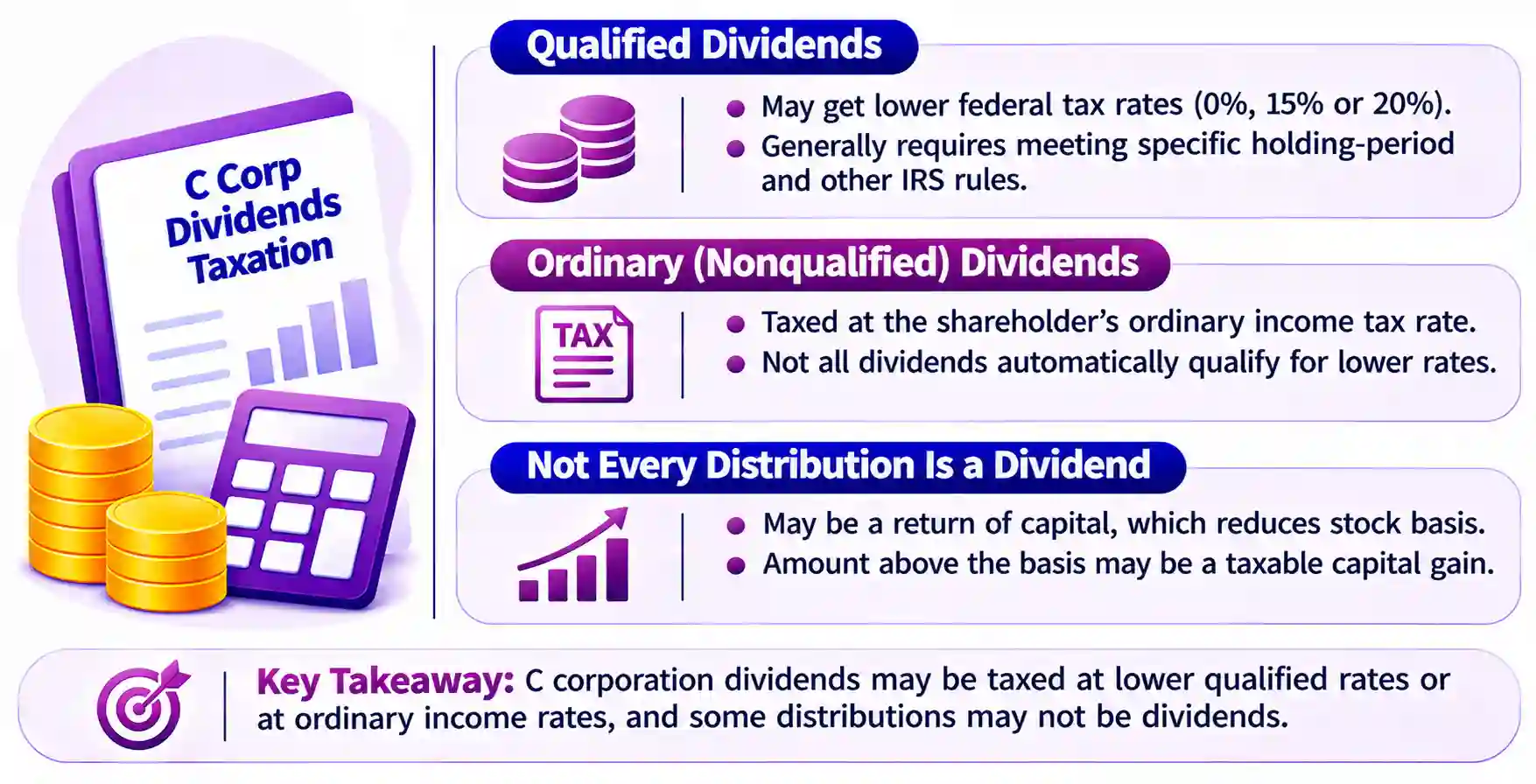
Qualified dividends may be eligible for preferential federal tax rates rather than ordinary income tax rates.
Generally, qualified dividends must meet requirements relating to the paying corporation, the type of dividend and the shareholder's holding period. For most common stock, the shareholder must generally hold the stock for more than 60 days during the 121-day period beginning 60 days before the ex-dividend date. Certain preferred stock is subject to a different holding-period requirement.
For example, dividends paid by an eligible U.S. corporation may qualify if the shareholder satisfies the applicable holding-period and other statutory requirements.
The maximum federal tax rates that generally apply to qualified dividends are 0%, 15% or 20%, depending on the taxpayer's circumstances and applicable tax-year thresholds.
Nonqualified dividends are generally taxed at the shareholder's ordinary income tax rates.
A dividend does not automatically qualify for preferential treatment simply because it is paid by a U.S. corporation.
The shareholder should review the dividend information reported by the corporation, including Form 1099-DIV where applicable, and determine the correct treatment on the individual tax return.
No. Not every payment or distribution made by a corporation to a shareholder is automatically treated as a taxable dividend.
The tax treatment generally depends on the corporation's current and accumulated earnings and profits, the shareholder's stock basis and the nature of the transaction.
A distribution that is not treated as a dividend may reduce the shareholder's stock basis. Any amount exceeding the applicable basis may result in a taxable gain.
Therefore, business owners should not assume that every shareholder payment has the same tax treatment.
For more information about dividend income and its reporting, refer to the IRS guidance on dividends and other corporate distributions.
One major difference between C Corporations and S Corporations is how business income is generally taxed for federal income tax purposes.
A C Corporation generally pays corporate income tax on its taxable income. Shareholders may then pay individual income tax when the corporation distributes taxable dividends.
An eligible S Corporation generally uses pass-through taxation. Its income, deductions, credits and other applicable tax items generally pass through to shareholders, who report their allocated amounts on their individual tax returns.
| Tax consideration | C Corporation | S Corporation |
|---|---|---|
| General federal tax treatment | Corporate-level income taxation | Generally pass-through taxation |
| Business taxable income | Generally taxed at corporate level | Generally passes through to shareholders |
| Shareholder taxation | Dividends may be taxed when distributed | Shareholders generally report allocated tax items |
| Tax on undistributed income | Corporate tax generally applies | Shareholders generally report allocated income even without distributions |
| Ownership requirements | Generally more flexible | Specific shareholder eligibility and ownership restrictions |
| Federal income tax return | Generally Form 1120 | Generally Form 1120-S |
An S Corporation does not automatically eliminate every form of entity-level tax. Certain S Corporations may be subject to specific federal taxes, and state tax treatment can differ.
S Corporation eligibility requirements include restrictions on shareholder types. Nonresident aliens generally cannot be S Corporation shareholders.
Similarly, S Corporation shareholders may owe tax on allocated income even when the business does not distribute cash to them.
The appropriate structure depends on the business's ownership, profitability, financing plans, shareholder circumstances and compliance requirements.
Read our S Corporation guide to understand its taxation, requirements and how it works.
Get help with corporate tax compliance, Form 1120 preparation and applicable state filing requirements.
C Corporation double taxation is an important consideration for U.S. business owners because corporate profits may be taxed once at the corporate level and again when distributed to shareholders as taxable dividends.
However, the actual tax burden depends on more than the general corporate tax rate. Dividend classification, shareholder income, distribution decisions, state tax obligations and the company's long-term financial plans can all affect the outcome.
Before choosing a C Corporation structure or deciding how to distribute profits, business owners should evaluate the corporate and shareholder tax consequences together.
SaveTaxs can help business owners review C Corporation tax obligations, understand corporate tax calculations, prepare Form 1120 and assess applicable tax considerations. Explore C Corporation Tax Services to get professional support for your business.
This article is for general informational purposes only and does not constitute tax, legal, financial, or investment advice. Laws, regulations, rates, and procedures may change over time and may vary based on individual circumstances.
While SaveTaxs makes reasonable efforts to keep the information accurate and up to date, readers should verify applicable rules with official authorities or consult a qualified professional before making decisions based on this information.
Vipul Jain is the Co-Founder of SaveTaxs and a tax expert with experience in Indian and NRI taxation. He advises individuals, NRIs, and businesses on tax filing, tax planning, capital gains, DTAA, and compliance matters. He focuses on making complex tax concepts simple and helping taxpayers make informed, compliant decisions. See Full Bio

Want to read more? Explore Blogs