NRI Income Tax Compliance
Income Tax Forms Renamed in 2026: Old vs New Form NumbersIncome Tax Forms Renamed in 2026: Old vs New Form Numbers
Written by Vipul Jain
Form 16 is issued by employers to employees who earn a salary, confirming the TDS details for their salary. The form details salary breakdown, deductions, exemptions, and so on. Whereas Form 16A is issued for non-salary payments such as professional fees, consultancy fees, rent, interest, and so on. 16 A is issued by the deductors, such as loans, banks, and tenants, to the deductee.
While Form 16 is issued annually, Form 16A is generally issued quarterly, and both forms are essential for accurate tax filing.
In this blog, we will understand the difference between Form 16 and Form 16A in detail.
The following table demonstrates the fundamental differences between Form 16 and Form 16A.
| The Basis | Form 16 | Form 16A |
|---|---|---|
| The Eligibility | For individuals with a salary | Individuals receiving non-salary income such as professional fees, interest, rent, commission, or consultancy payments. |
| Issuer | the Employer | Financial institutions, tenants, banks, etc. |
| Issued against | Salaried Individuals | Non-salaried individuals |
| Issuance frequency | Annual | Quarterly |
| Applies To | The salary income | Income from rent, commission, professional fees, interest, contractor payments, machinery hire charges, and other specified non-salary payments. |
| Law | Section 203 of the IT Act | Section 203 of the Income Tax Act |
Savetaxs helps NRIs file their ITR with expert guidance, confidence, and stress-free.
Form 16 is a certificate issued by an employer to their employees regarding Tax Deducted at Source (TDS) on the employee's salary income. This form serves as proof to the employee that their employer has deducted TDS from their salary and deposited it with the government, along with a summary of salary paid and deductions claimed. This form is generally important for salaried individuals when filing their income tax returns, as Form 16 provides a detailed summary of their earnings and the taxes they have paid.
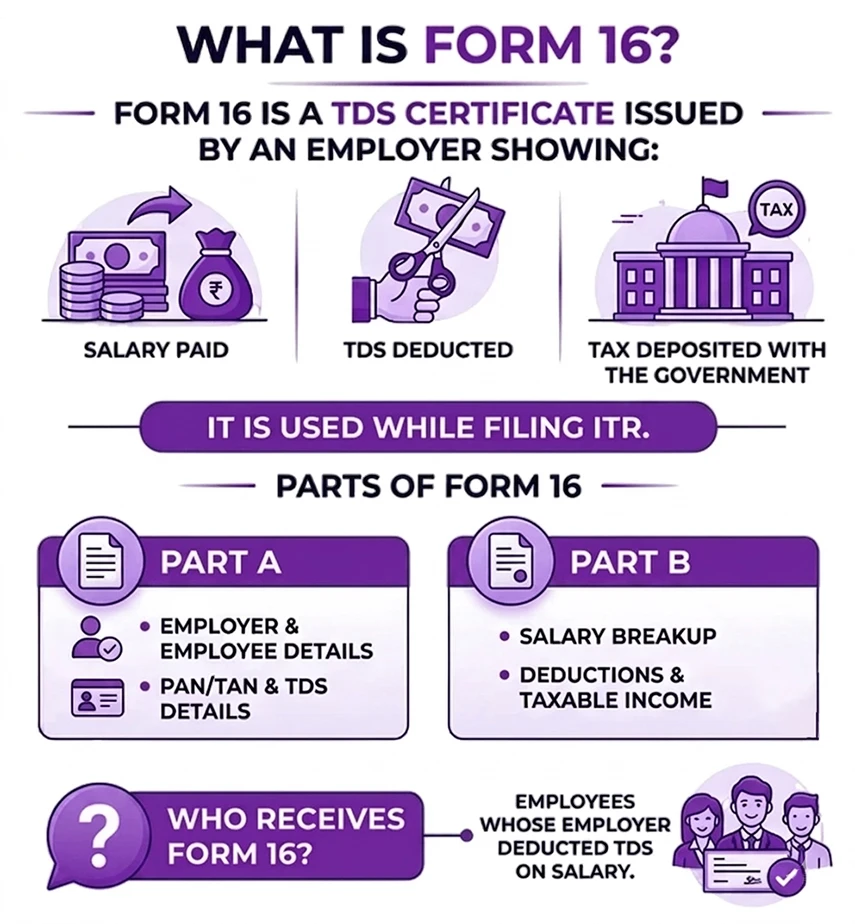
Form 16 has two parts: Part A and Part B; both serve distinct purposes.
Form 16 is generally issued to salaried individuals whose employer has deducted TDS from their salary during the financial year. If the employee's income exceeds the basic exemption limit, the employer must deduct TDS from the employee's salary and provide the employee with Form 16.
However, if the employer has not deducted the TDS, it is perhaps because your income is below the taxable limit or your taxable income becomes nil after considering applicable exemptions and deductions. Hence, the employer may not need to issue Form 16. In this case as well, you can still file your ITR using your salary slips and other relevant documents.
For example, if you are employed by a company and your employer deducts TDS every month, then at the start of the new financial year, you will receive a Form 16 showing your total earnings, deductions such as investments under Section 80C, HRA claims, and the tax paid on your behalf.
Form 16A is a TDS certificate issued for income other than salary, such as interest income, professional fees, commissions, and rent. This certificate is issued by the entity deducting TDS, such as banks, tenants, companies, or clients. The form serves as proof that TDS has been deducted and deposited with the government for the non-salary payments.
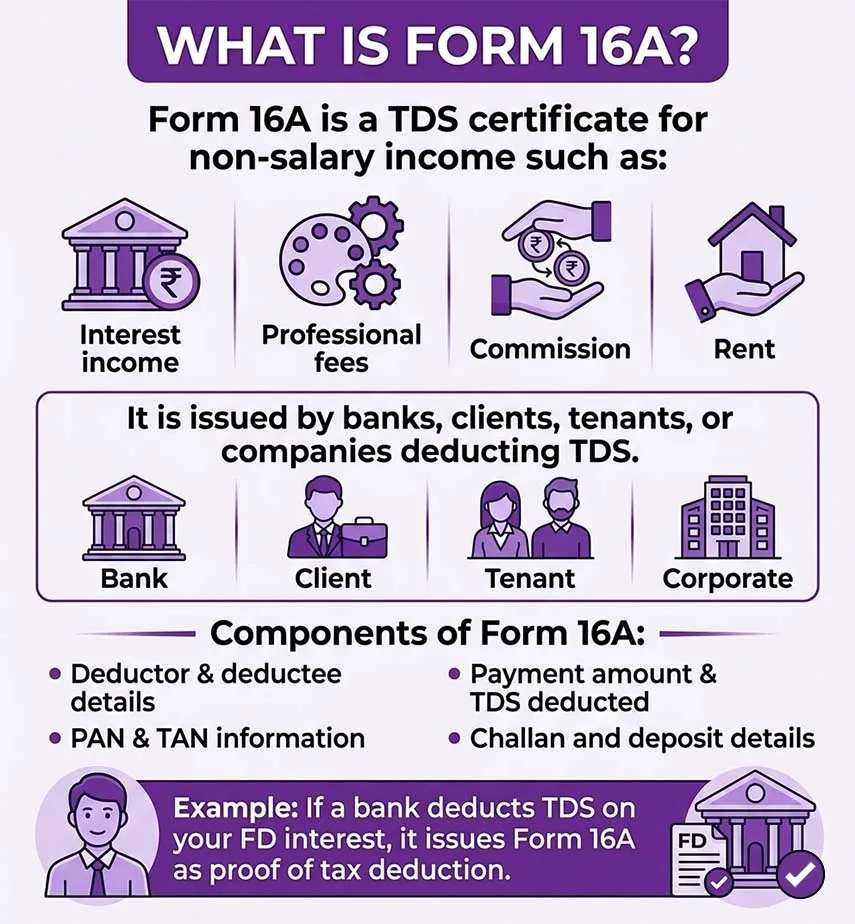
The components of Form 16A include.
In a nutshell, Form 16A is necessary to accurately report non-salary income and claim the appropriate tax credits.
Example
Let us assume that you earn Rs 45,000 in interest from a bank fixed deposit in a year, and the bank deducts TDS on it. If the interest exceeds the applicable TDS threshold limit during the financial year, the bank may deduct TDS and issue Form 16A. The banking institution will then issue you Form 16A, which includes details of the interest paid and the tax deducted. Just like this, if you are a freelancer or consultant and your clients deduct tax before they pay you, your Form 16A will reflect the same.
Yes, NRIs can receive Form 16 and Form 16A depending on their source of income in India. NRIs can receive Form 16 when they earn salary income in India and TDS is deducted on such salary. Whereas Form 16A is received if the NRIs have a non-salary income, such as interest income, rent, and other non-salary income.
From business setup to compliance, we have you covered.
In the life of a taxpayer, both Form 16 and Form 16A play essential roles in income tax compliance, addressing different aspects of financial and income transactions.
As an NRI, if you are seeking expert guidance for ITR filing in India, Savetaxs is the name to trust. We help NRIs with ITR filing, compliance, tax advisory, refund management, DTAA analysis, tax planning, capital gains calculations, document verification, litigation support, and more.
Connect with us as we serve our clients 24/7 across all time zones.
This article is for general informational purposes only and does not constitute tax, legal, financial, or investment advice. Laws, regulations, rates, and procedures may change over time and may vary based on individual circumstances.
While SaveTaxs makes reasonable efforts to keep the information accurate and up to date, readers should verify applicable rules with official authorities or consult a qualified professional before making decisions based on this information.
Vipul Jain is the Co-Founder of SaveTaxs and a tax expert with experience in Indian and NRI taxation. He advises individuals, NRIs, and businesses on tax filing, tax planning, capital gains, DTAA, and compliance matters. He focuses on making complex tax concepts simple and helping taxpayers make informed, compliant decisions. See Full Bio
Want to read more? Explore Blogs