NRI Income Tax Compliance
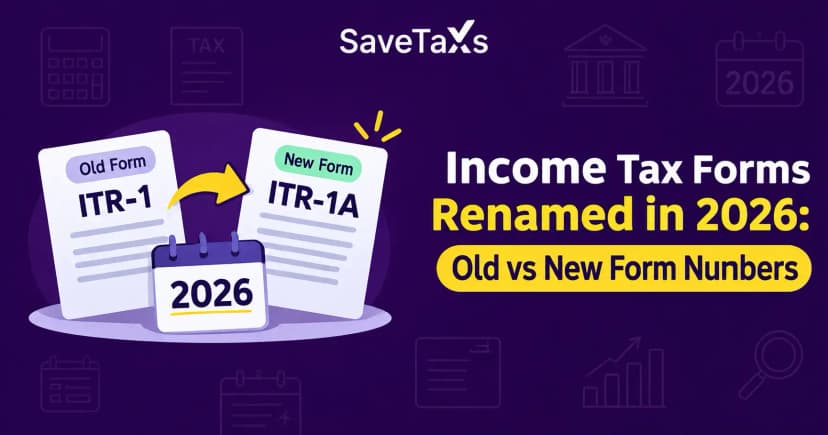
Income Tax Forms Renamed in 2026: Old vs New Form NumbersIncome Tax Forms Renamed in 2026: Old vs New Form Numbers
Written by Vipul Jain
_1778215894059.webp&w=3840&q=75)
What if the moment you return to India, you realise you lose all your NRI tax benefits? You instantly start calculating your foreign salary, rental income, and FCNR deposits and are amazed by the results. But the good news is that it is not completely true.
The tax obligations of an individual returning to India depend on three tax statuses, i.e., NRI, RNOR, or resident. Considering this, understanding residential status is vital when dealing with NRI vs resident tax filing in India. This is because a single factor determines whether you pay tax on your global income or on income received or earned in India. Additionally, the ITR form you will fill out, the deductions you can claim, and how much TDS will be deducted from your payments.
To help you out, this blog breaks down NRI vs resident tax filing in India and compares them across income types, tax slabs, TDS rates, and available tax deductions to help you know which works in your favour. So read on and resolve all your doubts.
First, let's clear your doubts: your tax obligation in India does not depend on your passport or citizenship. It depends on your residential status as stated under the Income-tax Act, 1961. Considering this, every financial year (April 1 to March 31), the Indian law determines the number of days you spend in India and labels your residential status accordingly.
Here, the transition sequence from NRI to RNOR works like this: You spend years overseas as an NRI and return to India. Now, for the first two to three years, you are considered an RNOR. After that, once your abroad history fades, you become ROR (resident and ordinarily resident) and become liable to pay tax on your global income.
This was all about tax residency status under Indian law. Understanding the residential status is important because it impacts whether you are liable to pay tax on your global income or only on the income you earned or received in India.
Moving forward, let's know what income is taxable for NRIs and residents in India.
NRI status and taxation explained
The table below answers all your queries, i.e., which income is taxed based on your residential status in India.
| Type of Income | NRI | RNOR | Resident (ROR) |
|---|---|---|---|
| Indian Wages/ Salary | Taxable | Taxable | Taxable |
| Foreign Salary (work done outside India) | Exempt | Exempt | Taxable |
| Rental income from Indian property | Taxable | Taxable | Taxable |
| Rental income from foreign property | Exempt | Exempt | Taxable |
| Capital gains from Indian property/ shares | Taxable | Taxable | Taxable |
| Capital gains from foreign property/ shares | Exempt | Exempt | Taxable |
| NRE/ FCNR/ FD interest | Exempt | Exempt (while holding NRI status) | Taxable |
| NRO FD/ savings interest | Taxable | Taxable | Taxable |
|
Dividends from Indian companies |
Taxable | Taxable | Taxable |
| PPF maturity proceeds (Indian PPF) | Exempt | Exempt | Exempt |
| Foreign bank interest/ dividends | Exempt | Exempt | Taxable |
This was all about the income taxable in India as per your residential status. Moving further, let's know about the tax regime and slabs available for NRIs and residents in India.
The residential status of an individual in India shapes tax slabs and rates. Considering this, residential faces a progressive income tax structure, while for specific income types, NRIs have a flat tax rate. Additionally, for certain income, such as dividends and capital gains, a special tax rate applies to both groups. Apart from this, NRIs and residents can choose from the new tax regime and the old tax regime.
The new tax regime treats both NRIs and residents alike, eliminating the slab rate difference.
| Income Slab | Resident Rate | NRI Rate |
|---|---|---|
| Up to INR 4,00,000 | Nil | Nil |
| INR 4,00,001 - INR 8,00,000 | 5% | 5% |
| INR 8,00,001 - INR 12,00,000 | 10% | 10% |
| INR 12,00,001 - INR 16,00,000 | 15% | 15% |
| INR 16,00,001 - INR 20,00,000 | 20% | 20% |
| INR 20,00,001 - INR 24,00,000 | 25% | 25% |
| Above INR 24,00,000 | 30% | 30% |
Along with all slab rates, 4% health and education are also applied to the total tax. Additionally, a surcharge also applies to income more than INR 50,00,000.
Under the old tax regime, NRIs and residents have similar tax slabs; however, for certain types of income, NRIs have special rates. Additionally, the old tax regime requires Form 10-IEA for business income.
| Income Slab | Resident Rate (<60 years) | NRI Rate |
|---|---|---|
| Up to INR 2,50,000 | Nil | Nil |
| INR 2,50,001 - INR 5,00,000 | 5% | 5% |
| INR 5,00,001 - INR 10,00,000 | 20% | 20% |
| Above INR 10,00,000 | 30% | 30% |
After knowing about the tax regime and slab rates for NRIs and residents in India, moving forward, let's know about the Section 87A rebate.
Under section 87A, a rebate is a tax benefit in India provided to middle to low-income earners. It is the most impactful difference between resident and NRI tax filing in India. This is because it is only available to residents.
| Feature | Resident Indian | NRI |
|---|---|---|
| Section 87A Rebate (Old Regime) | Up to INR 12,500 rebate if the total income is ≤ INR 5,00,000 - effectively zero tax | Not available for NRIs |
| Section 87A Rebate (New Regime) | Up to INR 60,000 rebate if the gross income is ≤ INR 12,00,000 - effectively zero tax | Not available for NRIs |
| Effective | Under the new tax regime, a salaried resident with INR 12,00,00 gross income pays zero tax (INR 60,000 rebate + INR 75,000 standard tax deduction) | An NRI with a total INR 12,00,000 Indian income pays full tax at the slab rate (~INR 60,000 + depending on composition) |
This was all about the section 87A rebate for NRIs and residents in India. Moving ahead, let's know about the TDS rates available for NRIs and residents in India.
Compared to residents, NRIs pay higher TDS rates for payments, showcasing the effort of the government to collect tax at source before funds leave India. This further creates a cash flow challenge. NRIs often pay more TDS, and to reclaim the excess, they should file an ITR. To provide you with an idea, the table below showcases TDS rates for NRIs and residents in India.
| Income Type | TDS Rate- NRI | TDS Rate- Resident |
|---|---|---|
| Bank Interest (NRO FD) | 30% + 4% cess = 31.2% | 10% above INR 40,000/year, INR 50,000 for seniors. |
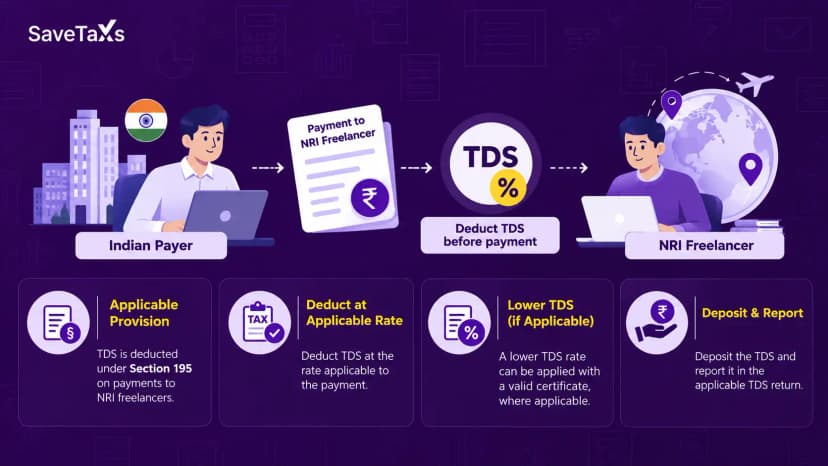
| Professional Fees | 30% (section 195) | 10% (section 194J) |
| Salary Income | Slab rate (section 192) | Slab rate (section 192) |
| Rent Received | 31.2% (section 195) | 5-10% (section 194I/ section 194IB) |
| Dividends | 20% (section 195) | 10% (section 194, above INR 5,000) |
| Property Sale Proceeds | 12.5% (section 195) | 1% of consideration (section 194IA) |
| No PAN Furnished | Higher of 20% or applicable rate | Higher of 20% or applicable rate |
This is how NRIs and residents are taxed in India. Moving further, let's know about the ITR forms available for NRIs and residents in India.
This is the area where most NRIs get confused, as the income tax department has issued several ITR forms. Considering this, NRIs need to choose the right ITR form based on their residential status and income type.
These are the different types of ITR forms available for NRIs and residents in India. Residents can fill out ITR-1, ITR-2, ITR-3, or ITR-4 forms without any restrictions. Additionally, like NRIs, RNOR individuals can use the ITR-2 or ITR-3 form based on their source of income in India. However, when filing the form, they need to choose their residential status as "RNOR." Failing to do so can result in paying tax on global income in India.
Now, moving forward, let's know about the tax deductions and exemptions available for NRIs and residents in India.
In India, NRIs can claim most of the tax deductions available to residents. However, not all tax deductions are available to NRIs in India. To give you an idea, here is a comprehensive deduction list available to NRIs and residents in India.
These are some of the tax deductions and exemptions available for NRIs and resident taxpayers in India. Moving ahead, let's know how NRIs and residents can claim DTAA benefits.
With the Double Taxation Avoidance Agreement (DTAA), India allows NRIs and residents to avoid paying double taxation with 20+ countries. Considering this, NRIs and residents use the DTAA benefits differently. Here, the table below showcases the DTAA use cases.
| DTAA Use Case | Resident | NRI |
|---|---|---|
| Reducing TDS on Indian Income | Generally not needed by residents as they already have low TDS rates. Additionally, DTAA is mainly used for foreign source income. | To reduce the TDS rates, NRIs need to provide a tax residency certificate (TRC) + Form 10F to Indian payers to reduce the rate from 30% to the DTAA treaty rate. For instance, 15% India-USA on interest. |
| Claiming Foreign Tax Credit (FTC) |
Residents using DTAA can claim FTC in India for taxes they paid on foreign income. For this, they need to file Schedule TR + Form 67 in India. |
NRIs can claim FTC in their resident country for taxes they paid in India. For acknowledgment, they need to use the Indian Form 16A/ ITR. |
| Capital Gains (Who has the right to tax) | India has the first right to claim capital gains tax. Considering this, residents on remaining income can claim FTC overseas. | Generally, India has the first right to claim the capital gains tax on Indian assets; NRIs in their resident country claim FTC. |
| Form 10F Requirement | Residents claiming FTC instead of Form 10F need to file Form 67 in India along with their ITR. | NRIs need to file Form 10F using the IT portal. Additionally, annually provide this form to the Indian deductor/ payer. |
This is how NRIs and residents can claim DTAA benefits and avoid double taxation on the same income twice.
Connect with Savetaxs and get the best tax solutions from tax experts.
Lastly, in India, the tax obligation of an individual, rather than citizenship or passport, depends on their residential status. Considering this, for optimal financial planning, it is vital to understand NRI vs resident tax filing in India. Additionally, to ensure compliance with Indian legal norms and increase financial benefits, staying informed about changing tax regulations and taking professional advice is important for NRIs.
Further, being an NRI, if you are also confused about your residential status in India or facing issues in paying taxes, connect with Savetaxs. We have a team of tax experts who assist you in determining your residential status and fulfilling your tax obligations on time with complete accuracy. You can contact us anytime; our customer service team is 24/7 available to help you.
This article is for general informational purposes only and does not constitute tax, legal, financial, or investment advice. Laws, regulations, rates, and procedures may change over time and may vary based on individual circumstances.
While SaveTaxs makes reasonable efforts to keep the information accurate and up to date, readers should verify applicable rules with official authorities or consult a qualified professional before making decisions based on this information.
Vipul Jain is the Co-Founder of SaveTaxs and a tax expert with experience in Indian and NRI taxation. He advises individuals, NRIs, and businesses on tax filing, tax planning, capital gains, DTAA, and compliance matters. He focuses on making complex tax concepts simple and helping taxpayers make informed, compliant decisions. See Full Bio
Want to read more? Explore Blogs