




NRI Income Tax Compliance
How to Claim Excess TDS Refund After Selling Property in India as an NRIHow to Claim Excess TDS Refund After Selling Property in India as an NRI
Written by Shubham Jain

Receiving an income tax notice under section 148A is nothing to be scared of. It is just the tax authorities' way of telling you that "We have information suggesting you have escaped assessment in the previous year. Before we repeat that year formally, we would like to give you a chance to explain."
For context, Sections 147 to 151 of the IT Act deal with provisions related to income that escapes assessment. Whenever the income tax department assessing officer (AO) has reasons to believe that an income has not been disclosed in the ITR, he/she can conduct an assessment, irrespective of whether the return is filed or not. This is known as income escaping assessment.
Now, Section 148A provides the taxpayer with an opportunity to explain their stance on whether an income escaping assessment is required. This is a show-cause notice and is used to notify the assessee, providing them with an opportunity to respond to the notice within a specified timeline, which is certainly 7 to 30 days.
In this blog, we will examine in detail the meaning of the notice under section 148A, how to respond to it, why such a notice is issued, the consequences, NRI considerations, and much more.
Section 148A of the Income-tax Act prescribes the mandatory pre-notice procedure that the Assessing Officer must generally follow before issuing a notice under Section 148, except in cases specifically excluded under the Act. In the 2021 Budget, the government of India introduced Section 148A to the Income-tax Act. Now, the support for the income tax officer indicates that you, as a taxpayer, have exhausted any income for any assessment year on which tax is payable. In such a case, Section 148A will require the income tax officer to first give you a chance to explain your case before issuing any notice.
In a nutshell, under section 148A, the assessee gets the chance to be heard by the officer.
After evaluating the taxpayer's reply, the income tax officer must decide whether to proceed with the income escaping assessment. If, by any chance, the IT officer decides to reopen the case, a copy of the order and a Notice Under Section 148 must be issued to the taxpayer.
With respect to the limitation clause, a notice that the taxpayer cannot be issued in normal circumstances if three years have elapsed since the end of the relevant assessment year. However, the notice beyond the three assessment years can be taken up only if there is solid evidence that the taxpayer has evaded an assessment of taxable income of at least Rs 50 lakh. Generally, a notice cannot be issued after three years from the end of the relevant assessment year. However, in cases covered under Section 149, where the prescribed conditions are satisfied, a notice may be issued up to ten years from the end of the relevant assessment year.
The income tax office must obtain the approval of the specified authority before conducting any such inquiries, providing the taxpayer with an opportunity, or passing such an order.
Ensure that none of the above applies to search or requisition cases.
Savetaxs helps NRIs file taxes in India under expert guidance and with 100% accuracy.
The income tax department issues a Section 148A notice when it has credible information indicating that income is chargeable to tax as an escape of assessment in a particular year. Common reasons include:
For NRIs, one of the most common issues is the undisclosed foreign bank account assets, explained remittances, and residential status disputes, where the global income may have been taxable in India for a particular year.
Your response to a Section 148A(b) notice is the most important opportunity in this entire process. A well-prepared, documented response can result in the matter being dropped entirely without any reassessment proceedings.
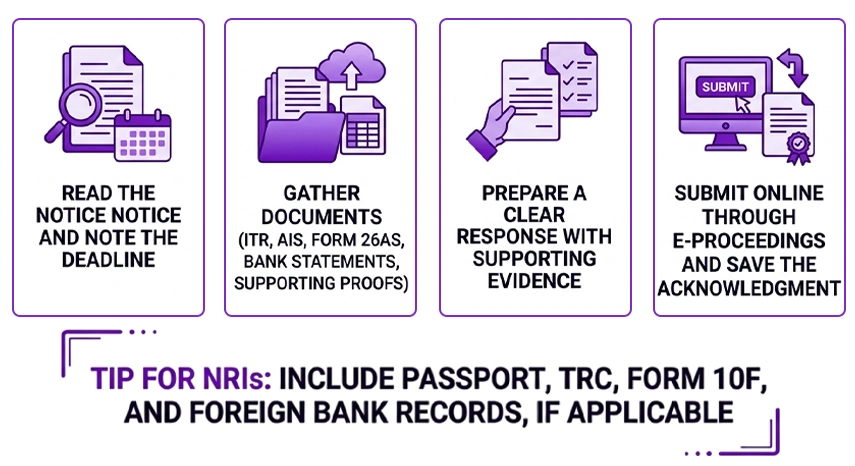
The notice will specify the assessment year, the relevant information, or the transaction the department is relying on, and the deadline for your response. Understand exactly what is being questioned before drafting your reply.
You must collect all the required documents to explain the income transitions in question.
Address the specific issues raised, nothing more or less. If the notice questions you about bank credits, just explain it clearly: salary, gifts, loan repayments, repatriation of own funds, and property sale proceeds. Attach supporting documents for every point you make.
Log in to incometax.gov.in, go to pending actions > e-proceedings, locate the section 148A notice, and submit the response. Upload your written reply and all the supporting documents as PDFs. Save this acknowledgment.
An essential point: Please do not treat a section 148A notice lightly, as it is only a show-cause notice. Your response here will determine whether the matter escalates to a full reassessment. A weak or incomplete response increases the likelihood that the AO will conclude that reassessment is warranted.
For NRIs and anyone dealing with such complex transactions, professional assistance at this stage is strongly advisable.
Section 148A has a specific time limit at both the response state and the order stage.
| Stage | Time Limit |
|---|---|
| Response time given to the taxpayer | Minimum time limit of 7 days, extendable to 30 days on request. |
| AO must pass the order under 148A(d) | Within 1 month from the end of the month in which the taxpayer's reply is received or the deadline expires. |
| Section 148 notice after 148A(d) order. | Issued along with or after the 148(d) order if reassessment is approved. |
Reassessment time limit under Section 149 (applicable to Section 148(d) and others).
| Escaped Income Amount | Time Limit For Section 148 Notice |
|---|---|
| Up to Rs 50 lakhs | Within three years from the end of the relevant assessment year. |
| Above Rs 50 Lakhs | Within 10 years from the end of the relevant assessment year. |
The extended limitation period of up to ten years applies only in cases covered under Section 149 where the prescribed conditions, including the applicable monetary threshold, are satisfied. This can be particularly relevant for NRIs with foreign assets or large remittances that may not have been properly disclosed.
A Flag For Legal verification: The time limits under Section 149 were amended by the Finance Act 2021 and further clarified through the subsequent CBDT circulars. Always verify the applicable limitation period for your specific assessment year, particularly for notices relating to years before AY 2021-22, where the transitional provision might apply.
The following consequences may apply to you if you fail to respond to a notice under Section 148A by the deadline.
To ensure comprehensive financial management and compliance with the notice, you may seek assistance from a CA who is well-versed in cross-border taxation and Indian tax laws.
In recent times, NRIs are increasingly receiving Section 148A notices, driven largely by FATCA and CRS data-sharing between countries, which gives the Indian tax department visibility into overseas bank accounts, investments, and the assets held by Indian residents and NRIs.
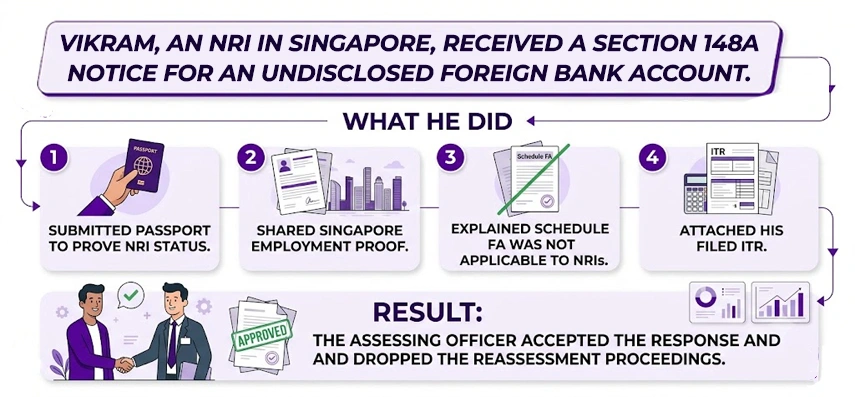
Vikram is an Indian citizen living in Singapore. In 2024, he received a Section 148A notice for the AY 2020-21, highlighting that he held a Singapore bank account with a balance of SGD 85,000, which was not disclosed in his Indian ITR Schedule FA.
Vikram has, in fact, been an NRI for the entire FY 2019-20, having spent only 45 days in India that year. As an NRI, he was required to disclose foreign assets in Schedule FA only if he was a Resident and ordinarily resident, which he clearly was not. His Singapore income and bank balance were legitimately outside India's tax net for that particular year.
Vikram then, with the help of a CA well-versed in NRI taxes, responded to the Section 148A(b) notice using this passport, showing he was in India for only 45 days in FY 2019-20. He provided his Singapore employment contract, his NRI status declaration, and a legal notice explaining that the Schedule FA disclosure implications apply only to ROR taxpayers, not to NRIs.
He further attached his filed ITR, showcasing that the NRI status was declared correctly.
The assessing officer then reviewed his response and passed an under Section 148A(d), dropping the matter, meaning no reassessment was initiated. This entire proceeding was resolved at the show-cause stage because Vikram responded with complete and accurate information.
The following are the tips that you must consider while responding to a Notice under Section 148.
Simplify your global and Indian tax compliance, maximize your earnings, and manage your offshore investments with Savetax's end-to-end expert NRI tax consultation.
A notice under Section 148A is part of the Income Tax Department's procedure to provide taxpayers with an opportunity to explain their case before reassessment proceedings are initiated under Section 148.
The key point is that Section 148A of the Income Tax Act was designed to protect taxpayers. Use it well. A formally opposed document presented at the show cause stage can and will regularly result in the matter being dropped entirely.
For NRIs, the notice generally relates to foreign asset disclosure, which includes FATCA/CRS data, and to residential states, where proper documentation and a clear understanding of your legal position are essential. Please do not respond to the notice under 148A casually in the air; you have to be professional and provide a relevant set of documents to support your response.
As an NRI, if you are seeking professional assistance in responding to an Income Tax Notice in India, Savetaxs is the name to trust. We have a team of experts who are well-versed in NRI and cross-border taxation. These experts will thoroughly analyze your notice and collect and organize the financial documents and records from you, including proof of investment, ITR copies, foreign bank statements, travel history, and more.
The expert will then help you draft a clear, professional response, ensure the flagged issues are addressed with utmost accuracy, and submit it. Our team will follow up on the status of the submitted response and keep you updated from time to time.
Connect with us as we serve our clients 24/7 across all time zones.
This article is for general informational purposes only and does not constitute tax, legal, financial, or investment advice. Laws, regulations, rates, and procedures may change over time and may vary based on individual circumstances.
While SaveTaxs makes reasonable efforts to keep the information accurate and up to date, readers should verify applicable rules with official authorities or consult a qualified professional before making decisions based on this information.
Vipul Jain is the Co-Founder of SaveTaxs and a tax expert with experience in Indian and NRI taxation. He advises individuals, NRIs, and businesses on tax filing, tax planning, capital gains, DTAA, and compliance matters. He focuses on making complex tax concepts simple and helping taxpayers make informed, compliant decisions. See Full Bio
Want to read more? Explore Blogs



Section 148 relates to the notice that the Income Tax Department can issue against any income that may have escaped assessment in previous assessment years.
Whereas Section 148A requires the Income Tax Department to give the taxpayers a chance to explain the reason for escaping an assessment.