US Tax Filing and Compliance
How to Report Multiple 1099 Forms on a U.S. Tax Return: A Guide for NRIsHow to Report Multiple 1099 Forms on a U.S. Tax Return: A Guide for NRIs
Written by Hatim Dudhiyawala


An NRI living in India may continue to hold US stocks, ETFs, real estate or other US-based assets after moving out of the United States. These investments may create a tax concern that many investors overlook: US estate tax.
Unlike income tax, which generally applies to income earned during a person's lifetime, estate tax may apply to certain assets when their owner dies. For a non-US citizen who is not domiciled in the United States, the rules can be particularly important because the US estate-tax filing threshold is generally just $60,000 of US-situated assets, subject to applicable adjustments and treaty provisions.
This does not mean every NRI who owns US assets automatically owes estate tax. The outcome depends on the person's citizenship, estate-tax domicile, asset location, ownership and applicable deductions or credits.
This guide explains when US estate tax may apply to NRIs, what the $60,000 threshold means, which assets may be included, and what the family or executor should review.
US estate tax is a federal tax imposed on the transfer of a deceased person's taxable estate. It is generally a tax on the estate, rather than a tax imposed directly on each beneficiary simply because they receive an inheritance.
For a US citizen or a person domiciled in the United States for estate-tax purposes, the rules generally consider worldwide assets. However, for a person who is neither a US citizen nor domiciled in the United States at death, the US estate-tax rules generally focus on specific assets situated in the United States.
This distinction matters for NRIs who live in India but continue to own US investments or property.
Suppose an Indian resident owns shares issued by US companies through a brokerage account. The investor lives in India and is not a US citizen or US domiciliary. If the investor dies while holding those shares, the value of the relevant US-situated assets may be considered when determining whether a US estate-tax return is required.
The family may therefore need to review US estate-tax filing obligations even though the investor was living in India.
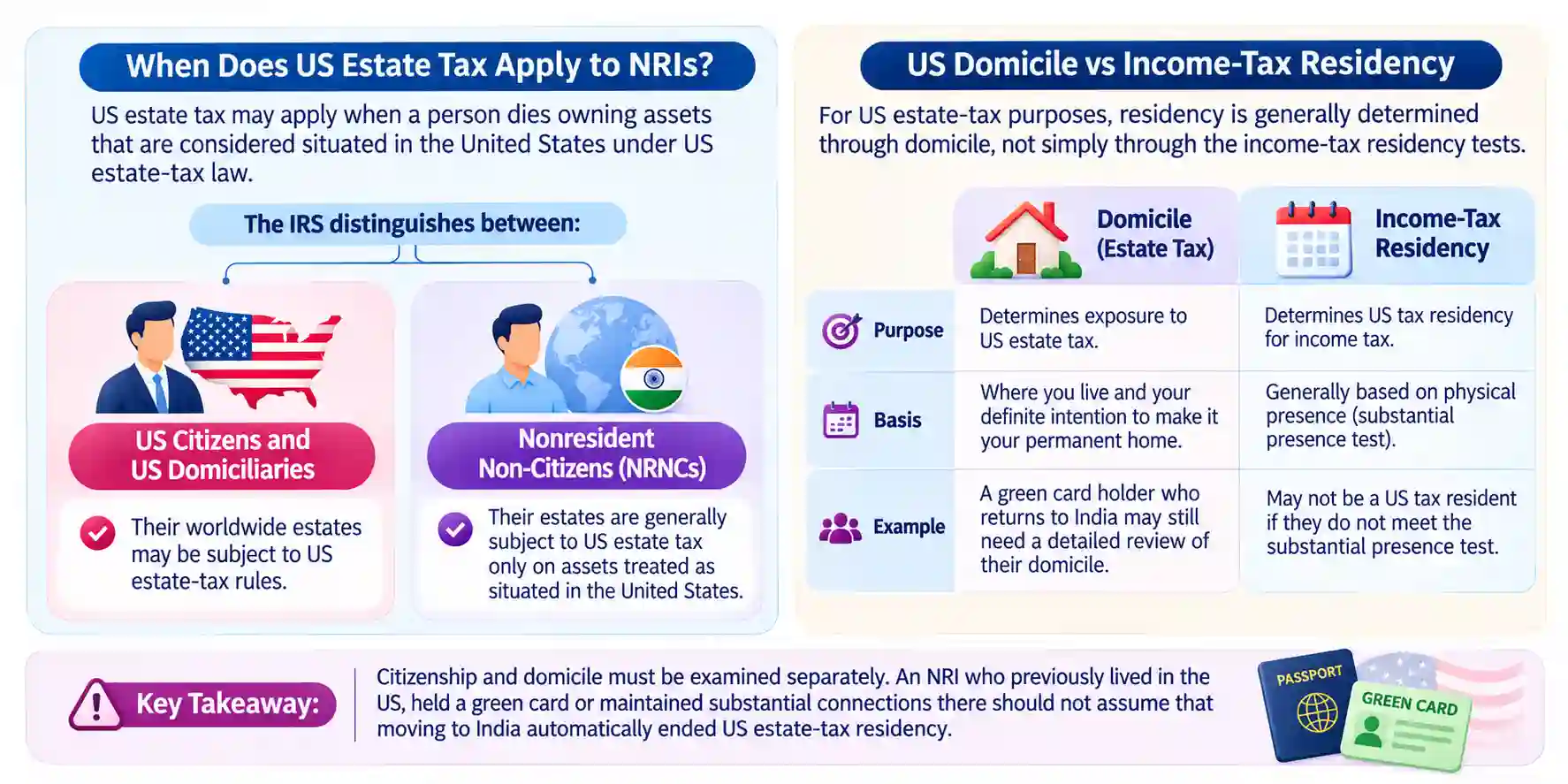
US estate tax may apply when a person dies owning assets that are considered situated in the United States under US estate-tax law.
For this purpose, the IRS distinguishes between:
An Indian citizen living in India who is neither a US citizen nor domiciled in the United States will generally fall into the second category.
However, citizenship and domicile must be examined separately. An NRI who previously lived in the United States, held a green card or maintained substantial personal and financial connections there should not assume that moving to India automatically ended US estate-tax residency.
For US estate-tax purposes, residency is generally determined through domicile, not simply through the income-tax residency tests.
Domicile considers where a person lives and whether they have a definite present intention of making that place their permanent home.
This is different from the income-tax substantial presence test, which generally uses physical presence in the United States to determine tax residency.
For example, a green card holder who returns to India may still need a detailed review of their estate-tax domicile. Holding a green card is relevant, but it is not conclusive evidence of US domicile for estate-tax purposes.
The distinction is important because the applicable estate-tax rules and filing requirements can differ significantly depending on the person's status at death.
Get professional guidance to understand your US estate-tax exposure and filing requirements.
The $60,000 threshold is the general filing threshold for the estate of a nonresident who was not a US citizen at the time of death.
Under the IRS rules, an executor generally must file Form 706-NA if the value of the deceased person's US-situated assets at the date of death, together with applicable adjusted taxable gifts and the specified gift-tax exemption, exceeds $60,000.
It is important to understand what this figure does and does not mean.
An NRI who is neither a US citizen nor US domiciliary dies holding US-situated assets worth $150,000.
Since the value exceeds the general $60,000 filing threshold, the executor should review the requirement to file Form 706-NA. The estate's final tax liability must then be determined under the applicable estate-tax rules, rather than assuming that tax is automatically charged on the entire $150,000.
The valuation is generally based on the fair market value of the relevant assets at the date of death, not their original purchase price.
Not every asset connected with a US financial institution is automatically treated as US-situated property. The legal character and location of the asset matter.
The following examples help distinguish assets that may be included from certain assets that are generally treated differently.
| Asset type | General US estate-tax treatment for NRNCs |
|---|---|
| Real estate located in the US | Generally treated as US-situated property |
| Shares issued by US corporations | Generally treated as US-situated property, even when held through a foreign brokerage or nominee |
| Tangible personal property physically located in the US | Generally included, subject to specific exceptions |
| Certain US debt obligations | May be included, depending on the nature of the obligation and applicable rules |
| Certain US bank deposits | May be excluded when they meet the applicable statutory conditions |
| Life insurance proceeds on the life of a nonresident non-citizen | Generally excluded under the relevant US estate-tax rule |
Shares issued by US corporations are generally considered US-situated assets for estate-tax purposes.
This can affect NRIs who hold US-listed shares through brokerage accounts, including accounts maintained outside the United States.
For example, an Indian resident holding shares issued by a US corporation may have a potential US estate-tax exposure even if the shares are maintained in an overseas brokerage account.
The location of the brokerage account alone does not determine the estate-tax treatment of the underlying shares.
For more information about the investment-related tax treatment of US stocks, see our guide on tax implications of US stocks for Indian investors.
Real estate physically located in the United States is generally considered US-situated property.
Therefore, an NRI who owns a US residential or commercial property may need to consider the property's value when reviewing potential estate-tax exposure.
The treatment may depend on the legal ownership structure and the facts of the case. Do not assume that jointly held property or property owned through an entity is automatically excluded.
The estate-tax calculation for a nonresident non-citizen is different from the calculation for a US citizen or US domiciliary.
Broadly, the process involves:
The estate may qualify for certain deductions or credits, depending on the facts. The availability and amount of these benefits can depend on the deceased person's status, the type of property, the beneficiary and any applicable treaty provisions.
For example, a limited unified credit is generally available under domestic US law to qualifying nonresident non-citizen estates. This is not equivalent to automatically receiving the full estate-tax exclusion available to US citizens and domiciliaries.
The executor should therefore avoid calculating the estate-tax liability simply by subtracting $60,000 from the value of US assets. The filing threshold and the final tax calculation are separate matters.
Form 706-NA, officially called the United States Estate (and Generation-Skipping Transfer) Tax Return, Estate of a Nonresident Not a Citizen of the United States, is used to calculate and report the estate-tax liability of a qualifying nonresident non-citizen estate.
The executor is generally responsible for reviewing and filing this return when the applicable filing threshold is exceeded.
The general deadline is nine months after the date of death.
If the executor needs additional time, an extension may be requested using Form 4768. An extension to file does not automatically extend the time to pay any estate tax due.
The executor may need to collect:
The exact documentation depends on the estate and the claims made in the return. The executor should review the current IRS instructions for Form 706-NA before preparing the filing.
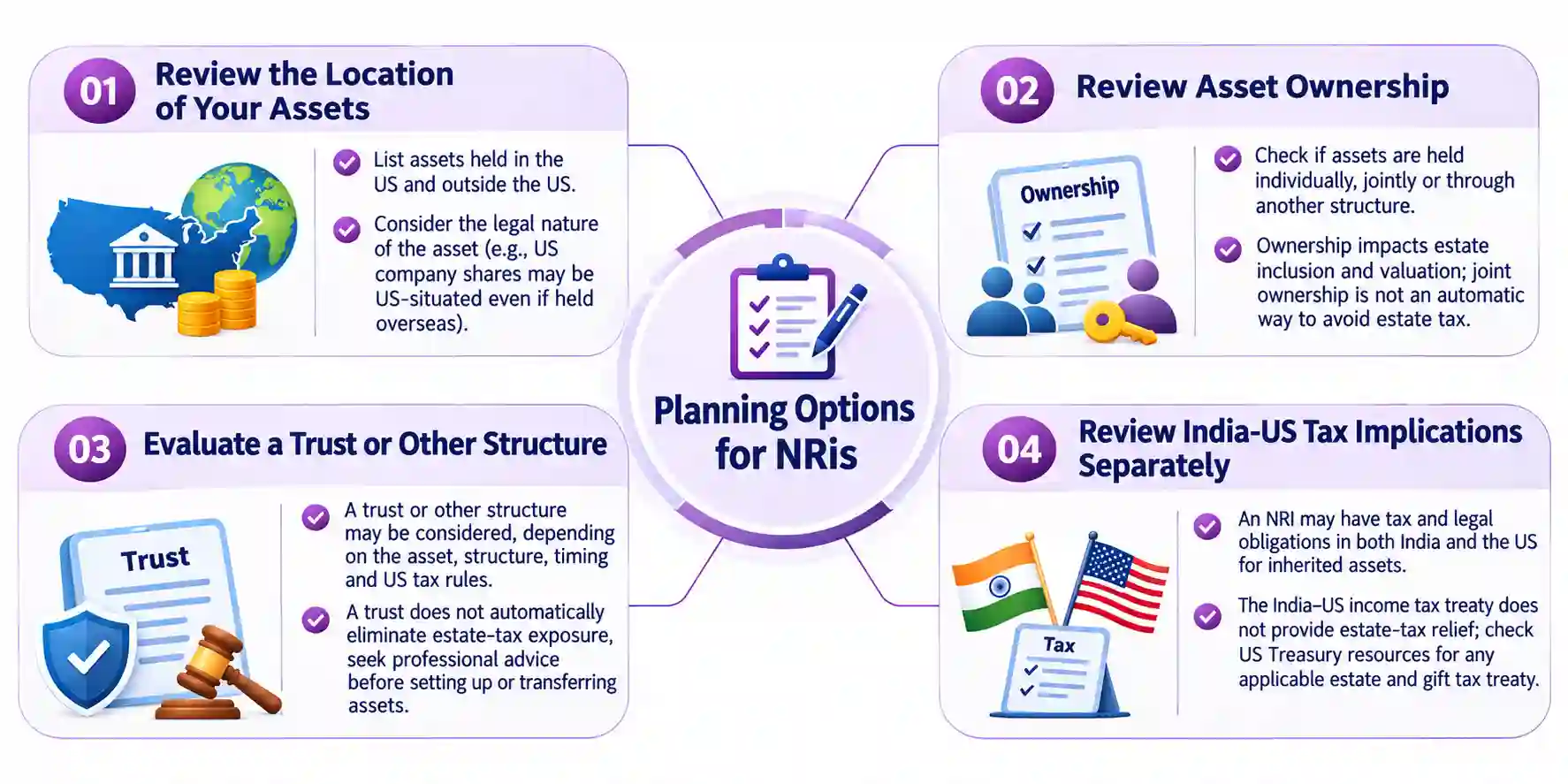
NRIs who own US-situated assets should review their potential estate-tax exposure while they are alive. The objective is to understand the applicable rules and avoid leaving the family with unexpected tax and documentation issues.
The following considerations may help structure that review.
Prepare a list of assets held in the United States and outside the country.
Do not classify an asset only by the location of the bank or brokerage account. The legal nature of the underlying property may determine whether it is treated as US-situated.
For example, shares issued by a US corporation may remain US-situated even when held through a foreign brokerage account.
Check whether assets are owned individually, jointly or through another legal structure.
Ownership arrangements can affect how an asset is included in the estate and how its value is determined. Joint ownership should not automatically be treated as a way to avoid estate tax.
Any proposed change in ownership should be reviewed for both estate-tax and gift-tax consequences before implementation.
Some investors consider trusts or other ownership structures when reviewing their US estate-tax exposure.
However, the outcome depends on the type of structure, the asset involved, the timing of the transfer and the applicable US tax rules. A trust does not automatically eliminate estate-tax exposure.
NRIs should obtain professional advice before transferring assets or creating a structure for estate-tax planning.
An NRI living in India may have tax and legal obligations in both countries when dealing with inherited assets.
The India-US income tax treaty should not be assumed to provide estate-tax relief. Income-tax treaty provisions and estate-tax rules are separate matters. The US Treasury's published treaty resources should be checked for any applicable estate and gift tax treaty; the existence of an income-tax treaty alone does not establish one.
For this reason, cross-border planning should consider the relevant Indian and US rules separately.
When an NRI dies holding US-situated assets, the executor or family may need to complete several administrative and tax-related steps before the assets can be transferred.
These may include:
A transfer certificate is an important part of the process for certain nonresident estates. It helps establish that the IRS estate-tax requirements have been addressed before the transfer of US assets.
Estate-tax compliance and probate are separate matters. The executor may also need to follow the applicable succession and probate procedures, depending on the asset and ownership arrangement.
For guidance on cross-border succession and wills, read our article on probate and cross-border wills for NRIs.
Get support reviewing your US and India tax obligations and related compliance requirements.
US estate tax can create unexpected compliance responsibilities for NRIs who hold US-situated assets. Understanding the $60,000 filing threshold, identifying potentially taxable assets and reviewing Form 706-NA requirements can help families prepare before an estate-tax issue arises.
However, determining your actual exposure requires reviewing your US asset ownership, estate-tax domicile and applicable tax rules. Savetaxs can help NRIs understand their US and India tax obligations, review cross-border tax considerations and identify relevant tax filing and compliance requirements. With the right professional guidance, you can make informed decisions about your US assets and help your family avoid unnecessary compliance complications.
If you hold US investments or property while living in India, consider reviewing your potential estate-tax exposure with a qualified cross-border tax professional.
This article is for general informational purposes only and does not constitute tax, legal, financial, or investment advice. Laws, regulations, rates, and procedures may change over time and may vary based on individual circumstances.
While SaveTaxs makes reasonable efforts to keep the information accurate and up to date, readers should verify applicable rules with official authorities or consult a qualified professional before making decisions based on this information.
Hatim Dudhiyawala is a Certified Public Accountant (CPA) with SaveTaxs and specializes in Indian and NRI taxation. He advises individuals, NRIs, and businesses on income tax filing, capital gains taxation, DTAA benefits, fund repatriation, and tax compliance. With experience in cross-border tax matters, Hatim helps taxpayers understand complex regulations and make informed decisions. Through his articles, he shares practical insights to help readers stay compliant and manage their tax obligations with confidence. See Full Bio

Want to read more? Explore Blogs