US Tax Filing and Compliance
Year-End Tax Planning Checklist for NRIs in the USYear-End Tax Planning Checklist for NRIs in the US
Written by Shubham Jain
An S Corporation may no longer fit a business's ownership structure, tax planning strategy, or long-term operating plans. In that situation, shareholders may decide to end the company's S Corporation tax status and have it treated as a C Corporation for federal tax purposes.
However, revoking an S Corporation election is not simply a matter of stopping Form 1120-S filings or notifying the IRS informally. The corporation must follow a specific procedure under Section 1362(d)(1) of the Internal Revenue Code. This includes obtaining the required shareholder approval, preparing a written revocation statement, and submitting it to the appropriate IRS service center.
The effective date also matters. Depending on when the corporation submits its revocation, the change may apply from the beginning of the current tax year, the beginning of the following tax year, or a specified future date.
This guide explains how to revoke an S Corporation election, what shareholder approval is required, how to submit the revocation statement, and what happens to the business's federal tax treatment afterward.
Revoking an S Corporation election means voluntarily ending the corporation's federal tax status as an S Corporation. Once the revocation becomes effective, the business generally stops being taxed under the S Corporation rules and is treated as a C Corporation for federal income tax purposes.
An S Corporation generally passes its income, deductions, and credits through to its shareholders. A C Corporation, by contrast, generally pays federal income tax at the corporate level, and shareholders may also face tax when they receive dividends.
Revocation changes the corporation's federal tax treatment. It does not automatically dissolve the legal entity, close the business, or cancel its state registration.
For example, suppose a corporation has several shareholders and wants to retain earnings in the business rather than distribute profits. Its owners may decide that C Corporation tax treatment better fits their plans. They can consider voluntarily revoking the S election, provided they meet the applicable approval and filing requirements.
The decision should be evaluated before submitting the revocation because the effective date can affect the corporation's tax returns and shareholder reporting.
Get guidance on shareholder approvals, revocation documentation, IRS submission, and the requirements for ending your S Corporation tax status.
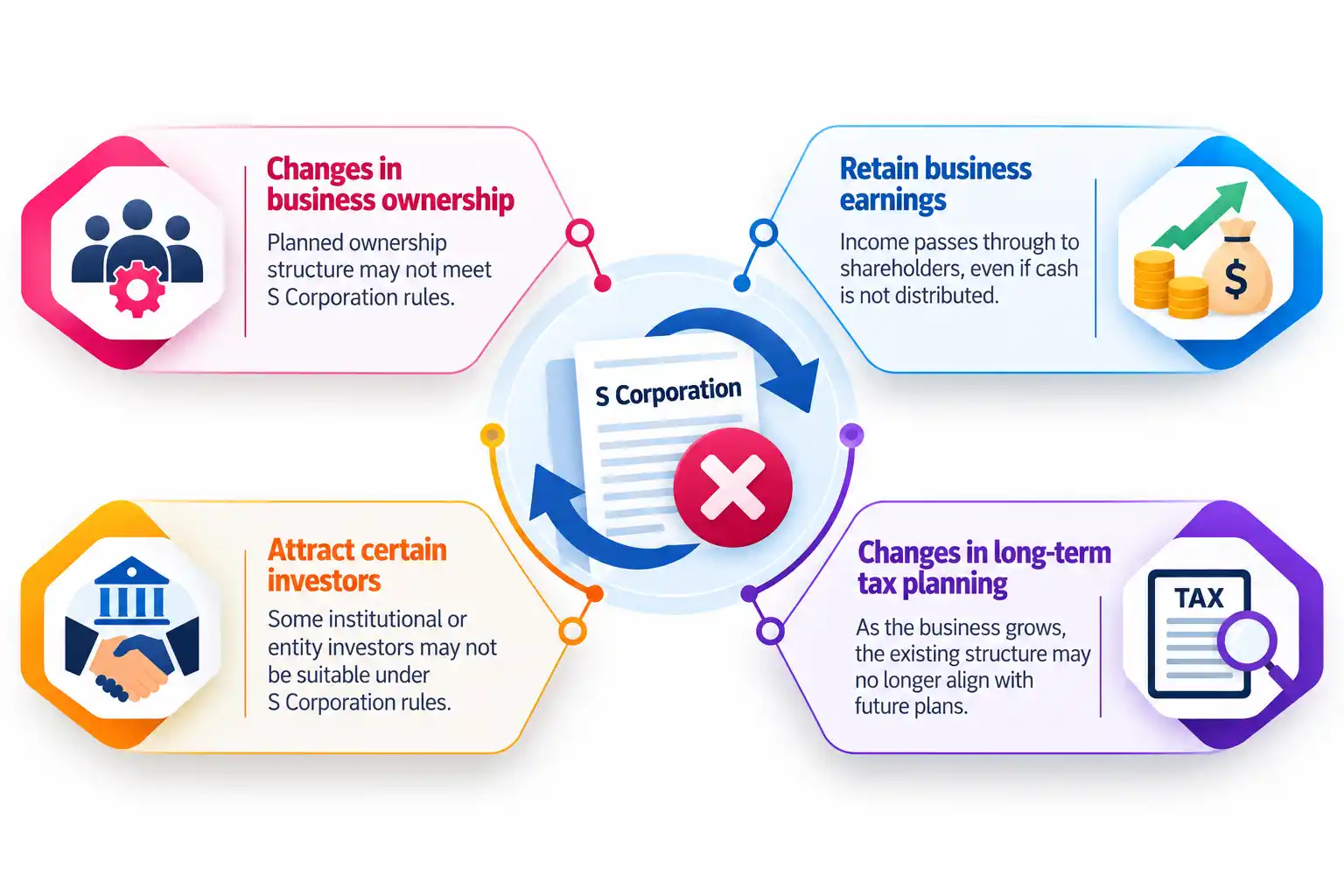
A business may voluntarily revoke its S Corporation election when its ownership, financial plans, or operating requirements change.
Common reasons include:
A corporation may be considering an ownership arrangement that does not fit the S Corporation eligibility requirements. For example, certain ownership structures or shareholder types may not be permitted under the S Corporation rules.
The business may evaluate whether C Corporation treatment is more appropriate for its future ownership plans.
S Corporation income generally passes through to shareholders, who may owe tax on their allocated share even when the corporation does not distribute the corresponding cash.
A business that intends to retain substantial earnings may evaluate whether C Corporation treatment better fits its financial strategy.
Some businesses may want to explore investment arrangements that are difficult to accommodate under S Corporation restrictions, including certain institutional or entity investors.
C Corporation status may provide a different ownership structure, although the company should evaluate the legal and tax consequences before making a change.
A company's financial position may change as it grows. Its shareholders may decide that the existing tax structure no longer aligns with their plans.
Revocation should not be based on one tax consideration alone. The business should compare the overall federal and state tax consequences, shareholder impact, and administrative requirements.
An S Corporation cannot revoke its election solely because one shareholder or the company's management wants to change its tax status.
Under Section 1362(d)(1)(B), shareholders holding more than one-half of the corporation's issued and outstanding shares on the date of revocation must consent.
The calculation includes both voting and non-voting shares. Therefore, the approval requirement is based on ownership of shares, not simply the number of shareholders or the number of votes cast.
Suppose a corporation has 1,000 issued and outstanding shares:
Shareholders must collectively consent to the revocation while holding more than 500 shares.
If Shareholders A and B consent, their combined 750 shares satisfy the requirement. If only Shareholder A consents, the 400 shares are insufficient.
The corporation should maintain the shareholder consents and ownership information with its records.
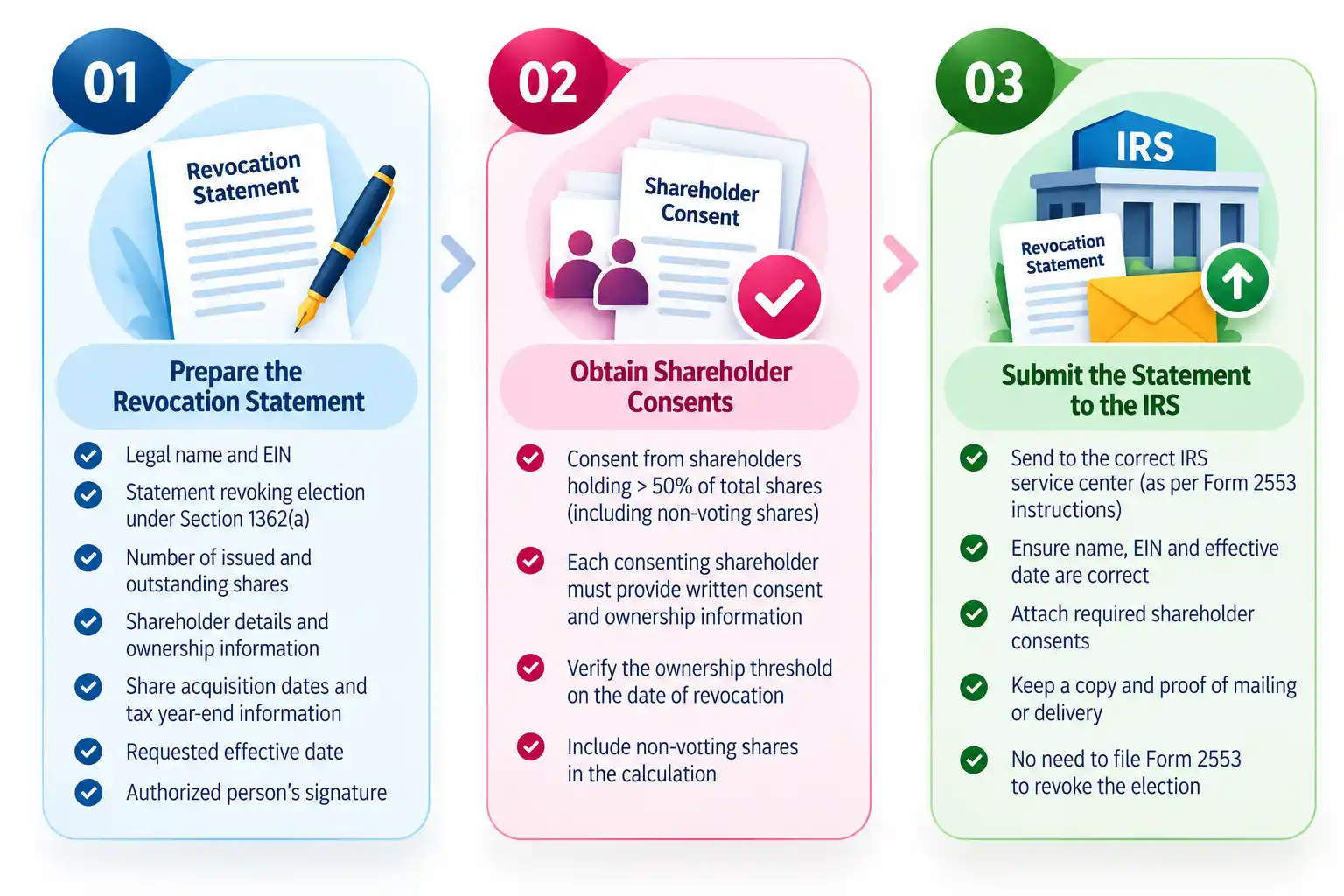
A corporation must submit a written revocation statement to the IRS. It does not use Form 2553 to revoke an existing S Corporation election; Form 2553 is used to make an S Corporation election.
Follow these steps to prepare and submit the revocation.
The corporation should prepare a written statement clearly declaring that it is revoking the election made under Section 1362(a).
According to IRS guidance and Treasury Regulation Section 1.1362-6(a)(3), the statement should include:
The statement must also include the required shareholder consent documentation.
The corporation must obtain consent from shareholders who collectively own more than 50% of the issued and outstanding shares, including non-voting shares.
Each consenting shareholder should provide the required written consent and ownership information. The shareholder consent must be signed under the applicable declaration requirements.
The corporation should verify that the consenting shareholders meet the ownership threshold on the date the revocation is made.
Do not calculate approval using only voting shares. Non-voting shares are included in the statutory calculation.
The corporation must send the completed revocation statement to the IRS service center where it properly filed its S Corporation election.
The IRS directs corporations to use the appropriate service center identified in the Instructions for Form 2553.
Before submitting the statement, check that:
The IRS does not require the corporation to file a separate Form 2553 merely to revoke its election.
The effective date depends on when the corporation makes the revocation and whether the statement specifies a permitted prospective effective date.
Under Section 1362(d)(1)(C), the general rules are:
| When the revocation is made | General effective date |
|---|---|
| On or before the 15th day of the third month of the tax year | First day of that tax year |
| After the 15th day of the third month | First day of the following tax year |
| A permitted future date is specified | The date specified, provided it is on or after the date of revocation |
Example for a calendar-year corporation:
Suppose a corporation follows the calendar tax year, beginning January 1 and ending December 31.
The deadline and effective date should be planned carefully. A revocation that takes effect during a tax year can create separate S Corporation and C Corporation tax periods.
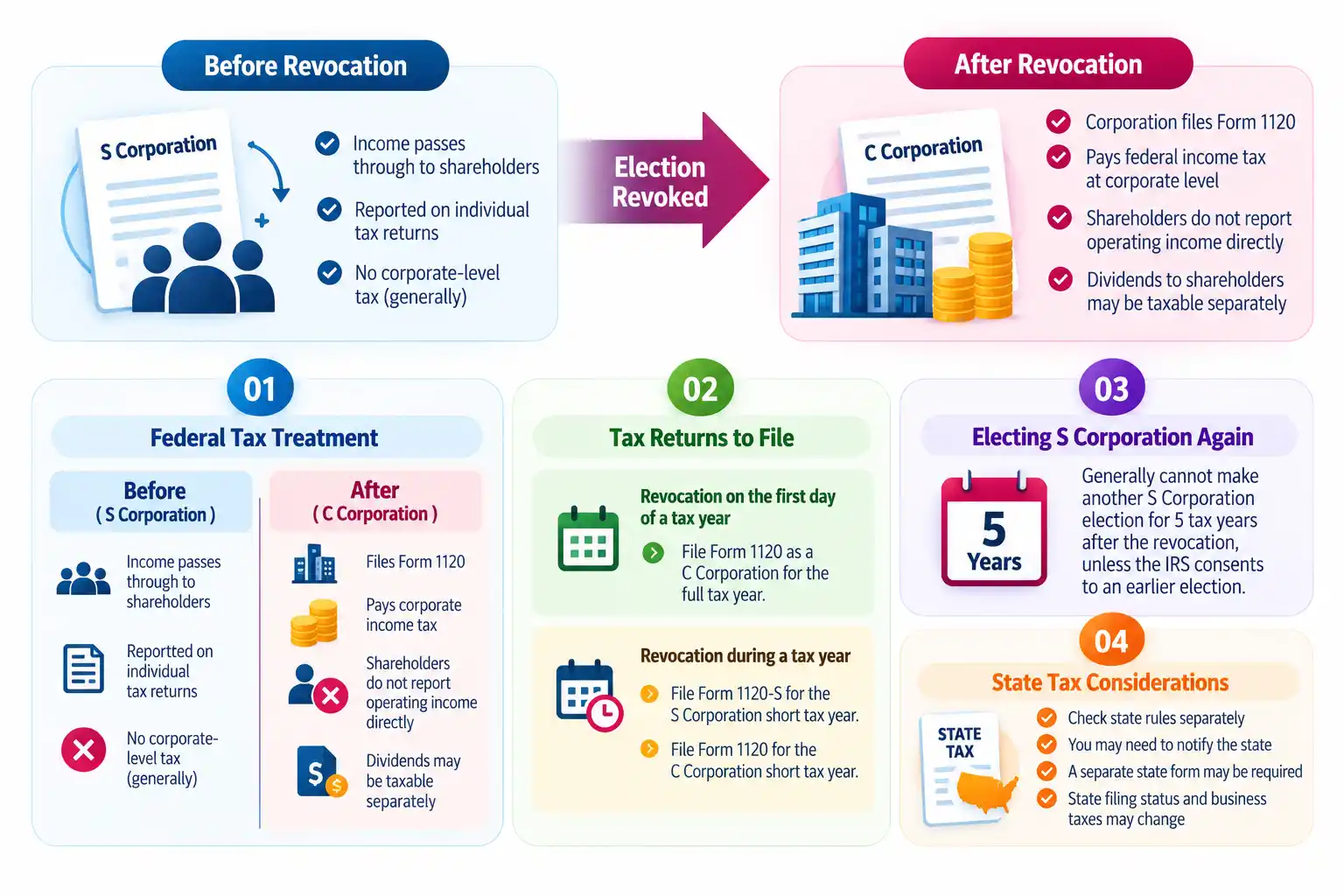
Once the revocation becomes effective, the corporation generally moves from S Corporation tax treatment to C Corporation tax treatment for federal tax purposes.
This change affects how the corporation reports its income and how shareholders are taxed.
Before revocation, an S Corporation generally passes its taxable income, deductions, and credits through to shareholders. Shareholders report their allocated items on their individual tax returns, subject to the applicable tax rules.
After revocation becomes effective, the corporation generally becomes subject to C Corporation taxation.
This means:
The corporation should review its tax planning, distributions, accumulated earnings and profits, and shareholder-level consequences before the revocation takes effect.
The tax returns depend on the effective date of the revocation.
If the revocation takes effect on the first day of a tax year, the corporation generally files as a C Corporation for that full tax year.
If the revocation takes effect during a tax year, the corporation generally has an S Corporation short tax year and a C Corporation short tax year. Special rules under Section 1362(e) govern the allocation of income, deductions, and other tax items between those periods.
The corporation may need to file:
The applicable due dates and reporting requirements should be checked for the corporation's circumstances.
For the S Corporation return filing process, see our guide to Form 1120-S filing requirements.
A corporation that voluntarily revokes its S Corporation election generally cannot make another S Corporation election for a tax year beginning before the fifth tax year after the first tax year for which the termination was effective, unless the IRS consents to an earlier election.
This restriction is important for businesses considering revocation as a temporary tax-planning decision.
For example, if a corporation's revocation becomes effective for the 2027 tax year, it should not assume that it can simply elect S Corporation status again for the next tax year. The five-tax-year restriction and any applicable IRS consent requirements must be reviewed before planning a return to S Corporation status.
The corporation must also satisfy the S Corporation eligibility and election requirements that apply when it seeks to elect that status again.
Revoking a federal S Corporation election does not automatically resolve every state-level tax requirement.
States may have their own rules for recognizing S Corporation status, terminating state elections, and changing a corporation's tax classification.
Depending on the state, a business may need to:
A corporation operating in more than one state should check the rules in every relevant jurisdiction. Federal revocation and state tax treatment should be reviewed separately.
For more information, see our guide to S Corporation state taxes and elections.
Understand the tax implications, filing requirements, and compliance responsibilities that apply after your corporation's S Corporation status ends.
Revoking an S Corporation election requires more than a business decision. The corporation must obtain consent from shareholders holding more than 50% of its issued and outstanding shares, prepare the required written statement, and submit it to the appropriate IRS service center.
The effective date is equally important because it determines when the corporation moves from S Corporation to C Corporation tax treatment. If the revocation takes effect during a tax year, the business may also need to manage separate S Corporation and C Corporation tax periods.
Before submitting a revocation, review the shareholder approval, filing requirements, effective date, federal tax consequences, and state-level obligations. Careful planning can help the corporation avoid filing errors and unexpected tax complications.
This article is for general informational purposes only and does not constitute tax, legal, financial, or investment advice. Laws, regulations, rates, and procedures may change over time and may vary based on individual circumstances.
While SaveTaxs makes reasonable efforts to keep the information accurate and up to date, readers should verify applicable rules with official authorities or consult a qualified professional before making decisions based on this information.
Vipul Jain is the Co-Founder of SaveTaxs and a tax expert with experience in Indian and NRI taxation. He advises individuals, NRIs, and businesses on tax filing, tax planning, capital gains, DTAA, and compliance matters. He focuses on making complex tax concepts simple and helping taxpayers make informed, compliant decisions. See Full Bio

Want to read more? Explore Blogs