


NRI Income Tax Compliance
How to Claim Excess TDS Refund After Selling Property in India as an NRIHow to Claim Excess TDS Refund After Selling Property in India as an NRI
Written by Shubham Jain
NRIs are often stressed about how to e-verify ITR for NRIs from abroad. The stress is mainly because the ITR verification process requires a one-time password (OTP), which cannot be delivered abroad.
But there are solutions to this problem. NRIs can file their income tax return online from anywhere, and verification can be done via net banking, a pre-validated bank account, a demat account to generate an EVC (electronic verification code), or a DSC (digital signature certificate).
In this blog, we will discuss every possible and legitimate method NRIs can use to e-verify their income tax returns from abroad.
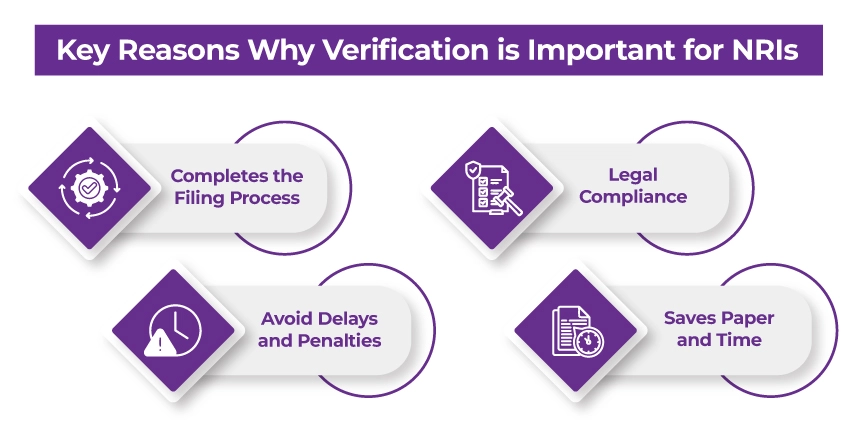
E-verification is a mandatory step in the filing process for income tax returns in India. Without e-verification, the filed ITR isn't considered valid, which leads to penalties, delayed tax refunds, and other non-compliance issues.
The following are the key reasons why verification is important for NRIs.
The following are the legitimate online methods NRIs can use to e-verify their IT return from anywhere in the world. ,
This method is one of the most convenient ones for NRIs living abroad, as this approach does not rely on OTP sent to the Indian mobile number during the verification step.
Requirement: Your PAN card must be linked to your bank account, and the net banking for the same must be enabled.
Process:
Non-resident Indians (NRIs) with a valid and active digital signature certificate can use this method to e-verify their ITR.
Requirement: A valid digital signature certificate must have been procured from a certifying authority, and the EMSigner utility must be installed and running on your device.
Process:
Savetaxs offers a full range of NRI Taxation compliance with expert guidance.
You can generate an electronic verification code (EVC) for your Indian Bank account, but only if it is verified on the e-filing portal.
Requirement: Your Indian Bank account must be pre-validated on the Income Tax Department portal. However, please ensure that your PAN is linked to your Indian bank account and that the bank verifies your mobile number and email ID, as the electronic verification code will be sent to those numbers.
Process:
This method is your last resort for NRIs. If all the online e-verification methods fail, you can print, sign, and mail the ITR-V acknowledgment form to the CPC (Centralized Processing Centre) in Bangalore, India.
Process:
CPC (Centralized Process Center)
Address: Post Box No. 1.
Electronic City Post Office,
Bangalore-560100, Karnataka.
However, please note that this method may delay tax refunds.
Which e-verification Method Should NRIs use?
Below is a clear table of NRI situations and the best verification method for each.
| NRI Situation | Best ITR e-verification method for NRIs |
|---|---|
| No Aadhaar Card | Net Banking/DSC |
| Indian mobile number not working abroad | Net Banking |
| Wants the fastest e-verification | Net Banking |
| Filing with CA/DSC | DSC |
| All online methods failed | ITR-V Acknowledgment Form by Post. |
Personalize NRI Taxation Plan Is Just A Call Away.
Filing ITR for NRIs is itself a complicated process, and to top it all off, there's a little more stress with e-verification for NRIs. However, in this blog post, we have discussed four methods NRIs can use to verify their returns from abroad easily.
However, even though these methods are pretty simple, NRIs still face many issues. And hence, Savetaxs is here to rescue them from the dilemma by providing the best income tax consultation for NRIs.
Our experts will help you not just file your Income tax return but also e-verify it within the time frame, so you don't face any last-minute hassles.
Connect with us today as we serve our clients 24/7 across all time zones.
This article is for general informational purposes only and does not constitute tax, legal, financial, or investment advice. Laws, regulations, rates, and procedures may change over time and may vary based on individual circumstances.
While SaveTaxs makes reasonable efforts to keep the information accurate and up to date, readers should verify applicable rules with official authorities or consult a qualified professional before making decisions based on this information.
Shubham Jain is the Founder of SaveTaxs and has extensive experience in Indian and NRI taxation. He advises individuals, NRIs, and businesses on tax filing, tax planning, capital gains, DTAA benefits, fund repatriation, and compliance matters. He regularly writes about taxation and related financial topics. His focus is on making complex tax concepts easy to understand. Through his articles, he helps taxpayers stay informed, avoid common mistakes, and stay compliant with Indian tax laws. See Full Bio

Want to read more? Explore Blogs
The primary e-verification methods available to NRIs are: