NRI Returning to India
NRI Returning to India from GermanyNRI Returning to India from Germany
Written by Hatim Dudhiyawala

After living in New Zealand for several years, moving to India may seem overwhelming; however, it is not as simple as it looks. Your responsibilities don't end with booking flights and completing your relocation formalities. As an NRI returning to India from New Zealand permanently, you need to consider several things. This includes fulfilling your tax obligations in both countries, managing your investments, determining your residential status, and more.
For this, you need proper planning because even a small mistake during your return can affect your tax obligations in both countries. Want to know about this in brief? This blog provides complete information on moving back to India from New Zealand, from day one to your permanent relocation. So read on and clear all your doubts.
Assuming your tax residency ends in New Zealand after you leave is the most common mistake NRIs make. Your New Zealand tax residency after leaving the country generally ends if you meet the following conditions:
A permanent place of abode means a place where an individual usually lives in New Zealand and considers their home. Considering this, if you do not have a permanent place of abode in New Zealand and meet the 325-day test, you are considered a non-resident.
However, owning a house, having significant personal connections, or having dependent family in New Zealand can complicate determining your tax residency status in New Zealand. To avoid it, keep proof of your permanent move, including your employment papers, travel records, accommodation, and the date you sold or rented out your New Zealand home.
Your tax residency ends when you meet the applicable physical-absence and permanent-place-of-abode conditions in New Zealand. Next, let's review the tax steps you need to complete before moving back to India from New Zealand.
Before moving back to India from New Zealand, update your contact and address details in your myIR account. Also review whether you need to file a tax return, generally known as IR3, in New Zealand during your departure year. If you continue receiving New Zealand-source income after becoming a non-resident, you may need to file an IR3NR. Additionally, before returning to India, collect the following documents:
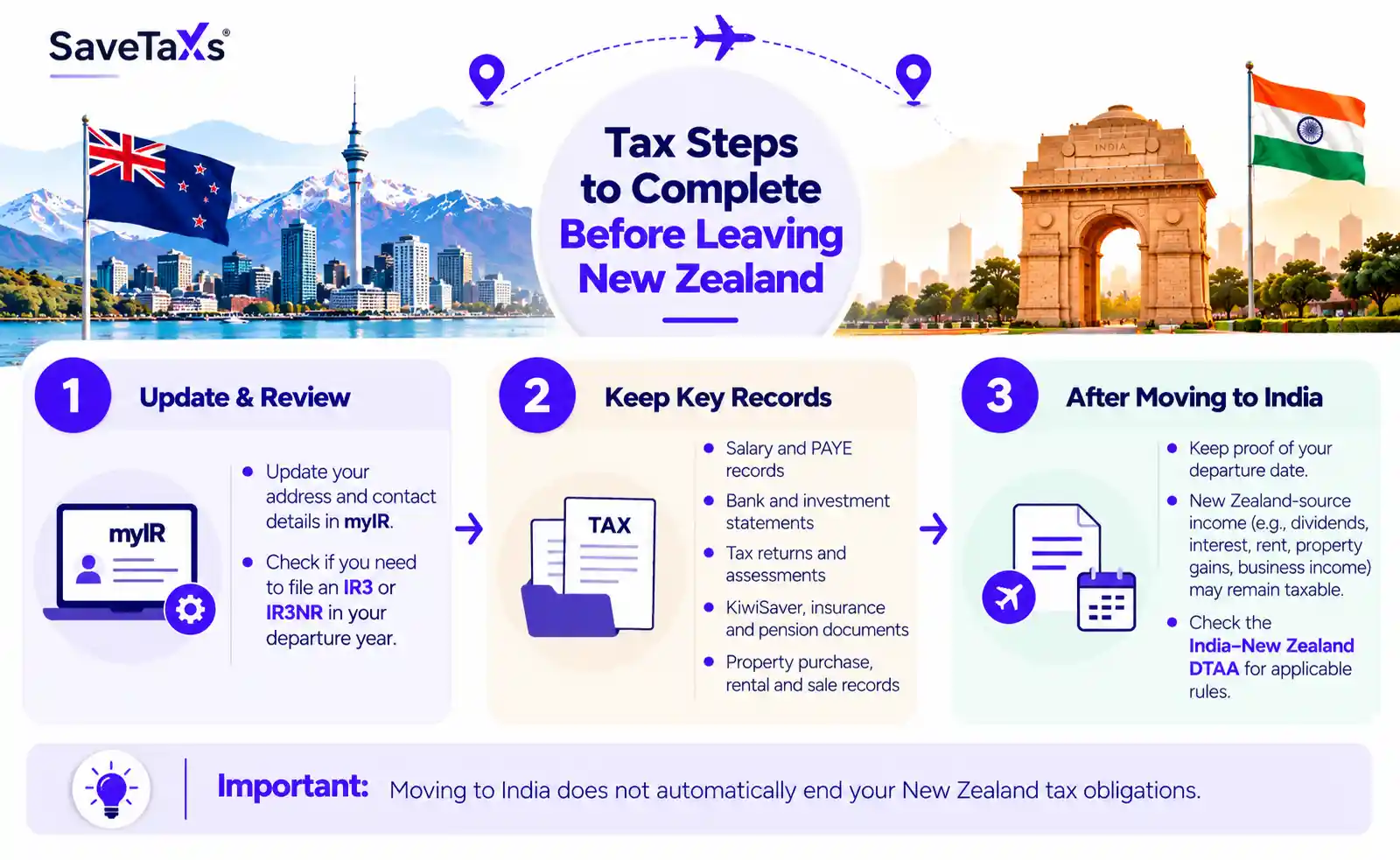
Further, even after becoming an NRI, if you have a source of income in New Zealand, you may continue to have New Zealand tax obligations on that income, subject to New Zealand domestic rules and the India-New Zealand DTAA. For instance, dividends, bank interest, rent, taxable property gains, and business income.
So even after moving back to India from New Zealand, if you have a source of income there, you may continue to have tax obligations there depending on the nature and source of the income, your residential status, and the applicable rules. Now, moving ahead, let's know about your tax status in India.
Connect with Savetaxs for personalized guidance based on your tax obligations in India, with complete accuracy.
In India, citizenship and tax residency status are two different things. For tax purposes, your residential status is determined each tax year, from April 1 to March 31. Considering this, depending on your arrival date and past travel history in India, you can be:
You can be considered an Indian resident in India even after living in New Zealand for several years if you meet the applicable residential-status conditions, including:
However, if you do not meet any of the mentioned conditions, you are generally considered an NRI for that year, subject to the applicable special and deemed-residency provisions. To determine your residential status in India using travel records and passport, prepare a day-count calendar. Additionally, during the relocation year, your arrival date can impact your residential status in India.
Not every returning NRI qualifies as RNOR. This completely depends on your past travel history. Considering this, you qualify as an RNOR:
After returning to India, the RNOR status for returning NRIs does not automatically provide a two- or three-year tax holiday. An RNOR is generally taxable on Indian income and specified foreign income derived from a business controlled in India or a profession set up in India, subject to the applicable rules. Use your travel history and the applicable residential-status rules to know whether you qualify for this status.
Moving further, let's know as an NRI returning to India from New Zealand how your New Zealand income is taxed in India.
Whether your New Zealand income is taxable in India after your departure depends on your residential status in India. Considering this:
| Indian Tax Residency Status | Tax Obligation |
|---|---|
| Non-Resident Indian (NRI) | Generally taxable in India on income received or deemed received in India and income that accrues, arises, or is deemed to accrue or arise in India, subject to the applicable provisions |
| Resident but Not Ordinarily Resident (RNOR) | Generally taxable on Indian income and specified foreign income derived from a business controlled in India or a profession set up in India, subject to the applicable provisions |
| Resident and Ordinarily Resident (ROR) | Liable to pay tax on global income |
Once you gain ROR status, you must report and pay tax on your global income in India, even if it remains in your New Zealand bank account. This includes:
After moving to India, where you keep New Zealand income does not determine your tax obligation in India. You need to consider your residential status, the source of your income, and the relevant tax rules. For a detailed overview, read our blog on "Tax Planning Before Permanently Moving Back to India."
If you're unsure whether you need to sell your New Zealand assets before or after moving to India, read our blog, "Should You Sell Foreign Assets Before or After Becoming a Resident?"
Now, moving ahead, let's talk about the India-New Zealand DTAA and foreign tax credit.
Both India and New Zealand have signed a Double Taxation Avoidance Agreement (DTAA) to prevent the same income from being taxed twice. The India-New Zealand DTAA sets out taxing rights for income such as interest, dividends, salary, capital gains, pension, and immovable property income.
If you are considered a tax resident in both countries, the DTAA's tie-breaker rules apply. These consist of four factors: your permanent home, center of vital interests, nationality, and habitual abode. However, applying the DTAA does not automatically make your New Zealand income tax-free in India. The treaty determines the applicable taxing rights and relief mechanism for the relevant type of income, subject to the treaty conditions and Indian tax rules.
For instance, if you already paid tax in New Zealand on income that is also taxable in India, you can claim a foreign tax credit under the India-New Zealand DTAA. To claim a foreign tax credit, you generally require:
Under Indian rules and the treaty, the foreign tax credit is generally limited to the lower of the Indian tax attributable to the relevant foreign income and the eligible New Zealand tax paid on that income, subject to the applicable rules. Additionally, a resident taxpayer claiming foreign tax credit in India must generally furnish Form 67 within the applicable statutory timeline.
This was all about the India-New Zealand DTAA and foreign tax credit. Now, moving forward, let's see what happens to your KiwiSaver after moving to India.
If you permanently emigrate to India, you can generally apply to withdraw most of your KiwiSaver savings no earlier than one year after your permanent emigration, subject to the applicable requirements. However, if you move to Australia, then you can transfer your KiwiSaver savings to your Australian superannuation scheme. Considering this, you can withdraw almost everything from your KiwiSaver savings, including:
Further, the withdrawal amount generally excludes the Crown contribution arising from government member tax credits. Eligible members who received the historical NZD 1,000 kick-start can generally withdraw it under the permanent-emigration rules. Additionally, you can request your Scheme provider to transfer your KiwiSaver savings to a foreign superannuation scheme authorised for that purpose under regulations made under Section 228 of the KiwiSaver Act 2006.
You also need to provide your identity documents, proof of permanent emigration, bank details, and evidence of your overseas address.
So, this is what happens to your KiwiSaver savings after moving to India. Now, moving ahead, let's look at NRE, NRO, and FCNR account changes.
Indian residency rules under Income tax laws and FEMA are separate concepts. Under FEMA, your residential status in India depends on your circumstances and intention to return to India. In contrast, under Indian income tax law, your residential status is determined for tax purposes based on your physical presence and past travel history.
Given this, under FEMA, if you plan to stay in India permanently, inform your Indian banks. Additionally, once you return to India for an indefinite period, your NRE and NRO accounts should be appropriately redesignated under RBI rules. Considering this:
According to RBI guidelines, when the account holder's residential status changes from non-resident to resident, the NRE account should be designated as a resident account or the funds held in it may be transferred to an RFC account, at the account holder's option. If they do not wish to retain their NRI accounts, they can also close them, subject to applicable banking procedures.
An RFC account helps NRIs returning to India from New Zealand to retain their permitted foreign currency balances without converting them immediately to INR after their return.
This was all about NRE, NRO, and FCNR account changes. Moving further, let's take a quick overview of moving back to India from New Zealand through a checklist.
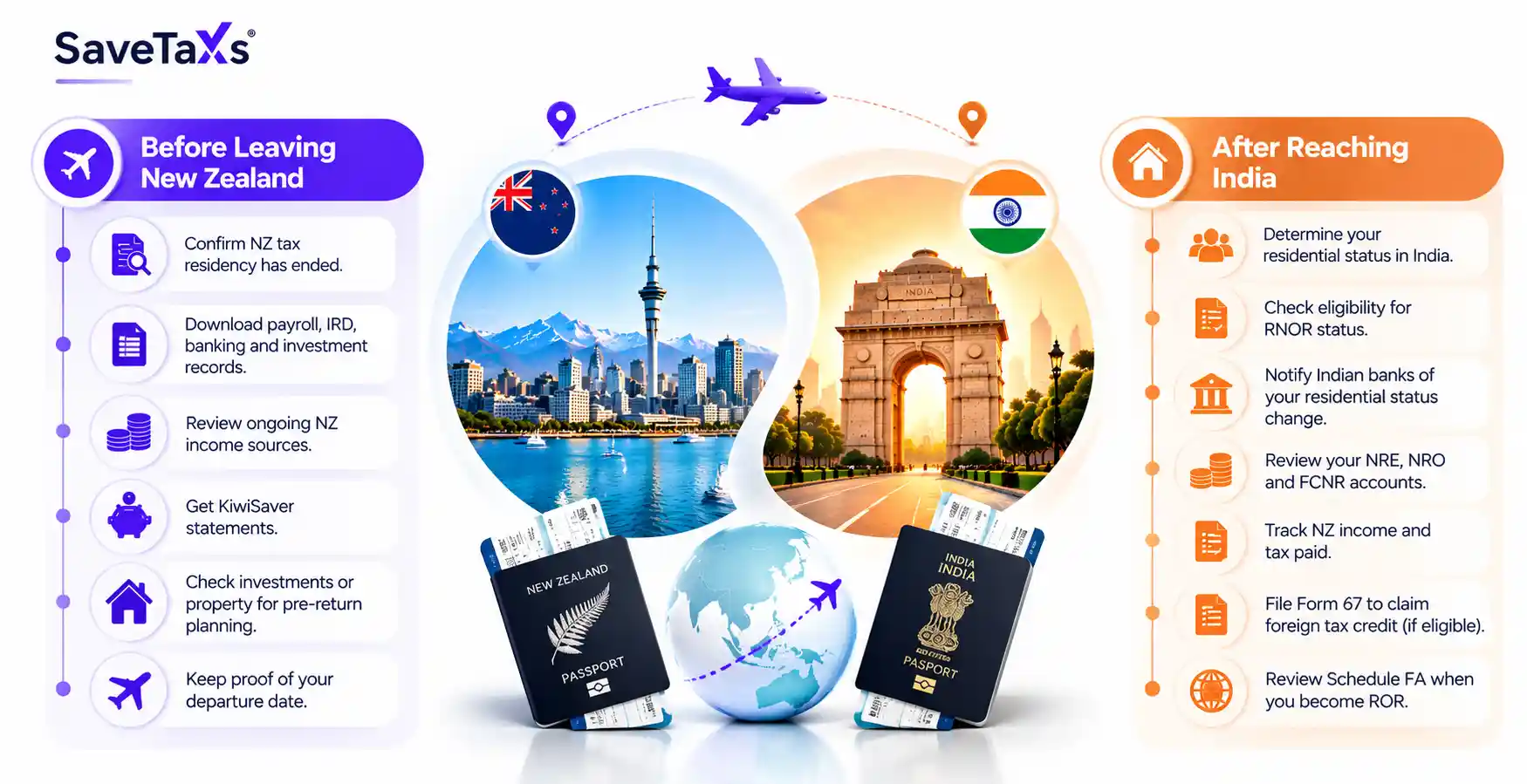
Consider the following tax and financial checklist before and after moving to India from New Zealand permanently:
At Savetaxs, we help returning NRIs determine their tax obligations, manage foreign assets, and claim DTAA relief.
Lastly, as an NRI returning to India from New Zealand, consider the tax rules and regulations of both countries. Also, under the applicable rules of both countries, determine your residential status, meet your tax obligations, and manage your investments properly. A small mistake in relocation planning can lead to double taxation, higher tax obligations, and missed disclosures.
At Savetaxs, we can help you determine your residential status in India, review your income from New Zealand, and help you claim DTAA benefits. Additionally, our team of financial and tax experts can also assist you in managing your foreign investments and income. Connect with us for a smooth return to India without tax issues.
This article is for general informational purposes only and does not constitute tax, legal, financial, or investment advice. Laws, regulations, rates, and procedures may change over time and may vary based on individual circumstances.
While SaveTaxs makes reasonable efforts to keep the information accurate and up to date, readers should verify applicable rules with official authorities or consult a qualified professional before making decisions based on this information.
Shubham Jain is the Founder of SaveTaxs and has extensive experience in Indian and NRI taxation. He advises individuals, NRIs, and businesses on tax filing, tax planning, capital gains, DTAA benefits, fund repatriation, and compliance matters. He regularly writes about taxation and related financial topics. His focus is on making complex tax concepts easy to understand. Through his articles, he helps taxpayers stay informed, avoid common mistakes, and stay compliant with Indian tax laws. See Full Bio

Want to read more? Explore Blogs