US Tax Filing and Compliance
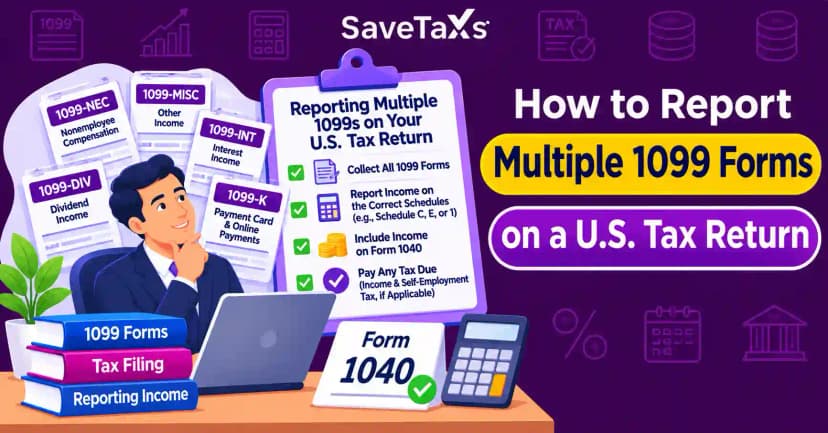
How to Report Multiple 1099 Forms on a U.S. Tax Return: A Guide for NRIsHow to Report Multiple 1099 Forms on a U.S. Tax Return: A Guide for NRIs
Written by Hatim Dudhiyawala
Filing Form 1120-S after the deadline can create significant compliance costs for a U.S. S Corporation. The IRS may impose a late-filing penalty based on the number of shareholders and how long the return remains overdue. Additional penalties may apply if the corporation owes tax or fails to provide accurate Schedule K-1 information to its shareholders.
Importantly, an S Corporation may face a late-filing penalty even when it has no federal income tax to pay. Therefore, business owners should understand the specific IRS rules before delaying a return or assuming that an extension removes their filing obligations.
This guide explains S Corporation late-filing penalties, how the IRS calculates them, other related tax penalties, and when penalty relief may be available.
An S Corporation generally must file its annual federal income tax return, Form 1120-S, by the 15th day of the third month after its tax year ends.
For a calendar-year S Corporation, the regular filing deadline is generally March 15. If that date falls on a weekend or legal holiday, the deadline moves to the next business day.
For example, the deadline for a calendar-year S Corporation's 2025 tax return was March 16, 2026, because March 15 fell on a Sunday.
The IRS may impose a late-filing penalty when an S Corporation:
The penalty is generally assessed against the S Corporation under Internal Revenue Code Section 6699.
An important point for business owners is that having no taxable income or no entity-level income tax due does not automatically eliminate the late-filing penalty. The filing requirement and the corporation's tax payment obligation are separate matters.
If your business needs additional time to submit its return, it may request an extension using Form 7004. However, the extension must be requested by the original filing deadline. Read our guide to Form 7004 extension for S Corporations to understand the extension process and deadlines.
Get professional assistance with Form 1120-S compliance, penalty assessment, and IRS penalty relief options.
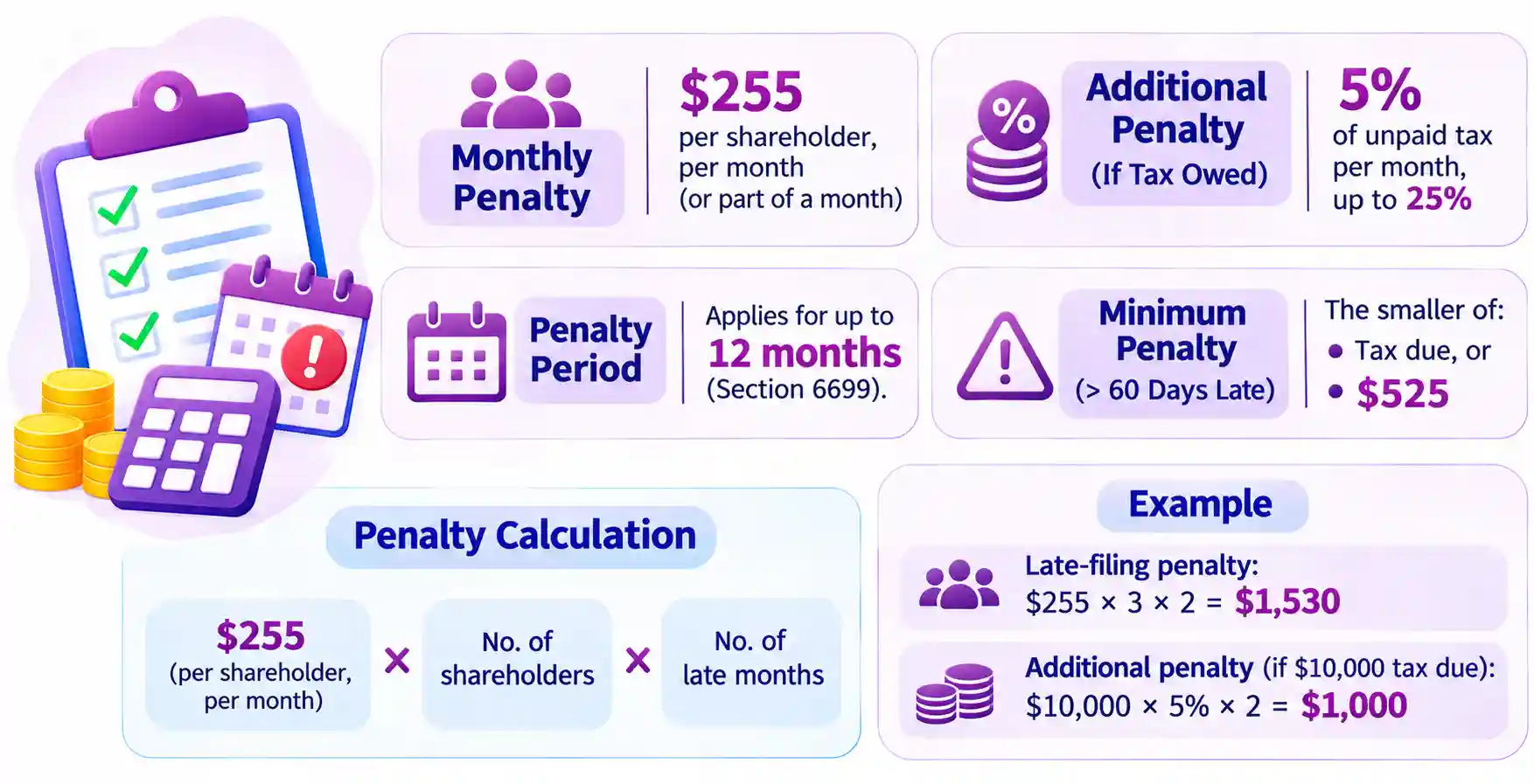
The IRS calculates the S Corporation late-filing penalty using the applicable monthly penalty amount, the number of shareholders, and the number of months or partial months the return remains late.
Under Section 6699, the penalty generally applies for up to 12 months.
For S Corporation returns required to be filed after December 31, 2025, the IRS's published 2025 Form 1120-S instructions specify a base penalty of $255 per shareholder, per month or part of a month.
The calculation is:
Late-filing penalty = Monthly base penalty × Number of shareholders × Number of late months
For example, assume an S Corporation has three shareholders and its return is two months late. If the $255 base rate applies, the basic penalty calculation is:
$255 × 3 shareholders × 2 months = $1,530
This is an illustration of the basic Section 6699 calculation. The actual amount depends on the applicable return due date, filing circumstances, and any available penalty relief.
If the S Corporation has unpaid tax, an additional amount may apply.
Under the Form 1120-S instructions, the late-filing penalty includes an additional 5% of unpaid tax for each month or part of a month, up to a maximum of 25% of the unpaid tax.
For example, if an S Corporation has $10,000 in unpaid tax and the applicable late-filing period is two months, the additional component would be:
$10,000 × 5% × 2 months = $1,000
This amount is in addition to the shareholder-based penalty, subject to the applicable IRS rules.
A minimum penalty may apply when a required return is more than 60 days late.
For a return required to be filed in 2026, the published IRS instructions specify that the minimum penalty is generally the smaller of:
The applicable minimum and penalty calculation should be checked against the instructions for the relevant tax year.
Important: The $255 monthly rate and $525 minimum are tied to the applicable filing-year rules. Do not automatically use these amounts for returns due in later years without checking the latest IRS instructions.
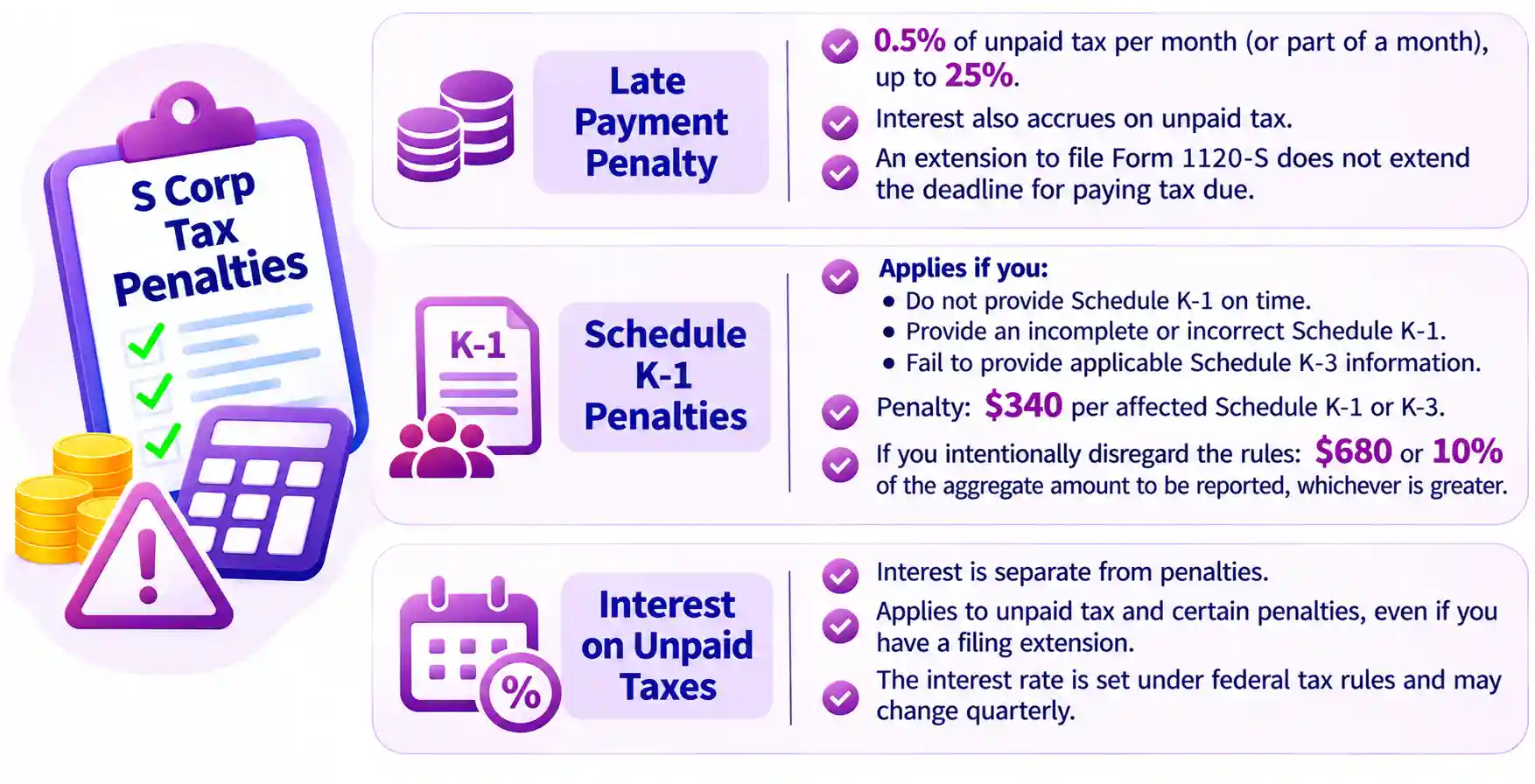
Apart from the Section 6699 late-filing penalty, an S Corporation may face other federal penalties when it does not meet its tax payment and shareholder information-reporting obligations.
An S Corporation may owe certain federal taxes at the entity level, even though most of its income, deductions, and credits pass through to shareholders.
If the corporation does not pay an applicable tax by its due date, the IRS may generally impose a late payment penalty of 0.5% of the unpaid tax for each month or part of a month, up to 25%.
Interest may also accrue on unpaid tax, even when the corporation has received an extension to file its return.
An extension to file Form 1120-S does not automatically extend the deadline for paying tax due.
An S Corporation must prepare and provide Schedule K-1 to its shareholders so they can report their respective shares of business income, deductions, credits, and other tax items.
The corporation generally must furnish Schedule K-1 by the due date of Form 1120-S, including a valid extension.
The IRS may impose a penalty when the corporation:
Under the published 2025 Form 1120-S instructions, the penalty is generally $340 for each affected Schedule K-1 or Schedule K-3.
If the corporation intentionally disregards the information-reporting requirements, the penalty may increase to $680 or 10% of the aggregate amount required to be reported, whichever is greater.
Reasonable-cause relief may be available when the corporation can establish that the failure was due to reasonable cause rather than willful neglect.
Interest is separate from penalties. The IRS may charge interest on unpaid tax even if the S Corporation has filed Form 7004 and received additional time to submit Form 1120-S.
Interest may also apply to certain penalties from the applicable date until payment.
The interest rate is determined under the federal tax rules and may change quarterly.
For a broader explanation of general IRS late-filing, late-payment, and penalty-relief rules, read our guide to IRS Penalties for Late Filing and Late Payment.
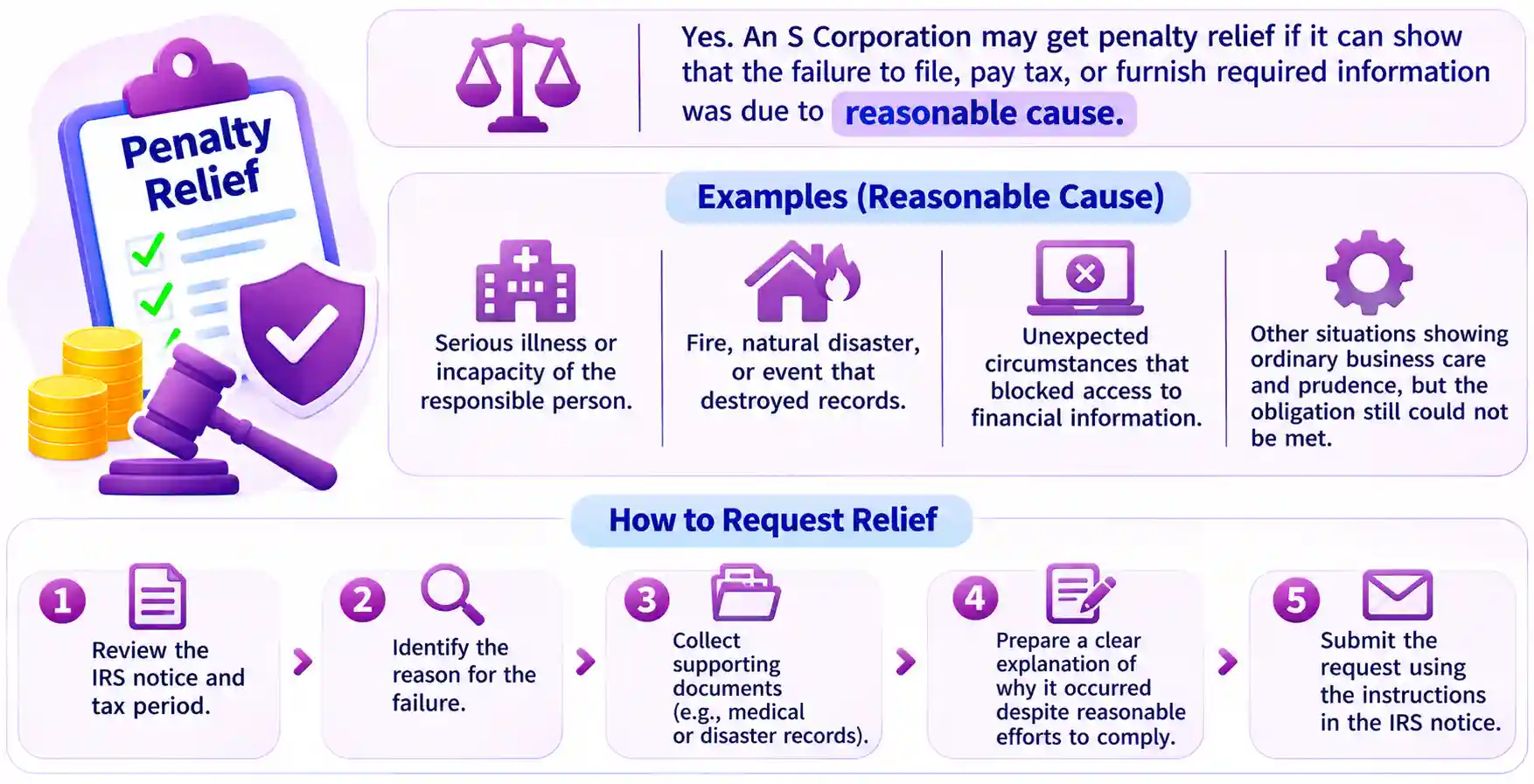
Yes. An S Corporation may qualify for penalty relief if it can demonstrate that its failure to file a complete return, pay applicable tax, or furnish required shareholder information was due to reasonable cause.
However, relief is not automatic. The corporation must explain what happened, why it could not meet the requirement, and what steps it took to comply once the circumstances were resolved.
Examples of circumstances that may support a reasonable-cause request include:
If the IRS assesses a penalty, the corporation should review the notice and identify the specific penalty being charged.
It should then:
The IRS evaluates reasonable-cause requests based on the facts and circumstances of each case. Simply stating that the business was busy, lacked funds, or forgot the deadline is generally not enough by itself.
Savetaxs helps business owners manage S Corporation tax filings, resolve compliance issues, and navigate IRS requirements.
S Corporation late-filing and tax penalties can increase the cost of missed filing deadlines and incomplete shareholder reporting. The penalty under Section 6699 may depend on the number of shareholders and how long Form 1120-S remains overdue. Additional charges may apply for unpaid corporate taxes and Schedule K-1 reporting failures.
U.S. business owners should maintain accurate accounting records, monitor filing deadlines, provide shareholder information on time, and pay applicable taxes by their due dates. If a deadline is missed, filing the outstanding return promptly and reviewing possible reasonable-cause relief can help address the issue.
Savetaxs helps U.S. business owners with business tax filing, S Corporation compliance, tax extensions, and related federal tax requirements. Professional guidance can help identify filing obligations, review penalty exposure, and determine the appropriate next steps.
This article is for general informational purposes only and does not constitute tax, legal, financial, or investment advice. Laws, regulations, rates, and procedures may change over time and may vary based on individual circumstances.
While SaveTaxs makes reasonable efforts to keep the information accurate and up to date, readers should verify applicable rules with official authorities or consult a qualified professional before making decisions based on this information.
Hatim Dudhiyawala is a Certified Public Accountant (CPA) with SaveTaxs and specializes in Indian and NRI taxation. He advises individuals, NRIs, and businesses on income tax filing, capital gains taxation, DTAA benefits, fund repatriation, and tax compliance. With experience in cross-border tax matters, Hatim helps taxpayers understand complex regulations and make informed decisions. Through his articles, he shares practical insights to help readers stay compliant and manage their tax obligations with confidence. See Full Bio

Want to read more? Explore Blogs