US Tax Filing and Compliance
How to Report Multiple 1099 Forms on a U.S. Tax Return: A Guide for NRIsHow to Report Multiple 1099 Forms on a U.S. Tax Return: A Guide for NRIs
Written by Hatim Dudhiyawala

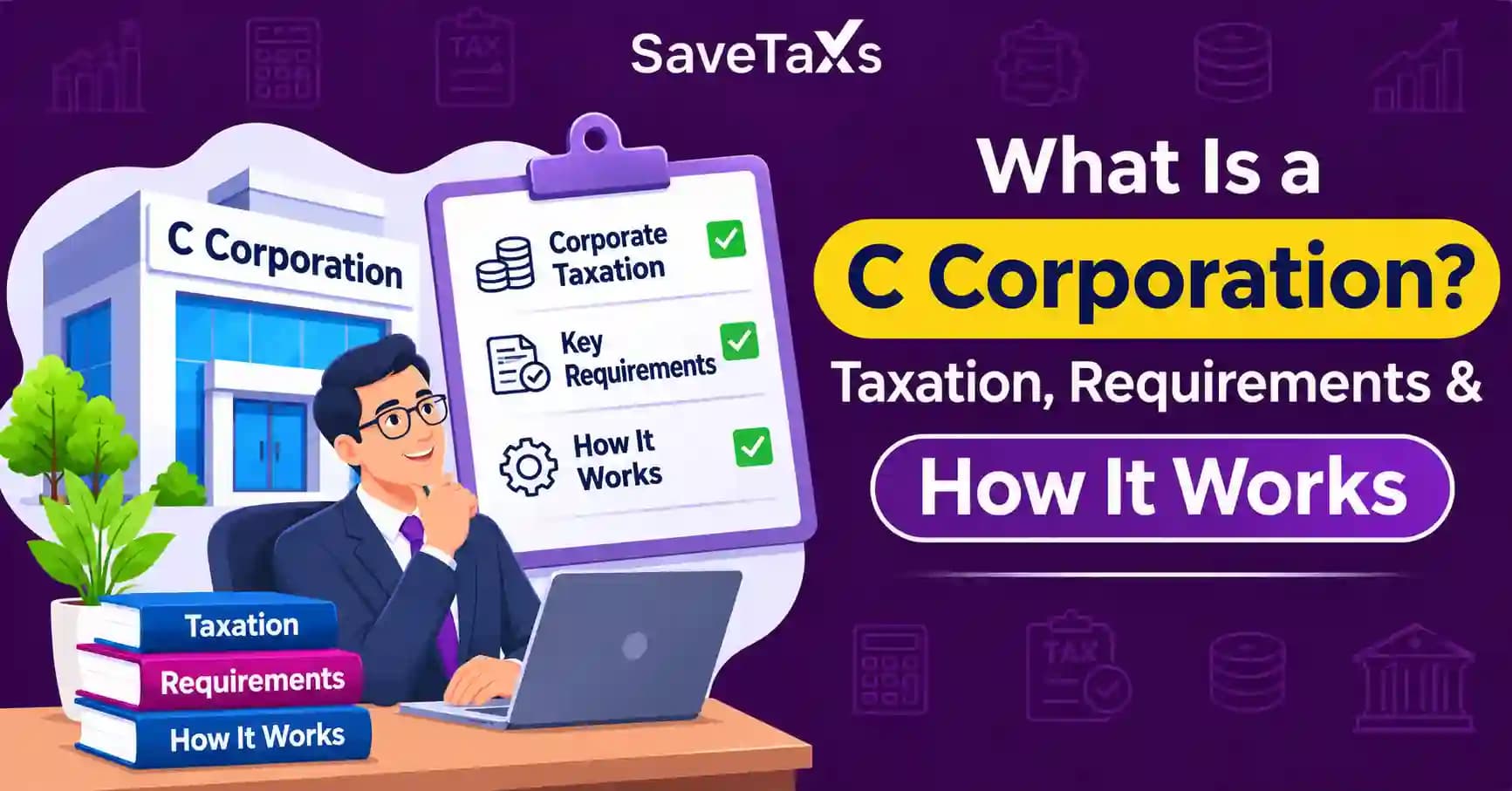
A business structure can influence how a company raises capital, manages ownership, protects shareholders and pays taxes. For businesses operating in the United States, a C Corporation (C Corp) is one option that provides a separate legal identity, flexible ownership and the ability to issue different classes of stock.
C Corporations are commonly used by businesses that plan to attract investors, expand operations or establish a formal corporate structure. However, they also have additional compliance responsibilities and a different tax treatment from pass-through businesses such as S Corporations and many LLCs.
Understanding how a C Corporation works can help business owners decide whether this structure supports their financial and long-term business goals.
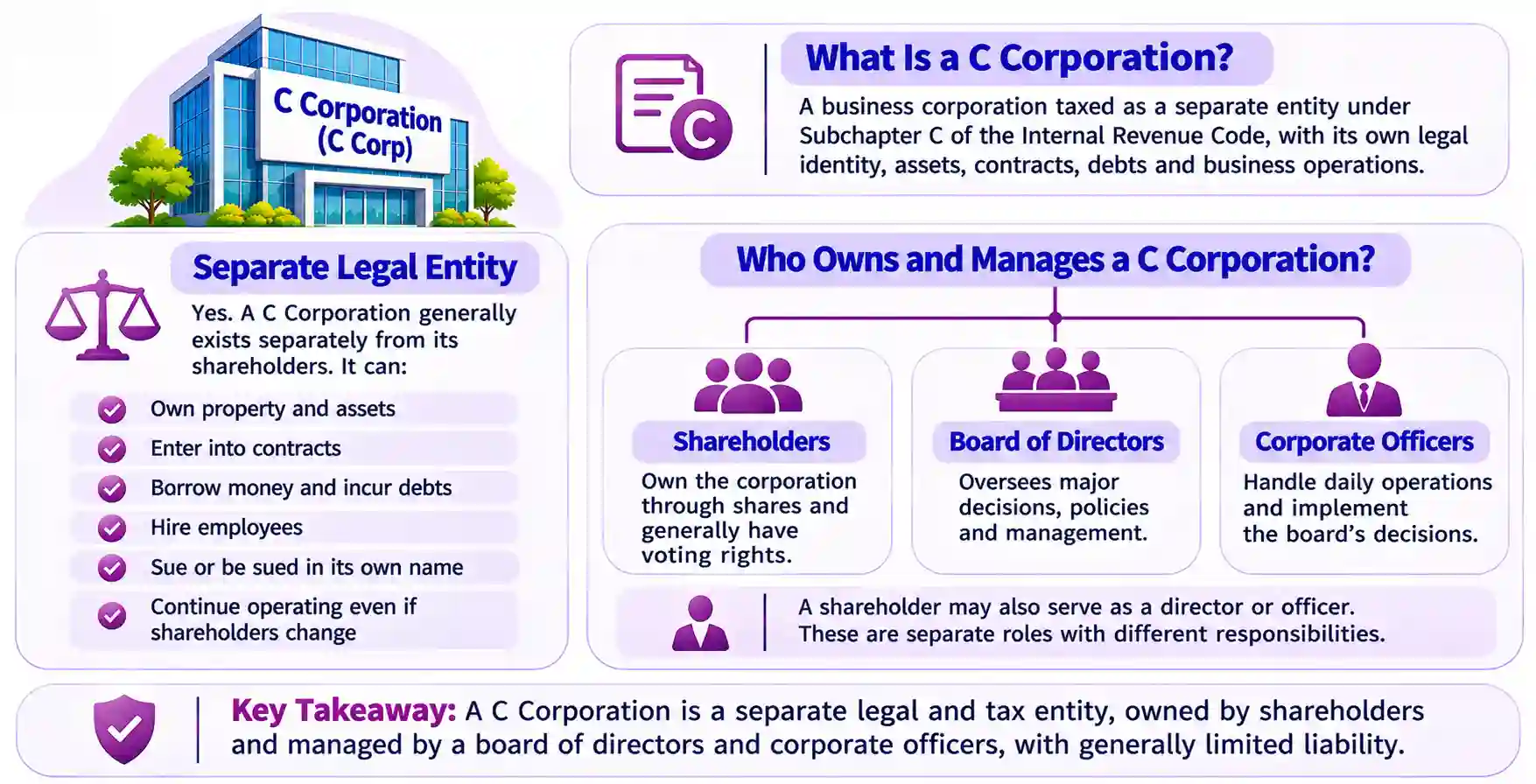
A C Corporation (C Corp) is a business corporation that is generally taxed as a separate entity under Subchapter C of the Internal Revenue Code. It has a legal identity separate from its shareholders, meaning the corporation can own assets, enter into contracts, earn income, incur debts and conduct business in its own name.
The term "C Corporation" comes from Subchapter C of the Internal Revenue Code, which contains the federal tax rules applicable to these corporations.
Unlike a sole proprietorship, where the business and owner are generally treated as the same legal person, a C Corporation exists independently of its shareholders. Shareholders own shares in the company, but they do not personally own the corporation's individual assets.
For example, if three individuals establish a technology company as a C Corporation, the corporation owns its business equipment, bank accounts and other corporate assets. The three individuals own shares representing their respective ownership interests.
Yes. A corporation formed under applicable state law generally exists as a separate legal entity from its shareholders.
This separation allows the corporation to:
Shareholders generally receive limited liability protection. This means they are not ordinarily personally responsible for corporate debts solely because they own shares. However, personal guarantees, fraud, commingling of funds and other circumstances may create personal liability.
A C Corporation separates ownership from management. Its main participants have different responsibilities:
A shareholder may also serve as a director or officer. However, these roles are legally distinct and carry different responsibilities.
Understand your corporate tax obligations, Form 1120 requirements and applicable filings with professional tax support.
A C Corporation operates as an independent business entity. It receives capital, conducts business, earns revenue, pays expenses, reports taxable income and distributes profits according to applicable corporate and tax rules.
Its operating structure generally follows this process:
Ownership in a C Corporation is represented by shares of stock. A corporation may issue shares to founders, employees or outside investors, depending on its structure and applicable requirements.
For example, suppose a corporation issues 10,000 shares:
If all shares have identical economic and voting rights, their respective ownership interests would be 50%, 30% and 20%.
However, ownership percentages do not always determine every shareholder's rights. Different classes of stock may carry different voting, dividend or liquidation rights.
Generally, yes. A C Corporation has an existence separate from its shareholders. A shareholder may sell or transfer shares, or leave the company, without automatically ending the corporation's existence.
This continuity can make the corporate structure useful for businesses that expect changes in ownership, outside investment or long-term operations.
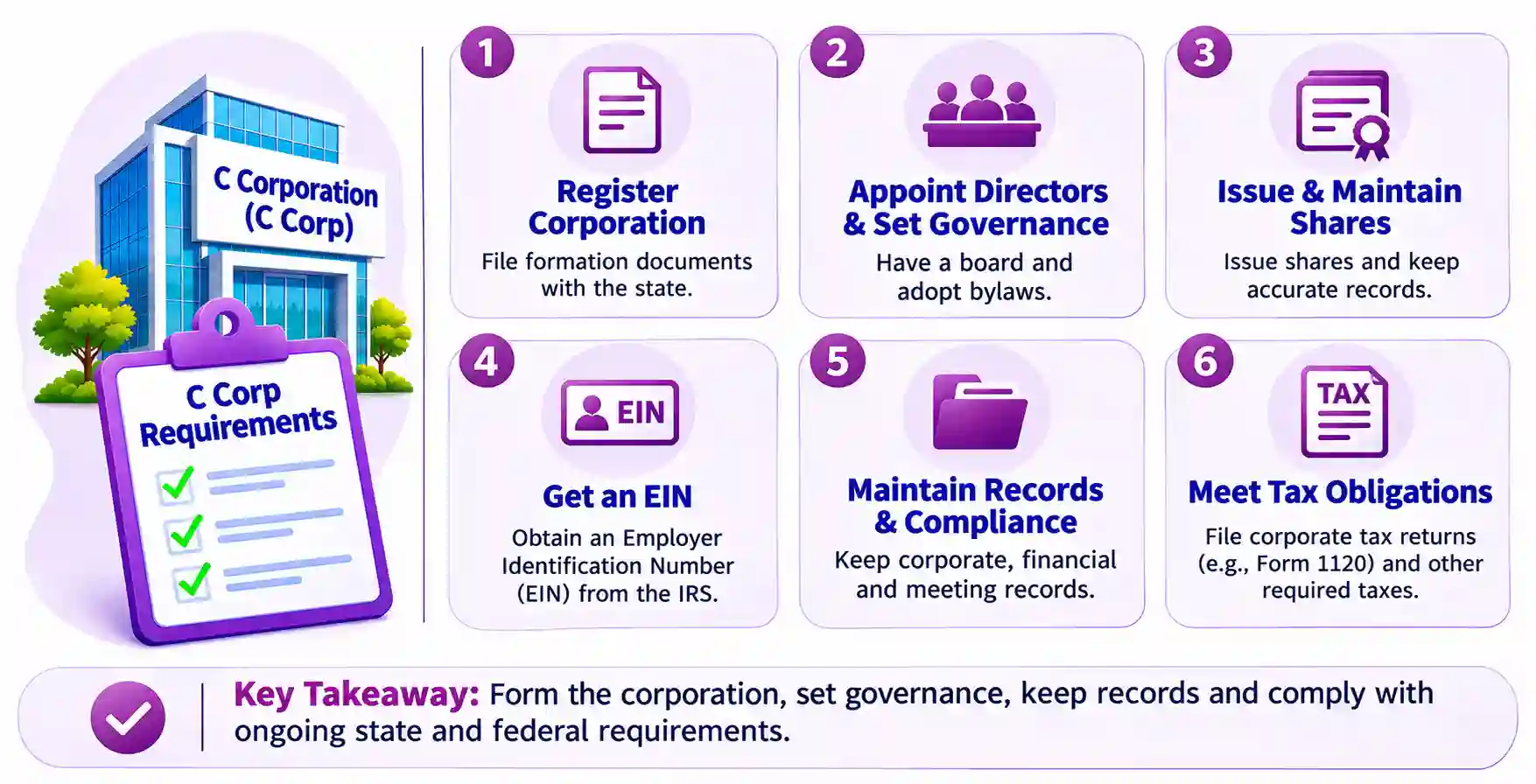
C Corporation requirements involve both state-level corporate law and federal tax obligations. The exact formation, governance, reporting and ongoing compliance rules depend on the state where the corporation is established and the activities it conducts.
Common requirements include:
A business generally establishes a corporation by filing its required formation documents, commonly called Articles of Incorporation or a Certificate of Incorporation, with the relevant state authority.
The filing requirements, fees and corporate naming rules vary by state.
A corporation generally has a board of directors responsible for overseeing its affairs. It also adopts governing documents, such as bylaws, that establish internal procedures and responsibilities.
The corporation should follow applicable state law and its governing documents when making significant decisions.
A C Corporation issues shares to represent ownership. Its authorized and issued shares, stock records and shareholder rights should be documented accurately.
Depending on its structure and applicable law, a C Corporation may issue multiple classes of stock with different rights.
A corporation generally needs an Employer Identification Number (EIN) from the IRS for federal tax administration. It uses the EIN for tax filings, employment-related reporting and other business tax purposes.
A corporation should maintain appropriate accounting records, ownership information, financial statements, meeting records and other corporate documents.
It may also have state-specific annual report, franchise tax, registered agent and business licensing obligations.
A C Corporation must comply with applicable federal, state and local tax rules. This may include corporate income tax returns, employment tax filings, estimated tax payments and other reporting requirements, depending on its activities.
For federal income tax purposes, domestic C Corporations generally file Form 1120, unless an exemption or special filing requirement applies.
The detailed filing process is covered separately in the Savetaxs Form 1120 guide.
A C Corporation is generally treated as a separate federal income taxpayer. Unlike a typical pass-through business, its profits are not automatically reported as the shareholders' business income simply because they own shares.
The corporation calculates its taxable income, applies the relevant corporate tax rules and pays any tax due. Shareholders may have separate tax consequences when they receive dividends or other taxable payments.
Under Internal Revenue Code Section 11, the general federal corporate income tax rate is 21% of taxable income.
For example, assume a C Corporation has $500,000 in taxable income before federal corporate income tax:
| Particulars | Amount |
|---|---|
| Corporate taxable income | $500,000 |
| General federal corporate tax rate | 21% |
| Illustrative federal corporate income tax | $105,000 |
| Remaining amount after this federal tax | $395,000 |
This is a simplified illustration. It does not account for tax credits, special deductions, other applicable adjustments, state taxes or other tax liabilities.
The 21% rate is the general federal corporate income tax rate; it should not be treated as the corporation's complete tax burden in every situation.
One important feature of C Corporation taxation is the possibility of double taxation.
It can occur when:
For example, a corporation earns profits, pays the applicable corporate tax and later distributes part of its remaining earnings to shareholders as dividends. The corporation generally does not receive a deduction merely for paying dividends, and shareholders may have their own tax liability on the distributions.
However, not all corporate earnings are automatically taxed twice. If the corporation retains profits rather than distributing dividends, shareholders do not generally pay dividend tax merely because the corporation earned those profits.
The actual shareholder tax treatment depends on the type of distribution, the shareholder's circumstances and applicable tax rules.
For a detailed explanation of this issue, see the planned Savetaxs guide on C Corporation Double Taxation Explained.
A domestic C Corporation generally uses Form 1120, U.S. Corporation Income Tax Return, to report its income, gains, losses, deductions, credits and federal income tax liability.
The corporation may also need additional schedules and forms depending on its financial activities, ownership and tax position.
The filing requirement generally applies even when a domestic corporation has no taxable income, unless an exemption or special filing rule applies.
The return's due date, payment requirements and extension rules depend on the corporation's tax year and applicable IRS rules. These details should be reviewed separately rather than assumed to be the same for every corporation.
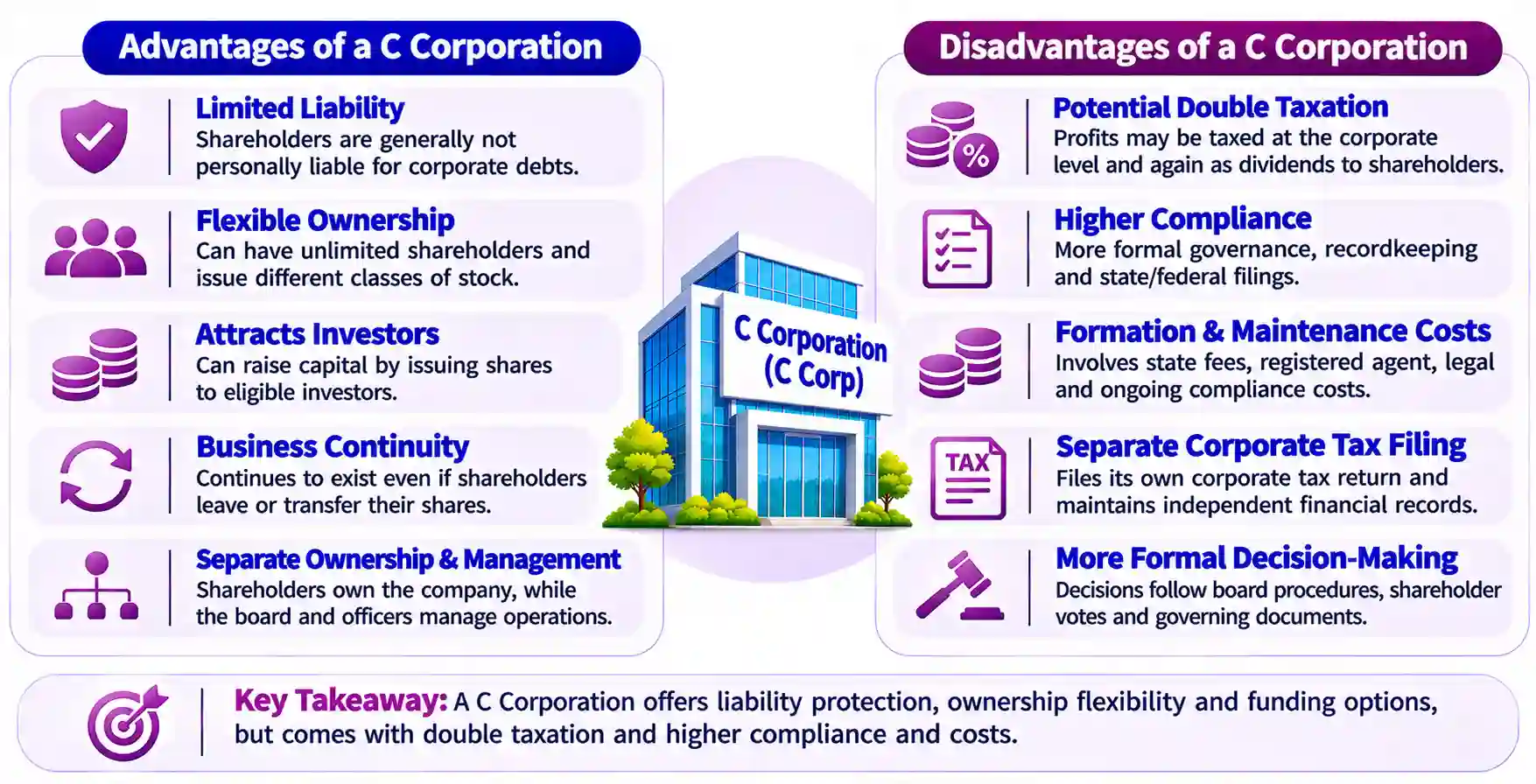
A C Corporation can support businesses that need flexible ownership, outside investment and a separate corporate structure. However, its tax treatment and compliance responsibilities may make it less suitable for some smaller businesses.
C Corporations, S Corporations and LLCs differ in their legal structure, federal tax treatment, ownership rules and compliance responsibilities. Choosing between them requires considering how the business will operate, who will own it and how profits will be used.
| Feature | C Corporation | S Corporation | LLC |
|---|---|---|---|
| Legal structure | Corporation formed under state law | Corporation or eligible entity with an S election | Entity formed under state law |
| Federal tax treatment | Generally taxed at corporate level | Generally pass-through taxation | Depends on default classification or tax election |
| Shareholder or owner limit | Generally no S Corp-style limit | Generally limited to 100 shareholders | No general federal member limit |
| Nonresident alien ownership | Generally permitted, subject to applicable rules | Generally not permitted as a shareholder | Depends on applicable law and tax classification |
| Stock classes | Can generally issue multiple classes | Generally limited to one class of stock | Membership interests rather than corporate stock |
| Federal income tax return | Generally Form 1120 | Generally Form 1120-S | Depends on tax classification |
| Potential double taxation | Yes, when taxable dividends are distributed | Generally avoids regular corporate-level income tax, subject to exceptions | Depends on tax classification |
An important distinction is that an LLC is a state-law business entity, while C Corporation and S Corporation treatment describes federal tax classification. An eligible LLC can elect to be taxed as a corporation. It may also qualify for an S Corporation election if it meets the applicable requirements.
A C Corporation may suit a business seeking flexible ownership, multiple stock classes or outside investment. An S Corporation may suit an eligible business seeking pass-through tax treatment. An LLC may offer management and tax-classification flexibility, depending on the owners' needs and applicable state law.
There is no universally best structure. Business owners should evaluate ownership, financing plans, tax treatment, state requirements and long-term objectives before choosing.
Get professional assistance with corporate tax returns, tax compliance and state filing requirements
A C Corporation can be a suitable structure for businesses that want a separate legal identity, flexible ownership, the ability to issue different classes of stock and opportunities to raise capital. It also comes with corporate-level taxation, potential double taxation on dividends and ongoing compliance responsibilities.
Before choosing this structure, business owners should evaluate their expected profits, shareholder arrangements, investment plans, state requirements and tax obligations. The right decision depends on how the company plans to operate and distribute its earnings.
Savetaxs helps U.S. businesses manage C Corporation tax compliance through corporate tax return preparation, Form 1120 support, applicable schedules and state filing assistance. If you already operate a C Corporation or are planning its tax compliance, you can explore Savetaxs C-Corporation Tax Services for professional support.
This article is for general informational purposes only and does not constitute tax, legal, financial, or investment advice. Laws, regulations, rates, and procedures may change over time and may vary based on individual circumstances.
While SaveTaxs makes reasonable efforts to keep the information accurate and up to date, readers should verify applicable rules with official authorities or consult a qualified professional before making decisions based on this information.
Hatim Dudhiyawala is a Certified Public Accountant (CPA) with SaveTaxs and specializes in Indian and NRI taxation. He advises individuals, NRIs, and businesses on income tax filing, capital gains taxation, DTAA benefits, fund repatriation, and tax compliance. With experience in cross-border tax matters, Hatim helps taxpayers understand complex regulations and make informed decisions. Through his articles, he shares practical insights to help readers stay compliant and manage their tax obligations with confidence. See Full Bio

Want to read more? Explore Blogs