NRI Income Tax Compliance
How to Claim Excess TDS Refund After Selling Property in India as an NRIHow to Claim Excess TDS Refund After Selling Property in India as an NRI
Written by Shubham Jain

Many people move overseas to pursue better opportunities for further studies, jobs, projects, etc., without knowing what they need to do. Additionally, numerous NRIs remain who haven't yet complied with several mandatory requirements. It can be due to negligence or maybe a lack of knowledge.
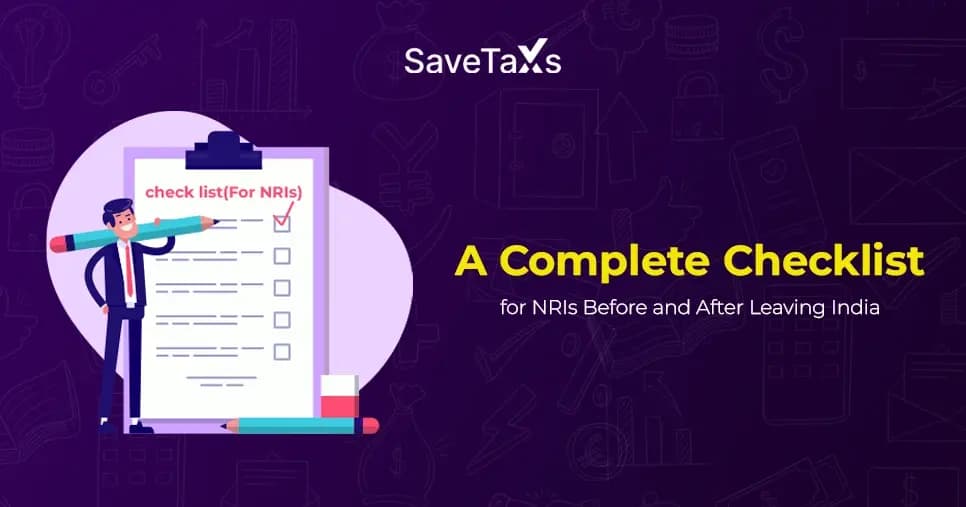
Preparing a checklist is essential for NRIs to understand the financial, legal, and administrative problems of moving abroad. It can help them stay compliant with regulations and prevent future issues such as penalties or frozen accounts.
Here is a complete checklist for individuals planning to move out of India. Also, for those who have already moved out to secure their assets. In this blog, we have divided the NRI checklist into two main parts: steps to take before leaving India and after leaving India. Let's first understand the steps to take before leaving India.
Here is a list of the important tasks that you must do before moving abroad and becoming an NRI:
The first thing you must do before moving abroad is to convert your existing resident bank account to an NRO account. It is because when you move abroad, your residential status changes to an NRI. So, according to FEMA regulations, an NRI must mandatorily either:
Additionally, you must convert your FDs as well. You need to open an NRE account to deposit the income earned outside India and repatriate it easily whenever required.
You must build a strong credit history if you have moved abroad recently. Having a good credit score in a foreign country will help you secure loans at reduced interest rates, make renting easier, and avail lower insurance premiums.
Some Indian banks provide the chance to open an international bank account through their overseas branches, allowing you to access foreign currency from the day you visit abroad. This can help you avoid the forex conversion fees that come with using Indian debit/credit cards internationally.
All credits to your international bank account must comply with the prevailing FEMA rules and the outward remittance limits set under the Liberalized Remittance Scheme (LRS). Such banks offer accounts in the local currency of your destination.
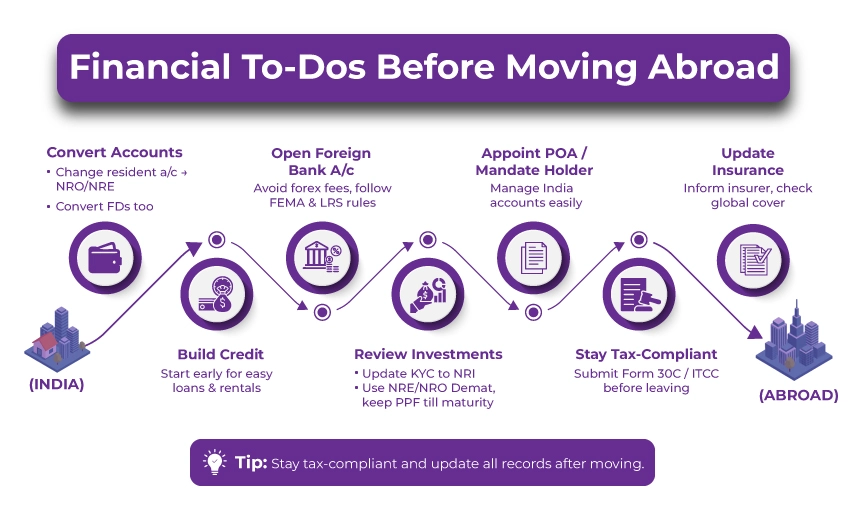
Once you have decided to move abroad, take time to assess your assets and investments in India. You must decide whether to keep or sell your existing investments, which may include mutual funds (MF), shares, or a public provident fund (PPF).
While you are allowed to retain your investments, remember that capital gains on them may be taxed in India.
Consider assigning a Power of Attorney (PoA) or a mandate holder to manage your financial and banking activities in India before moving overseas. A mandate holder can operate your bank account and make investments on your behalf, while a PoA has a broader authority for various matters.
You must complete these steps before moving abroad to make sure you stay tax-compliant:
Even after moving abroad, NRIs can retain their insurance policies, including life and general insurance (such as health and motor insurance). They need to notify their insurance provider about their change in residential status and update their bank account details through the insurer's specified service channels.
Additionally, an NRI must review the geographical coverage and residency requirements of health insurance policies. It is because some plans may offer coverage only for medical expenses incurred within India or strictly for Indian residents.
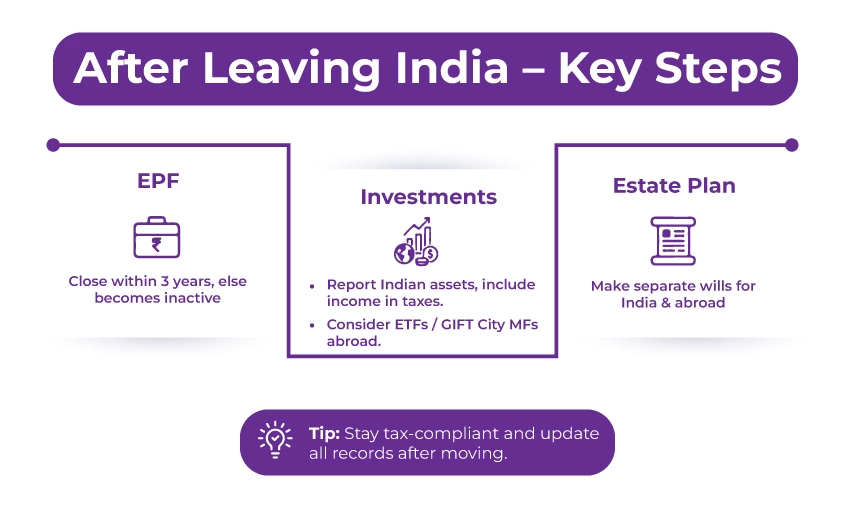
The following are the steps an NRI must take after leaving India:
If you are going abroad to stay for an indefinite period and have an employee provident fund (EPF) account in India, you must close it within 3 years. If you don't apply for EPF withdrawal within 36 months of quitting the job, your account will become inoperative.
One must carefully consider whether to continue investing in India after moving. When it comes to investments, there are two critical obligations:
Since these requirements are annual, and financial years differ across countries, this may lead to confusion and potential miscalculations. Therefore, if managing investments from an NRE account in India seems complex, it can be advisable to consider investing directly through:
Additionally, NRIs can invest in mutual funds in India through International Financial Services Centers (IFSC), such as GIFT City in Gujarat.
It's wise to create separate wills for assets in both the country of residence and those held in India.
The transition to NRI status may seem exciting. However, it brings both opportunities and challenges. This NRI checklist can help you navigate the difficulties of managing your finances, legal complexities, and tax implications. Taking a proactive approach after becoming an NRI can ensure a smooth, hassle-free experience.
One such approach is seeking guidance from an expert to navigate these complexities more easily. Talking about experts, Savetaxs tops the list. At Savetaxs, we specialize in providing customized assistance to NRIs to help them handle their financial and legal responsibilities with confidence. Our team will guide you through every tax issue, ensuring precision and peace of mind.
Our team has 30 years of expertise so that you can fulfill all your tax responsibilities without any worries. Reach out to us anytime—we are available 24*7 around the globe.
This article is for general informational purposes only and does not constitute tax, legal, financial, or investment advice. Laws, regulations, rates, and procedures may change over time and may vary based on individual circumstances.
While SaveTaxs makes reasonable efforts to keep the information accurate and up to date, readers should verify applicable rules with official authorities or consult a qualified professional before making decisions based on this information.
Shubham Jain is the Founder of SaveTaxs and has extensive experience in Indian and NRI taxation. He advises individuals, NRIs, and businesses on tax filing, tax planning, capital gains, DTAA benefits, fund repatriation, and compliance matters. He regularly writes about taxation and related financial topics. His focus is on making complex tax concepts easy to understand. Through his articles, he helps taxpayers stay informed, avoid common mistakes, and stay compliant with Indian tax laws. See Full Bio
Want to read more? Explore Blogs