


Investment & Financial Planning
FCNR Deposit Interest Rates in 2026FCNR Deposit Interest Rates in 2026
Written by Vipul Jain


Small-cap funds primarily invest in small companies with the potential to grow and generate high returns. Post-COVID, these funds have performed very well. So, being an NRI, if you are planning to invest in small-cap mutual funds in India, then surely it is the right decision.
However, these funds, to know their growth potential and manage volatility, require time. Additionally, also need a long-term approach and patience from investors. To help you out, this blog explains everything about small-cap funds for NRIs, from their benefits to tax implications and top small-cap funds. So read on and gather all the information.
According to the Securities and Exchange Board of India (SEBI), small-cap mutual funds are investments that focus on companies that rank below 250 by market capitalization. For instance, consider India has 5,000 listed companies, among them 4,750 firms have small caps. These are companies that generally have market caps below INR 5,000 crore ($600 million). These represent the development of business in earlier stages.
These funds operate by taking money from several investors and directing a minimum of 65% of this capital into small-cap stocks. Considering this, SEBI has stated clear instructions for small-cap funds to invest at least 65% of their asset in small firms.
Further, unlike large-cap funds that invest in the top 100 blue-chip companies of India, small-cap funds put their money on emerging businesses at their growth stages. In this, the job of the fund manager is to look for the undervalued firms that have strong growth potential.
Confused, think of it like large caps are hotels established in prime locations, whereas small caps are food trucks that in the future might become a restaurant or go bankrupt while trying.
So, this was all about small-cap mutual funds. Moving ahead, let's know why NRIs should choose small-cap funds over large-cap funds.
NRIs should opt for small-cap funds instead of large-cap funds because they offer advantages like:
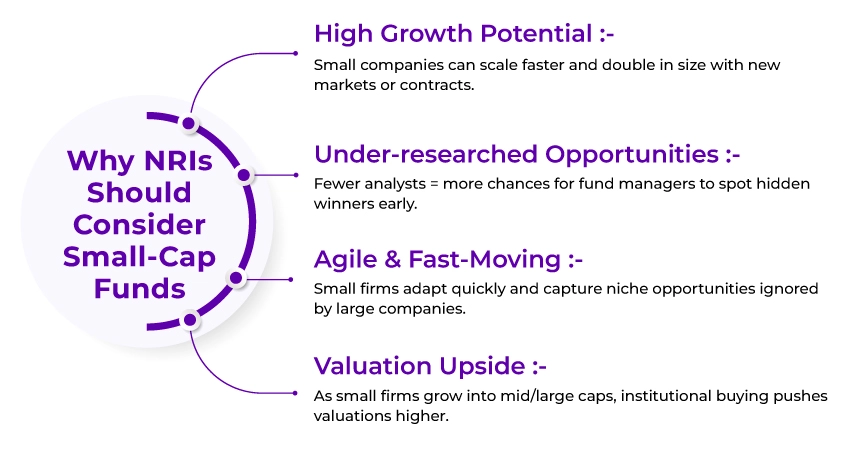
In simple words, small companies have benefits that decades ago large companies have lost. So, this is why NRIs should opt for small-cap funds instead of large-cap funds. Now, moving further, let's know the things NRIs should consider before investing in these funds.
At Savetaxs, we provide end-to-end DTAA guidance to NRIs and help in maximizing their returns.
Although small-cap funds are good options for investment. However, compared to large-cap investments, they have higher risk as they are in their initial stage of establishment. Further, understanding these risks helps NRIs make the right decisions before investment.
So, before investing in small-cap funds, it is advisable for NRIs to carefully assess their risk tolerance. Moving ahead, let's know how the NRIs can invest in these funds.
Here is how NRIs can invest in small-cap mutual funds:
Before investing in small-cap funds, first know your residential status, i.e., NRI, RNOR, or Indian resident. It is because, according to residential status in India, tax obligations will be imposed on you.
To invest in India, under the FEMA regulations, you need to open either a Non-Resident External (NRE) or Non-Resident Ordinary (NRO) account.
Before investing in India, NRIS must complete their Know Your Customer (KYC) process. The required documents:
Further, due to FATCA (Foreign Account Tax Compliance Act), NRIs from Canada and the US may need to submit some additional requirements. Additionally, some fund houses like SBI Mutual Fund, Aditya Birla Sun Life, and ICICI Prudential allow these NRIs to transit offline only.
You have two options to choose between SIP and Lumpsum:
Further, for small-cap mutual funds, it is advisable over lumpsum choose SIP.
While choosing the investment fund, look for:
Once you link your bank account, through the given options, you can invest:
This is how NRIs can invest in small-cap funds. Moving further, let's know the NRI income tax in India that NRIs face while investing in these funds.
Connect with Savetaxs, get expert guidance, and simply claim your DTAA benefits.
Since small-cap funds hold 65%+ in equities, for taxation purposes, these are stated as equity funds. Compared to NRO fixed deposits or debt instruments, this provides NRIs with preferential tax rates.
These are the tax implications NRIs face when investing in small-cap funds in India. Moving ahead, now let's know the top small-cap funds for NRIs.
Based on the historical performance, track record of the manager, and fund size, here are the top small-cap funds for NRIs:
| Name of the Fund | AUM (as of September/ October 2025) | Returns (Annualized) | Expense Ratio (Direct Plan) | Why | Minimum SIP |
|---|---|---|---|---|---|
| Nippon India Small Cap Fund | INR 66,136 Crore | 5-Year: 34.29% | 0.64% | Have a large fund size, diversified across sectors, and experienced management | INR 500 |
| SBI Small Cap Fund | INR 35,585 Crore | 5-Year: 25.68% | 0.76% | Reasonable expense ratio, trusted AMC | INR 500 |
| Quant Small Cap Fund | INR 29,288 Crore | 3-Year: 25.6%, 5-Year: 35.56% | 0.71% | Quantitative approach, shorter track record, aggressive growth, higher risk | INR 1000 |
| Axis Small Cap Fund | INR 25,975 Crore | 5-Year: 27.9% | 0.56% | Quality stock selection, lower expense ratio, consistent performance | INR 100 |
| Kotak Small Cap Fund | INR 17,480 Crore | 5-Year: 27.74% | 0.52% | Good option for conservative small-cap exposure, with steady performance, established fund, compared to peers, has lower volatility (Std Dev: 11.91% vs category average 13.62%) | INR 100 |
So, as per your financial goals and preferences, choose any of these small-cap funds for investment. Further, to reduce the risk of a manager, it is advisable instead of a single fund, diversify across 2-3 small cap mutual funds.
Lastly, by investing in small-cap funds, NRIs help in the growth of the emerging companies of India. It further provides them with strong returns during recoveries but needs a disciplined long-term approach. Here, the complete blog was about small-cap funds for NRIs. Hope after reading it all your doubts get resolved.
Further, if you are still confused or need assitance in choosing the right investment plan, connect with Savetaxs. We have a team of financial advisors who have years of experience in NRI investments. Additionally, if you want, they can also help in resolving your tax obligations.
This article is for general informational purposes only and does not constitute tax, legal, financial, or investment advice. Laws, regulations, rates, and procedures may change over time and may vary based on individual circumstances.
While SaveTaxs makes reasonable efforts to keep the information accurate and up to date, readers should verify applicable rules with official authorities or consult a qualified professional before making decisions based on this information.
Shubham Jain is the Founder of SaveTaxs and has extensive experience in Indian and NRI taxation. He advises individuals, NRIs, and businesses on tax filing, tax planning, capital gains, DTAA benefits, fund repatriation, and compliance matters. He regularly writes about taxation and related financial topics. His focus is on making complex tax concepts easy to understand. Through his articles, he helps taxpayers stay informed, avoid common mistakes, and stay compliant with Indian tax laws. See Full Bio

Want to read more? Explore Blogs
_1781845771869.webp&w=828&q=75)
_1778936280179.webp&w=828&q=75)
_1778936089630.webp&w=828&q=75)