



Investment & Financial Planning
NRI Property Sale: How to Calculate Capital Gains TaxNRI Property Sale: How to Calculate Capital Gains Tax
Written by Shubham Jain


To build long-term wealth in India, millions of NRIs prefer investing in mutual funds. However, they end up facing the biggest challenge, which is double taxation. Double taxation is a situation in which a person is taxed twice on the same income in two different nations.
The government deducts TDS (Tax Deducted at Source) on capital gains when an NRI redeems mutual fund units in India. Simultaneously, a lot of foreign countries, specifically those following a worldwide income taxation system, require residents to report and pay taxes on their global income, including mutual fund gains from India. It means they pay capital gain tax TDS in India, pay additional tax, and report the same gains in their country of residence.
Several countries like the USA, Australia, and Canada enforce global taxation, resulting in NRIs being taxed twice. This is when DTAA comes into the picture, which is an agreement that ensures NRIs are not taxed twice on the same income.
In this blog, we will learn how an NRI can avoid double taxation on mutual fund gains. We will also discuss how the DTAA tax treaty works and how it applies specifically to mutual fund gains for NRIs.
India has signed a DTAA (Double Taxation Avoidance Agreement) with several countries. It allows NRIs to avoid paying tax twice on the same income, once in India and again in their country of residence.
The main provision that permits this tax provision is called the 'residual clause' in Article 13 of certain DTAAs. As per the residual clause, capital gains are subject to taxation only in the country of residency of the seller. It doesn't include those received from immovable property and shares.
In short, if you are a tax resident of a country like Singapore, the UAE, Mauritius, Portugal, Spain, or the Netherlands, you might qualify to enjoy zero tax liability on mutual fund gains in India.
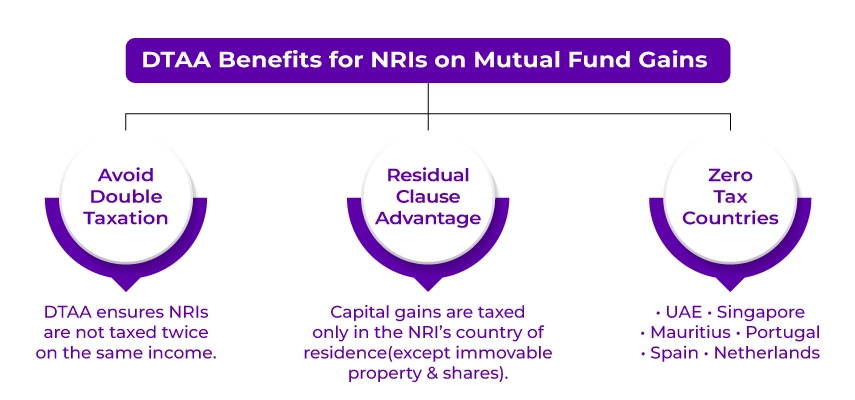
Consider the following tax implications if you are an NRI seeking to invest in mutual funds in India:
When redeeming mutual funds, NRIs are liable to pay TDS at the specific TDS rate determined by the scheme type (equity or non-equity) and the duration of fund holding.
| Particulars | TDS on Short-Term Capital Gains | TDS on Long-Term Capital Gains | TDS on Distributed Income Under IDCW Option |
|---|---|---|---|
| Equity Mutual Funds | 15% | 10% | 20% |
| Other Than Equity-Oriented Fund | 30% |
Listed - 20% with indexation. Unlisted - 10% without indexation. |
20% |
The TDS is levied at the highest applicable rate. The NRI will qualify to claim a refund when filing their returns, provided they fall in a lower tax slab.
Capital gains taxation on mutual funds depends on the holding period and the type of scheme.
| Particulars | Tax on Short-Term Capital Gains | Tax on Long-Term Capital Gains |
|---|---|---|
| Equity Mutual Funds | 15% | Gains that go beyond Rs. 1 lakh - 10% without indexation benefit |
| Other than the Equity-Oriented Fund | Taxed based on the income tax bracket |
Listed - 20% with indexation. Unlisted - 10% without indexation. |
When filing taxes, an NRI can claim a refund if they have paid higher TDS than their lower tax slab. TDS deducts income tax at the highest rate, so if an NRI's tax slab is lower, then they can claim the extra tax paid through refunds.
If an NRI's total income includes only investment income or long-term capital gains with appropriate TDS deductions, they don't need to file a return of income.
Filing returns in India also has its own advantages. When filing returns, you will be eligible to claim a refund on the TDS deduction if your income falls under a lower tax slab.
Dividends acquired from dividend schemes, equity, and non-equity will be deemed as income of the year and will be taxed according to the applicable tax slab rate.
Ease filing NRI ITR by getting personalized assistance at every step of the process.
Mutual fund units had been treated as shares of companies by the Income Tax Department. Under that classification, capital gains would be subject to taxation in India for most NRIs. However, according to the ITAT (Income Tax Appellate Tribunal), it is clarified as:
In India, mutual funds are set up as trusts in accordance with SEBI regulations. When you invest in a mutual fund, you are actually buying units of a trust, not shares of a company.
Share represents ownership in a company registered under the Companies Act, while mutual fund units are a different type of investment. This distinction is essential because most DTAA specifically state that only "shares of a company deriving value from Indian assets are taxable in India.
Since mutual fund units are not mentioned in these agreements, they fall under the residual clause that usually allows the taxing rights to go to your country of residence. This means that, for capital gains from mutual fund investments, your home country typically has the right to tax those gains rather than India.
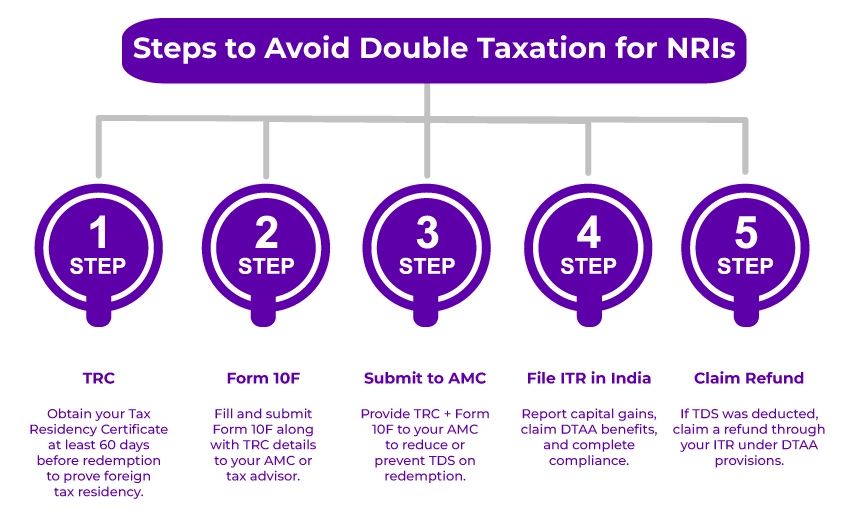
Understanding your eligibility for DTAA is one thing; claiming the benefits of the treaty is another. Follow these steps to avail yourself of all the benefits under the DTAA tax treaty and avoid double taxation on mutual fund gains:
You need to obtain a TRC (Tax Residency Certificate). TRC is used to prove your tax residency status in a country and is one of the most important documents.
Ensure that you apply for a TRC at least 60 days before you plan to redeem your mutual funds, as processing times may vary by country.
Fill out Form 10F, which is an Indian tax form that includes details from your TRC. After filling it out, it is typically submitted to your mutual fund house or through your tax advisor when filing returns.
Many AMC (Asset Management Companies) offer the option to submit your TRC and Form 10F before the redemption. It will help you avoid or lower TDS deduction at source.
However, remember that not all AMCs follow this process consistently. Many AMCs will still deduct TDS and require you to claim a refund later.
You need to file an ITR in India even if your gains are exempt under DTAA. It is required to:
You can claim a refund, provided your AMC deducted TDS before you submitted your TRC.
You can do this through the ITR filing process. The Income Tax Department will process your refund when you file and claim the exemption under the DTAA (Double Taxation Avoidance Agreement).
Double taxation can't be avoided. You can legally reduce or avoid tax on mutual fund gains with proper planning under the DTAA provisions. With the help of this blog, you will get an idea of double taxation on mutual fund gains for NRIs and a way to avoid it.
Furthermore, to accurately claim the exemption and avoid any mistakes, contact an expert. When it comes to experts, Savetaxs tops the list. We have a team of professionals carrying years of experience in this field. They have been helping NRIs manage their tax obligations and plan their finances. We will ensure you follow everything accurately and help you reduce your tax burden. Contact us anytime you want, as we are working 24*7 around the globe.
This article is for general informational purposes only and does not constitute tax, legal, financial, or investment advice. Laws, regulations, rates, and procedures may change over time and may vary based on individual circumstances.
While SaveTaxs makes reasonable efforts to keep the information accurate and up to date, readers should verify applicable rules with official authorities or consult a qualified professional before making decisions based on this information.
Shubham Jain is the Founder of SaveTaxs and has extensive experience in Indian and NRI taxation. He advises individuals, NRIs, and businesses on tax filing, tax planning, capital gains, DTAA benefits, fund repatriation, and compliance matters. He regularly writes about taxation and related financial topics. His focus is on making complex tax concepts easy to understand. Through his articles, he helps taxpayers stay informed, avoid common mistakes, and stay compliant with Indian tax laws. See Full Bio
Want to read more? Explore Blogs

_1781845771869.webp&w=828&q=75)
_1778936280179.webp&w=828&q=75)
NRIs can invest securely in mutual funds via:
NRE/NRO accounts
Online KYC process
Reputed fund houses or registered platforms.
An NRI can reduce tax on mutual fund gains by using:
DTAA benefits to avoid double taxation.
Long-term holding for lower capital gains tax.
ELSS funds under Section 80C (If subject to taxation in India).
Investing in equity funds that attract lower tax than debt funds.