
NRI Income Tax Compliance
How to Claim Excess TDS Refund After Selling Property in India as an NRIHow to Claim Excess TDS Refund After Selling Property in India as an NRI
Written by Shubham Jain

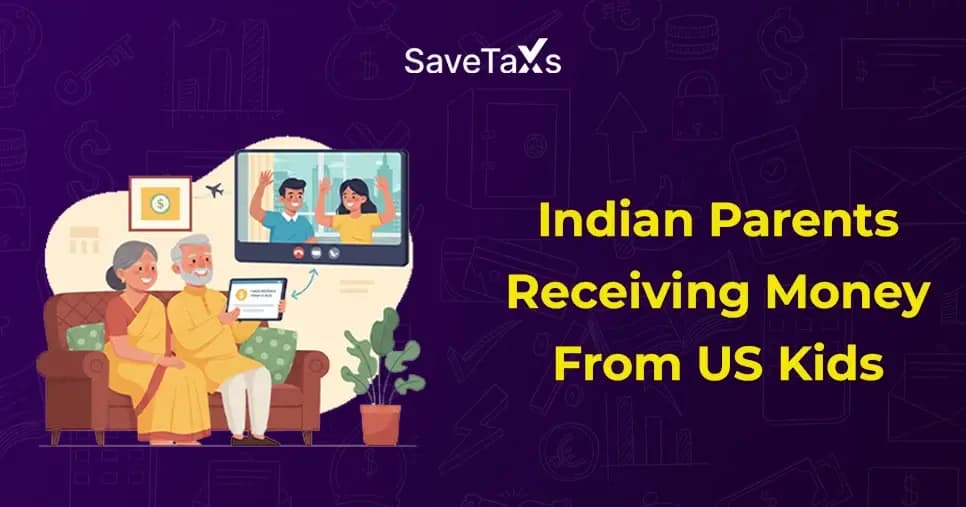
exempt income Every kid living abroad can resonate with the feeling of sending their parents money back home in India, which feels surreal. However, the process is not as simple as it seems; the emotions are undermined when you consider the tax implications, reporting requirements, and other related concerns.
This guide will discuss the aspects of sending money back home to India, including taxes, limits, and reporting requirements, that you must know whether you are sending the money or an Indian parent receiving money from US Kids.
First, let's start with the good news: in India, gifts received from NRI children and other specified relatives are completely tax-free in India, regardless of the amount. This means that when an NRI living in the US sends money back home to their parents, the parents in India do not have to pay any tax on the amount received.
Now comes the second aspect of this discussion: what will happen to parents who invest the money they receive in a fixed deposit elsewhere?
In this case, any income generated from the gifted amount will be taxable in the hands of the parents. The income can be of any type, such as dividends, interest, rental income, or others.
Note: Please ensure that here we are discussing only the remittance made through legal banking channels. Carrying cash has its own set of restrictions and required declarations that are not covered in this article.
NRIs living in the United States usually have this fear that the IRS might tax the money they sent to India. However, this is not the case here.
The Internal Revenue Service does not impose any NRI remittance tax; it only taxes income, not the movement of money. This is because when you transfer money to your parents or any other relative in India, you do not earn anything from this transaction. All you are doing is shifting your legally taxed income from a US bank account to an Indian bank account, so there is no US to India remittance tax on the money movement.
But this does not mean that the IRS will ignore these money remittances entirely. In case of any large remittance to India, your sending bank in the USA will automatically report it to the Income Tax authorities.
In the USA, any remittances above the USD 10,000 threshold will be directly reported to the IRS.
However, there is no maximum remittance limit to India on how much NRIs can send to their relatives in India, but the IRS closely monitors any large remittance. This is done to prevent:
In a nutshell:
Sending money as an NRI living in the USA to your parents in India is tax-free. Similarly, Indian parents receiving money from US kids is also tax-free in India.
However, if you send large amounts such as $30,000, $50,000, or $100,000, the IRS might ask you to.
But again, these are just reporting requirements, not taxes.
File your NRI ITR with Savetaxs, maximum refunds and minimum liabilities with zero stress, assured!
Under US law, money transfers from the USA to India when given to parents are considered a gift.
What are the U.S. gift tax Rules For?
You can send up to $18,000 every year to your parents without any reporting requirements.
But if you send more, you will have to file Form 709 (Gift Tax Return).
So, basically, there is no IRS gift tax; only a reporting requirement if the remitted amount exceeds $18,000. NRIs often have this misunderstanding that Filing Form 709 means paying taxes, when it is just a reporting requirement.
Many NRIs living in the USA usually stress about the fact that upon receiving the money in India, their parents will have to file taxes. But in reality, the case is opposite as the rules are made much simpler and more relaxed than ever.
Apparently, parents are required to report the money received in the ITR only if they have already filed tax returns. And even after filing, it is only shown as exempt income because, as aforementioned, the money received from the children is considered a tax-free gift under the Indian tax law.
You need no separate schedules for the gifted money or any additional forms to be filed.
Additionally, parents who do not usually file tax returns do not need to start filing the ITR because a monetary gift was received.
The following NRI-centric cases, which relate to sending money to India from the USA, help explain the concept better.
Scenario 1: Son sends $3000 per month to his mother in India
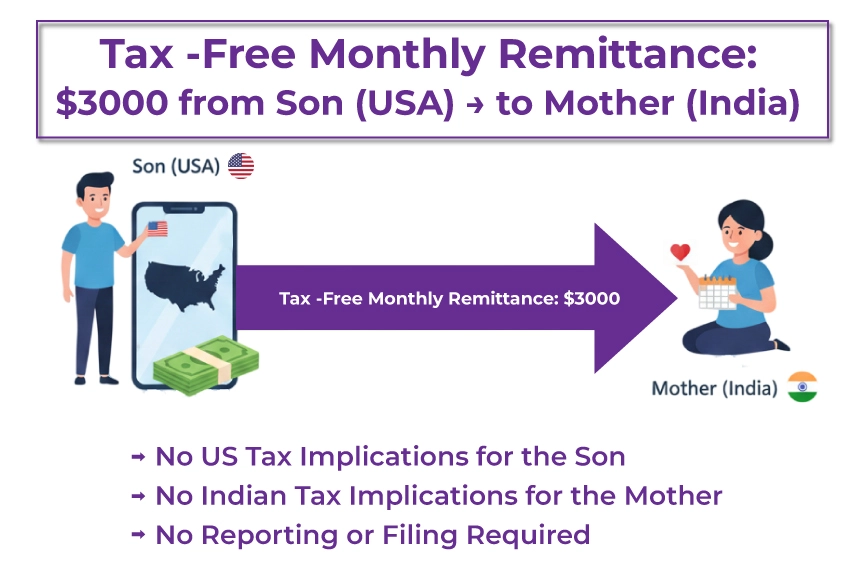
With respect to this scenario, there will be no US tax implications on the son. Simultaneously, there will be no Indian tax implications for the mother in India. Hence, no reporting requirements or filing are required.
Scenario 2: Daughter sends $25,000 to father for his medical treatment in India.
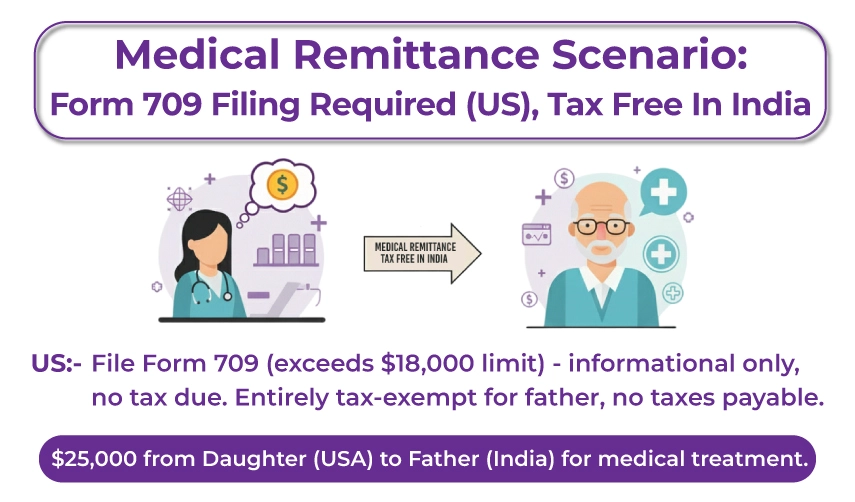
In this scenario, the daughter must file Form 709 in the US because the remittance amount limit exceeds $18,000. However, Form 709 is just a filing requirement, and there is no need to pay the taxes in India. Even in India, the amount is entirely tax-exempt for the father.
Scenario 3: Son sends $100,000 to help parents buy a house

In this scenario, since the son has remitted the money above the thresholds, he will be obliged to file the Form 709 in the US.
Whereas the parents will not be liable to pay taxes in India. However, after buying the home, the parents outsourced the house on rent and have started earning rental income through it.
This rental income will be taxable under the Indian Income Tax Act. As the IT Act states, any income generated from a gifted amount is taxable.
Now that we have understood the tax implications, filing requirements, and other related compliances, the overwhelming motion that the NRI kids face, we hope, will be subdued now.
In a nutshell, NRI sending money to parents in India is tax-free in the hands of the receiver. Additionally, proper documentation and consulting an NRI tax advisor can make the remittance process seamless and hassle-free.
And when it comes to trusting an NRI tax advisor for your remittance purpose, Savetaxs is the name to trust. We have our expertise in NRI financial planning, international money transfers, cross-border taxation, and regulatory compliance. Our experts have been helping NRIs from over 20+ countries securely transfer their money overseas while maintaining compliance.
Connect with us today as we serve our clients 24/7 across all time zones.
This article is for general informational purposes only and does not constitute tax, legal, financial, or investment advice. Laws, regulations, rates, and procedures may change over time and may vary based on individual circumstances.
While SaveTaxs makes reasonable efforts to keep the information accurate and up to date, readers should verify applicable rules with official authorities or consult a qualified professional before making decisions based on this information.
Shubham Jain is the Founder of SaveTaxs and has extensive experience in Indian and NRI taxation. He advises individuals, NRIs, and businesses on tax filing, tax planning, capital gains, DTAA benefits, fund repatriation, and compliance matters. He regularly writes about taxation and related financial topics. His focus is on making complex tax concepts easy to understand. Through his articles, he helps taxpayers stay informed, avoid common mistakes, and stay compliant with Indian tax laws. See Full Bio
Want to read more? Explore Blogs