
The Three R's of investing are Research, Risk, and Reward.
The highlights from the Reserve Bank of India's research report state that NRI investment in Indian has doubled in 2024, reaching 7.82 billion USD between April and August, with the outstanding total now at nearly $159 billion USD.
Amid global chaos, India's economy is growing steadily and sustainably and has become a preferred investment destination for NRIs. Hence, in this guide, we will discuss the top 10 NRI investment options in India, including their taxation and compliance requirements.
- India offers plenty of investment opportunities, ranging from safe fixed deposits and government bonds to high-growth REITs and equities.
- All investments made by NRIs must be routed through NRE, NRO, or FCNR accounts as per FEMA regulations.
- National Pension Scheme, Public Provident Funds, and ULIPs let you secure your retirement savings while building your long-term wealth.
- To invest in India, you will need your PAN card, a TRC (Tax Residency Certificate) to claim DTAA (Double Taxation Avoidance Agreements) benefits, and identification and address proofs.
- Digital gold, SGBs, and ETFs offer innovative gold investment options for NRIs.
Why Should NRIs Invest in India?
India's economy is among the fastest-growing and is projected to become the world's third-largest by 2028-2030. This rapid growth has made India an enticing global investment destination for NRIs.
For NRIs, investing in India is more than financial benefits; it's about staying connected to their roots while contributing to their home country's economic growth.
Given India's robust, rapidly transforming economy, NRIs must invest in India for the following reasons:

Portfolio Diversification Benefits for NRIs
One of the key reasons NRIs invest in India is to diversify their portfolios across different market segments. Diversification helps you minimize the overall risk.
India offers an array of investment options for NRIs, such as:
- Equities and the stock market.
- Mutual Funds
- Real estate.
- Fixed deposits & more
High Return Potential in Indian Markets
The Investment Avenue in India offers strong potential for returns. Perhaps this is why, from April 2020 to September 2023, Foreign Direct Investment (FDI) in India amounted to $953.143 billion and has been growing annually.
Attractive Interest Rates for NRI Investments
Banks in India offer better interest rates than those in the US, Australia, Japan, Saudi Arabia, China, and many other countries. This might sound surprising, and many NRIs aren't even aware of this fact.
For example, the United States Bank does not offer interest rates above 2-3%, and in Japan, interest rates are negative.
India’s Stable and Growing Economy
There is no doubt that India's economy is among the most stable in the world. Hence, investing in a stable country reduces risk even when markets are volatile.
The list of reasons why, as an NRI, you should invest in India is endless. It all boils down to one thing: Research, Research as much as you can about the economy of India, and you yourself will be surprised to know that the economy of your home country has a lot to offer.
Best NRI Investment Options in India
Right from safe investment bets like fixed deposits and government bonds to high-return options like fractional real estate, REITs, and equities, the investment options for NRIs in India are wider and smarter than ever.
The following are 10 investment options for NRIs, along with their estimated returns, tax implications, and rules, to help you grow wealth in your home country while living abroad.
1. Direct Equity Investments (Stocks & ETFs)
When you invest in direct equity investments in India as an NRI, it's like you are driving India's economic growth story.
What Is Direct Equity Investment?
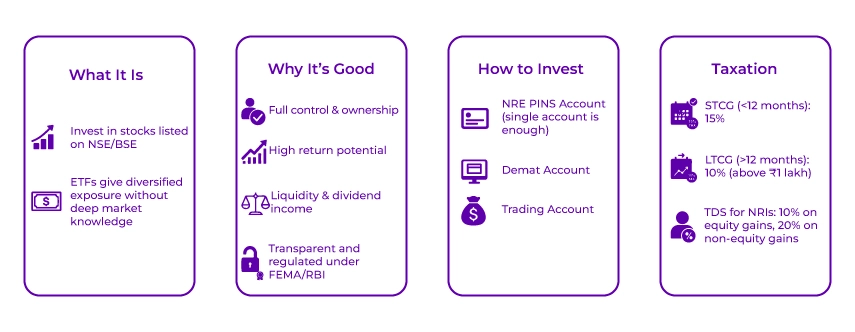
Well, direct equity investment for NRIs means investing in listed securities traded on Indian stock exchanges, such as BSE (Bombay Stock Exchange) and NSE (National Stock Exchange).
Exchange-traded funds, or ETFs, offer another way to combine the best of both stocks and mutual funds. ETFs invest across bonds, money market instruments, and shares, making them accessible to you even if you lack the core stock market knowledge.
As an NRI, when you invest in India, you must follow the regulatory framework set by the Reserve Bank of India and the guidelines rolled out by the Office of Foreign Exchange Management (FEMA).
Why Direct Equity Is a Good Option for NRIs
It is good because of the ownership and control you have with direct equity investments: you can choose which stocks to buy and when to sell. Additionally, direct equity investment also offers high potential returns, liquidity, dividend income, and transparency, which is the cherry on the cake.
How Can NRIs Invest in Equity Markets?
To invest in direct equity, you need.
- Portfolio Investment NRI Scheme (PINS).
- Demat Account for holding your securities electronically.
- Trading Account linked to your Demar account.
However, as per recent RBI guidelines, you do not need separate NRO PINS accounts and NRE PINS accounts; only one NRE PINS account is sufficient.
Taxation and Compliance for NRI Equity Investments
The capital gains here are classified as.
- Short term (under 12 months): 15% tax.
- Long term (over 12 months): 10% tax on gains exceeding Rs 1 lakh.
TDS for NRIs of 10% applies to equity-related gains, and 20% to non-equity-related gains.
File Your NRI ITR Online Hassle-Free And With Expert Assistance.
2. Mutual Funds for NRIs
As an NRI investor, if you're seeking professional management and do not need any direct stock selection complexity, the mutual fund is your pick. This investment option stands out as one of the most practical options for NRIs aiming for long-term growth.
What are Mutual Funds?
The mutual fund collects money from different non-resident investors to build a diversified portfolio of bonds, stocks, and other related securities.
Here, the mutual fund manager will be responsible for managing your investment in the mutual fund scheme. They will allocate your money into different instruments such as money market instruments, equity, or debt. Now, the professional mutual fund manager handles the investment decisions here. This brings in the expertise particularly needed for managing investments abroad.
So, depending on your potential return expectation, risk appetite, and the goal of the investment, you can choose any mutual fund.
Why Mutual Funds Are Suitable for NRIs
It is excellent for NRI investors for multiple reasons, such as.
- Expert management: The fund managers here will handle your daily decisions.
- Additional reasons why it's great for NRIs include instant diversification, cost averaging, complete flexibility, and currency benefits.
How Can NRIs Invest in Mutual Funds?
To invest in MFs, you need to complete the mandatory SEBI KYC process. Here you'll be needing.
- A passport
- PAN Card
- Overseas address proof
- Bank statement.
- FATCA declaration.
Now open the designated NRI accounts, and once your account is ready, you can invest in mutual funds through AMC websites, registrar platforms, stock exchange facilities, and mutual fund utilities.
Taxation and Compliance for NRI Mutual Funds
For mutual funds, the tax treatment for NRIs depends on the fund type and the holding period.
- Equity mutual fund faces 20% tax on short-term gains and 12.5% on long-term gains over Rs 1.25 lakh.
Whereas with respect to debt funds.
- Short-term gains are taxed at 12.5% without the indexation.
3. Debt Mutual Funds
This type of mutual fund is ideal for NRIs seeking a lower-risk investment product with stable returns. Debt mutual funds offer a balanced approach to wealth creation while keeping risk at a manageable level.
What Are Debt Mutual Funds?
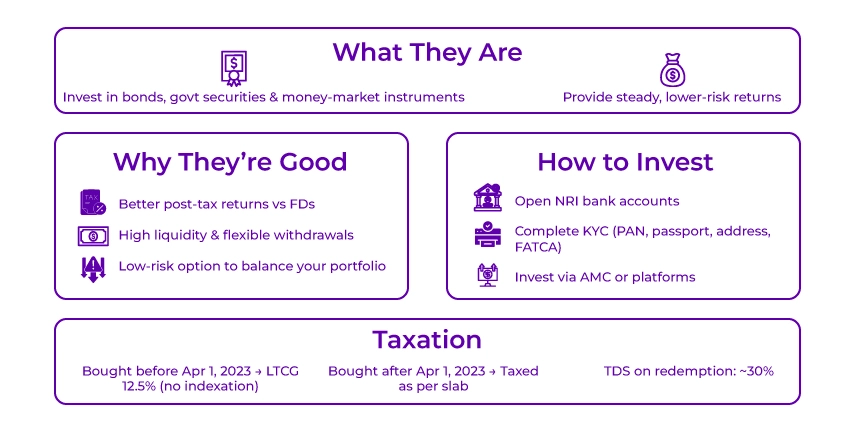
Debut funds are a specific type of mutual fund scheme that invests primarily in fixed-income securities, such as corporate bonds, government bonds, and other money-market instruments. These funds offer a steady income stream.
Why Debt Funds Are Good for NRIs
For NRI investors, debt funds are great in the following ways:
- Debt funds offer high returns that often beat those of traditional fixed deposits after taxes.
- They offer high liquidity to their investors. Meaning you can redeem the units whenever you want.
- A flexible investment product.
- Partial withdrawals are allowed.
- Since it is a low-risk investment option, it serves as a cushion, reducing overall portfolio risk.
How Can NRIs Invest in Debt Funds?
- Open the NRI-designated accounts.
- Complete the KYC process using your password, PAN Card, overseas address proof, and the FATCA declaration.
- Once KYC verification is complete, you can start investing through the AMC websites or via other means.
Taxation and Compliance for Debt Mutual Funds
- For the debt funds that you have bought before April 1, 2023, and April 1 to July 22, 2024: the July 22nd gains are taxed at 12.5% without indexation, whereas short-term gains follow the income tax slab rates.
- For debt funds purchased after April 1, 2023, all April 1 income is taxed at your income tax slab rate, regardless of how long you have held them. These taxation changes came into effect after the Finance Act 2023.
TDS on redemption is generally deducted at a rate of 30%.
4. NRI Fixed Deposits (NRE, NRO & FCNR Accounts)
If you are selling redirect resources with lower risk, NRI fixed deposits must be in your investment portfolio. You can think of these fixed deposits as a reliable, easy financial safety net designed for NRI investors seeking steady market growth.
What Are NRI Fixed Deposits?
NRI fixed deposits are of three different types.
- Non-Resident External FDs (NRE Fixed Deposits): The funds you are depositing in NRE FDs are your foreign earnings that are maintained in INR in India. The NRE fixed interest rates vary from bank to bank.
- Non-Resident Ordinary FDs (NRO Fixed Deposits): The funds you are depositing in NRO FDs are your indian income sources, such as rent, dividends, or pension. The NRO fixed interest rates vary from bank to bank.
- Foreign Currency Non-Resident FDs ( FCNR Fixed Deposits): This type of fixed deposit can hold your money in six major currencies, such as USD, Pounds Sterling, Euro, Japanese Yen, Australian Dollars, and Canadian Dollars, with a 1-5 year tenure.
Why NRIs prefer fixed Deposits
- Fixed deposits offer predictable, guaranteed returns.
- Since returns are predictable, this eliminates investment uncertainty.
- For NRIs, here, joint holding is available with other NRIs or resident Indians.
- With NRE and FCNR deposits, you get complete repatriation rights.
- The tenure of fixed deposits can be aligned as per your financial timeline.
How Can NRIs Invest in Fixed Deposits?
The process to invest in NRI fixed deposits is relatively seamless.
- You can either roll out an online application through bank websites.
- You can visit the branch on your trip to India and start a fixed deposit then.
- You can even do it through internet banking channels if you already have NRE or NRO accounts.
The documentation here requires you to have a copy of your passport, valid work and residence permits, and address proofs of both overseas and Indian locations.
Taxation and Compliance for NRI Fixed Deposits
With NRI FDs, the tax treatment depends on what type of deposit you hold.
- NRE and FCNR deposits, the interest here remains entirely tax-free in India.
- The NRO deposits are subject to 30% TDS for NRIs, plus applicable cess and surcharge.
Connect with Savetaxs and, with expert guidance, open your NRI bank account without any issues.
Get Started5. Real Estate Investment in India (Residential & Commercial)
Real estate investments offer something that stocks and mutual funds cannot: a tangible asset in India. This type of investment provides both a strong emotional connection to India and substantial financial returns, making it a favorable option for NRIs planning their future in India.
What Is Real Estate Investment?
Investing in real estate means owning a property in India, such as a villa, apartment, office space, house, retail outlet, or other commercial building.
As an NRI, you cannot invest in agricultural land, plantation properties, or farmhouses. However, you can inherit these properties but can not directly invest in them.
Why Real Estate Is a Good Investment Option for NRIs
It is a great investment option for NRIs for the following reasons.
- Massive returns: NRIs may be able to deliver superior returns on commercial properties, yielding annual rental yields of 7-10%. This is far more than most traditional savings options.
- The currency advantage: Today's exchange rate is approximately Rs 85 per USD, making purchases in India more affordable than ever.
- Future Planning: Almost two-thirds of NRIs plan to return to India at some point; hence, for such NRIs, pre-arrival investment is a practical preparation.
- Smart Diversification: Real estate investment diversifies your portfolio beyond the usual market-linked investments.
How Can NRIs Invest in Indian Real Estate?
The real estate investment process follows a structured approach.
- Documentation: Keep your address and identity proof handy, plus a PoA (power of attorney) if you cannot be present in India to purchase the property.
- Fund Transfer: You must route all yur property-related transactions through NRE/NRO/FCNR accounts.
- Property verification: Verifying and running legal checks on the property's background.
- Registration: Complete property registration at the sub-registrar's office.
Taxation and Compliance for NRI Real Estate Investments
- The seller will be obliged to pay the purchase TDS and the capital gains taxation, depending on how long the property has been held.
- The buyer deducts TDS from the purchase price paid to the seller.
- Additionally, all property-related transactions must comply with FEMA and RBI guidelines.
6. National Pension System (NPS) for NRIs
This investment product aims to solve the retirement challenges for NRIs through a restricted market-linked investment.
NPS is government-backed and offers numerous tax advantages for NRIs, as well as long-term wealth creation.
What Is the National Pension System (NPS)?
The national pension scheme was initially established in 2004 as a government-sponsored retirement plan for its employees. It later then opeded ot all the Indian citizens, including NRIs.
This National Pension Scheme is managed by the Pension Fund Regulatory and Development Authority (PFRDA). Here, your investment occurs in two stages: accumulation, where you contribute regularly to the scheme, and withdrawal, when you have access to the funds at maturity.
Why NPS Is a Good Retirement Option for NRIs
It is excellent for NRIs because:
- The returns are market-linked: equity schemes deliver returns of 12 to 15% annually, government bonds yield 9 to 10%, and corporate bonds yield 8 to 10%.
- When you invest in NPS, your funds are spread across various financial securities to achieve balanced growth.
- After connecting to the NPS for three years, you can have access to 25% of your crops.
- The repatriation is easy under NPS if you have invested through NRE accounts.
How Can NRIs Invest in NPS?
To invest in NPS, you must be between 18 and 60 years old. Please note that PIOs are not eligible to open an NPS account, whereas OCI holders are. The documents that you will need to invest are.
- Subscriber registration form.
- Paspoet Copy.
- PAN Card.
- Canceled Cheque.
- Address Proof.
You can start with an account opening of Rs 500 and can then maintain an annual contribution of Rs 6,000.
Taxation and Compliance for NPS Investments
When you invest in NPS, you get tax benefits under the old regime, which allows the deduction of up to Rs 1,50,000 under Section 80CCD(1), plus an additional Rs 50,000 under Section 80CCD (1B).
7. Corporate Bonds and Non-Convertible Debentures (NCDs)
Corporate bonds and Non-Convertible Debentures (NCDs) provide a fixed-income investment channel for NRIs looking to diversify their portfolios in India.
What Are Corporate Bonds and NCDs?
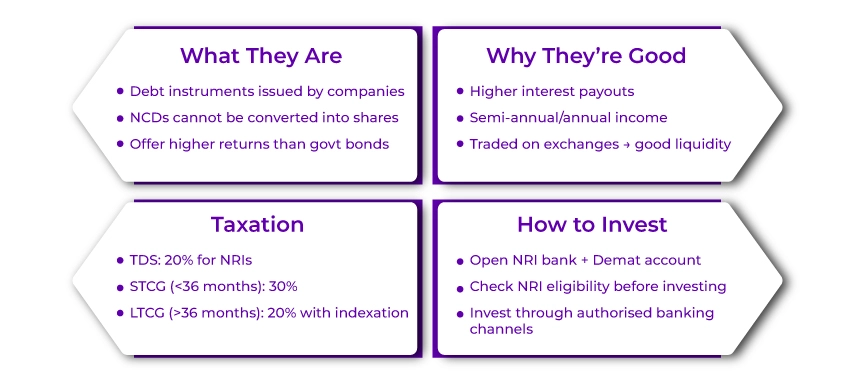
To put it simply, corporate bonds are debt instruments used by both public and private companies to raise capital for expansion, operations, and other business needs.
These bonds are known for offering higher returns than government bonds, but they do carry greater risk. Whereas NCDs are a specific debt instrument that cannot be converted into equity shares of the issuing company.
Why Bonds and NCDs Are Suitable for NRIs
From higher returns to semi-annual or annual interest payments that help you have a steady income stream, these bonds are a preferred option for NRI investment in India.
Additionally, these securities can be traded on the stock market, which ensures liquidity whenever needed.
How Can NRIs Invest in Corporate Bonds?
To invest in corporate bonds:
- Open the designated NRI account and a demat account.
- Verify the NRI eligibility at the bond offer before you invest.
- Lastly, ensure that all investments are made through reliable banking channels.
Taxation and Compliance for Bonds and NCDs
- NRIs are subject to a 20% TDS rate on corporate bonds. Capital gains taxation depends on how long you have held the bond.
- Short-term gains (held for less than 36 months) are taxed at 30%, whereas long-term capital gains are taxed at 20% with indexation benefits.
8. Gold Investments for NRIs (ETFs, Digital Gold)
Inevitably, investing in gold has been a tradition in India, and even in today's volatile market, it acts as your financial anchor.
What Are Gold Investment Options for NRIs?
With ETFs and digital gold, NRIs can invest in gold beyond traditional jewelry. Exchange-traded funds (ETFs) are a specific type of mutual fund traded on stock exchanges that track the price of gold, with each unit representing 1 gram of 99.5% pure gold.
Digital gold gives you the flexibility to purchase gold online in denominations as small as 1 Rs. Additionally, these digital goods are secured in insured vaults on your behalf.
Why Gold Is a Popular Investment Choice for NRIs
Gold has been the unsaid king of the investment world since the beginning of human existence. It is excellent for NRIs.
- This acts as an inflation shield because gold preserves your wealth when currencies weaken or prices rise.
- Gold helps stabilize your overall investment returns because the stock market does not influence it.
- Digital gold eliminates the risk of physical storage and the associated costs.
How Can NRIs Invest in Gold in India?
- To invest in digital and EFTs, you need to open a designated NRI account. For gold EFTs, you will need a demat and a trading account.
- Purchase via Non-PINS accounts only. For digital gold, prioritize those platforms that offer secure vault storage.
- Digital gold can be purchased without a demat account.
Taxation and Compliance for Gold Investments
- Physical and digital gold held for less than 24 months is a short-term gain and is taxed as per your income tax slab.
- Held for more than 24 months, the gains are long-term and taxed at 12.5% without indexation.
- Please note that the TDS here does not apply when you trade Gold EFTs through the exchange.
9. ULIPs (Unit Linked Insurance Plans)
This investment option combines the best of life insurance and investment opportunities in one package.
What Are ULIPs?
ULIPs split your insurance premium for two purposes. The first part of your money goes toward your life insurance coverage, while the remaining part is invested in market-linked funds.
You can think of this investment product as two engines running in tandem: one protects your family's financial future, and the other grows your wealth through market-linked funds.
Why ULIPs Can Be Beneficial for NRIs
- It is excellent for NRIs, offering market-linked returns, flexibility to switch funds, dual protection for your family and your investment portfolio, and a disciplined investment approach.
How Can NRIs Invest in ULIPs?
When investing in ULIPs, you need basic identity and address proof, along with income documents and a PAN Card.
The premium payment can be made through your NRI accounts, online wallets, international credit cards, and internet banking.
Taxation and Compliance for ULIPs
- For NRIs, the tax benefit here applies to a premium of Rs 1.5 lakhs under Section 80C.
- The maturity proceeds of ULIPs remain tax-exempt under Section 10(10D) when annual premiums are less than Rs 2.5 lakh for policies issued after Feb 1, 2021.
10. Portfolio Management Services (PMS) for NRIs
PMS offers tailored services for high-net-worth NRIs who need expert-backed guidance in the Indian market.
What Is Portfolio Management Service (PMS)?
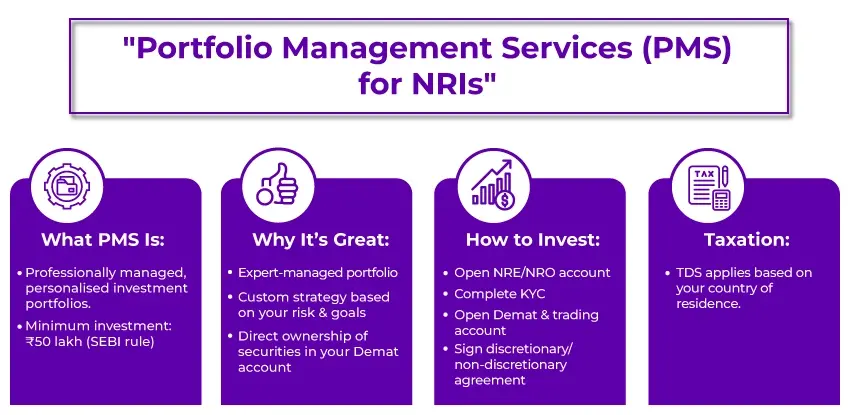
The portfolio management services, as the name suggests, provide NRIs with professional investment management, with a portfolio manager overseeing their portfolio based on their risk appetite and long-term financial goals.
As per SEBI guidelines, a minimum investment of Rs 50 lakh is required to open a PMS account.
Why PMS Is Ideal for High-Net-Worth NRIs
- You get expert-backed, personalized portfolios built around your financial objectives.
- Experts will manage your portfolio.
- You have direct ownership of securities in your Demat Account.
How Can NRIs Invest Through PMS?
The investment process here involves.
- Opening designated NRE/NRO accounts.
- Complete the KYC verification process with your passport, visa, PAN Card, and address poof.
- Set up the Demat and trading account.
- Signing a discretionary or a non-discretionary management agreement.
Taxation and Compliance for PMS Investments
TDS applies to the NRI portfolio. However, the TDS rate depends on your country of residence.
We at Savetaxs offer personalized investment strategies for NRIs, tailored to their risk appetite and financial goals.
How Can NRIs Start Investing in India?
To start investing in India as an NRI, all it takes is careful planning and a well-thought-out approach to grow your wealth while staying close to your roots.
- Start by opening NRI-designated accounts under FEMA regulations.
- Apply for a PAN card, and you become eligible for most investment avenues in India.
- Begin with simple investment options like fixed deposits or mutual funds for easier compliance and to get a knack of the indian market.
- Use a PIS account while investing in Indian equities.
- You must also explore the real estate segment for long-term investment.
- Please ensure you review the tax implications before choosing any investment.
- And yes, always keep in mind to start small, grow gradually, and invest with a clear financial plan approved by an investment professional.
Conclusion: Choosing the Right Investment Options for NRIs in India
These were the top 10 NRI investment options that you can choose to invest in India. Apart from the ones mentioned above, you can also invest in Sovereign Gold Bonds (SGBs), Fractional real Estate Ownership, REITs (Real Estate Investment Trusts), and Alternative Investment funds.
The only way to build a successful investment portfolio is to find what best fits your financial goals and invest wisely. If you lack core knowledge of the investment sector, it's best to seek professional help from an NRI investment strategist who is also well-versed in cross-border taxation.
One such expert for NRIs is Savetaxs. We have been helping NRIs across 90+ countries build their investment portfolios in India. Our portfolio and fund managers bring extensive knowledge and a decade of experience across all investment avenues in India.
Connect with us today as we serve our clients 24/7 across all time zones.
Note: This guide is for information purposes only. The views expressed in this guide are personal and do not constitute the views of Savetaxs. Savetaxs or the author will not be responsible for any direct or indirect loss incurred by the reader for taking any decision based on the information or the contents. It is advisable to consult either a CA, CS, CPA, or a professional tax expert from the Savetaxs team, as they are familiar with the current regulations and can help make accurate decisions and maintain accuracy throughout the process.

Shubham Jain is the Founder of SaveTaxs and has extensive experience in Indian and NRI taxation. He advises individuals, NRIs, and businesses on tax filing, tax planning, capital gains, DTAA benefits, fund repatriation, and compliance matters. He regularly writes about taxation and related financial topics. His focus is on making complex tax concepts easy to understand. Through his articles, he helps taxpayers stay informed, avoid common mistakes, and stay compliant with Indian tax laws. See Full Bio
Expert CA-led ITR filing

- Capital Gains Tax for NRIs in India: Rules, Rates & Exemptions
- NRI Repatriation from India: Complete RBI & FEMA Guide (2026)
- Things NRIs Should Consider While Investing in India
- DTAA for NRIs – Double Tax Avoidance Agreement India Guide (2026)
- New NRI Taxation & Residency Rules in India (Effective 2026)
Frequently Asked Questions
Investing in India is beneficial for NRIs for multiple reasons, including a diversified portfolio, strong potential returns, current advantages, and more. The list goes on.
Yes, NRIs can invest in mutual funds in India.
Yes, you can invest in SIPs while staying abroad.
Yes, NRIs can open a demat account.
Yes, NRIs can invest in the Indian stock market.