NRI Income Tax Compliance
How to Claim Excess TDS Refund After Selling Property in India as an NRIHow to Claim Excess TDS Refund After Selling Property in India as an NRI
Written by Shubham Jain

An NRI (Non-Resident Indian) needs to report any India-taxable crypto income from VDA (Virtual Digital Assets) in their Indian ITR. This is done using Schedule VDA in ITR-2 or ITR-3 with a flat tax rate of 30% plus cess on gains. Accurate reporting depends on the NRI's residential status, the location where the trade occurs (whether in India or foreign exchanges), and whether the income is "earned" or "received" in India.
Keep reading further to know more about how an NRI should report crypto while filing their Indian ITR (Income Tax Returns).
NRIs are taxed in India only on the income that is either earned, received, or deemed to accrue or arise in India. Hence, crypto must be reported in your ITR if:
Your gains will not be subject to taxation in India if all your crypto activities are conducted offshore, such as through foreign exchanges or transfers. Additionally, it doesn't have to be reported as Indian income; however, you must maintain complete documentation of your residency status and transaction history.

Under the Income Tax Act, "Virtual Digital Assets" (VDAs) are recognized as a separate asset class, including cryptocurrencies (like BTC and ETH), NFTs, and other cryptographic tokens as identified by the government. Most tokens, including stablecoins and meme coins, are classified as VDAs and are subject to the same 30% crypto tax regime unless explicitly excluded.
Budget amendments clarify that any digital representation of value through a distributed ledger or similar technology that can be traded electronically qualifies as VDA. This lets several mainstream crypto instruments fall under the same tax rules.
Crypto becomes taxable for NRIs in India when there is a transfer of a VDA linked to Indian tax situations. It can include sale, exchange (including crypto-to-crypto trades), or converting it to INR through Indian platforms or Indian residents. Key taxable events for NRIs are as follows:
Simply holding crypto without selling is not subject to taxation. However, once it's transferred within Indian jurisdiction, any resulting profits become taxable, even for NRIs.
Say goodbye to the stress of last-minute tax filing rush with expert-backed guidance.
Income from the transfer of VDAs is taxed at a flat rate of 30% under Section 115BBH, regardless of your slab and whether the individual is a resident or an NRI. Additional changes, such as a surcharge (if applicable) and a 4% health and education cess, apply to the tax amount. Here are some important points to remember:
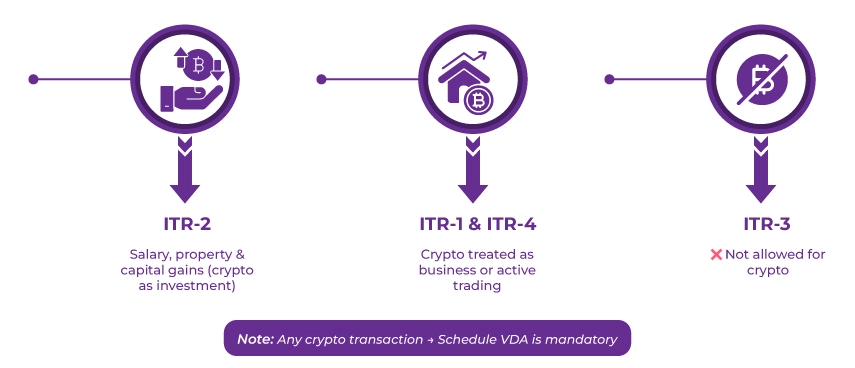
The Income Tax Department specifies that NRIs must use ITR-2 or ITR-3 for AY 2025-2026, not ITR-1 or ITR-4. Relevant details include:
If you have any taxable VDA transactions in the year, you will have to fill out Schedule VDA (available in both ITR-2 and ITR-3), regardless of your residency.
You are required to submit detailed information in Schedule VDA for the individual categories of VDA income while filing ITR-2 or ITR-3. Here are the steps to follow to report crypto in the Indian ITR:
When it comes to aridrops, staking rewards, or mining income routed through Indian exchanges, numerous practitioners first consider the fair market value on receipt as income (generally "other source" or business). After that, they treat the sale as a separate VDA transfer with its own gain in Schedule VDA.
Ensure accurate reporting and filing of your crypto earnings with expert assistance at Savetas.
Schedule FA (Foreign Assets) is not mandatory for Non-Residents (NR) or Resident but Not Ordinarily Resident (RNOR) taxpayers. However, it is required only for Resident and Ordinarily Resident (ROR) individuals who hold foreign assets. Hence:
If Schedule FA is applicable and you don't report foreign assets, you may attract rigid penalties. It can include hefty fines of up to Rs. 10 lakh and even prosecution under the Black Money Act.
For NRIs, Indian taxation on crypto is only applicable when there is a tie to an Indian entity, such as trading on Indian exchanges or recieveing payments in Indian rupees. You must report such gains on Schedule VDA of ITR-2 or ITR-3, which will be taxed at a flat rate of 30% plus cess. Generally, purely offshore trades by NRIs remain exempt from taxation in India if both accrual and receipt are done abroad. However, thorough residency documents and transaction flow are mandatory for defense and future changes in residency.
Furthermore, if you need expert consultancy regarding NRI crypto taxation, connect with Savetaxs. We have an entire team of expert professionals who can guide you with all your crypto taxation issues or NRI tax obligations. They carry years of expereince and can help you in better tax planning. Connect with our team today
This article is for general informational purposes only and does not constitute tax, legal, financial, or investment advice. Laws, regulations, rates, and procedures may change over time and may vary based on individual circumstances.
While SaveTaxs makes reasonable efforts to keep the information accurate and up to date, readers should verify applicable rules with official authorities or consult a qualified professional before making decisions based on this information.
Shubham Jain is the Founder of SaveTaxs and has extensive experience in Indian and NRI taxation. He advises individuals, NRIs, and businesses on tax filing, tax planning, capital gains, DTAA benefits, fund repatriation, and compliance matters. He regularly writes about taxation and related financial topics. His focus is on making complex tax concepts easy to understand. Through his articles, he helps taxpayers stay informed, avoid common mistakes, and stay compliant with Indian tax laws. See Full Bio

Want to read more? Explore Blogs