NRI Income Tax Compliance
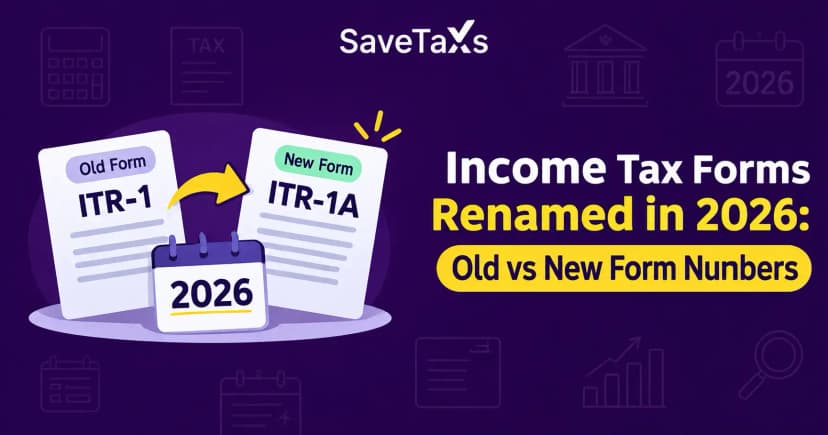
Income Tax Forms Renamed in 2026: Old vs New Form NumbersIncome Tax Forms Renamed in 2026: Old vs New Form Numbers
Written by Vipul Jain


The Black Money (Undisclosed Foreign Income and Assets) and Imposition of Tax Act, 2015, implies rigorous rules that aim to prevent tax evasion related to offshore accounts and properties. This legislation shifts the taxation responsibilities of an NRI when they return to India, making full disclosure of foreign assets and income important.
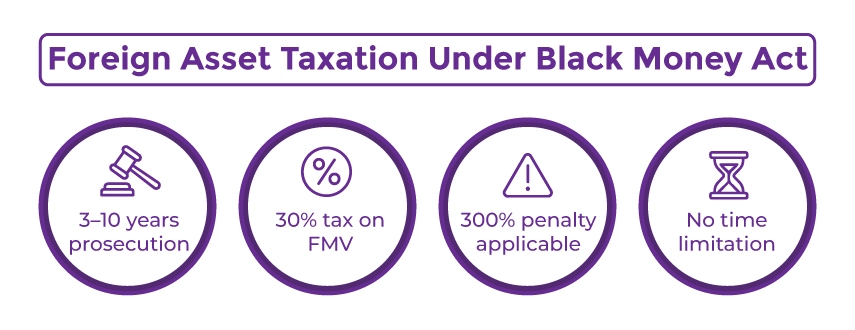
All undisclosed foreign assets become subject to taxation at 30% once you become an ordinary resident. It also includes penalties of up to 120% and even imprisonment in serious situations. It is vital to comply with the provisions of Black Money Act, as neglecting it could attract severe financial and legal consequences.
In this blog, we will understand the implications of the Black Money Act for NRIs. Also, we will discuss the related requirements to help NRIs ensure compliance with Indian tax laws.
The Black Money Act, officially known as the Black Money (Undisclosed Foreign Income and Assets) and Imposition of Tax Act, 2015, is India's strict approach to preventing tax evasion through offshore assets. As a Non-Resident Indian (NRI), your tax responsibilities shift mainly based on your residency status, making it essential to understand this law.
The Act primarily targets undisclosed foreign assets held by individuals who are considered Indian residents for tax purposes. While you are an NRI, your foreign income is not covered by this legislation. However, once you return to India and become a resident, any such assets and income will be subject to examination.
Under the Black Money Act, undisclosed foreign income and assets are subject to tax and penalties. For NRIs returning to India, this includes:
This law's extensive reach makes it essential for returning NRIs. Even if you have earned your money legally while staying abroad, failing to disclose these assets when you become an Indian resident can lead to serious consequences.
If you plan to return to India, it's important to understand the disclosure requirements under the Black Money Act to ensure compliance and avoid significant penalties.
According to the Income Tax Act, 1961, Indian residents who are qualified as ROR need to disclose their foreign assets and income in their income tax return. The following individuals need to disclose their foreign assets on the income tax return:
Filing NRI ITR becomes easy with Savetaxs expert-backed guidance.
Under the Black Money Act, "foreign assets" include a range of overseas holdings:
Additionally, joint accounts, trusts, and beneficial ownerships need to be reported.
After becoming an ROR, if a foreign asset is not reported, then the Act imposes:
Here is a table stating the difference between foreign income and foreign assets:
| Category | Foreign Income | Foreign Assets |
|---|---|---|
| Meaning | Income earned from sources situated outside India. | Assets owned, held, or controlled outside India. |
| Applicable Law | Income Tax Act, 1961 | Black Money Act, 2015 (if undisclosed). |
| Taxability | Taxed in India only if you are an ROR. | Assets value is taxed at 30 % if undisclosed. |
| Reporting Requirement | Report only if income is subject to taxation. | Need to be reported in Schedule FA (if ROR), regardless of income. |
| Penalty for Non-Reporting | No penalty if no income is earned | Severe: 300% penalty + possible prosecution. |
| Does Income Matter? | Yes, income matters as only income is taxed. | No, even zero-income assets need to be disclosed. |
| Risk Factor | Carries a lower risk unless income is hidden. | Higher risk if the asset is not disclosed, even if it is owned legally. |
| Main Insight | Income - taxable money earned internationally. | Assets = need to be disclosed even without income. |
Schedule Foreign Assets (FA) is one of the main compliance sections in the Indian Income Tax Returns (ITR) for individuals who hold some assets outside India. This Schedule aims to ensure complete transparency of a taxpayer's foreign financial interests when they become a resident and ordinarily resident (ROR) in India.
Reporting accurately in Schedule FA is important as the Indian Tax System works on a rigid global disclosure framework. Upon becoming an ROR, you need to disclose every foreign account, investment, or property, regardless of whether you acquired your foreign assets legally while staying abroad or whether they generate income.
Failing to disclose these assets may result in serious consequences. Under the Black Money Act (Undisclosed Foreign Income and Assets ), 2015, any undisclosed foreign asset can attract the following:
Minor omissions, such as a dormant foreign bank account, a low-value ESOP, or a joint account with a spouse, can incur issues due to non-compliance. Additionally, if Schedule FA is incomplete, the ITR may be marked as defective.
In short, don't consider an accurate declaration in Schedule FA as a formality because it is a legal requirement having strong enforcement. In case you are someone who holds any foreign asset and qualifies as an ROR. Then, full and accurate disclosure is essential to avoid severe penalties and stay compliant with the Indian tax laws.
Contact our experts anytime and get personalized guidance on all your tax issues.
The Black Money Act is a crucial element in the Indian taxation system, particularly for returning NRIs. It is important to understand its provisions and implications for anyone who holds foreign assets or income. Accurate reporting of these assets is a legal obligation. Neglecting the requirements under this Act can lead to serious consequences.
Furthermore, it is advised for NRIs to seek expert guidance to ensure compliance. One such expert is Savetaxs. We have a team of experts who can help NRIs safeguard their financial interests and navigate the complexities of taxation in India with utmost confidence. Contact our team right away to ensure that you don't face any penalties or legal issues related to undisclosed foreign assets.
This article is for general informational purposes only and does not constitute tax, legal, financial, or investment advice. Laws, regulations, rates, and procedures may change over time and may vary based on individual circumstances.
While SaveTaxs makes reasonable efforts to keep the information accurate and up to date, readers should verify applicable rules with official authorities or consult a qualified professional before making decisions based on this information.
Shubham Jain is the Founder of SaveTaxs and has extensive experience in Indian and NRI taxation. He advises individuals, NRIs, and businesses on tax filing, tax planning, capital gains, DTAA benefits, fund repatriation, and compliance matters. He regularly writes about taxation and related financial topics. His focus is on making complex tax concepts easy to understand. Through his articles, he helps taxpayers stay informed, avoid common mistakes, and stay compliant with Indian tax laws. See Full Bio

Want to read more? Explore Blogs