NRI Income Tax Compliance
Income Tax Forms Renamed in 2026: Old vs New Form NumbersIncome Tax Forms Renamed in 2026: Old vs New Form Numbers
Written by Vipul Jain

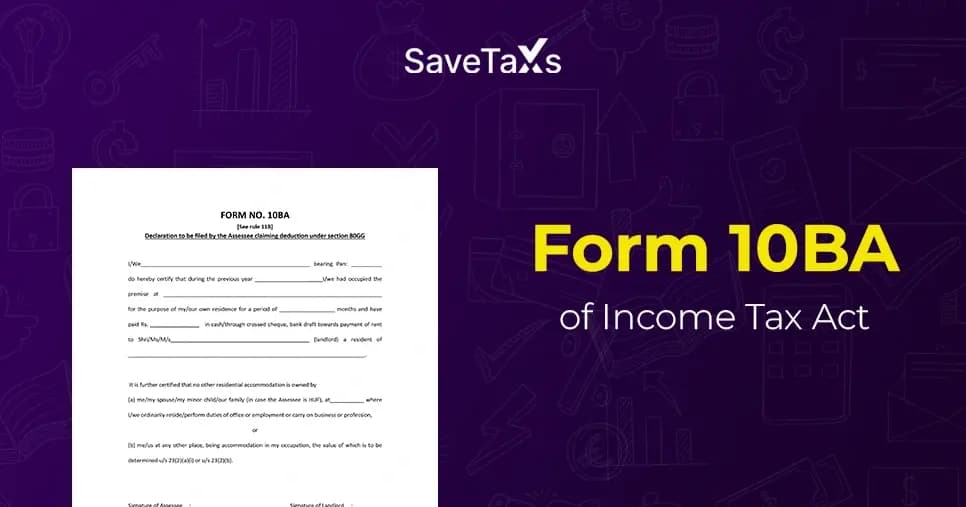
Do you know that, using Form 10BA, under section 80GG, you can claim house rent deduction? Both Indian residents and non-Indian residents (NRIs) are eligible to claim; however, they must meet certain conditions. It includes not receiving House Rent Allowances (HRA) from your employer. Through this, you can reduce your taxable income and overall tax liabilities. Want to know how you can do so and claim tax benefits using the Form 10BA of the Income Tax Act? Then you are on the right page. Read on the blog and get your answers.
Form 10BA under the Income Tax Act 1961 is a statement used by taxpayers, whether Indian residents or NRIs in India, to specify the rent paid and the tax deducted therefrom under section 80GG. It is for people who do not have a house or other property but want to claim tax deductions for paid rent on residential accommodations. This tax benefit is generally available for self-employed individuals and salaried employees who do not receive HRA from their employer.
This was all about Form 10BA of the Income Tax Act. Moving ahead, let's review the conditions for filing Form 10BA.
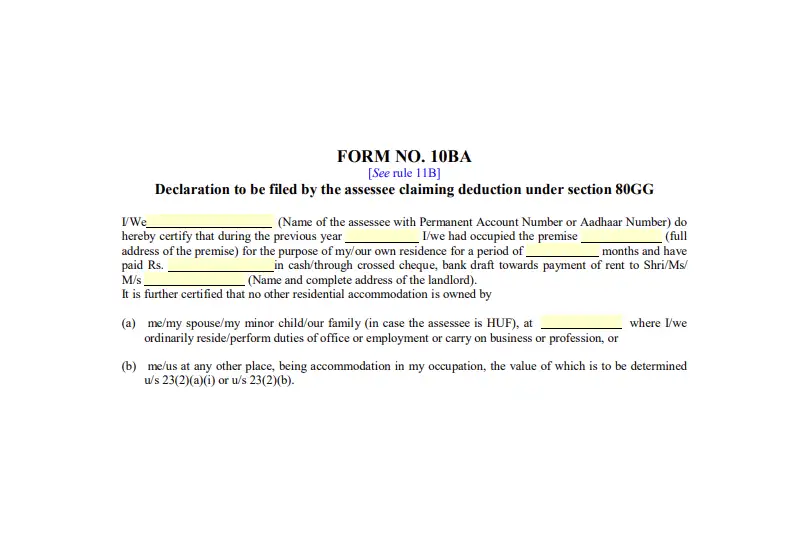
As stated above, to file Form 10BA and claim the rental tax benefits under section 80GG, individuals must meet specific conditions. These conditions apply to both self-employed and salaried individuals who do not receive HRA. For both Indian residents and NRIs, the conditions for filing Form 10BA differ. Moving further, let's know about each of them.
Indian residents can fill out Form 10BA and claim rental tax benefits under section 80GG of the Income Tax Act, but they need to fulfill the following conditions:
Here are the following conditions that NRIs need to fulfill to fill out Form 10 BA and claim rental tax benefits under section 80GG of the Income Tax Act in India:
This was all about the conditions both Indian residents and NRIs need to fulfill to fill out Form 10BA of the Income Tax Act. However, it does not apply to the rent paid outside India or to passive income, such as rent, interest, received in India. Moving ahead, let's know why it is essential to fill out this form.
Yes, it is mandatory to file Form 10BA to claim rent deduction under section 80GG of the Income Tax Act before filing the income tax return (ITR). Mentioned below is the list of reasons before filling ITR, why it is essential to fill Form 10BA:
These are the key reasons why it is essential to file Form 10BA before filing ITR. Moving forward, please let us know the tax deduction limit applicable under this form.
Under section 80GG of the Income Tax Act, the Form 10BA limit for claiming tax benefit for paid rent in India is as follows:
These are the tax deduction limits you can claim through Form 10BA for your paid rent in India. Among them, the lowest amount will be deducted. Moving ahead, now let's know the due date to fill out this form.
Before submitting your income tax return, you must fill out Form 10BA of the Income Tax Act. The due date of both Form 10BA and ITR is the same. Confused, let's understand it with an example. For instance, for the fiscal year 2023-24, the due date to fill out Form 10BA is July 31, 2024. If your accounts need an audit, you must complete this form by September 30, 2024.
This was all about the due date of filing out Form 10BA. Moving forward, let's review the information needed to fill out this form.
Here is the following information required to fill in the Form 10BA:
Personal Information of the Individual
Details of Paid Rent, Name of landlord, PAN, and Address
These are the details generally required when filing Form 10BA under the Income Tax Act. Moving on, let's see how you can fill out this form online.
To fill out Form 10BA online, follow the steps mentioned below:
Here are the steps to fill out Form 10BA online. For both Indian residents and NRIs, the procedure for filling out the form remains the same. Moving ahead, let's know how you can download your filled form from the site.
You cannot download the Form 10BA directly online; you can only fill it out. To download the form online using your credentials, log in to the Income Tax e-filing portal. Once you log in, go to the "e-file'> "Income Tax Form" > "File Income Tax Form." Under "person not dependent on any source of Income," search for Form 10BA and click on the "File Now" option.
Click on the "Download Form 10BA" to Download the Form
Whether it is an Indian resident or an NRI who pays tax in India, Form 10BA undoubtedly provides value, as it allows them to claim a tax deduction under section 80GG for rent paid in India. Through this, their taxable income gets reduced, and their overall tax liabilities are reduced. It is especially beneficial for individuals with lower incomes and who are self-employed. The above blog was all about Form 10BA of the Income Tax Act. Hope that after reading it, you gain a clear understanding. Furthermore, if you need more guidance on this or are facing any issues filing the ITR, contact Savetaxs. We have a team of experts with years of experience in the tax field who can better assist you.
This article is for general informational purposes only and does not constitute tax, legal, financial, or investment advice. Laws, regulations, rates, and procedures may change over time and may vary based on individual circumstances.
While SaveTaxs makes reasonable efforts to keep the information accurate and up to date, readers should verify applicable rules with official authorities or consult a qualified professional before making decisions based on this information.
Shubham Jain is the Founder of SaveTaxs and has extensive experience in Indian and NRI taxation. He advises individuals, NRIs, and businesses on tax filing, tax planning, capital gains, DTAA benefits, fund repatriation, and compliance matters. He regularly writes about taxation and related financial topics. His focus is on making complex tax concepts easy to understand. Through his articles, he helps taxpayers stay informed, avoid common mistakes, and stay compliant with Indian tax laws. See Full Bio
Want to read more? Explore Blogs