


Investment & Financial Planning
NRI Property Sale: How to Calculate Capital Gains TaxNRI Property Sale: How to Calculate Capital Gains Tax
Written by Shubham Jain


Do you know, apart from traditional investment options like mutual funds, fixed deposits, there are other advanced investment options also available for NRIs and residents in India? These are AIFs, REITs & Bonds. Although traditional investment options are not bad, they come with certain limits. For instance, equity mutual funds are good for generating long-term wealth. However, these come with volatility, which is why NRIs look for other alternatives.
Want to know about these advanced investment options in detail? This blog breaks down all the information about Alternative Investment Funds (AIFs), Real Estate Investment Trusts (REITs), and Bonds. So, read on and know about them.
For 2026, will AIFs, REITs, and bonds continue to be safe investment options for NRIs? Moving further, I'd like to find out about them.
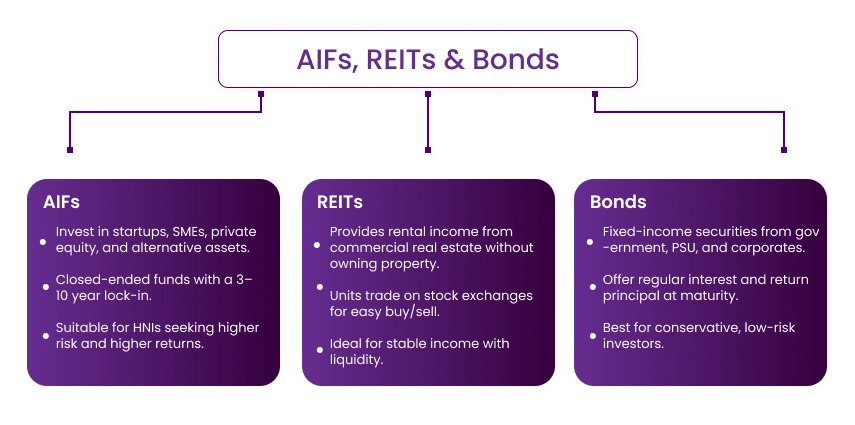
AIFs, or alternative investment funds for NRI investors who look beyond the regular options available in the market, serve as a unique investment. Unlike mutual funds, AIFs invest in assets that you do not find in any traditional financial markets.
These investments are structured as closed-ended funds with a 3-10 year term. Further, this extended timeline helps the fund managers to generate returns and let their strategies mature. AIFs are generally established in the form of a company, LLP, or trust. Additionally, AIFs are categorized into three categories:
Generally, these funds target Foreign Institutional Investors (FIIs), HNIs, and Ultra HNIs. Additionally, they are not traded on a stock exchange. Also, it has a longer lock-in period, making it an ideal option for experienced investors who can handle higher risk.
A REIT is a firm or company that owns and manages real estate, intending to generate income. NRI investment in REIT allows them to earn income dividends from real estate investment. For this, they do not need to purchase, manage, or finance any property themselves.
Like shares, you purchase units in REITs. From tenants, REITs generate rental income, which this further distributed as dividends to you. REITs function like mutual funds; however, instead of investing in bonds or stocks, they invest in real assets. Here, the key difference is that these are listed on stock exchanges, and you can sell and purchase them anytime.
Bonds are fixed-income securities issued by entities and governments to finance their operations, expenses, and other activities. In this, generally, investors who buy bond issues provide money to the issuing entity. In return for it, at periodic intervals, the entity pays interest to them.
Further, on the maturity date of the bonds, the principal is paid to the bondholder. So, for bond issuers, bondholders can be considered creditors.
This was all about these three investment options. Moving on, let's look at the eligibility criteria and how NRIs can invest in them.
Here are the following eligibility criteria that NRIs need to follow to invest in AIFs, REITs, and bonds.
NRIs, Indian residents, and foreign nationals can invest in SEBI-registered AIFs; however, for this, they need to follow banking routes and compliance steps. Considering this, through proper banking channels, like an NRE or NRO account, funds should be routed. Additionally, the guidelines of FEMA and RBI should be followed during investments along with the own subscription documents of AIFs.
Further, some AIFs allow NRIs for investment on a non-repatriable basis, while others allow repatriation, which calls for thorough verification of the AIF's terms.
Being an NRI, to invest in REITs in India, you should be:
To invest in Indian bonds, NRIs should have:
This was all about the eligibility criteria for advanced investment options for NRIs. Moving ahead, let's know the minimum investment requirements for these.
Connect with Savetaxs and plan your finances simply with expert guidance.
Here is the minimum investment requirement that you need to fulfill to invest in AIFs, REITs, and bonds.
So, these were the minimum investment requirements of AIFs, REITs, and bonds. Moving further, now let's know the tax obligations of these investments on NRIs.
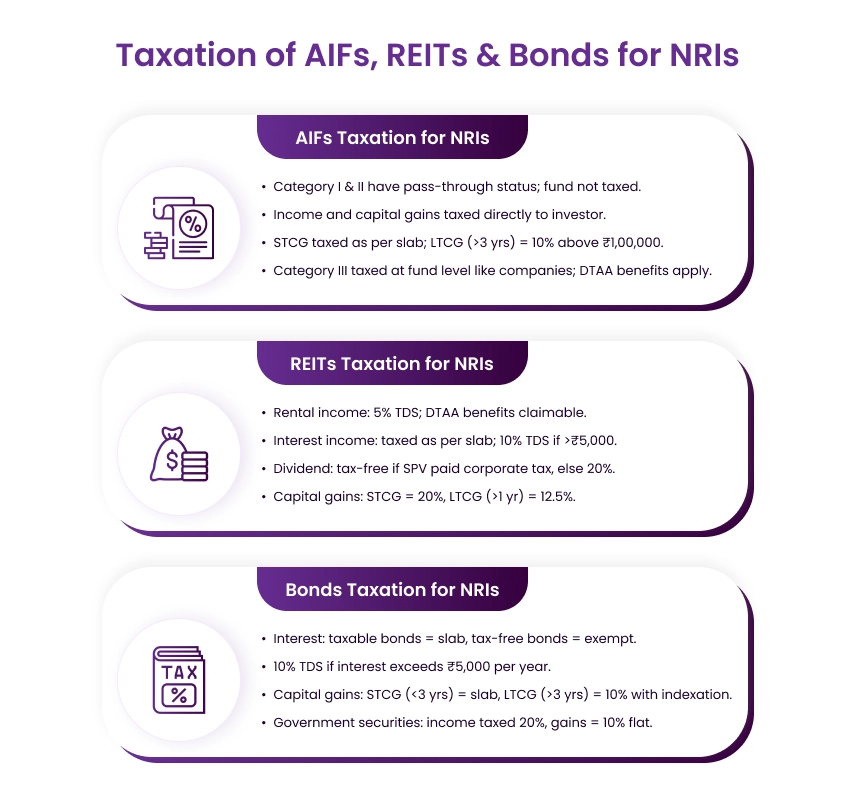
Depending on the type of investment, the tax implications differ for NRIs. So, let's know about it according to the investment type.
The categories I and II of AIFs have pass-through status. This states:
It further helps in avoiding double taxation. In a company structure, corporate tax (~25%) is paid, and then you pay dividend tax on it. Here, pass-through denotes single-level taxation. Moreover, for NRIs, this is:
Moreover, Category III of AIFs is taxed at the fund level. These are treated like companies, not like pass-through vehicles.
According to the income type and Special Purchase Vehicle (SPV), which pays the corporate tax, taxation on REITs varies. Further, to understand, let's break down the REITs taxation for NRIs:
Further, depending on the residence country, NRIs can claim DTAA benefits.
Easily navigate your NRI tax complications with Savetax.
The taxation on bonds depends on the type of it and its holding period.
This is how NRIs pay tax on AIFs, REITs, and bonds. Moving ahead, let's know the risks associated with these investments for NRIs.
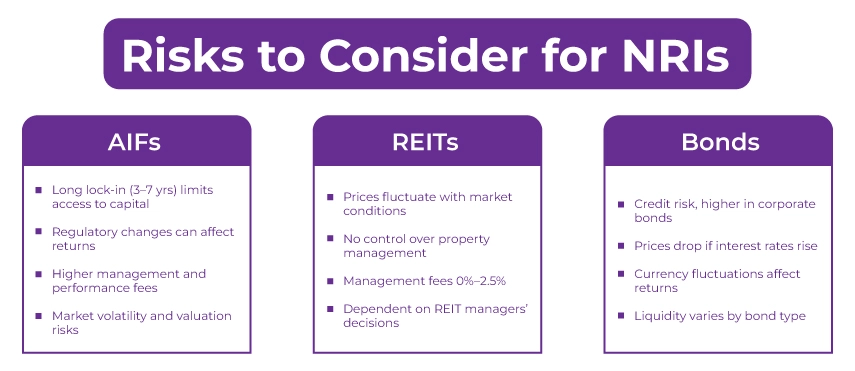
Here are the risks that NRIs need to consider while investing in AIFs, REITs, and bonds in India:
These were the risks associated with AIFs, REITs, and bonds that NRIs need to consider before investing.
Lastly, while AIFs, REITs, and bonds have their own investment advantages for NRIs, with varying features, they are quite different from traditional investment options. This was all about the advanced investment options available for NRIs in India. Additionally, before investing, consider thea return potential of the investment, liquidity, and safety of the capital.
Further, if you are still confused about choosing the right investment option, connect with Savetaxs. We have a team of financial experts who can guide you in choosing the right investment as per your financial goals. Additionally, they can also assist you with fulfilling your cross-border tax obligations.
This article is for general informational purposes only and does not constitute tax, legal, financial, or investment advice. Laws, regulations, rates, and procedures may change over time and may vary based on individual circumstances.
While SaveTaxs makes reasonable efforts to keep the information accurate and up to date, readers should verify applicable rules with official authorities or consult a qualified professional before making decisions based on this information.
Shubham Jain is the Founder of SaveTaxs and has extensive experience in Indian and NRI taxation. He advises individuals, NRIs, and businesses on tax filing, tax planning, capital gains, DTAA benefits, fund repatriation, and compliance matters. He regularly writes about taxation and related financial topics. His focus is on making complex tax concepts easy to understand. Through his articles, he helps taxpayers stay informed, avoid common mistakes, and stay compliant with Indian tax laws. See Full Bio

Want to read more? Explore Blogs

_1781845771869.webp&w=828&q=75)
_1778936280179.webp&w=828&q=75)