


Investment & Financial Planning
NRI Property Sale: How to Calculate Capital Gains TaxNRI Property Sale: How to Calculate Capital Gains Tax
Written by Shubham Jain

India's growing economy is projected to become the third-largest in the world by 2030. This growth has significantly improved the real estate market in India, offering robust infrastructure and attractive investment returns.
Hence, there is no doubt that the real estate market in India is rising rapidly. As a result, NRIs are purchasing property in India, particularly those living in the USA. And now that the laws governing real estate market investments have been revised for the better, investing is even more easier for NRIs.
According to statistics released early this year, NRI investors have invested more than USD 13.3 billion in the Indian real estate market.
So, as an NRI, if you haven't invested yet or are planning to purchase property in India, you're in the right place.
This blog discusses all aspects of NRI purchasing property in India from the USA. Right from drafting a PoA in the USA, to selecting a property in India, verifying documentation, executing the entire process, and the tax implications in both India and the USA.
Yes, NRIs and the PIOs can purchase an immovable property in India. But what's restricted to them is to buy a plantation property, agricultural land, or a farmhouse.
NRIs purchasing property in India can buy either residential or commercial property.
Additionally, as per the FEMA regulation, NRIs can purchase a commercial or residential property from another Indian resident, NRI, or an OCI only.
This is where FEMA hasn't imposed any restrictions on NRIs, as they can inherit any type of immovable property from an Indian resident or any other person who has legally acquired it.
As a gift, NRIs can receive either a commercial or a residential receipt from their relatives. Ensure that the relative gifting a prepry must either be a resident of India, an NRI, or an OCI. The restriction on agricultural land, farming, and planting also applies to gifting.
Lastly, please note that citizens of Pakistan, Sri Lanka, Afghanistan, China, Bangladesh, Iran, Nepal, or Bhutan must obtain permission from the Reserve Bank of India (RBI) to purchase or transfer any property in India. This is not mandatory for a lease agreement of up to 5 years.
NRI buying property in India is going to be a tedious task as it involves strategic planning and understanding cross-border tax implications in India and the USA. But with proper guidance and awareness, you can get through the process seamlessly.
Following is the property purchase process for NRI
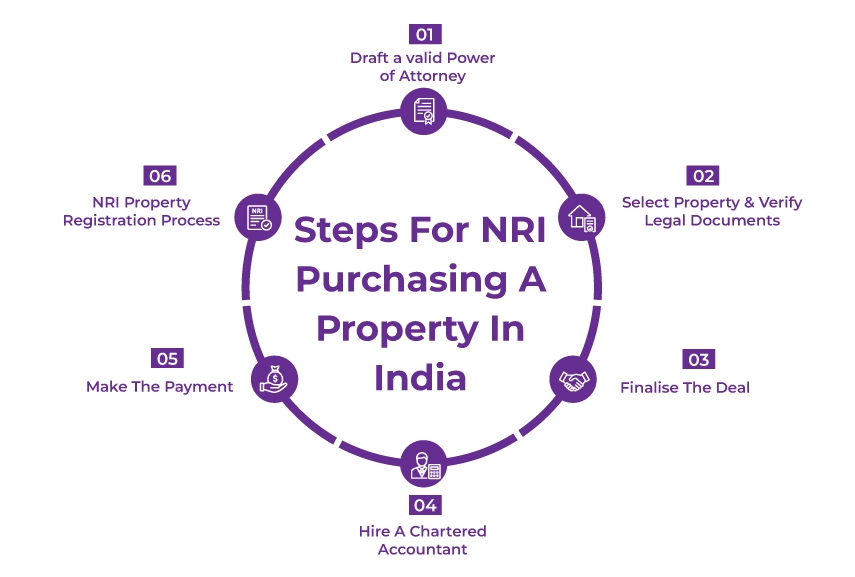
As an NRI living in the USA who cannot be physically present in India at the time of purchase, you can appoint a Power of Attorney holder in India.
A PoA (power of attorney) gives the chosen individual or an entity, also known as agents or PoA holder ( the person to whom the power is granted), the authority to make confident decisions or handle affairs on your behalf.
Granting your rights legally to someone else to purchase a property in India is a sensitive matter; hence, please ensure that your PoA holder is someone you trust, or hire a professional Power Of Attorney Consultant to ensure your matter is in the hands of an expert.
Process:
However, please note that the general PoA is often rejected, hence use a specific PoA type only.
This is one of the necessary steps in the property purchase process for NRIs.
Selecting the party and then verifying all its legal documents are essential steps. This needs to be done mindfully and with the help of a reputable real estate agent.
Lastly, if you are purchasing a property from another NRI, please ensure to get a No Objection Certificate (NOC) from the income tax department. This certificate will confirm that the relevant seller has fulfilled all tax obligations for the property.
Please verify every document mentioned here. This will confirm that the seller has clear marketable ownership of the property and that its history is undisputed.
Once the property is selected and all verification checks are complete, you can proceed to pay the booking or the token amount for the property.
Sign the Agreement of Sale and ensure that all the payable terms, timelines, special case clauses, and penalties are documented clearly in the agreement.
In the case of an NRI, the PoA holder can secure the agreement of sale by signing the sale deed.
As an NRI buying property in India, it is non-negotiable for you to hire a CA.
A CA's expertise can provide you with the Correct TDS calculation, which in this case will be.
As an NRI, please ensure payment is made only through authorized channels. Such as:
Please note that cash payments are not permitted for NRIs.
Once you've paid the remaining amount, it's time to register your property.
The NRI property registration process involves you.
File Your NRI ITR Today with an expert-backed approach at Savetaxs.
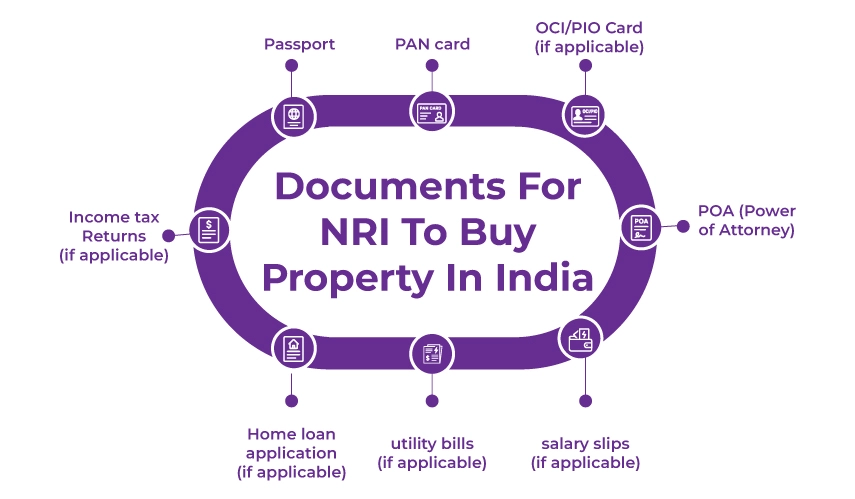
Mandatory documents you must keep in order at the time of registration
Documents you must keep in order after registration
Having all the documents in order beforehand will save you from any last-minute legal complications.
Following the documents, the NRI needs to purchase a property in India.
To assess NRI property tax in India, it is essential to determine whether the seller is a resident of India or a non-resident. For accurate property tax filing for NRI please know:
As an NRI purchasing property in India, you are required to deduct TDS (tax deducted at source). Now, the TDS rate depends entirely on the seller's residential status and the type of capital gain from the property sale.
As an NRI, if you have acquired an immovable property from someone who is an Indian resident, then in this case, the TDS will be deducted at the rate of 1% only of the sale proceeds exceeding the total of 50 lakhs.
Whereas, if the seller's residential status is NRI and the property being sold has been held by the seller for more than 24 months from the date of acquisition, the gains from the sale of that property will be treated as long-term capital gains.
As an NRI buyer, you will deduct the TDS at the TDS deduction rate on long-term capital gains, which is 20%.
In case of a property that is held for less than or exactly 24 months, then the gains earned from that property will be classified as short-term capital gains for the seller, and you, as an NRI buyer, will deduct the TDS at the rate of 30%.
After deducting the TDS, please submit it to the department within 30 days of the deduction. Failure to do so will result in a fine of 1% per month on the outstanding TDS amount.
As an NRI, if you plan to put up your purchased property in India for rent, then the rental income you earn from it will be taxable.
Following the tax treatment of the NRI Rental Income:
The rental income earned by an NRI from a property in India is declared under the head 'Income from House Property' while filing the ITR. It is taxed as per your applicable income tax slab rate.
Additionally, unlike resident Indians, NRIs' TDS deduction on their rental income is mandatory under Section 195 of the Income Tax Act, regardless of the rent value.
The tenant is obligated to deduct TDS at the rate of 31.2% (30% basic tax + 4% health and education tax) on the entire rent value. Meaning that, as an NRI, even if you earn rent of Rs 1, TDS will still be deducted.
Note: If the TRC is not provided, the TDS on rental income will be deducted at a higher rate, meaning the DTAA can reduce TDS through lower tax rate claims.
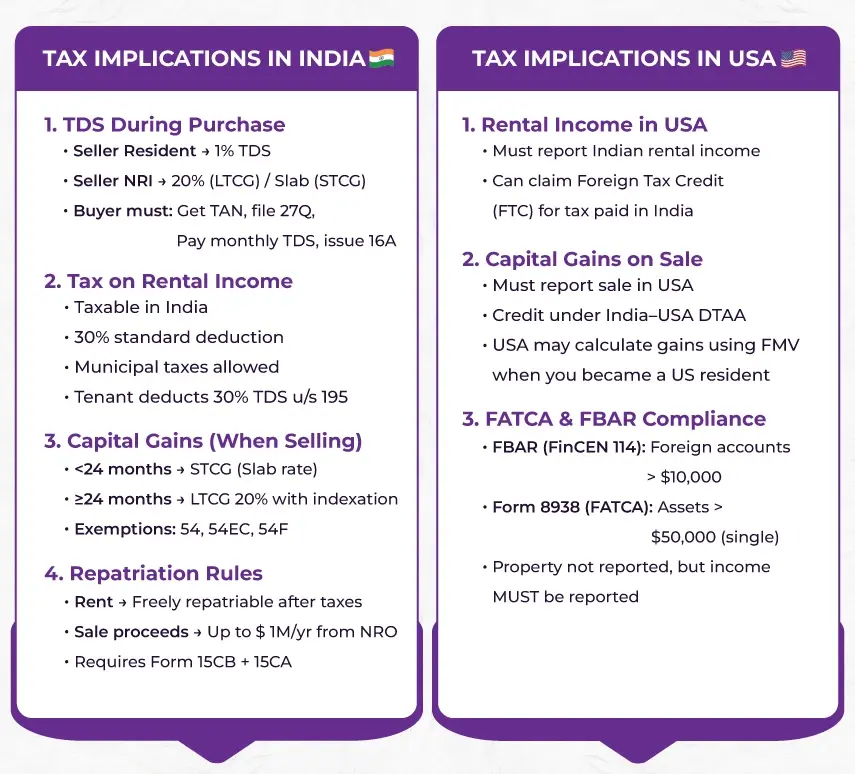
NRIs in the USA are generally taxed on their global income, including the Indian property.
If you have rented out your recently purchased property in India.
NRIs ensure that even though you have paid the NRI property tax in India, you must still.
However, the USA may calculate your capital gains differently, using FMV at the time you are a US tax resident.
NRIs living in the USA, this one's mandatory for you.
FBAR (FinCEN Form 114)
This form is your Report of Foreign Bank and Financial Accounts (FBAR). The US government uses the form to collect information about your foreign financial accounts.
You are required to use this form if your foreign account balances exceed the set threshold of USD 10,000 at any point in the financial year in your NRE and NRO accounts.
Form 8938 (FATCA Reporting)
This form is the Statement of Specified Foreign Financial Assets. You will use it to report your financial interests in foreign assets to the IRS if the total value of the foreign assets exceeds USD 50,000 for individuals and USD 100,000 (joint).
However, the Indian property itself does not need FBAR, but the rental income here must be reported.
Before buying a property in India, NRIs must conduct a careful evaluation, including associated factors, to ensure they are making a legitimate and secure investment.
The following are the rules for NRI buying property in India
Before investing in any property, no matter how flashy or attractive the price may look, please ensure the property title is clear of any ownership issues. Additionally, run a check on all necessary approvals, including land-use approvals, construction permissions, and no-objection certificates (NOCs).
Research the location of the property. Consider the property's infrastructure, the facilities available in the neighborhood, and the location's connectivity to other hospitals, convenience stores, the airport, and famous attractions.
When buying a property in India as an NRI from the USA, it is essential to consider all available financing options. Such via NRE/NRO account and home loan for NRIs. Consider additional expenses, such as stamp duty, legal fees, and other costs, to estimate the property's final price.
For NRIs, the most tedious task in the property purchase process is correctly understanding the India-US tax implications. This includes understanding capital gains tax, TDS, income tax, and related matters.
Get your cross-border taxes handled by an expert here at Savetaxs.
For NRI purchasing property in India, this concept offers a mix of personal connection and an incredible financial opportunity. With the real estate market in India growing rapidly, NRIs can benefit in the long run with appreciated capital values and rising rental income.
All you need to do is ensure that everything is done in accordance with the law and that you understand the tax implications of both India and the USA.
However, if you're looking for an NRI real estate taxation consultant who can provide expert insights and assist you throughout the process, Savetaxs is the name to trust.
We have been helping NRIs across 20+ countries with their cross-border real estate needs and tax compliance. Our experts bring more than 3 years of experience to the table so that you can be assured of the best real estate investment strategies tailored to your specific goal.
This article is for general informational purposes only and does not constitute tax, legal, financial, or investment advice. Laws, regulations, rates, and procedures may change over time and may vary based on individual circumstances.
While SaveTaxs makes reasonable efforts to keep the information accurate and up to date, readers should verify applicable rules with official authorities or consult a qualified professional before making decisions based on this information.
Shubham Jain is the Founder of SaveTaxs and has extensive experience in Indian and NRI taxation. He advises individuals, NRIs, and businesses on tax filing, tax planning, capital gains, DTAA benefits, fund repatriation, and compliance matters. He regularly writes about taxation and related financial topics. His focus is on making complex tax concepts easy to understand. Through his articles, he helps taxpayers stay informed, avoid common mistakes, and stay compliant with Indian tax laws. See Full Bio

Want to read more? Explore Blogs
_1781845771869.webp&w=828&q=75)
_1778936280179.webp&w=828&q=75)