


Investment & Financial Planning
NRI Property Sale: How to Calculate Capital Gains TaxNRI Property Sale: How to Calculate Capital Gains Tax
Written by Shubham Jain


For NRIs looking to increase their wealth while managing risk exposure, investing in hybrid mutual funds is a good option. These investment tools in a single portfolio combine both equity and debt components. Being an NRI, you can access hybrid mutual funds that specifically cater to your investment preferences and needs. This makes it suitable for financial planning and wealth creation.
Confused? Here, this blog answers your every question about the hybrid mutual funds. By the end of it, you will know whether these investments are right for you, how to invest, and how to increase your returns while complying with the taxes. So read on and gather all the information about it.

A hybrid mutual fund combines two or more mutual funds in one portfolio. Primarily, these funds combine equity and debt instruments. It provides the investors with a balanced investment approach, which, while maintaining the growth potential, easily handles market fluctuations. You can consider these funds as both a growth engine and a safety cushion. These are suitable choices for investors who are looking for moderate risk with reasonable investment returns.
The foundation of hybrid mutual funds is based on three fundamental principles:
Further, being an NRI, if you are seeking a way that combines growth potential with proper risk management, hybrid mutual funds provide a simple entry point into the Indian market. Actively managing your portfolio, the fund manager, based on the market conditions, constantly monitors your investment and adjusts allocations.
This was all about hybrid mutual funds. Moving ahead, let's discuss why these investment options are good for NRIs.
Many NRIs, while investing in India, face the same issue. Over the long-term period, pure equity funds offer 12-15% returns; however, they are volatile. Pure debt funds provide stability, but only offer 6-7% returns. In this situation, hybrid mutual funds resolve this issue. Investing in these products provides you with both growth potential with downside protection of debt. Further, for NRIs, it is more beneficial because:
So, these are the reasons why hybrid funds are good investment options for NRIs. Moving further, let's know the different types of hybrid funds available for NRIs.
The market consists of several types of hybrid mutual funds. To match the investment goals and risk tolerance of NRIs, each of them is designed with a different equity-debt allocation ratio. Having an understanding of them can help you choose the correct fund as per your financial situation.
These funds maintain a higher equity component, generally investing 65-80% in stocks and remaining in debt instruments. The aggressive hybrid through the debt portion by offering some stability aims to increase capital. Considering this, if your investment horizon is longer and you have a higher risk tolerance, these funds can match your growth objectives.
Balanced hybrid funds or balanced advantage funds generally maintain around 40-60%, an even distribution between debt and equity. Based on the market valuations, these funds rebalance the equity and debt automatically. It further assists in receiving reasonable investment returns with less exposure to market volatility.
With expert-backed guidance from Savetaxs, filing ITR becomes easy for NRIs.
Over-investment growth, these funds give priority to preserving capital. Considering this, it allocated 10-25% to equity and 75-90% to debt instruments. The conservative hybrid funds are a perfect choice for investors seeking steady income with less volatility.
Beyond just equity and debt, multi-asset allocation funds include commodities like gold investment options. It further offers wider protection against the changing market conditions. Additionally, these funds also provide portfolio diversification to investors. It is especially good for NRIs, who have limited investment options in Indian investments.
These funds combine debt, equity, and arbitrage options, generally managing a 30-35% direct equity exposure. In this, the arbitrage components assist in decreasing the overall portfolio risk, while potentially providing tax benefits.
Arbitrage funds are low-risk funds. These funds influence the cost difference between cash and derivatives markets. Considering this, these funds behave like liquid funds but are taxed like equity funds. Most of the NRIs for short-term parking of funds use them as an alternative to tax-efficient investments. Further, these funds are good for short-term investments, i.e., 3-12 months, with better tax efficiency than debt funds.
These were the different types of hybrid mutual funds available for NRIs for investment. Moving ahead, now let's know the tax implications for NRIs in these funds.
In hybrid mutual funds, the tax on capital gains is as follows:
Equity Component of Hybrid Mutual Fund: This is taxed like equity funds.
Debt Component of the Hybrid Fund: Regardless of the holding period, all gains on debts are taxed as per the income tax slab rate of the individual.
Further, using the DTAA benefits you can claim a refund and avoid paying taxes twice on the same income. This is how NRIs pay taxation on the gains received from the hybrid mutual funds. Moving further, let's know how NRIs can invest in these funds.
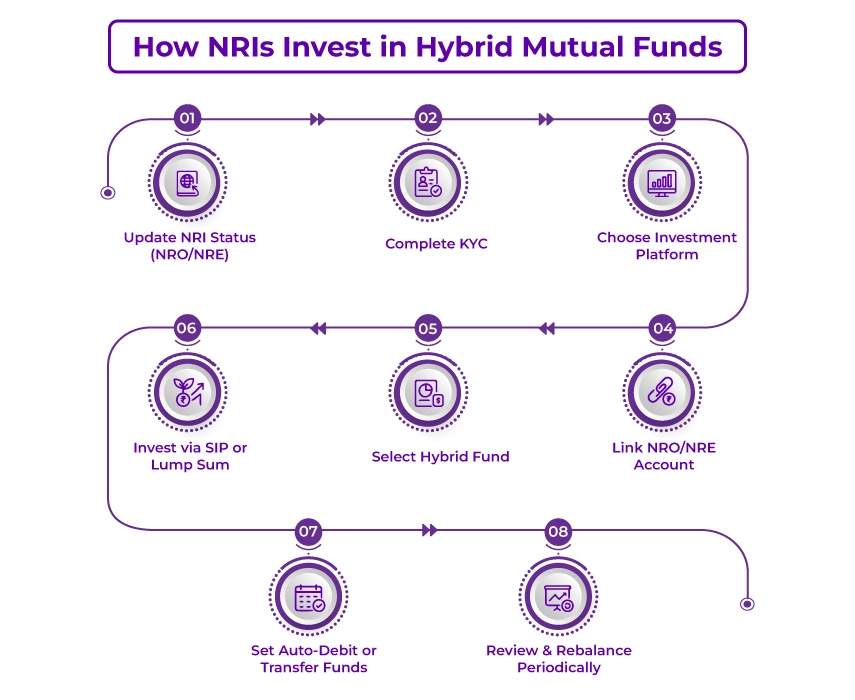
Here is how NRIs can invest in hybrid mutual funds:
Step 1: Update Your Residential Status
If you moved overseas recently, update your Indian residential status to NRI status with your bank. Following this, your current savings account will be changed to an NRO account. Additionally, you need to open an NRE account separately.
Step 2: Complete KYC Compliance
Once your residential status changes to NRI, you need to complete a new KYC. Also, you need to submit the following documents:
Step 3: Select Your Investment Platform
You can invest in hybrid mutual funds through:
Step 4: Link Your Bank Account
Link your NRO or NRE account with your investment platform. To verify the account, the investment platform will send a small test deposit to you.
Step 5: Choose Your Hybrid Mutual Fund
Select funds based on:
Step 6: Decide Lump Sum or SIP
Step 7: Set Up Payments
For SIP, from your Indian bank account, set up an auto-debit mandate. This certifies without manual intervention, timely investment. Additionally, for a lump sum, you can transfer funds via UPI, NEFT, or RTGS.
Step 8: Track and Rebalance
In every 6-12 months review your investment portfolio. Also, check if your invested funds are meeting your expectations or not. Additionally, based on market conditions and changing financial goals, rebalance them.
This is how, using the steps above, NRIs can invest in hybrid mutual funds. Moving ahead, now let's know the investment risks associated with these funds.
Connect with us today and plan your investment in India as per your financial goals.
Among NRIs, hybrid mutual funds are popular for their balanced debt and equity. However, like every investment, they also carry certain investment risk. To know about them, read the points below.
A part of the hybrid funds is allocated to equities. This means, with the stock market, the value of the fund will change. Considering this, during market corrections, temporarily, your portfolio can lose its value even though these funds, through diversification, aim to reduce risk.
The debt portion of the hybrid mutual funds, directly affected by the changes in interest rates set by the RBI. Additionally, the interest rate is also influenced by the inflation trends. Further, even though debt looks stable, during high-interest-rate cycles, your income returns may decrease.
Hybrid funds heavily depend on the decision of the fund manager to shift between equity and debt. Additionally, wrong timing in reducing or increasing equity exposures can impact your returns. So, your returns from investment during market volatility depend on whether your fund manager rebalances it on time or not.
With different credit quality, sometimes debt funds are invested in corporate bonds. If a company defaults or delays your repayment, the NAV may suddenly drop. Considering this, debt risk is not always free from market fluctuations. Additionally, poor credit exposure can decrease the stability you expect from the funds.
Under this, NRIs investing with their foreign income should later convert it back to their home currency. It is because even if the funds are performing well, the currency movement can impact your final repatriated capital gains. Additionally, against your current resident country, if the value of the rupee decreases, you may get lower returns.
Compared to residents, NRIs have different Indian taxation rules for hybrid funds, and in this, TDS adds another layer. Considering this, if the tax liability of an NRI is lower, they may face higher TDS. Additionally, without a tax residency certificate and Form 10F, they cannot claim DTAA benefits. Also, from equity-oriented funds, debt funds are taxed differently. Apart from this, poor tax planning and improper documentation lead to lower post-tax returns and tax leakage.
So, these were the risks associated with hybrid mutual funds that NRIs should consider while investing. Moving further, now let's know when NRIs should consider investing in these funds.
Hybrid funds are not always the best choice for investments for NRIs. Here is when you should choose them:
Further, in the above-mentioned conditions, NRIs should consider investing in hybrid mutual funds.
Lastly, hybrid mutual funds provide NRIs with a practical investment path between conservative debt funds and aggressive equity funds. Additionally, if you are comfortable with mild risk and do not need guaranteed returns, these funds can be a good addition to your NRI portfolio.
Further, if you are facing issues in choosing the right investment option in India, connect with Savetaxs. We have a team of financial advisors who can help you out in selecting the correct investment options as per your financial goals. Additionally, they can also help you with your tax planning in India.
This article is for general informational purposes only and does not constitute tax, legal, financial, or investment advice. Laws, regulations, rates, and procedures may change over time and may vary based on individual circumstances.
While SaveTaxs makes reasonable efforts to keep the information accurate and up to date, readers should verify applicable rules with official authorities or consult a qualified professional before making decisions based on this information.
Shubham Jain is the Founder of SaveTaxs and has extensive experience in Indian and NRI taxation. He advises individuals, NRIs, and businesses on tax filing, tax planning, capital gains, DTAA benefits, fund repatriation, and compliance matters. He regularly writes about taxation and related financial topics. His focus is on making complex tax concepts easy to understand. Through his articles, he helps taxpayers stay informed, avoid common mistakes, and stay compliant with Indian tax laws. See Full Bio

Want to read more? Explore Blogs

_1781845771869.webp&w=828&q=75)
_1778936280179.webp&w=828&q=75)