


Investment & Financial Planning
FCNR Deposit Interest Rates in 2026FCNR Deposit Interest Rates in 2026
Written by Vipul Jain


India offers an array of investment options for NRIs. But when it comes to safe investment options, the comparison between Bank FD vs Gold is a standard topic of conversation. Both investment options are considered secure and stable; they serve different purposes.
Talking about gold, specifically exchange-traded funds or digital gold, they are known for their ability to uphold their value over time. At the same time, NRI Fixed deposits (FDs) provide predictable returns while keeping the risk factor relatively low.
This guide covers all aspects of Bank FDs and Gold, including their tax implications, storage considerations, repatriation rules, compliance requirements, and more.
By the end, our NRI investors will know which investment avenue is the best fit for their investment goal, risk appetite, and timeline.
When it comes to NRIs investing in India, bank FDs are considered one of the most reliable investment options.
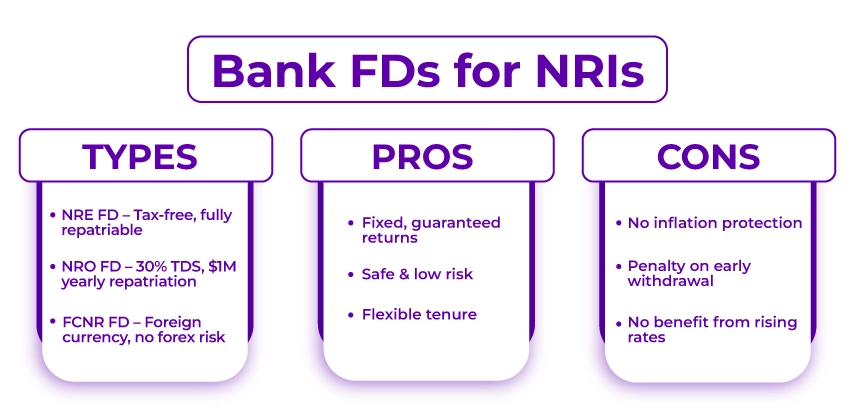
NRIs have three types of bank FDs available.
NRE Fixed Deposits: This fixed deposit is intended to park foreign currency remittances in Indian rupees only. Both the principal and interest are tax-free and fully repatriable.
This fixed deposit is best for NRIs who want to deposit their foreign earnings in India.
NRO Fixed Deposits: This fixed deposit is ideal for managing income earned in India, such as dividends and rents. Unlike NRE fixed deposits, NRO FDs are subject to 30% TDS on interest; however, NRI investors can claim a refund by filing an ITR.
Additionally, in NRO FDs, you can repatriate only up to $1 million annually after tax compliance. This type of FD is the best option for NRIs with income in India.
FCNR Fixed Deposit: This type of fixed deposit is suitable for NRIs who want to maintain their deposits in foreign currencies. This fixed deposit protects your investment from currency conversion losses.
The tax and reorganization treatment for FCNR fixed deposits is similar to that for NRE fixed deposits.
The following are the benefits of investing in bank fixed deposits.
Fixed Returns: NRI invests to seek low-risk, stable returns; bank FDs are an appropriate choice for yoy as they offer guaranteed interest throughout the tenure.
Safety First: Fixed deposits in reputable financial institutions or banks in India are generally rated AAA.
Flexibility: As an investor, you can choose the FD's tenure based on your convenience and financial goals.
Diversification: Every investor loves to diversify their investment portfolio, and by adding FDs to it, you can reduce the overall risk factor as they offer a low-risk, steady income option to your portfolio.
The following are some drawbacks of Bank FDs for NRIs to consider.
No Counter To Inflation Risks: Since the NRI fixed deposits offer predictable returns, their interest rates remain fixed throughout the tenure. These rates are not dynamic in nature; if your FD is providing 5% interest rate, but the inflation in the economy goes up by 6%, the interest rate will not adjust itself to inflation, and you will be earning negative interest on the investments you have made in the FD.
Premature Closure Penalty: When you withdraw the money from the fixed deposit before the tenure ends, you will be charged a penalty fee for premature closure. Additionally, the interests you have earned so far may also be deducted before crediting the principal amount.
Fixed Rate Of Interest: Fixed deposits have "fixed" in their name because this investment option offers a fixed interest rate for the entire duration of the deposit's tenure. Hence, the NRI investors will not benefit from the high interest rate if market interest rates increase.
For Indian, gold has always been considered the king of investments. This is because of the long-term value and stability it offers. Apart from traditional physical gold investment options such as jewelry, gold coins, and bars, India now provides good alternative gold investment options for NRIs, including Gold ETFs, Gold Mutual Funds, and Digital Gold.
Let us explore some good alternative gold investment options for NRIs
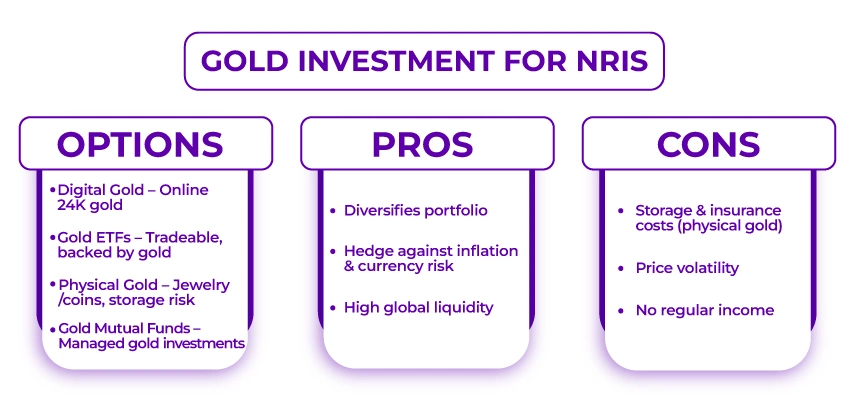
Digital Gold: This is one of the most convenient gold investment options for NRIs, as it allows NRIs to invest in 24K real gold online. Investors don't have to worry about storage costs, insurance, or theft as digital gold is securely stored in insured vaults by India's leading gold refineries.
Investing in digital gold for NRIs offers security, flexibility, and convenience. Additionally, one of the most significant advantages of investing in digital gold for NRIs is its accessibility. NRI investors can sell or buy gold anytime from anywhere in the world using certified online platforms.
Ensure that SEBI and RBI do not regulate digital gold.
Gold ETFs: Gold Exchange-Traded Funds offer NRIs exposure to the gold price via stock exchanges. These gold funds are backed by physical gold and provide a secure way to invest.
Investors can easily buy and sell Gold ETFs on stock exchanges, making them a highly liquid investment option for NRIs.
Physical Gold Investments: Beyond investment, buying gold in India is a deep-rooted tradition. Many NRIs do invest in physical gold, but it comes with its own set of restrictions. Storage is a significant concern here, because you cannot keep large quantities of gold at home due to the risk of theft, whereas bank lockers add an extra cost and accessibility issues.
Additionally, physical gold also attracts import duties when carried abroad, making it less practical for NRIs than other gold investment alternatives.
Gold Mutual Funds: If you are planning to invest in gold but don't want to invest directly in gold ETFs because of their complex nature, you can opt for gold mutual funds. These funds invest in gold mining companies or Gold ETFs on your behalf. All you get here is professional management and diversification, with fund managers handling your investments.
The following are the benefits of investing in gold for NRIs.
Portfolio Diversification: Investing in gold offers diversification benefits, including protection against market volatility and a hedge against currency fluctuations. Additionally, gold has global acceptance and liquidity, which provides a sense of balance to your portfolio when the economy is uncertain.
Cultural Value: For centuries in India, gold has been considered more than an investment; it is a traditional value in Indian culture. And more than financial gold offers emotional security.
Inflation Protection: There's no doubt that gold serves as a hedge against inflation and provides protection against currency devaluation. When the economy is uncertain or inflation is high, gold serves as a haven and preserves your wealth.
The following are the drawbacks of investing in gold for NRIs to consider.
The following table provides a clearer understanding of Bank FD for NRIs vs. Gold for NRIs.
| Comparison Factor | Bank FDs | Gold |
|---|---|---|
| Returns | Bank FDs offer NRI investors predictable returns and low-risk profiles. | With respect to gold, the returns here fluctuate with global markets. |
| Risk Level | Low risk since the capital protection is often guaranteed by the bank. | Geopolitical events, inflation, and currency movements also influence the high price volatility and the risk levels. |
| Liquidity | Premature withdrawals attract penalty fees. | Physical goods are highly liquid worldwide. |
| Investment Purpose | Bank FDs are ideal if you are seeking safe wealth parking and a stable income from your investment. | This is the ideal that your investment plan includes hedging against inflation, global uncernauttya nd currency depreciation. |
| Repatrition | NRE and FCNR FDs can be entirely repatriable, including both principal and interest. | Depends on the type of bank you have used for the initial investments. |
Let us understand this in detail.
Starting with the Gold, this investment option has been glittering in terms of returns for centuries. Last year, in December 2024, the gold was averaging around Rs 77,630 to Rs 80,000 for 10 grams of 24K gold. And just 12 months later, in December 2025, the price of gold has skyrocketed to a whopping Rs 130,070 (approx) per 10 grams.
This comparison shows a massive return of 62-67% in just one year. It explains why Indians have been calling gold the King of investments.
Now that we have talked a little about gold, let's see how the fixed deposit interest rate fluctuates and what the average return has been so far, compared to gold.
NRI Fixed deposits are known for their guaranteed returns and low risk profile, as the returns are not unpredictable, unlike gold. When the RBI changes the repo rate, the interest rate on FDs is likely to be hammered.
With FDs, the primary goal is wealth maximization, so choose a bank that offers the best NRI FD rate as per your financial goals.
Let us look at a more extended period to gain a broader perspective on this matter.
| Period | Gold Returns ( CAGR ) | Average NRI FD Returns |
|---|---|---|
| 2015 - 2025 | 11 - 12% | 6 - 7% |
| 2020 - 2025 | 15% | 6.5% |
| The last 30 years | 10% | 8-9% |
The Savetax Tip: Definitely gold did better in returns if we look at the 2024 to 2025 chart, but do not get carried away with just one exception year of returns, because how gold performed in 2025 is not necessarily a sign that this performance will repeat itself. Make your investment decision based on long-term averages, not recent spikes.
NRIs, understanding the tax implications here is important, so you don't lose out on thousands of your hard-earned money.
Fixed Deposit Taxation For NRIs
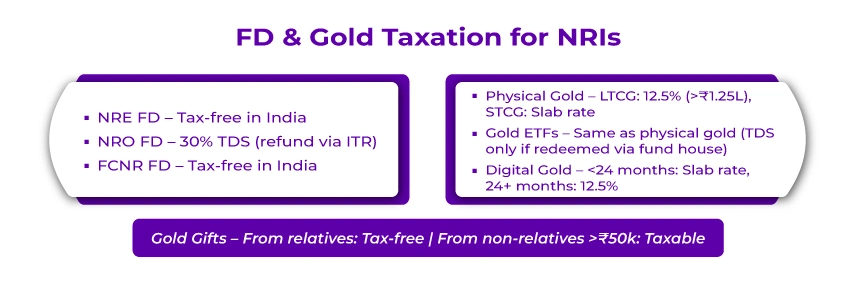
NRE FDs: These fixed deposits are exempt from income tax in India. However, please ensure you may need to pay for this in your country of residence, depending on your location.
NRO FDs: On NRO fixed deposits, NRIs face 30% TDS upfront as fixed deposit taxation. However, as an NRI, you can claim the TDS refund via ITR filing if your tax liability is lower.
FCNR FDs: Similar to NRE FDs, they are tax-free in India, but you must check for the tax implications on this in your country of residence.
Gold Investments Taxation For NRIs
Physical Gold Taxation: For long-term capital gains (meaning the gold has been held for 24 months or more), the tax is 12.5% on LTCG exceeding 1.25 lakh. For short-term capital gains, gold is taxed at your slab rate.
Paper Gold Taxation: NRI investors investing in Gold ETFs through the stock exchange are not subject to any tax deduction at source. But if redeemed directly with the fund house, the TDS applies. Additionally, the taxation of ETFs is similar to that of physical gold for NRIs, with LTCG taxed at 12.5%. An exemption of 1.25 lakh Rs is given for LTCG.
Digital Gold Taxation: In India, digital gold is not regulated by SEBI or RBI. If digital gold is held for less than 24 months, it is considered a short-term capital gain and taxed at your individual slab rate. For long-term capital gains (gold held for more than 24 months), the LTCG tax is 12.5%.
When we talk about gold taxation, another factor many don't consider is how the tax is applied to gold received as a gift or inheritance.
With respect to gold received as a gift or inheritance, as per section 56(2) of the Income Tax Act, parents, spouses, or children receiving gold ornaments are not liable to any income tax in India.
However, suppose you received the gold from someone who is not a relative, and the amount exceeds Rs 50,000. In that case, it is subject to taxes in the hands of the receiver and is taxed under the head "Income from Other Sources." The tax rates remain similar to those on physical gold.
Life emergencies do not wait for investment maturity dates. Let us see how bank FDs and gold perform when you need emergency access or want to liquidate them.
Fixed Deposit Liquidity
With FDs, a premature-withdrawal penalty applies. Meaning you will have to pay a certain percentage of the amount if you want to withdraw your money before the maturity date hits. Additionally, some banks even have a policy of releasing no interest if the withdrawal is made before the minimum tenure.
Whereas some FD schemes do not allow premature withdrawal.
Fixed Deposit Repatriation Rules
Wth resect to NRE and FCNR fixed deposits, the principal and interest in these fixed deposits are fully repatriable without any limits. However, NRO FDs have a repatriation limit of $1 million per financial year, and you will also be required to file Form 15CA/15CB for repatriating large amounts.
Gold Liquidity
Physical Gold: Immediate liquidity is available, but at a negotiable price. Additionally, making charges are not recoverable.
Gold ETFs: This alternative to gold investment can be instantly liquidated during market hours, the origin is transparent, and it is based on stock rates.
Digital Gold: Immediate 24/7 liquidity available on most platforms, and the amount is instantly credited to your bank account. Generally, there is no minimum selling quality.
Gold Investment Repatriation
Gold investments made via NRE account funds are fully repatriable without limit. This applies to all gold investment alternatives, whether Gold EFTs, mutual funds, or physical gold.
Whereas gold investments made via NRO accounts are subject to a USD 1 million annual repatriation limit. Additionally, CA certification is required for compliance.
After analyzing the key aspects of gold and bank FDs, here's a framework to help you make informed decisions.
Choose Bank FDs Only If
Choose Gold Only If
The Savetax Tip: Most successful NRIs have never chosen one investment option. It is also better to take a balanced approach, such as 30% in FDs, 20% in Gold, 20% in stocks, and 40% in other investments. (This is just an idea; you can adjust the percentage based on your financial goal.)
With all the information available by now, we can say that both fixed deposits and gold are low-risk investment options for NRI investors to build their wealth in the long term. If FD generates a guaranteed return on material, the price of gold fluctuates with currency economic cycles, but the returns have generally been on an upward trajectory.
Whatever you choose between Gold vs. ban FDs, remember to plan everything according to your financial goals and risk appetite.
If you want experienced fund and investment portfolio managers to handle your NRI investments in India, Savetaxs is the name you can trust. We have been helping NRIs from 90+ countries with their cross-border investment portfolios and the associated taxation compliance.
Our experts bring more than 30 years of combined experience to making successful NRI investments in India.
Connect with us as we serve our clients 24/7 across all time zones.
This article is for general informational purposes only and does not constitute tax, legal, financial, or investment advice. Laws, regulations, rates, and procedures may change over time and may vary based on individual circumstances.
While SaveTaxs makes reasonable efforts to keep the information accurate and up to date, readers should verify applicable rules with official authorities or consult a qualified professional before making decisions based on this information.
Shubham Jain is the Founder of SaveTaxs and has extensive experience in Indian and NRI taxation. He advises individuals, NRIs, and businesses on tax filing, tax planning, capital gains, DTAA benefits, fund repatriation, and compliance matters. He regularly writes about taxation and related financial topics. His focus is on making complex tax concepts easy to understand. Through his articles, he helps taxpayers stay informed, avoid common mistakes, and stay compliant with Indian tax laws. See Full Bio

Want to read more? Explore Blogs
_1781845771869.webp&w=828&q=75)
_1778936280179.webp&w=828&q=75)
_1778936089630.webp&w=828&q=75)