



Investment & Financial Planning
NRI Property Sale: How to Calculate Capital Gains TaxNRI Property Sale: How to Calculate Capital Gains Tax
Written by Shubham Jain
_1767429506.webp&w=3840&q=75)
Owing to robust economic growth, technology advancement, and structural reforms, India is one of the most attractive investment destinations for investors. In this, monthly income investments for NRIs are an investment type that offers them regular income in India. These investment plans are a combination of equity and debt instruments, concentrating more on debt to certify steady returns.
To help you out, in this blog, we have listed down the best investment plans for NRIs to generate monthly income in India. So read on and gather all the information.
Warren Buffett always said, "Do not depend on a single income; by investment, create a second source of income." Considering this, India, with its constantly growing economy in the world, is reflected not only in GDP numbers but also in the debt and capital markets have increased in depth and participation. So, one should not be surprised that many NRIs are opting for investments in India.
Another key reason for NRIs investing in India is the easy contrast in returns. Many NRIs reside in developed markets that have mature economies and fixed income yields. On the other hand, India, across multiple debt avenues, still provides higher payouts. Currently, as of December 2025, corporate bonds offer 8% to 15%, NBFC fixed deposits or small finance banks reach about 8.5% and 10-year government bonds provide around 6.5% return.
In short, India provides NRIs with better returns without the requirement of full-time involvement or constant monitoring. Further, this is why NRIs are opting for a monthly income from India. Now, moving ahead, let's know the best income investment plans for NRIs in India.
Here is a list of some of the best monthly income investment plans for NRIs in India, tailored to different circumstances and financial needs, that assist you in generating stable income.
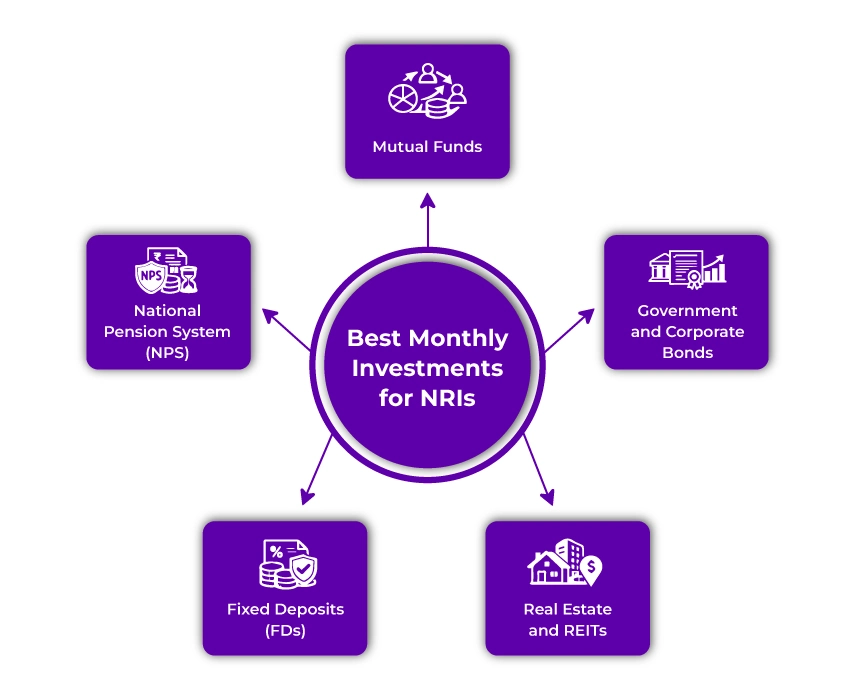
For conservative investors, fixed deposits remain one of the most favorable investment options. At present, the FD interest rate ranges from 6-7.50% at major Indian banks. However, the NBFCs and small finance banks provide up to 8.5% interest rate on FDs. Further, here is how the three FD variants differ for NRIs:
You can select the tenure of your FD from 7 days to 10 years, and the interest payout frequency, i.e., monthly, quarterly, half-yearly, or annually. Additionally, from bank to bank, the interest rates vary and depend on the currency, tenure, and account type. In short, for people who like security backed by a bank against market fluctuations, FDs are a good investment option.
Government bonds are debt instruments issued by the central or state government to fund several public expenditures and projects. They pay a fixed rate of interest to investors, generally semi-annually or annually. Additionally, at maturity, the principal amount is paid. Government securities in India are stated as the safest debt securities. As per your choice, you can opt for both short-term and long-term securities like treasury bills.
Apart from this, many investment-grade corporate bonds provide annual 8% to 15% returns. So, if you like predictability, then Indian bonds are one of the safest ways to have a stable and fixed income.
Apart from paper assets, if you want something tangible, then the property and infrastructure sector of India has again gained the spotlight. In the financial year 2025, the real estate sector of India rose to INR 23,080 crores. It is the best in seven years. With rental yields of 2% to residential, 4% and commercial sectors of 6 to 9% the real estate has regained the confidence of investors.
For those who like a hands-off approach, real estate investment trusts (REITs) provide exposure to malls and office spaces, paying quarterly dividend-like distributions. Further, through an Indian demat account, you can hold them, and under RBI norms, you can repatriate them.
As of October 2025, the mutual fund industry of India now manages over INR 79.79 lakh crore. It is nearly triple what the industry did 5 years ago. This showcases both accessibility and trust. Further, as an NRI, you can opt for:
Additionally, many mutual fund houses also provide Systematic Withdrawal Plans (SWP) that work like a "monthly income" setup from your accumulated corpus.
NRIs through NRE/NRO accounts can invest in the National Pension Scheme (Tier-I and Tier-II). Over the long term, with potential annual income returns between 6 to 10%, contributions are invested in a mix of government equity or corporate bonds.
At the age of 60, up to 60% of the corpus has no tax imposed, while the remaining is used to purchase an annuity offering monthly pension income. Also under section 80C (INR 1,50,000) and section 80CCD (INR 50,000) of the Income Tax Act, 1961, you can qualify for a tax deduction for your NPS account contribution.
So, these were some of the best monthly income investment options available for NRIs in India. You can choose any of them or multiple as per your financial goals. Moving further, now, let's know the key tax and regulatory rules that NRIs need to follow while investing in India.
File your NRI ITR in minutes without any issues with Savetaxs.
The key tax and regulatory rules for NRIs are as follows:
| Type of Asset | Tax Treatment (India) | Repatriation Rules |
|---|---|---|
| Govt/ Corporate Bonds | Generally, interest is charged as per the tax slab rate of NRIs. Under the new tax regime, long-term capital gain is taxed at 12.5% and short-term capital gain is taxed at 20%, depending on the mutual fund type and period. | As per RBI rules, if held via NRE/FCNR, fully repatriable. However, if you held funds via an NRO account you can repatriate up to USD 1 million per financial year cap (including income/ assets). |
| FDs- NRO | Interest taxable at the slab rate; 30% TDS is charged. | After tax, up to USD1 million per financial year, you can repatriate funds from your NRO account, subject to Form 145/ 146. |
| FDs- NRE/FCNR | For NRIs, interest is tax-free. | Without any restrictions, both principal and interest are fully repatriable. |
| Debt Mutual Funds | For funds bought on or after 1 April 2023, capital gain is taxed at the per slab rate; no LTCG benefit is provided. Considering this, for older, i.e., pre-April 2023 purchase units, standard STCG/ LTCG rules may apply, which is 20%/ 12.5% + surcharge/cess depending on holding if held for more than 2 years. | Via NRE account, funds are fully repatriable, via NRO account |
| Equity Mutual Funds (or Listed Stocks) | Under the new tax regime, STCG is charged at 20% and LTCG is charged at 12.5% without a threshold benefit. | Via NRE/ PIS, funds are fully repatriable; via NRO/ PIS, repatriation is restricted to USD 1 million per financial year. |
| REITs/ InvITs | Distribution, i.e., interest/dividend, is often subject to TDS (consessional or slab depending on structure). Further, the capital gain tax imposed on sales is similar to equity mutual funds, i.e., LTCG 12.5%. | NRE/PIS are fully repatriable, whereas NRO accounts allow up to USD 1 million per financial year. |
| Real Estate- Rental Income | Under section 24, after standard deduction, rental income is taxed at slab rates. Considering this, under section 195, the tenant should deduct TDS at 30%. | You can repatriate rental income via an NRO account. However, it is subject to USD 1 million per financial year. |
| Real Estate- Sale of Property | On sale after holding for more than 24 months, LTCG is charged at 12.5% (post-2024 capital gain regime) + surcharge/cess. | In case you purchase the property using your foreign funds, for up to two residential properties, you can repatriate sale proceeds. Further, properties require RBI approval or the NRO route, subject to USD 1 million per financial year. |
| National Pension Scheme (Tier I) | On withdrawal/ exit, a 60% lump sum amount is tax-free. Additionally, a 40% annuity is taxed at the slab rate. | Subject to NRE/ NRO account rules, annuity payments/ withdrawals can be repatriated. |
These were the key taxation and regulatory rules that NRIs need to follow while investing in the Indian market.
Opt for the best investment option in India as per your financial goals and risk appetite.
Lastly, monthly income investments for NRIs in India are a good option to generate wealth and have savings for their future. Considering this, there are several investment options available for them to earn a monthly income in India. However, while choosing any, you should consider your financial goals, risk profile, currency fluctuations, and tax implications.
Further, if you are facing issues in selecting the right monthly income investments, connect with Savetaxs. Our financial experts will guide you in the selection process and help you with your investments.
This article is for general informational purposes only and does not constitute tax, legal, financial, or investment advice. Laws, regulations, rates, and procedures may change over time and may vary based on individual circumstances.
While SaveTaxs makes reasonable efforts to keep the information accurate and up to date, readers should verify applicable rules with official authorities or consult a qualified professional before making decisions based on this information.
Vipul Jain is the Co-Founder of SaveTaxs and a tax expert with experience in Indian and NRI taxation. He advises individuals, NRIs, and businesses on tax filing, tax planning, capital gains, DTAA, and compliance matters. He focuses on making complex tax concepts simple and helping taxpayers make informed, compliant decisions. See Full Bio

Want to read more? Explore Blogs

_1781845771869.webp&w=828&q=75)
_1778936280179.webp&w=828&q=75)