


Investment & Financial Planning
NRI Property Sale: How to Calculate Capital Gains TaxNRI Property Sale: How to Calculate Capital Gains Tax
Written by Shubham Jain

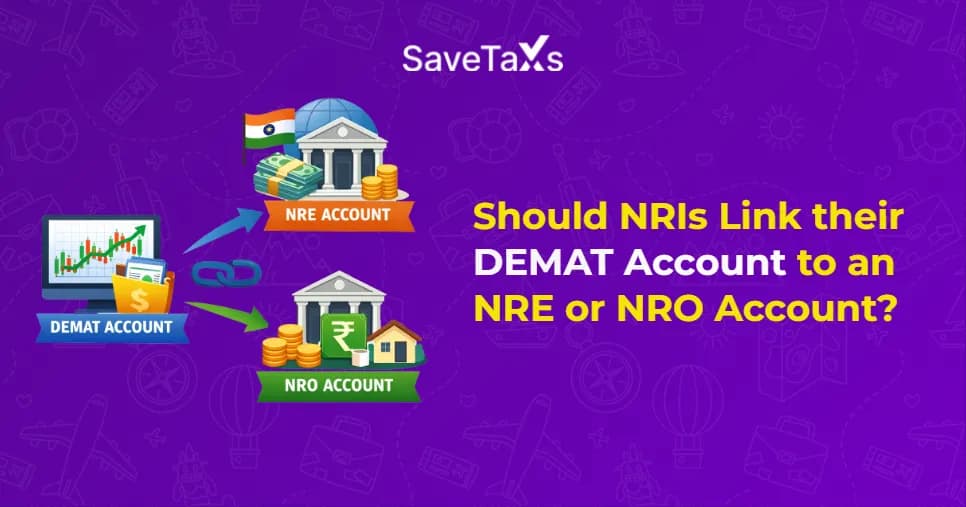
For Non-Resident Indians (NRIs), investing in Indian stocks is more than just choosing good companies. It also includes complying with the rules and regulations set by the Reserve Bank of India (RBI) and FEMA (Foreign Exchange Management Act). One key decision in this process is whether to link the NRI DEMAT account to a Non-Resident External (NRE) account or a NRI DEMAT account with a Non-Resident Ordinary (NRO) account.
This choice impacts the nature of investments, the ability to repatriate funds, and compliance with the Foreign Exchange Management Act (FEMA) and Reserve Bank of India (RBI) guidelines. Keep reading further to learn the implications of each option. This will help NRIs to invest with confidence, prevent procedural complications, and align their portfolios with long-term financial goals.
A DEMAT account for NRIs cannot function independently. It must be linked to a bank account, either NRE or NRO. Each account serves a unique regulatory purpose.
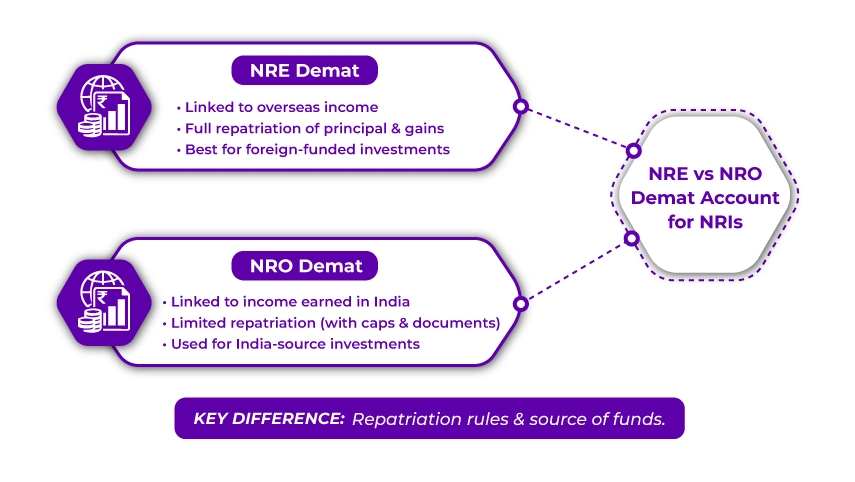
The distinction between these two routes is significant, affecting how investments are classified, monitored, and eventually liquidated.
Reach out to Savetaxs, our experts are ready to simplify all your tax paperwork.
Linking a DEMAT account to an NRE account allows investments to be repatriable by default. This structure is suitable in situations where the capital is sourced from outside India, and the investor desires flexibility in transferring funds. You should consider linking your DEMAT account to an NRE account if:
*Point to Note: NRE-linked DEMAT account for investments falls under the repatriable Portfolio Investment Scheme (PIS). Your DEMAT account, PIS account, and NRE bank account must be properly aligned for regulatory compliance.
When linking a DEMAT account to an NRO account, investments are deemed non-repatriable, although limited remittance is permissible. This option is mandatory when the source of funds is based in India. Common scenarios include:
Repatriation from an NRO-linked DEMAT account for NRIs is capped at USD 1 million per financial year, subject to tax clearance and compliance with prescribed forms. For many NRIs with a focus on long-term investments in India, this structure provides compliance certainty without significant operational barriers.
For NRI investments in listed equity shares, the portfolio investment scheme (PIS) is a crucial compliance mechanism. According to RBI mandates, PIS ensures that NRI investments stay within specific-sector and ownership limits. Key points to consider include:
While certain instruments, like mutual funds and IPOs, may be exempt from PIS requirements, direct equity investments are not. Proper alignment is essential to prevent reporting discrepancies and regulatory issues.
A common misconception is that NRE-linked investments are tax-exempt. However, in reality, taxation in India doesn't consider repatriation status. For both NRE and NRO DEMAT accounts:
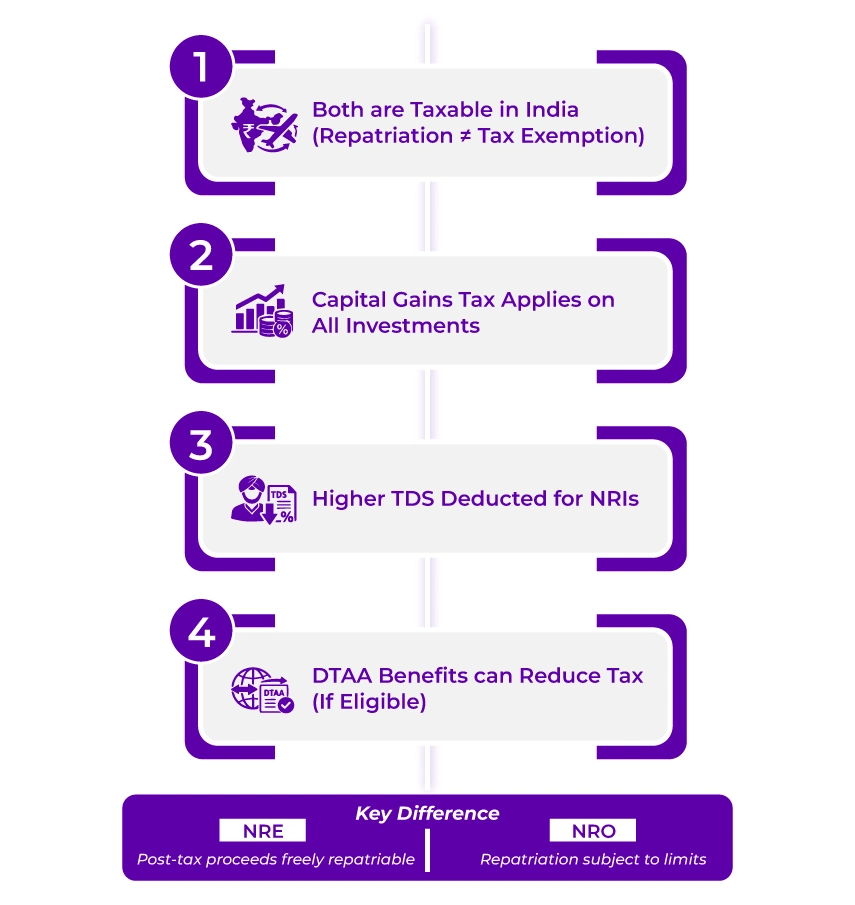
The key difference arises post-tax. NRE-linked proceeds can be repatriated freely, while NRO-linked proceeds must navigate regulatory thresholds.
To make the right choice, ask yourself these three questions:
An NRE-linked DEMAT account for NRIs is generally advisable if investments are financed by overseas income, and global liquidity is essential. On the other hand, an NRO-linked DEMAT account for NRIs is both compliant and practical if funds are sourced from India and expected to remain invested domestically.
Many NRIs adopt a split approach, meaning they maintain both NRE and NRO DEMAT accounts to distinguish investments based on the origin of funds. This separation simplifies compliance, improves transparency, and minimizes the risk of unintentional violations of FEMA regulations.
Savetaxs offers comprehensive, expert guidance for NRIs regarding investment strategies and related financial matters.
NRIs must recognize several operational difficulties they might face:
Staying aware of these restrictions ensures you take future-proof investment decisions.
Linking a DEMAT account to either an NRE or NRO account is a foundational choice for NRIs seeking to invest in India. This decision shapes the regulatory nature of investments, determines repatriation rights, and influences long-term financial flexibility. An NRE-linked DEMAT account prioritizes repatriation and cross-border mobility, while an NRO-linked DEMAT account for NRIs aligns investments with India-sourced funds and structured remittance.
Additionally, as an NRI, if you need expert-backed professional advice on understanding linked demat accounts, Savetaxs is the name to trust. We have been helping NRIs from over 90 countries for several years now. Connect with us anytime as we are actively working 24*7 across all time zones.
This article is for general informational purposes only and does not constitute tax, legal, financial, or investment advice. Laws, regulations, rates, and procedures may change over time and may vary based on individual circumstances.
While SaveTaxs makes reasonable efforts to keep the information accurate and up to date, readers should verify applicable rules with official authorities or consult a qualified professional before making decisions based on this information.
Vipul Jain is the Co-Founder of SaveTaxs and a tax expert with experience in Indian and NRI taxation. He advises individuals, NRIs, and businesses on tax filing, tax planning, capital gains, DTAA, and compliance matters. He focuses on making complex tax concepts simple and helping taxpayers make informed, compliant decisions. See Full Bio

Want to read more? Explore Blogs

_1781845771869.webp&w=828&q=75)
_1778936280179.webp&w=828&q=75)