

Investment & Financial Planning
FCNR Deposit Interest Rates in 2026FCNR Deposit Interest Rates in 2026
Written by Vipul Jain


NRIs living in foreign countries like Singapore have access to several investment options, providing them opportunity to increase their wealth across global markets. However, with the substantial opportunity comes the requirement for comprehensive strategic planning. It helps in identifying the challenges of managing wealth across multiple jurisdictions.
To help you out, this blog provides you with a goal-oriented, practical approach to financial planning for NRIs in Singapore. From income management to tax optimization and retirement planning, here is your details overview of the financial success in the country. So read on and gather all the information.
Singapore is one of the developed countries in the world. It has low tax rates; however, the cost of living in the country is very high. Whether you are working in the banking and financial services industry or the thriving technology sector, or running your own business, effective financial planning is important. Moving further, here are some points that you need to consider when doing financial planning in Singapore.
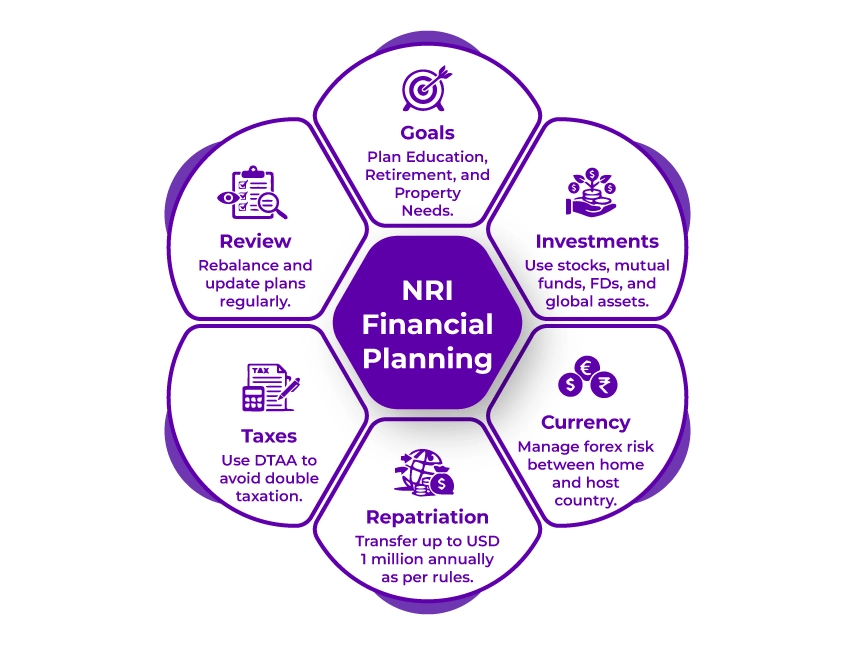
The first step towards successful financial planning is having clear priorities and objectives. Considering this, common financial goals for Singapore-based NRIs include funding the education of children at world-class institutions, generating substantial wealth for a comfortable retirement, buying property either in India or for investment, and more.
The critical successful financial factors lie precisely in fulfilling these goals with appropriate risk profiles and timeframes. In this, short-term objectives are generally completed within three years. It includes emergency funds or planned major purchases that need capital preservation and high liquidity. It makes them ideal options for conservative instruments like short-term FDs, savings accounts, or liquid funds.
Further, long-term financial goals like property acquisition, retirement planning, and higher education for children allow for growth-oriented, higher-risk investments. For instance, direct stock investments, equity mutual funds, or real estate that, over extended periods, deliver superior returns.
Once you set clear financial goals and a timeline, you can move to the implementation phase, identifying the most appropriate strategies for how and where to invest your money in the country.
As a Singapore-based NRI, you can enjoy the unique benefits of accessing sophisticated, diverse investment options available across both countries. Each of them provides different opportunities and benefits. However, a key question arises: where should you invest your money? The clear answer to this question is to choose an investment as per your financial goals, risk tolerance, and the unique benefits each market provides.
Considering this, in Singapore, the investment options include the following:
On the other hand, in India, investment options available for NRIs are equally compelling. You can access your NRI mutual funds through your NRO or NRE accounts, providing diversification and professional management across different market capitalizations and various asset classes. Additionally, on NRE FDs, no tax is charged in India, making them ideal for investors looking for guaranteed returns.
Further, the key principle is certifying that every investment serves a specific, well-defined goal in your financial planning. For example, if you have a plan to retire in India, then having a substantial part of your wealth in INR assets makes sense to fulfill your currency needs in the future. On the other hand, if your children want to pursue higher studies in Singapore, consider having education funds in worldwide accepted currencies like SGD, EUR, or USD.
We provide tailored tax solutions that align with your individual tax regimes and regulations.
One of the most common issues for Singapore-based NRIs includes managing the SGD-INR currency exchange relationship effectively. It further impacts the outcomes of your financial planning and overall returns. Compared to the Indian Rupee, the general strength of the Singapore Dollar offers substantial benefits when remitting funds to India for investment, family support, or buying property. However, if not managed properly through proper timing and planning, currency volatility can impact your returns.
Consider using the proper currency management strategies. It includes, rather, relying on traditional bank transfer, using remittance services that continuously provide low transfer fees and competitive exchange rates. Among the NRE or NRO accounts, choose the right NRI account to transfer your funds. Develop the discipline to strategically transfer your money, specifically when the value of INR is weaker against the SGD, increasing your remittance value.
Further, if you are planning a retirement in India, have income streams and currency-aligned investments with INR-denominated expenses. Additionally, avoid investing all your income in USD and SGD assets, as it will create currency risk that, over time, impacts your purchasing power.
Moreover, under the RBI guidelines, repatriation regulations, i.e., transferring money from India back to Singapore, are clearly stated. As per this, after tax compliance, per financial year, you can transfer up to $1 million from your NRO accounts. Additionally, planning your repatriation strategy well in advance ensures easier cash flow management and helps in avoiding any regulatory delays and complications.
Talking about taxation, Singapore has a favorable tax environment. Considering this, on most investments, no capital gains tax is charged. Additionally, in comparison to many developed countries, the personal income tax rates in Singapore are low. However, according to local tax laws, you are liable to pay tax in India for the income you generate from your Indian investments.
In this, using the India-Singapore Double Taxation Avoidance Agreement (DTAA) helps you avoid double taxation. Further, it also helps you in planning the tax-efficient withdrawal strategies that reduce your tax burden while fulfilling the compliance requirements of both countries.
Financial planning is not a thing that you can only perform once. Based on your life and career changes, you need to regularly review and adjust your financial plans. It is because it significantly affects your cash flow, investment priorities, and tax exposures. In this, the best practices involve:
Additionally, it should also include choosing the right investment horizons, certifying liquidity, and planning for fund repatriation in the future in compliance with Indian regulations. Further, by following a long-term, disciplined approach and making timely adjustments, you can achieve steady wealth growth, financial stability, and peace of mind.
Moreover, this is how NRIs can do financial planning in Singapore.
Get personalized financial plans aligned with your long-term family and wealth goals.
Lastly, from the blog, it is clear why financial planning for NRIs in Singapore is important. It helps them build a flexible, secure financial foundation. Additionally, helps them maintain their lifestyle and goals across different countries, opportunities, and regulations. Whether your future lies in Singapore, India, or somewhere else in the world, financial planning helps you remain confident, prepared, and in complete control of your finances.
Further, if you are facing issues in planning your taxes or finances, connect with Savetaxs. We have a team of financial advisors who assist you in proper planning of your finances as per your goals and risk appetite. Additionally, they can also assist you in choosing the right investment option as per your preference.
This article is for general informational purposes only and does not constitute tax, legal, financial, or investment advice. Laws, regulations, rates, and procedures may change over time and may vary based on individual circumstances.
While SaveTaxs makes reasonable efforts to keep the information accurate and up to date, readers should verify applicable rules with official authorities or consult a qualified professional before making decisions based on this information.
Vipul Jain is the Co-Founder of SaveTaxs and a tax expert with experience in Indian and NRI taxation. He advises individuals, NRIs, and businesses on tax filing, tax planning, capital gains, DTAA, and compliance matters. He focuses on making complex tax concepts simple and helping taxpayers make informed, compliant decisions. See Full Bio

Want to read more? Explore Blogs
_1781845771869.webp&w=828&q=75)
_1778936280179.webp&w=828&q=75)
_1778936089630.webp&w=828&q=75)