



Investment & Financial Planning
NRI Property Sale: How to Calculate Capital Gains TaxNRI Property Sale: How to Calculate Capital Gains Tax
Written by Shubham Jain
_1767955810.png&w=3840&q=75)
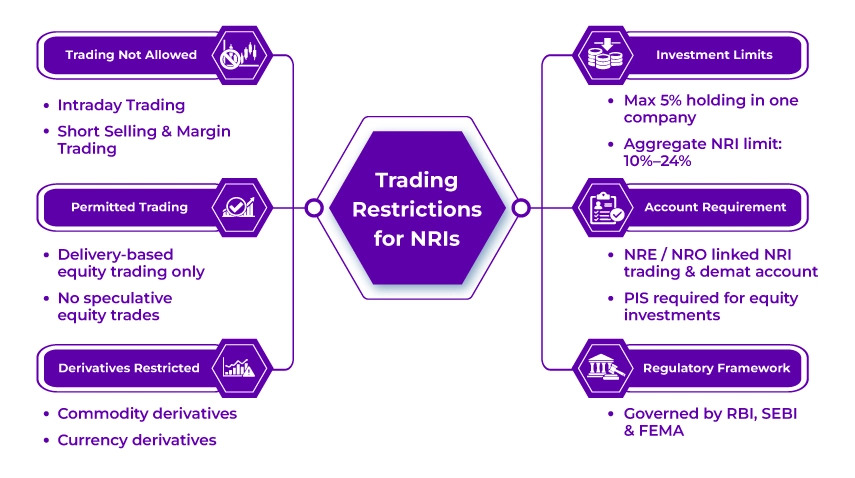
For NRIs investing in the Indian stock market from overseas, it has always remained exciting. However, NRIs face several trading restrictions in India, primarily being restricted from intraday trading, short selling, and trading in commodity/ currency derivatives.
These restrictions are imposed by the Reserve Bank of India (RBI) and the Securities and Exchange Board of India (SEBI) to ensure fair markets and protect investors.
Furthermore, understanding these rules helps you avoid common mistakes and achieve the best returns. To help you out, this blog provides you with a clear understanding of the trading restrictions for NRIs in India. So read on and gather all the information.
The table below showcases the trading restrictions for NRIs in the Indian stock market:
| Aspect | Trading Restrictions for NRIs |
|---|---|
| Equity Trading | Through NRI trading demat accounts, NRIs are only permitted for delivery-based equity trading. |
| Intraday & Margin Trading | Generally, NRIs are not allowed to do intraday trading and margin-based speculative trades. |
| Individual Holding Limit | NRIs in a single Indian company can hold a maximum of 5% of paid-up equity capital. |
| Aggregate NRI Holding Limit | With shareholder approval, capped at 10% which is extendable to 24%. |
| Currency & Commodity Derivatives | On Indian exchanges, it is generally not permitted for NRIs. |
| F&O Trading | With a custodian, F&O trading on a non-repatriable basis is allowed only via an NRO non-PIS account. |
| NRE-PIS Account Usage | On a repatriable basis, NRE-PIS account usage is restricted to delivery-based equity investments. |
| Regulatory Oversight | Governed by the Foreign Exchange Management Act (FEMA), RBI, and SEBI guidelines. |
This was all about the trading restrictions for NRIs. Moving ahead, now let's know the account and compliance requirements that NRIs need to follow while trading in India.
Here are the account and compliance requirements that NRIs need to follow for trading in India:
This was all about the account and compliance requirements that NRIs need to follow while trading in India. Moving further, let's know the tax and repatriation rules impacting NRI trading.
NRIs are subject to specific tax and repatriation rules for trading in the Indian stock markets. These rules are generally governed by the Income Tax Act and FEMA. Additionally, the rules depend on the nature of the income and the used bank account type, i.e., NRE or NRO account.
Further, the income that is accrued or earned in India only for NRIs is liable to be taxed in India. Considering this, the table below showcases how capital gains from Indian securities are taxed:
| Investment Gain | Holding Period | Tax Rate (plus surcharge & cess) |
|---|---|---|
| Equity Shares/ Equity Mutual Funds | Short-term capital gain if held for less than 12 months | 15% |
| Equity Shares/ Equity Mutual Funds (annually) | Long-term capital gain if held for more than 12 months | 10% tax imposed on capital gains more than INR 1,00,000 |
| Debt Mutual Funds | Short-term capital gain if held for less than 36 months | As per applicable income tax slabs (up to 30%) |
| Debt Mutual Funds | Long-term capital gains if held for more than 36 months | 20% with indexation benefits |
| Derivatives (F&O) | Treated as business income | Taxed according to the applicable slab rates. |
| Dividends/ Interest DTAA | Not applicable | Taxed at 20% or 30% TDS, depending on your income sources and DTAA |
Additionally, TDS is mandatory for most NRI income in India. It is often deducted by the fund house or bank at the time of payment. In case the deducted TDS is more than the actual tax liability, NRIs can claim for refund when filing their ITR.
Further, let's know about the repatriation rules.
Repatriation can be defined as the process of fund transfer from India to your resident country. The repatriation rules are governed by FEMA. Further, let's know about them.
NRE/ FCNR Accounts: Under these accounts, you can transfer both the principal invested amount (foreign currency source) and the earned interest/ capital gains. Without restriction, you can fully repatriate the whole amount.
NRO Accounts: Funds in an NRO account, generally for India-sourced income or non-repatriable investments, can be repatriated up to USD 1 million per financial year. Across all NRO accounts, this repatriation limit is cumulative. Additionally, it requires tax compliance and specific documentation, such as Form 145 and Form 146, certified by a CA.
DTAA Benefits: With over 90 countries, India has signed a Double Taxation Avoidance Agreement (DTAA). It helps NRIs to avoid paying taxes on the same income twice (once in India and once in the resident country). To claim the DTAA benefits, NRIs need to provide a Tax Residency Certificate and Form 10F.
These were the tax and repatriation rules that impact NRI trading. Moving ahead, let's know how to stay compliant and avoid mistakes in trading.
Connect with Savetaxs, and get help from financial experts for your NRI taxation in India, and stay compliant with the tax laws.
Here are some tips that help NRIs to stay compliant and avoid mistakes in trading:
So, follow the above tips and stay compliant with the trading rules for NRIs.
Lastly, this was all about trading restrictions for NRIs in India. Trading in India as an NRI comes with a few extra regulations. By using the right account type, sticking to delivery-based trades, and seeking help or a reliable broker, you can enjoy the benefits of the vibrant stock market of India.
Further, if you need more information about NRI investment plans, connect with Savetaxs. We are a team of financial experts who help you choose the best investment as per your financial goals, risk appetite, and time horizon. Additionally, we can also help you with your tax planning in India.
This article is for general informational purposes only and does not constitute tax, legal, financial, or investment advice. Laws, regulations, rates, and procedures may change over time and may vary based on individual circumstances.
While SaveTaxs makes reasonable efforts to keep the information accurate and up to date, readers should verify applicable rules with official authorities or consult a qualified professional before making decisions based on this information.
Vipul Jain is the Co-Founder of SaveTaxs and a tax expert with experience in Indian and NRI taxation. He advises individuals, NRIs, and businesses on tax filing, tax planning, capital gains, DTAA, and compliance matters. He focuses on making complex tax concepts simple and helping taxpayers make informed, compliant decisions. See Full Bio

Want to read more? Explore Blogs
_1781845771869.webp&w=828&q=75)
_1778936280179.webp&w=828&q=75)